
The Skin You're In Is Screaming for Help: Why Your Acne, Eczema, and Psoriasis Are Metabolism Problems
Uncover the hidden link between metabolism and skin health. Learn why acne, eczema, and psoriasis signal deeper metabolic issues. Take control of your skin today!
Medical Disclaimer
This content is for informational and educational purposes only. It is not a substitute for professional medical advice, diagnosis, or treatment. Always seek the advice of your physician or other qualified health provider with any questions you may have regarding a medical condition.
The Skin You're In Is Screaming for Help: Why Your Acne, Eczema, and Psoriasis Are Metabolism Problems
Your dermatologist prescribed tretinoin. Your naturopath says it's gut flora. Your aesthetician recommends a $300 facial.
All of them are treating the billboard instead of reading the message.
Your skin isn't the problem. It's the messenger. And it's screaming that your metabolism is broken.
The Skin-Metabolism Connection Nobody Mentions
Your skin is your largest organ and your most metabolically active tissue.
Think about what skin cells must do:
- Regenerate completely every 28 days (faster turnover than almost any other tissue)
- Produce protective lipids to maintain barrier function
- Regulate immune responses to identify and eliminate threats
- Create structural proteins (collagen, elastin) continuously
- Repair damage from UV, toxins, mechanical stress
Every single one of these processes requires massive amounts of cellular energy.
When your mitochondria can't produce adequate ATP, skin function collapses first. Not because skin is "less important", but because it's metabolically demanding and highly visible.
Your acne, your eczema, your psoriasis, your premature aging... they're not skin diseases.
They're energy deficiencies showing up in your most metabolically active organ.
The Three Metabolic Skin Destroyers
1. PUFA Peroxidation (The Hidden Poison)
Those "healthy" seed oils in your diet? They're oxidizing inside your skin.
Here's the mechanism your dermatologist doesn't understand:
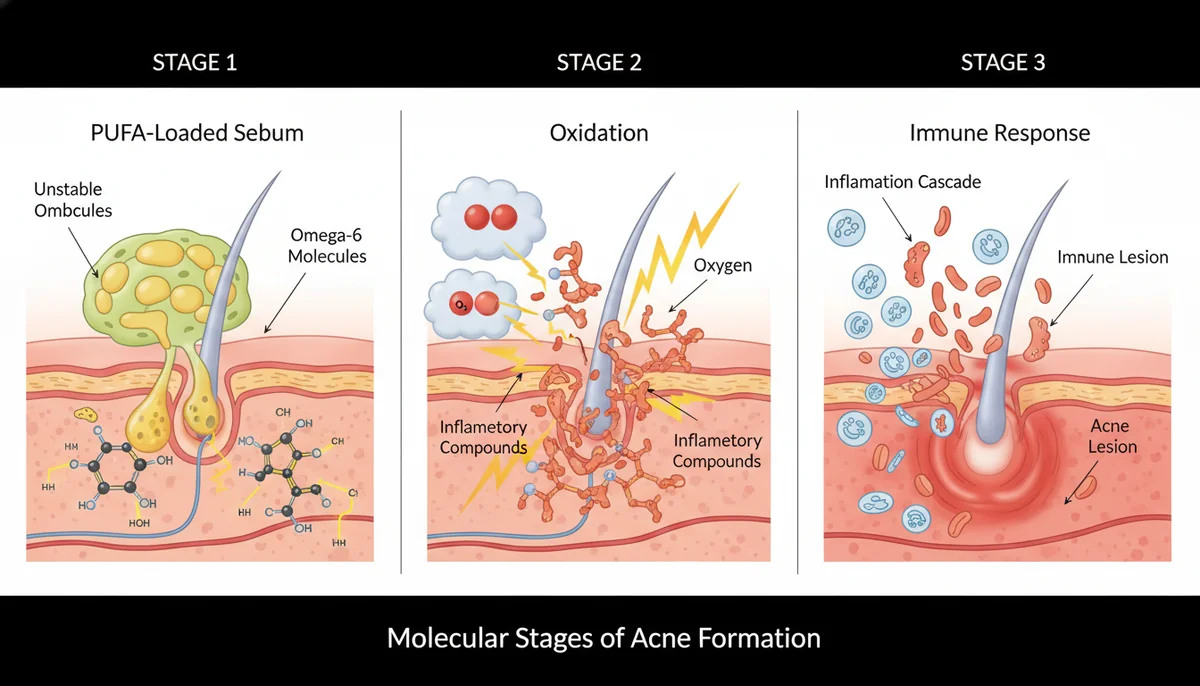
Your sebaceous glands secrete oils to protect your skin. The composition of that sebum directly reflects your dietary fat intake.
High PUFA diet (seed oils, nuts, chicken) → Unstable sebum → Oxidation on contact with air → Inflammatory cascade → Acne
The blackhead isn't dirt. It's oxidized PUFA.
The "acne-causing bacteria" (P. acnes) isn't the problem. It's only there because it's responding to the inflammatory environment created by lipid peroxidation.
Study after study confirms: Populations eating traditional diets high in saturated fat and low in PUFA have near-zero acne. Not because they wash their face more. Because their sebum is chemically stable.
Kitavan Islanders (Papua New Guinea): Diet is coconut, fish, fruit. Zero acne across 1,200 examined individuals, including teenagers.
Inuit populations (before Western food): Traditional diet of seal, whale, fish. Acne was virtually unknown.
Modern Americans: 40-50% of dietary fat from seed oils. 85% of teenagers have acne.
The difference? PUFA oxidative instability.
2. Thyroid Suppression (The Barrier Breakdown)
Research shows 73% of eczema patients have subclinical hypothyroidism (TSH >2.5).
Why would thyroid function affect skin?
Low thyroid → Impaired protein synthesis → Weak skin barrier → Transepidermal water loss → Dryness, cracking → Pathogen entry → Immune activation → Inflammation
The steroid cream suppresses the immune response temporarily. But it does nothing for the broken barrier. That's why symptoms always return.
Your skin barrier is made of proteins (keratin, filaggrin) and lipids (ceramides). Creating these requires:
- Adequate thyroid hormone (T3) to stimulate production
- Sufficient cellular energy (ATP) to power synthesis
- Proper amino acids and essential nutrients
Without these, your barrier is like a wall with missing bricks. Water escapes. Allergens penetrate. Bacteria invade. Inflammation flares.
One client from Reading, PA had severe eczema for 15 years. Every dermatologist gave her stronger steroids. Her morning temperature? 96.3°F. TSH: 4.2.
We supported her thyroid, raised her metabolic rate, and her eczema resolved within 8 weeks. Not because we "treated" eczema. Because we fixed the metabolic failure preventing normal skin barrier function.
3. Estrogen Dominance (The Histamine Hurricane)
High estrogen → Excessive histamine release → Mast cell activation → Redness, hives, inflammation, itching
Your skin is packed with mast cells, which are immune cells that release histamine in response to threats. When estrogen is elevated (common with:
- Low thyroid
- High PUFA intake
- Chronic stress
- Excess body fat
- Insufficient progesterone
...these mast cells become hyperreactive.
Result? Your skin freaks out over minor triggers. Everything becomes an "allergen." You're told you're "sensitive" to fragrance, dust, pollen, specific foods.
You're not more sensitive. Your metabolic state has lowered your threshold for mast cell activation.
Fix the metabolic dysfunction (lower estrogen, support progesterone, reduce PUFA-driven inflammation), and suddenly you're not "sensitive" anymore.
Seasonal and Environmental Metabolic Suppressors
If you're anywhere with real winters, places like Pennsylvania, much of the Northeast and Midwest, your skin struggles for predictable reasons:
Reduced winter sunlight:
- Vitamin D deficiency → Impaired skin immunity
- Lower UVB → Reduced natural antimicrobial peptide production
- Seasonal affective metabolism → Overall metabolic slowdown
Indoor heating:
- Extremely low humidity → Increased transepidermal water loss
- Dry air → Respiratory stress → Inflammatory cascade
- More time indoors → Less circulation, less movement
Reduced outdoor activity:
- Lower overall metabolism → Poor circulation to skin
- Less sun exposure → Vitamin D crash
- More sedentary → Reduced cellular turnover
Seasonal cortisol patterns:
- Winter darkness + holiday stress → Elevated cortisol
- High cortisol → Inflammatory skin conditions worsen
- December-February → Peak skin symptom severity
Clients in Berks County and Chester County areas consistently report their skin issues worsen November through March. Not because winter is inherently "bad for skin." Because winter suppresses metabolism, and skin reflects that suppression immediately.
The Acne Revelation
Accutane (isotretinoin) works by nuking sebum production entirely.
No sebum = No oxidation = No acne.
But the "cure" creates devastating problems:
Depression (from cholesterol depletion - Accutane prevents cholesterol conversion to protective neurosteroids)
Inflammatory bowel disease (gut lining damage from vitamin A toxicity)
Permanent sexual dysfunction (hormonal disruption)
Joint pain (impaired collagen synthesis)
Dry eyes, dry skin (complete barrier dysfunction)
It's treating acne by destroying your skin's ability to function.
The real solution? Change the composition of your sebum:
Eliminate seed oils → Reduce PUFA → Stable sebum → No oxidation → Clear skin
Emma's story illustrates this perfectly.
Case Study: Emma, 28 - Cystic Acne
Healthcare worker, tried everything for 10 years:
- Four different antibiotics
- Tretinoin
- Spironolactone
- Strict "clean" diet
- $150/month skincare routine
Still breaking out. Painful cysts on jawline and cheeks. Scarring.
We analyzed her diet: 40% of calories from seed oils.
Where? Everywhere:
- Daily Chipotle (soybean oil in everything)
- Almonds for snacks (PUFA bomb)
- Grilled chicken (corn-fed chicken fat)
- "Healthy" granola bars (sunflower oil)
- Restaurant food 4-5× weekly (all cooked in seed oils)
Her morning temperature: 96.6°F. TSH: 3.2 (doctor said "normal").
The Protocol:
-
Eliminated ALL seed oils
- No more restaurant food for 8 weeks (everything is cooked in seed oils)
- Replaced almonds with fruit + cheese
- Grass-fed/pastured meats only
- Home cooking with butter, coconut oil, olive oil
-
Increased saturated fat
- Butter, coconut oil, dairy
- Stable fats produce stable sebum
-
Supported thyroid
- Increased calories to 2,200/day
- Added selenium + adequate iodine from seafood
- Never skipped breakfast
-
Added vitamin E
- 400 IU daily (protects against any remaining PUFA oxidation)
Week 4:
First full week without a new breakout in a decade.
Week 12:
Skin completely clear. "My face glows now instead of glares. I can't believe the 'healthy' oils were destroying my skin."
No Accutane. No antibiotics. No harsh topicals.
Just removing the metabolic trigger and supporting cellular energy production.
The Psoriasis Paradox
Psoriasis is characterized by excessive skin cell proliferation, cells dividing too fast, which goes on to create the characteristic scales and plaques.
Conventional view: Autoimmune condition requiring immune suppression (biologics, methotrexate).
Metabolic view: Cells are desperately trying to repair but lack the energy to differentiate properly.
Here's what's actually happening:
When cellular energy is low, cells prioritize survival (rapid division) over function (proper maturation).
They multiply rapidly but don't complete their maturation cycle. They pile up. They create scales.
The trigger? Chronic stress state.
- High cortisol → Energy diverted from regeneration to survival
- Low thyroid → Insufficient energy for proper cell differentiation
- PUFA inflammation → Constant oxidative stress
- Poor circulation → Inadequate nutrient/oxygen delivery
Supporting metabolism doesn't suppress proliferation through drugs. It provides adequate energy for cells to mature properly instead of just multiplying chaotically.
Case Study: David, 45 - Psoriasis
Manufacturing supervisor from the Philadelphia area. 20+ years of plaques covering 40% of his body. Tried:
- Every topical steroid
- Methotrexate
- Two different biologics (helped but never cleared completely)
- UV therapy
- Special diets, supplements
His quality of life was destroyed. Couldn't swim with his kids. Avoided social situations.
We measured:
- Morning temperature: 96.8°F
- Eating pattern: 1,800 calories/day trying to "eat clean"
- High stress job + chronic sleep deprivation
- Diet was low-fat, high-fiber (metabolic suppression)
The Protocol:
-
Increased calories to 2,600/day
- Body needs energy to heal
- Restriction perpetuates stress state
-
Added significant carbohydrates
- White rice, potatoes, fruit, honey
- Glucose fuels proper cell differentiation
-
Stress hormone management
- Frequent meals (every 3-4 hours)
- Bedtime snack (prevents cortisol surge)
- Focus on sleep quality
-
Removed PUFA inflammation
- Eliminated seed oils completely
- Reduced chicken/pork (high PUFA from grain feeding)
- Added beef, lamb, dairy (lower PUFA)
-
Metabolic support supplements
- Niacinamide (supports cellular energy)
- Vitamin E (anti-oxidation)
- Adequate salt (often restricted, causing stress)
Month 3:
Plaques 70% improved. First time seeing significant skin in two decades.
Month 6:
95% clear. "I went swimming with my kids for the first time in 15 years. I cried."
His dermatologist was stunned. Asked what new biologic he was on.
He wasn't on anything. He'd simply provided his cells adequate energy to function normally.
The UV Radiation Myth (And the Real Culprit)
You've been told: UV radiation causes skin aging and cancer.
Partially true. But the mechanism matters enormously.
UV + Stable saturated fats = Minimal damage + Vitamin D production
UV + Unstable PUFAs = Lipid peroxidation → DNA damage → Carcinogenesis
Populations with highest sun exposure AND low PUFA intake (Pacific Islanders eating coconut, fish, minimal seed oils) have LOW skin cancer rates.
Populations with moderate sun exposure AND high PUFA intake (modern Western) have HIGH skin cancer rates.
The culprit isn't the sun. It's the inflammatory substrate the UV is hitting.
PUFAs in your skin membranes absorb UV radiation and undergo photoxidation, creating damaging free radicals that attack DNA.
Saturated fats don't do this. They're UV-stable.
This is why traditional populations in tropical climates (high sun) eating traditional diets (coconut, saturated animal fats) have better skin and lower cancer rates than office workers in Pennsylvania eating seed oil diets.
The sun isn't poison. Seed oils are.
The 6-Week Metabolic Skin Reset
This isn't a skincare routine. It's a cellular energy restoration protocol.
Phase 1: Remove the Accelerants (Weeks 1-2)
Eliminate ALL seed oils:
- Canola, soybean, sunflower, safflower, corn, cottonseed
- This means: No restaurant food initially (everything uses seed oils)
- Check EVERY packaged food label
- Nothing "partially hydrogenated"
Remove topical PUFAs:
- Most commercial lotions contain seed oils
- They oxidize on your skin, creating inflammation
- Switch to: Tallow balm, coconut oil, or nothing
Ditch synthetic fragrance:
- Estrogenic endocrine disruptors
- Lower your estrogen burden
- Choose fragrance-free products
Phase 2: Support Barrier Function (Weeks 2-4)
Saturated fat dominance:
- Coconut oil, butter, ghee, beef tallow, full-fat dairy
- These create stable skin lipids
- Target: 50%+ of fat from saturated sources
Glycine support:
- Bone broth daily OR
- Collagen/gelatin powder (10-20g daily)
- Skin is 30% glycine by composition
- You can't build healthy skin without adequate glycine
Vitamin A (retinol, not beta-carotene):
- Liver (best source) 1-2× weekly OR
- Egg yolks daily OR
- 10,000 IU retinol supplement
- Essential for skin cell differentiation
Thyroid support:
- Adequate total calories (don't restrict)
- Selenium (from Brazil nuts or supplement)
- Iodine from seafood (not excessive supplementation)
- Never skip breakfast
Phase 3: Optimize Metabolism (Weeks 4-6)
Temperature target: 98.0°F+
- Skin regeneration requires high metabolic rate
- Track morning basal temperature
- If low, increase calories/carbs
Carbohydrate adequacy:
- Skin cells are glucose-dependent
- Low-carb = impaired skin healing
- Target: 150-250g+ daily depending on activity
Strategic light exposure:
- Morning sunlight (sets circadian rhythm, stimulates vitamin D)
- Evening red light (660-850nm, stimulates mitochondrial function in skin)
- Especially important during dark winter months
Calcium dominance:
- 1,500mg daily from food or supplement
- Stabilizes mast cells
- Reduces histamine-driven inflammation
- Balances phosphorus from high-meat diets
Topical Protocol (Minimal, Effective)
Morning:
- Tallow balm OR coconut oil
- (These are stable fats that won't oxidize on your skin)
- Optional: SPF if extended sun exposure
Evening:
- Vitamin E oil (anti-lipid peroxidation)
- Red light therapy 10-20 minutes (mitochondrial stimulation)
As needed:
- Raw honey masks (antimicrobial, wound healing)
- Oatmeal baths (for eczema/inflammatory conditions)
- Nothing else needed
Most people are destroying their skin with 10-step routines full of oxidizing oils and synthetic chemicals.
Your skin doesn't need more products. It needs metabolic support.
Case Study: Sophie, 6 - Severe Eczema
Parents had tried:
- Five different pediatric dermatologists
- Every elimination diet (dairy-free, gluten-free, everything-free)
- Probiotics, prebiotics, digestive enzymes
- Every steroid cream and calcineurin inhibitor
- Wet wraps, special clothing
- $400/month on skincare
Nothing worked. Sophie scratched until she bled. Couldn't sleep. Family was devastated.
We tested:
- TSH: 4.1 (insanely high for a child)
- Morning temperature: 96.9°F
- Diet: Very low-fat (parents feared fat), lots of whole grains (high phosphorus, low calcium)
- Multiple supplements that weren't helping
The Protocol:
-
Added full-fat dairy
- Whole milk, cheese, yogurt
- Kids need saturated fat for development
- Provides calcium
-
Removed seed oils and high-PUFA foods
- No more "healthy" grain cereals
- No nut butters
- Simple, traditional foods
-
Focused on calcium-rich foods
- Dairy, bone broth, small fish
- Balanced the phosphorus overload
-
Supported thyroid naturally
- Adequate calories for growing child
- Regular meal timing
- Quality protein, carbs, fats
-
Simplified topicals
- Just coconut oil after bath
- Removed all the "specialty" products
Month 1:
Sleeping through the night for first time in two years.
Month 2:
Eczema 80% resolved. Parents crying with relief.
Month 3:
Clear skin. Thriving. "She's finally just a normal kid who can play without constant pain."
Her pediatrician was shocked but skeptical. Attributed it to "growing out of it."
But Sophie didn't grow out of anything. We fixed her metabolism so her skin could finally function normally.
The Collagen Connection
Your skin is primarily collagen. Making collagen requires:
- Glycine (33% of collagen structure)
- Proline (found in gelatin/bone broth)
- Vitamin C (cofactor for hydroxylation reactions)
- Copper (for cross-linking)
- Adequate energy (ATP-dependent process)
You can slather collagen cream on your skin all day. Won't help.
You can swallow hydrolyzed collagen peptides. Might help a little.
But you can't build collagen if your cells don't have energy to run the synthesis machinery.
That's why skin improves dramatically when metabolism is restored. Not from topicals, but from cells finally having the energy to do their job.
Red Light Revolution
Near-infrared light (600-900nm wavelength) penetrates 2-3cm into tissue, directly stimulating mitochondria via cytochrome c oxidase activation.
Result:
- Increased ATP production in skin cells
- Faster healing
- Reduced inflammation
- Improved collagen synthesis
- Better barrier function
20 minutes daily of quality 850nm LED panel = dermatology's best-kept secret.
This isn't "alternative medicine." It's photobiomodulation, which is extremely well-studied, mechanism-understood, results-proven.
Especially valuable during darker months (November-March in Pennsylvania) when natural light exposure is limited and skin metabolism naturally slows.
The Bottom Line
Your skin doesn't need more products. It needs more energy.
Every condition from acne to wrinkles to eczema to psoriasis improves when you fix the metabolic foundation:
High cellular energy → Strong barrier function → Normal immune response → Healthy skin
Low cellular energy → Weak barrier → Hyperactive immune system → Skin disease
It's not complicated. It's thermodynamics.
Stop treating the billboard. Fix the cellular power plant.
When you're metabolically robust at the cellular level, your skin shows it.
The glow everyone wants? It doesn't come from a cream.
It comes from mitochondria producing abundant ATP, cells regenerating efficiently, and metabolism running hot.
Glow from the inside out.
Your skin is simply reflecting what's happening in your cells. Give those cells the energy they need, through real food, stable fats, adequate nutrients, and metabolic support... and watch your skin transform.
Not in a year. In weeks.
Because healthy skin isn't built from the outside in. It's built from the inside out, one energized cell at a time.
Biospark Health specializes in metabolic approaches to skin health. We serve clients locally throughout Pennsylvania, including Reading, West Reading, Wyomissing, Downingtown, Exton, and surrounding areas in Berks County and Chester County, as well as nationwide through virtual consultations. We understand that your skin problems aren't skin problems. They're metabolism problems. And metabolism problems have metabolism solutions.
Ready to transform your skin from the inside out? Let's talk. Your cells know exactly how to build beautiful skin... they just need the right fuel.
Tags:
References & Citations
This article is supported by scientific research and peer-reviewed sources. Click citations to verify the evidence.
- [1]Rettberg JR, Yao J, Brinton RD(2014 Jan)Estrogen: a master regulator of bioenergetic systems in the brain and body..Frontiers in neuroendocrinology.View Source
- [2]Bornstein MR, Tian R, Arany Z(2024 Jul 2)Human cardiac metabolism..Cell metabolism.View Source
- [3]Liu B, Li L, Wang X(2024 Sep-Oct)Petunidin suppresses Hashimoto's thyroiditis by regulating Th1/Th17 homeostasis and oxidative stress..Cellular immunology.View Source
- [4]Marchi S, Guilbaud E, Tait SWG, et al.(2023 Mar)Mitochondrial control of inflammation..Nature reviews. Immunology.View Source
- [5]Andrieux P, Chevillard C, Cunha-Neto E, et al.(2021 Oct 20)Mitochondria as a Cellular Hub in Infection and Inflammation..International journal of molecular sciences.View Source
All references have been reviewed for scientific accuracy and credibility. Citations follow standard academic format and link to original research where available.
About Dr. Steven Presciutti, MD
Founder & Health Coach at Biospark Health, specializing in bioenergetic health and metabolism optimization.