Carb Intolerance Is Not a Diagnosis. Thiamine Deficiency Is.
Carb intolerance is not a diagnosis. Crash, bloat, anxiety or constipation after carbs can be thiamine deficiency. A Reading, PA physician on how it is tested.
Medical Disclaimer
This content is for informational and educational purposes only. It is not a substitute for professional medical advice, diagnosis, or treatment. Always seek the advice of your physician or other qualified health provider with any questions you may have regarding a medical condition.
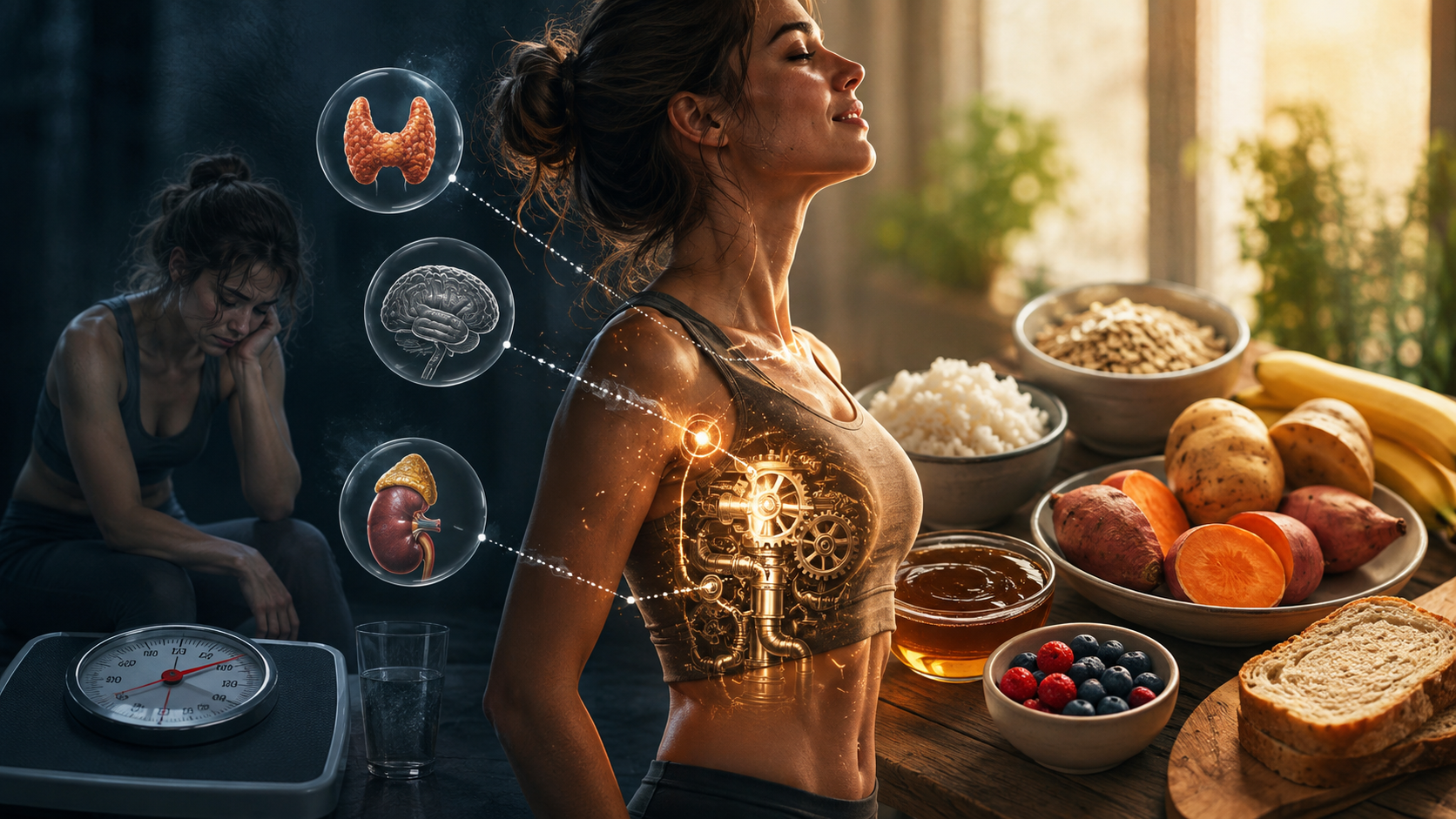
Rice at lunch, asleep at your desk by two. Bread with dinner, bloated and oddly wired at bedtime. Oatmeal for breakfast and your heart is pounding before the bowl is empty. You call it carb intolerance. So does half the internet.
Here is the problem with the label. Carb intolerance is not a diagnosis. There is no test for it, no code for it, and no textbook that describes what you are describing. It is a name for a set of symptoms that show up after carbohydrate, and the name quietly assumes the carbohydrate is the cause.
Often it is not. Often what you are feeling is a body that has the fuel and cannot burn it, because the enzyme that lets carbohydrate into the mitochondrion is short of the cofactor it runs on. That cofactor is thiamine, vitamin B1, and a real, measurable thiamine deficiency produces the exact cluster above: the crash, the bloat, the anxiety, the cold hands, the constipation.
I am a physician in Reading, Pennsylvania, and I see this pattern weekly. None of what follows is a supplement pitch. It is an argument for testing the cofactor before you blame the food.
What "Carb Intolerance" Means Online, and What It Means in Medicine
Online, carb intolerance is a symptom list: fog within an hour of starch or sugar, bloating, a racing pulse, feeling cold afterward instead of warm, constipation. The people describing it are not making it up. The question is what the list points to.
In medicine the phrase has two meanings, and neither is that list. In gastroenterology, carbohydrate intolerance means a digestive or absorptive failure for a specific sugar: lactose, fructose, or the sucrase-isomaltase pathway (Sibley 2004). Undigested sugar reaches the colon and ferments. In older endocrine usage it meant impaired glucose tolerance. One is a plumbing problem. The other is a blood sugar problem.
The gastroenterology literature holds a detail that matters. A 2022 review found no difference in how often people with irritable bowel syndrome malabsorb sugars compared with healthy controls. What differed was symptom severity after a sugar challenge, which was higher in the IBS patients (Fernandez-Banares 2022). The amount of sugar that goes unabsorbed does not predict how bad you feel. The state of the body receiving it does.
So how do you know if you are carb intolerant? From the symptoms alone, you do not. You know that something happens after carbohydrate. That is the start of a workup, not the end of one.
The Crash After Carbs Is Usually Not Low Blood Sugar
The explanation most people reach for is reactive hypoglycemia: insulin overshoots, blood sugar drops, the crash follows. Tidy, occasionally true, and the endocrine literature is blunt about how occasionally.
Reactive hypoglycemia is diagnosed when symptoms occur at the same moment as a measured glucose below 3.3 mmol/l, and the oral glucose tolerance test produces false positives while a mixed meal produces false negatives (Brun 2000). A 1989 Mayo Clinic review put it more directly: most patients with adrenaline-type symptoms after meals turn out to have a diagnosis other than reactive hypoglycemia (Hofeldt 1989). Where the real thing exists, it shows up in very lean people, after massive weight loss, and after bariatric surgery.
That leaves most people with the afternoon crash holding a real symptom and a wrong label. The shakiness, the pounding heart, the fog: those are adrenaline and cortisol, and they show up because the cell did not get the energy it expected from the meal. Blood sugar may be perfectly normal. The question is not how much glucose is in the blood. It is whether the glucose that reached the cell was burned.
Which brings us to the gate.
Pyruvate Dehydrogenase: The Gate Between Eating a Carb and Burning It
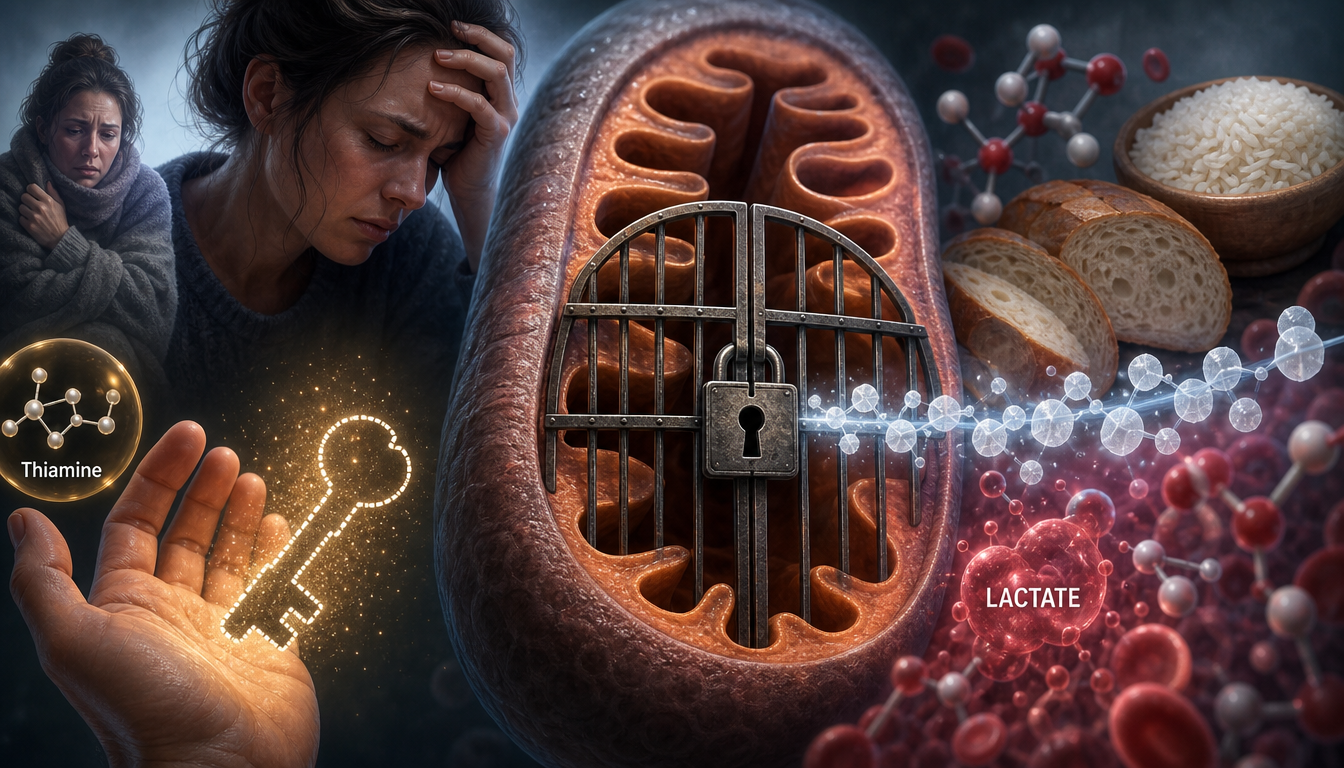
Glycolysis breaks glucose down to pyruvate. Pyruvate then has to enter the mitochondrion and become acetyl-CoA before the Krebs cycle and the electron transport chain can turn it into carbon dioxide, water and the bulk of your ATP. One enzyme complex performs that conversion. Pyruvate dehydrogenase is the gate between eating carbohydrate and actually burning it, and it runs on thiamine diphosphate in its E1 active site, alongside lipoic acid, NAD+, coenzyme A, magnesium and calcium (Tylicki 2018).
When the gate slows, pyruvate does not wait. It gets converted to lactate. That is why inherited PDH E1 defects list lactic acidosis as a defining feature (Whitley 2018), and why in 32 patients with diabetic ketoacidosis, lactate rose as plasma thiamine fell (Moskowitz 2014). Lactate is what the gate does when it is shut.
Ray Peat named the part that makes this self-sustaining, in "Glucose and sucrose for diabetes": "Lactic acid itself, and the longer chain fatty acids, inhibit the regulatory enzyme pyruvate dehydrogenase (which is activated by insulin), reducing the oxidative production of energy." The lactate you make because the gate is slow then holds the gate slower, and the fatty acids a stressed body mobilizes are a second brake on the same enzyme.
Oxidative stress closes it too. In rat heart mitochondria, a breakdown product of polyunsaturated fat selectively inactivates pyruvate dehydrogenase by modifying the lipoic acid it depends on, and hydrogen peroxide hits the same target. Animal data, labelled as such. But it explains why a person can eat enough thiamine and still behave as if they do not: the enzyme is being taken offline from the other side. Elliot Overton calls this "functional" thiamine deficiency. I think of it as the same gate, closed by two different hands.
What Low B1 Feels Like: The Carb Intolerance Symptom Cluster
So what does low B1 feel like? Nothing like the textbook. Beriberi and Wernicke encephalopathy are the end of the road. The early thiamine deficiency symptoms look like this.
You eat a bowl of rice and forty minutes later you are foggy, warm, heavy, faintly nauseated. So you decide carbohydrate is the problem. You cut it, feel sharper for three weeks, then slowly get colder. I have heard versions of that story from more patients than I can count.
Map the symptoms to the machinery and they stop looking random:
- The crash and the post-meal heaviness. Carbohydrate arrived, the gate slowed, and the pyruvate went to lactate instead of ATP. Less energy from the meal, and the adrenaline that follows a shortfall.
- Bloating and constipation. Gut motility is muscle work, and muscle work costs energy. A 2026 genetic study of stool frequency in 268,606 people found its strongest signals converged on vitamin B1 metabolism, including a gene that transports thiamine into cells, and in 98,449 UK Biobank participants higher thiamine intake went with more frequent bowel movements (Diaz-Munoz 2026). Associations, not trials of thiamine for constipation. But the direction is consistent.
- Anxiety, palpitations, lightheadedness on standing. Early deficiency affects the autonomic nervous system, and the case descriptions read like a panic attack: resting tachycardia, irregular sweating, blood pressure dropping on standing. To be precise: there is no human trial of thiamine for anxiety or panic (Borges-Vieira 2023). What exists is the overlap between the two symptom lists, plus a published case of a 64-year-old whose restrictive diet for IBS and anxiety ended in Wernicke encephalopathy.
- Cold hands and feet, and brain fog. Warmth is a readout of how fast you make energy, and the brain runs on glucose through the same gate. No thiamine-specific temperature study exists; this is the bioenergetic model's inference.
Who Runs Short of Thiamine
The obvious answer is "people who do not eat enough of it", and it is the least useful one, because the two populations who run shortest are eating plenty of calories.
Obesity. At a VA weight clinic, 32.2% of 146 patients with obesity tested thiamine deficient before anyone had surgery (Costello 2025). In a 400-patient pre-bariatric series, 16.5% met a clinical definition, and the deficient patients presented with cardiac and neurological symptoms far more often than gut symptoms (Nath 2017).
Diabetes. This one gets misquoted constantly, so here is what the study found. Thornalley and colleagues found plasma thiamine about 75% lower in type 1 and type 2 diabetes than in controls. That is a drop in concentration, not a percentage of patients. The reason was the kidney: renal clearance of thiamine was 24-fold higher in type 1 and 16-fold higher in type 2 (Thornalley 2007). The people who handle carbohydrate worst are losing the cofactor for handling it in their urine.
The rest of the list. Refined, milled carbohydrate, because milling strips B1 from the grain while the requirement rises with the carbohydrate you eat (Elmadfa 2001). Alcohol (Herve 1995). Loop diuretics. Bariatric surgery and rapid weight loss. Elimination diets, as in the IBS case above. And low-carbohydrate diets, which get their own section.
The honest wrinkle. Prevalence depends on which marker you draw. Plasma and clinical-definition studies find deficiency in a sixth to a third of people with obesity. Whole-blood thiamine diphosphate studies, which measure the active form inside red cells, found it uncommon in heart failure outpatients (Teigen 2016) and hospitalized elderly patients (Pourhassan 2018). Both are true. Which test you order decides whether you see it.
Why Cutting Carbs Makes Carb Intolerance Worse
Here is the trap. You feel bad after carbohydrate, so you cut it. For a few weeks it works, because you have removed the load from a gate that could not keep up. Less traffic, less lactate, less adrenaline. That relief is real, and the standard advice of more protein, more fat, less carbohydrate does quiet post-meal symptoms (Brun 2000).
Now look at the cofactor. In 2024 a Glasgow group compared 49 adults who had followed a low-carbohydrate diet for a median of nine months with 49 controls. From food alone, 43% of the low-carb group failed to meet the thiamine reference intake versus 14% of controls. Many took supplements, and on paper the supplements closed the gap. Their red cell thiamine diphosphate was still about a third lower than the controls', and three of them were frankly deficient (Churuangsuk 2024). The authors' phrase: "incompletely corrected by supplement use". It is cross-sectional, and the low-carb group also ate more saturated fat and protein, so it cannot prove direction. What it can do is contradict the assumption that removing carbohydrate lowers the need. Status fell.
The bioenergetic reading explains the pattern. Low-carb works by lowering demand on a struggling system. It does not rebuild the capacity to make energy. Meanwhile a body denied carbohydrate mobilizes its own fat, and a heavy fat load delivers electrons to the mitochondrial chain in a form that congests it. The chain jams, the overflow leaks off as reactive oxygen species, and that redox signal is what makes the cell restrict glucose uptake. In rodents and humans, a high-fat diet raised mitochondrial hydrogen peroxide emission, and in the rodent arm, mopping up that peroxide preserved insulin sensitivity despite the diet (Anderson 2009). Insulin resistance, on this reading, is a cellular antioxidant defense (Hoehn 2009). That same oxidant load closes the thiamine-dependent gate from the other side. Cutting the carbohydrate feeds the very congestion that made carbohydrate feel bad.
One practitioner observation, not evidence: restore thiamine in a carbohydrate-restricted patient and blood sugar sometimes drops, because the gate reopens with nothing coming in behind it. The gate and the fuel go together. You cannot fix one by removing the other.
How a Physician Tests for Thiamine Deficiency
This is where I want to be most careful, because the internet's answer is "just try it" and mine is not. There are three ways to measure thiamine status, and they do not always agree.
Whole-blood or red cell thiamine diphosphate by HPLC. This measures the active coenzyme directly, where it works, and it is the test most laboratories now run (Lu 2008). When Talwar and colleagues compared it against the older functional assay in 63 at-risk patients, most agreed, but a handful disagreed in each direction (Talwar 2000).
Erythrocyte transketolase activation. The functional assay: add thiamine diphosphate to the patient's red cells and see how much the enzyme speeds up. It measures how starved the enzyme is rather than how much cofactor is present. Sensitive in principle, but the field has no agreed cutoff (Jones 2021).
Plasma or serum thiamine. Free thiamine reflects recent intake more than tissue stores (McCann 2017), the weakest single marker. But it is the one Thornalley used, and his paper adds a twist: in diabetes, red cells upregulate their thiamine transporters, so the red cell measurement can look adequate while plasma is severely depleted. He wrote that the conventional assessment was "masked". In a diabetic patient, the standard test can under-call.
Alongside these, a clinician might look at a lactate to pyruvate ratio, which reads how much traffic is going around the gate, and at magnesium, which thiamine diphosphate and every enzyme that uses it require (Talwar 2022).
What I will not do is tell you what to do about a low result. That depends on why it is low, what else is low, and what you are eating, and it is a physician's call.
What Else Mimics Carb Intolerance
The thiamine story is one door. Skipping the others to chase a vitamin is the same mistake as skipping the vitamin to chase the food.
Hypothyroidism. Every item on the carb intolerance list is also on the low-thyroid list, and thyroid hormone sets the speed of the whole system the gate feeds into. A full thyroid picture, not TSH alone, belongs in this workup.
SIBO and specific-sugar malabsorption. Real carbohydrate intolerance in the gastroenterology sense, with breath testing to find it. Overton has argued that thiamine deficiency can itself cause the slow motility that lets overgrowth take hold. A hypothesis, labelled as one, but it means the two are not mutually exclusive.
Cortisol and adrenaline. A body that cannot burn the carbohydrate it just ate reaches for stress hormones to hold blood sugar up. The anxiety after eating is often this, and treating it without asking why the fuel is not burning rarely holds.
True reactive hypoglycemia. Uncommon, but real after bariatric surgery, in very lean people, and in a subset of women with polycystic ovary syndrome. It is diagnosed with a measured low glucose at the time of symptoms, not a guess.
Test, then decide. A year of elimination dieting costs more than the panel.
The Biospark Approach
Here is where we land.
The reflex, when carbohydrate makes you feel bad, is to remove the carbohydrate. It works for a while because it removes the load. What it actually does over months is drop the cofactor status further, push your body to run on its own fat, and feed the same oxidative congestion that was closing the gate in the first place. You get sharper for three weeks and colder for a year.
What we do instead is find out why the gate is slow and open it, while keeping the fuel. Labs first: thiamine status by the marker that fits the patient, magnesium, a lactate to pyruvate ratio, a full thyroid panel, and waking temperature and resting pulse, which move before any lab does. Then what is closing the gate from the other side: the polyunsaturated fat load, the fasting, the over-training, the alcohol. And carbohydrate kept in the diet, chosen for what is easy to burn and digest, ripe fruit, juice, honey, milk, well-cooked starch, with fat moderate rather than eliminated.
I want to be plain about which claims carry which weight. The cited findings are that thiamine status was lower on low-carbohydrate diets even with supplements, that a third of a weight clinic population was deficient, that diabetes wastes thiamine through the kidney, and that most post-meal crashes are not measurable hypoglycemia. Keeping the carbohydrate and rebuilding the capacity to burn it is our clinical position, reasoned from the mechanism. No trial has tested that protocol head to head against low-carb. That distinction is yours to know.
Ready to restore your metabolism at the cellular level?
The Bioenergetic Reset Program addresses root causes, not symptoms. Join 300+ members who've discovered what real metabolic health feels like.
- 9+ hours of comprehensive training
- Twice-monthly LIVE coaching calls
- Complete meal plans and protocols
- Direct email support
$133/month | Cancel anytime
Carb Intolerance and Thiamine Testing in Reading and Berks County, PA
If you are in Reading, Wyomissing, or anywhere in Berks County and you have spent a year avoiding carbohydrate because of how it makes you feel, and you are now colder, more constipated, and more anxious than when you started, this article was written for you. It is rarely the carbohydrate's fault.
At Biospark Health we start with the tests that answer the question instead of the diet that avoids it: thiamine status by the right marker, magnesium, a full thyroid picture, and waking temperature and pulse tracked at home, because those cost nothing and move first.
We serve clients throughout the region, including Lancaster, Downingtown, Allentown, West Chester and the greater Philadelphia suburbs, in person and virtually. If you come in, bring a food log with timing and a note of exactly when the symptoms hit relative to the meal. Those two pieces of paper narrow the differential more than any single test.
If you are searching for carb intolerance help in Reading, PA, or metabolic health support anywhere in Pennsylvania, the first step is measuring the cofactor before you blame the food.
Frequently Asked Questions
How do you know if you are carb intolerant?
From symptoms alone, you cannot. Feeling foggy, bloated, anxious or cold after carbohydrate tells you something happens after a meal, not why. A physician sorts the causes with thyroid labs, thiamine and magnesium status, breath testing where gut symptoms dominate, and a measured glucose at the time of symptoms. The label describes a timing. The workup finds the cause.
What does low B1 feel like?
Early on, it feels like carb intolerance. The thiamine deficiency symptoms people notice first are fatigue and heaviness after meals, brain fog, bloating and slow bowels, a racing heart, lightheadedness on standing, and anxiety that arrives with food. Cold hands are part of the picture in my clinical experience. The classic signs, nerve damage and confusion, come much later.
What happens when you start taking thiamine?
I can tell you what the trials measured. In a double-blind crossover of 40 patients with quiescent inflammatory bowel disease and severe fatigue, oral thiamine dropped fatigue scores while placebo rose, and an open-label follow-up found the benefit was not maintained. In 12 adults with high blood sugar, six weeks of thiamine lowered the two-hour glucose on a tolerance test. There is no trial for constipation or anxiety. Dose and form are a physician's decision, because a reopened gate needs fuel behind it.
Does thiamine help constipation?
The evidence for thiamine for constipation is association, not a trial. The 2026 stool-frequency study found its strongest genetic signals in vitamin B1 metabolism and higher thiamine intake tracked with more frequent bowel movements. Its Mendelian randomization linked stool frequency to IBS risk; it did not test thiamine as a treatment for IBS. A US survey of over 10,000 adults found the highest dietary thiamine tertile had lower odds of chronic constipation. Nobody has run a randomized trial.
Conclusion
Carb intolerance is a description of when you feel bad. It is not a diagnosis, and treating it as one leads to a predictable place: you remove the food, feel better for three weeks, and then you are colder, more constipated, and lower on the very cofactor you needed to burn the food. That last part is not my inference. Thiamine status fell in people who cut carbohydrate, and supplements did not fully bring it back.
The bioenergetic view is that the symptom was never a verdict on the carbohydrate. It was a report from a cell that had the fuel and could not move it through the gate. Cut the carbohydrate and the gate closes further. Find what is closing it, open it, keep the fuel coming, and the body gets to do what it was asking to do: burn what it eats and stay warm doing it.
A thiamine level, a magnesium and a real thyroid panel cost less than a year of elimination dieting. Rule the cofactor in before you rule the food out.
Tags:
References & Citations
This article is supported by scientific research and peer-reviewed sources. Click citations to verify the evidence.
- [1]Churuangsuk C, Catchpole A, Talwar D, Welsh P, Sattar N, Lean MEJ, Combet E(2024)Low thiamine status in adults following low-carbohydrate / ketogenic diets: a cross-sectional comparative study of micronutrient intake and status.European Journal of Nutrition.View Source
- [2]Costello E, Kerns J(2025)Thiamine deficiency in US veterans with obesity.Obesity (Silver Spring).View Source
- [3]Thornalley PJ, Babaei-Jadidi R, Al Ali H, Rabbani N, Antonysunil A, Larkin J, Ahmed A, Rayman G, Bodmer CW(2007)High prevalence of low plasma thiamine concentration in diabetes linked to a marker of vascular disease.Diabetologia.View Source
- [4]Díaz-Muñoz C, Bozzarelli I, Lopera-Maya EA, et al.(2026)Genetic dissection of stool frequency implicates vitamin B1 metabolism and other actionable pathways in the modulation of gut motility.Gut.View Source
- [5]Talwar D, Davidson H, Cooney J, St JO'Reilly D(2000)Vitamin B1 status assessed by direct measurement of thiamin pyrophosphate in erythrocytes or whole blood by HPLC: comparison with erythrocyte transketolase activation assay.Clinical Chemistry.View Source
- [6]Brun JF, Fedou C, Mercier J(2000)Postprandial reactive hypoglycemia.Diabetes and Metabolism.View Source
All references have been reviewed for scientific accuracy and credibility. Citations follow standard academic format and link to original research where available.
About Dr. Steven Presciutti, MD
Founder & Health Coach at Biospark Health, specializing in bioenergetic health and metabolism optimization.