Coconut Oil vs Seed Oils: The Metabolic Truth Your Doctor Was Never Taught
Discover why coconut oil vs seed oils isn't even close. Learn how MCTs fuel your mitochondria, support thyroid function, and why the saturated fat myth kept you sick.
Medical Disclaimer
This content is for informational and educational purposes only. It is not a substitute for professional medical advice, diagnosis, or treatment. Always seek the advice of your physician or other qualified health provider with any questions you may have regarding a medical condition.
You've been told your entire life that saturated fat clogs arteries and coconut oil is dangerous. Meanwhile, the industrial seed oils you've been cooking with every single day are quietly destroying your mitochondria, suppressing your thyroid, and driving chronic inflammation at the cellular level. The coconut oil vs seed oils debate isn't a close call. It never was.
The truth is that the saturated fat myth was manufactured by the sugar industry in the 1960s, amplified by vegetable oil corporations, and cemented by a pharmaceutical industry that profits enormously from the metabolic damage these oils create. Once you understand what polyunsaturated fats actually do inside your cells, you'll never look at that bottle of canola oil the same way again.
Why Coconut Oil vs Seed Oils Comes Down to Mitochondrial Chemistry
The difference between coconut oil and seed oils isn't about calories or even cholesterol. It's about what happens at the mitochondrial level when these fats enter your cells.
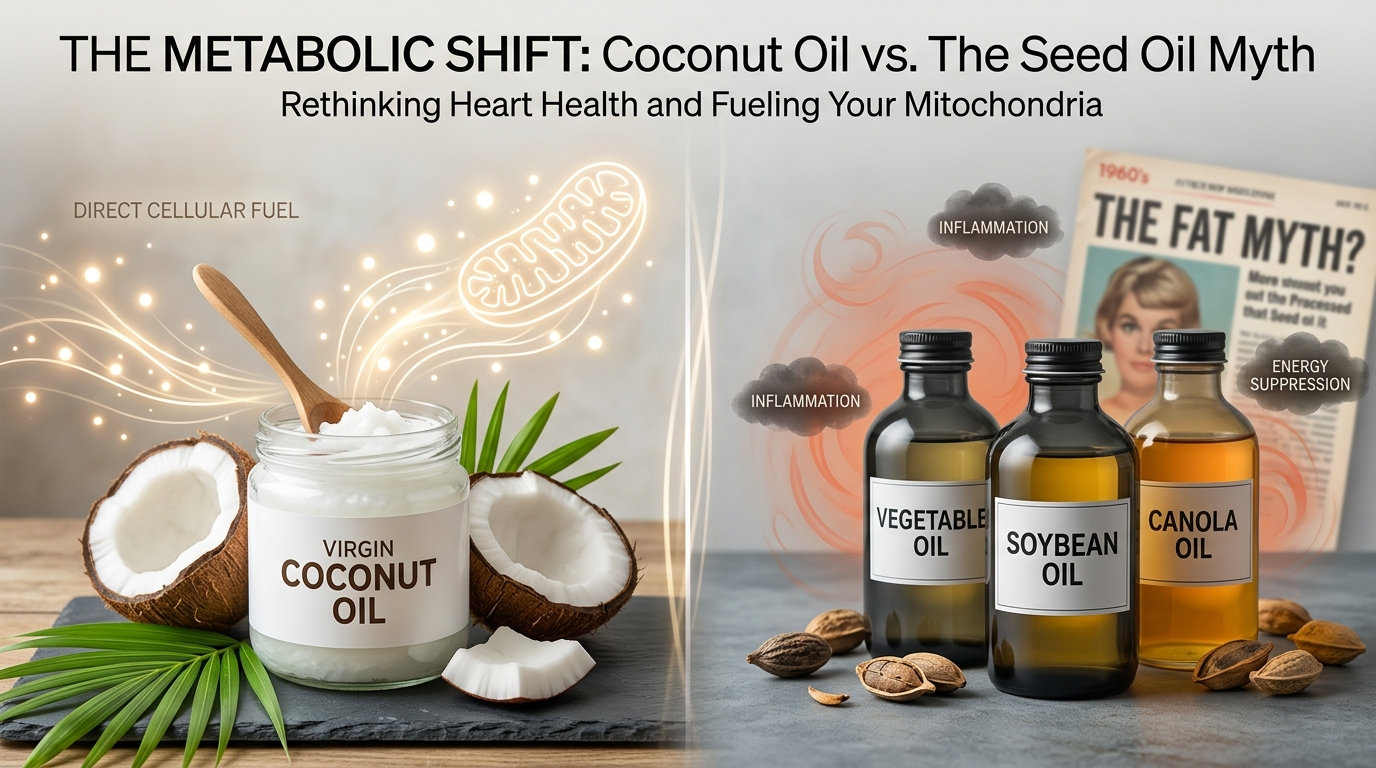
Polyunsaturated fatty acids (PUFAs) found in soybean, corn, canola, safflower, and sunflower oils contain multiple double bonds in their chemical structure. These double bonds make them chemically unstable and highly susceptible to oxidation when exposed to the heat and oxygen inside your body. When you consume these oils, they get incorporated directly into your cell membranes and into the inner lining of your mitochondria, specifically into a phospholipid called cardiolipin.
Here's where the damage begins. The structural instability of PUFAs makes your mitochondrial membranes "leaky" to protons. This dissipates the electrical gradient your mitochondria need to efficiently produce ATP (your cellular energy currency). As these unstable fats oxidize inside your body, they shatter into toxic fragments: malondialdehyde, acrolein, and 4-HNE (4-hydroxynonenal). These byproducts directly damage mitochondrial DNA, proteins, and the respiratory enzymes you need for energy production.
Coconut oil is fundamentally different. Its saturated fatty acids contain no double bonds, making them chemically stable and completely resistant to this kind of oxidative damage. The medium-chain triglycerides (MCTs) in coconut oil are uniquely beneficial because they bypass the carnitine transport system entirely, entering your mitochondria directly to provide rapid, clean cellular fuel. A 2023 randomized crossover trial published in the American Journal of Clinical Nutrition confirmed that coconut oil produces distinct postprandial fatty acid metabolism compared to other dietary fats, with rapid absorption and oxidation of its medium-chain components.
The Saturated Fat Myth: How Industry Manufactured a Health Crisis
If coconut oil is so metabolically superior, why has the medical establishment spent 60 years telling you it causes heart disease?
The answer begins in 1967, when the Sugar Research Foundation (now called the Sugar Association) paid three Harvard scientists the equivalent of $50,000 in today's dollars to publish a review in the New England Journal of Medicine that systematically downplayed the role of sugar in heart disease and shifted blame onto saturated fat. This wasn't discovered until 2016, when researchers at UCSF unearthed internal sugar industry documents proving the deliberate manipulation.
Once vegetable oil producers recognized the opportunity, they invested heavily in promoting the "lipid hypothesis," the theory that dietary saturated fat raises cholesterol, which clogs arteries. The medical community couldn't fully capitalize on this narrative until statins arrived in 1987. After that, a $25-billion-per-year drug market formed virtually overnight, funded by an ocean of research arguing that saturated fats and cholesterol were dangerous.
The bioenergetic model of health reveals a completely different picture. Cholesterol is not a toxin clogging your pipes. It is a vital, life-sustaining molecule that acts as a powerful antioxidant, neutralizes bacterial endotoxins, and serves as the fundamental building block for all protective steroid hormones (pregnenolone, progesterone, DHEA, and testosterone). When your thyroid function is suppressed (often by the very seed oils you've been told to eat), your body cannot efficiently convert cholesterol into these protective hormones. The cholesterol accumulates in your bloodstream not because you ate too much saturated fat, but because your metabolism is too suppressed to use it properly.
A 2008 analysis published in the Journal of the American College of Cardiology found that lipid levels among cardiac patients challenged fundamental assumptions about cholesterol and cardiovascular risk, adding to a growing body of evidence that the lipid hypothesis oversimplifies a complex metabolic reality.
How Seed Oils Suppress Your Thyroid and Wreck Your Metabolism
Perhaps the most insidious effect of seed oils is their systematic suppression of thyroid function, the master regulator of your metabolic rate.
PUFAs block thyroid hormone at virtually every level of its pathway. They inhibit the thyroid gland's release of hormone. They interfere with transport proteins in your blood. They suppress your liver's ability to convert inactive T4 into active T3. And they block the nuclear thyroid receptors inside your cells that actually respond to the hormone.
Research pioneer Ray Peat documented that populations consuming coconut oil as their primary fat source had metabolic rates averaging 25% higher than comparable American populations. This isn't a small difference. A 25% metabolic advantage means more energy, better body temperature regulation, improved mood, stronger immunity, and fundamentally different aging trajectories.
Peat also observed that switching from unsaturated to saturated fats produced immediate, measurable metabolic changes: increased breathing depth, faster pulse, and visible improvements in skin perfusion within 30 minutes. His research showed that obesity in animal studies correlated directly with the proportion of unsaturated fat in the diet, completely independent of total fat consumed.
The 1947 study by researcher B.A. Houssay demonstrated this principle in dramatic fashion. Animals fed lard (which is high in PUFAs when pigs eat conventional corn and soy feed) experienced 100% mortality. Animals fed a diet based on coconut oil and sugar experienced zero mortality. The same caloric intake. The same macronutrient ratios. The only difference was the type of fat.
Coconut Oil as a Seed Oil Alternative: Practical Applications
Understanding the science is essential, but what does a seed oil alternative strategy look like in practice?
Cooking: Coconut oil (particularly refined coconut oil) has a high smoke point, making it safe for frying and high-heat cooking. Unlike seed oils, it does not produce dangerous aldehydes and free radicals when heated. For those who prefer neutral flavor, refined coconut oil works beautifully in virtually any recipe that calls for vegetable oil.
Processed foods: Coconut oil can substitute for seed oils in approximately 50-60% of processed food applications. An increasing number of brands now offer coconut oil versions of common products like chocolate, potato chips, and baked goods. These alternatives consistently taste and feel better than their seed oil counterparts because coconut oil doesn't carry the rancid, oxidized flavors that characterize aged vegetable oils.
Coconut water benefits: Fresh coconut water is one of the only naturally occurring substances ever successfully used as an intravenous fluid. Its composition is remarkably compatible with human plasma. It contains a unique electrolyte profile (high potassium, low sodium) along with health-promoting antioxidant phenolics, organic acids, amino acids, and phytohormones. Many people experience immediate improvements in energy and hydration after drinking quality coconut water, likely due to its electrolyte composition supporting proper cellular fluid balance.
Skin and hair: Coconut oil serves as an excellent chemical-free moisturizer, hair conditioner, and carrier oil. Reports consistently indicate it functions as an effective tick repellant, with ticks refusing to attach to skin covered with coconut oil.
Brain health: MCTs from coconut oil have shown remarkable promise for neurodegenerative conditions. A 2020 review in Mechanisms of Ageing and Development found significant potential for coconut oil-derived MCTs in both the prevention and treatment of Alzheimer's disease, with clinical evidence suggesting it may outperform costly pharmaceutical interventions.
Is Coconut Oil Bad for Triglycerides? Separating Fact from Fiction
One of the most common concerns people raise about coconut oil relates to blood lipid markers. A 2020 systematic review and meta-analysis in Nutrition Reviews examined the totality of evidence on coconut oil consumption and cardiovascular health markers. While coconut oil does raise total cholesterol compared to certain unsaturated oils, the increase is driven primarily by HDL (protective cholesterol), and the clinical significance of these changes remains far less clear than mainstream guidelines suggest.
A landmark 1986 paper by Kaunitz in the Journal of Environmental Pathology found that long-term MCT consumption was associated with reduced markers of aging and arteriosclerosis, directly contradicting the assumption that saturated fats accelerate cardiovascular disease.
The 2019 narrative review by Wallace in the Journal of the American College of Nutrition concluded that the health effects of coconut oil are more nuanced than either its proponents or detractors suggest, but noted its unique medium-chain fatty acid profile distinguishes it from other saturated fat sources.
Perhaps most striking: a 2025 study in the Journal of Hepatology demonstrated that polyunsaturated fatty acids directly cause "metabolic exhaustion and ferroptosis" (a form of iron-dependent cell death) in immune cells. This represents cutting-edge evidence that the very oils we've been told are "heart healthy" actively damage cellular function at a fundamental level.
The Biospark Approach: Restoring Metabolic Health Through Proper Fat Selection
At Biospark Health, we recognize that the type of fat you consume is one of the most powerful levers for restoring cellular energy production. Our approach focuses on the root cause of metabolic dysfunction rather than managing downstream symptoms with pharmaceuticals.
The bioenergetic model recommends prioritizing chemically stable saturated fats: coconut oil, butter, ghee, beef tallow, and cocoa butter. These fats support mitochondrial respiration rather than suppressing it. They stabilize cell membranes rather than making them leaky. And they support thyroid hormone function at every level of its pathway.
Specifically, the protocol involves keeping total linoleic acid (the primary PUFA in seed oils) intake below 5 grams per day, ideally closer to 2 grams. This mirrors traditional ancestral diets and prevents the accumulation of oxidative lipid peroxides in your tissues. Dietary fat should come from 20-40% of total calories, sourced primarily from saturated fats.
For those actively working to restore metabolic function, coconut oil's MCTs provide a uniquely therapeutic tool. Because they enter mitochondria directly without requiring carnitine transport, they can support energy production even when long-chain fat metabolism is compromised. This makes coconut oil particularly valuable during the transition period when accumulated tissue PUFAs are being gradually replaced with stable saturated fats.
Ready to restore your metabolism at the cellular level?
The Bioenergetic Reset Program addresses root causes, not symptoms. Join 300+ members who've discovered what real metabolic health feels like.
- 9+ hours of comprehensive training
- Twice-monthly LIVE coaching calls
- Complete meal plans and protocols
- Direct email support
where/month | Cancel anytime
Seed Oil-Free Living in Reading & Berks County, PA
If you're working to eliminate seed oils from your diet in the Reading or Wyomissing area, you're part of a growing movement. More residents throughout Berks County are recognizing that the cooking oils they've used for decades may be contributing to fatigue, weight gain, thyroid dysfunction, and chronic inflammation.
At Biospark Health, we serve clients throughout southeastern Pennsylvania who want to understand the metabolic impact of their dietary fat choices. Whether you're in Lancaster, Downingtown, Allentown, or the greater Philadelphia suburbs, our programs provide the specific protocols and guidance needed to transition away from inflammatory seed oils and restore cellular energy production.
Finding seed oil-free food options locally is becoming easier. Many health food stores in the West Chester, King of Prussia, and Montgomery County area now stock coconut oil-based alternatives for common processed foods. Our programs help you navigate these choices and build sustainable, metabolism-supporting eating patterns.
Frequently Asked Questions
Is coconut oil a healthy alternative to seed oil?
Yes. Coconut oil's fully saturated chemical structure means it resists oxidation, supports mitochondrial function, and does not suppress thyroid hormone. Seed oils contain unstable polyunsaturated fats that break down into toxic aldehydes inside your body. The metabolic profiles of these two fat categories are fundamentally opposite.
Why is coconut oil good if saturated fat is bad?
The premise that "saturated fat is bad" is itself flawed. This claim originated from industry-funded research in the 1960s and has been sustained by pharmaceutical interests selling cholesterol-lowering drugs. Coconut oil's saturated fats are chemically stable, support hormone production, and provide clean mitochondrial fuel. The real danger comes from the unstable polyunsaturated fats in seed oils.
Does coconut oil help with cortisol?
Saturated fats like coconut oil help terminate stress responses, while polyunsaturated fats amplify them. By supporting thyroid function and providing stable cellular energy, coconut oil reduces your body's reliance on stress hormones (cortisol, adrenaline) for fuel. This is one reason people often report improved stress resilience after switching to saturated fat-dominant diets.
Why is coconut oil healthier than seed oil?
Coconut oil is healthier because of oxidation stability. At cooking temperatures, seed oils break down into aldehydes and free radicals that damage cells and blood vessels. Coconut oil remains stable even at high heat (smoke point around 177C/350F), producing far fewer harmful compounds. Additionally, its MCTs provide rapid energy without the metabolic suppression caused by PUFA accumulation.
What about coconut water benefits?
Coconut water contains a unique electrolyte profile compatible with human plasma, along with antioxidant phenolics and natural cytokinins. Its high potassium, low sodium composition supports cellular hydration at a level most electrolyte drinks cannot match. Quality matters significantly: unpasteurized brands like Harmless Harvest preserve heat-sensitive nutrients that pasteurization destroys.
Moving Forward: Your Metabolism Deserves Better
The coconut oil vs seed oils question has a clear answer once you understand cellular energy production. Seed oils suppress your mitochondria, block your thyroid, amplify stress hormones, and generate toxic oxidation products inside your body. Coconut oil does the opposite at every level.
The saturated fat myth served corporate interests for six decades. It sold statins. It sold vegetable oil. It sold the idea that your body's own cholesterol was trying to kill you. But the science tells a different story, one where stable, saturated fats support the very metabolic processes that keep you energized, hormonally balanced, and resistant to chronic disease.
Making the switch doesn't require perfection. Start by replacing your cooking oils. Read labels for hidden soybean and canola oil. Choose coconut oil-based products when available. Your mitochondria will notice the difference before your next blood panel does.
Tags:
References & Citations
This article is supported by scientific research and peer-reviewed sources. Click citations to verify the evidence.
- [1]Wallace TC(2019)Health Effects of Coconut Oil-A Narrative Review of Current Evidence.Journal of the American College of Nutrition.View Source
- [2]Teng M, Zhao YJ, Khoo AL, et al.(2020)Impact of coconut oil consumption on cardiovascular health: a systematic review and meta-analysis.Nutrition Reviews.View Source
- [3]Furuta Y, Manita D, Hirowatari Y, et al.(2023)Postprandial fatty acid metabolism with coconut oil in young females: a randomized, single-blind, crossover trial.The American Journal of Clinical Nutrition.View Source
- [4]Chatterjee P, Fernando M, Fernando B, et al.(2020)Potential of coconut oil and medium chain triglycerides in the prevention and treatment of Alzheimer's disease.Mechanisms of Ageing and Development.View Source
- [5]Kaunitz H(1986)Medium chain triglycerides (MCT) in aging and arteriosclerosis.Journal of Environmental Pathology, Toxicology and Oncology.View Source
- [6]Eyres L, Eyres MF, Chisholm A, et al.(2016)Coconut oil consumption and cardiovascular risk factors in humans.Nutrition Reviews.View Source
- [7]Deschler S, Pohl-Topcu J, Ramsauer L, et al.(2025)Polyunsaturated fatty acid-induced metabolic exhaustion and ferroptosis impair the anti-tumour function of MAIT cells in MASLD.Journal of Hepatology.View Source
- [8]Miller M(2008)Lipid levels in the post-acute coronary syndrome setting: destabilizing another myth?.Journal of the American College of Cardiology.View Source
All references have been reviewed for scientific accuracy and credibility. Citations follow standard academic format and link to original research where available.
About Dr. Steven Presciutti, MD
Founder & Health Coach at Biospark Health, specializing in bioenergetic health and metabolism optimization.