Why the 2026 Cholesterol Guidelines Are the Largest Uncontrolled Drug Experiment in History
The new statin guidelines 2026 could expose millions of young adults to decades of cholesterol suppression with no long-term safety data. Here's what they're not telling you.
Medical Disclaimer
This content is for informational and educational purposes only. It is not a substitute for professional medical advice, diagnosis, or treatment. Always seek the advice of your physician or other qualified health provider with any questions you may have regarding a medical condition.
On March 13, 2026, the American College of Cardiology and American Heart Association released new dyslipidemia guidelines that could reshape how millions of Americans are medicated. The media headlines were swift and reductive: "Young adults should take statins if LDL is over 160." But buried beneath the simplified messaging is something far more consequential. These new statin guidelines 2026 effectively launch the world's largest open-label prospective study on chronic cholesterol suppression in young, low-risk adults, and nobody signed a consent form.
No randomized controlled trial has ever followed people on statins from their thirties into old age. No study has established the safety of suppressing cholesterol synthesis daily for 40 or 50 years. Yet the new guidelines now frame statin therapy as "reasonable" for selected adults as young as 30 with LDL between 160 and 189 mg/dL, even when their 10-year cardiovascular risk is below 3%. That is not evidence-based medicine. That is an assumption dressed in clinical language.
If you care about your long-term metabolic health, your brain, your hormones, or your mitochondrial function, what follows should concern you deeply.
What the New Statin Guidelines 2026 Actually Say (and What the Media Got Wrong)
The March 13 guideline does not create a blanket rule that "LDL over 160 equals statin for everyone." The actual clinical framework is risk-stratified using the new PREVENT-ASCVD equations, and the language matters. For adults with a 10-year ASCVD risk of 5% or greater, lipid-lowering therapy is recommended (a Class I recommendation). For those in the 3% to under 5% range (called "borderline"), statin therapy is merely "reasonable to consider" after clinician-patient discussion (Class IIa). And for younger adults aged 30 to 59 with low 10-year risk (under 3%), a statin is "reasonable" only if LDL is 160 to 189 or if 30-year PREVENT-ASCVD risk reaches 10% or greater.
The word "reasonable" is not the word "recommended." In guideline language, those are different tiers of clinical confidence. But within 24 hours of publication, major outlets compressed this nuance into headline-friendly thresholds. The Wall Street Journal ran a piece describing LDL 160 mg/dL as a medication trigger for anyone under 40. That translation gap, the distance between what the guideline actually says and what clinicians and patients hear, is exactly where avoidable population harm occurs.
The NHANES data makes the scale of this problem concrete. Among U.S. young adults aged 20 to 39, approximately 5.2 million have LDL at or above 160 mg/dL. Among those with LDL between 160 and 189, nearly 68% of adults aged 30 to 39 are "unaware and untreated." A single wave of media-driven screening plus simplified LDL messaging could translate these numbers into millions of new prescriptions overnight.
Can Statins Cause Long-Term Damage? The Numbers They Don't Advertise
The question of whether statins cause long-term damage is not theoretical. Blinded randomized trials have quantified several categories of measurable harm, though they are almost always presented in relative terms that obscure their population-level impact.
The most concrete short-term adverse outcome is muscle pain and weakness. A 2022 individual-participant meta-analysis published in The Lancet found an absolute excess of 11 events per 1,000 person-years in the first year of statin therapy. That translates to a number needed to harm (NNH) of approximately 91. In practical terms: for every 91 people started on a statin, one additional person will experience clinically meaningful muscle symptoms within the first year.
For new-onset type 2 diabetes, the CTT individual-participant meta-analysis found that moderate-intensity statin therapy raises annual diabetes incidence by approximately 0.1%, or about 1 additional case per 1,000 person-years. A separate 2010 meta-analysis of 13 trials covering over 91,000 patients showed a 9% relative increase in new-onset diabetes. That means roughly 1 extra diabetes diagnosis per 255 patients treated for four years.
Liver function abnormalities add another 1.3 per 1,000 person-years in absolute excess. When these adverse events are combined and projected across plausible prescribing scenarios, the numbers become staggering.
Under a strict, risk-guided implementation with approximately 5 million new starts among younger adults, the projected excess adverse events reach about 71,500 in year one and 137,500 cumulative over five years. Under a headline-driven scenario where 17 to 25 million young adults are newly medicated, year-one excess events jump to 243,000 to 357,000, with five-year cumulative totals reaching 467,000 to 687,000. And under real-world conditions where adverse event reporting exceeds trial attribution (a well-documented phenomenon), those numbers could climb above one million.
These are not speculative projections based on fringe science. They are arithmetic consequences of applying published RCT-derived excess risks to the population pools that NHANES data tells us exist.
Cholesterol Too Low on Statins: What Happens When You Suppress an Essential Molecule for Decades
Here is the question that the guidelines do not answer and the trials were never designed to test: what happens when you suppress cholesterol synthesis in a 35-year-old for the next 40 to 50 years?
Cholesterol is not simply a circulating risk marker. It is a structural and biochemical necessity. The brain contains roughly 25% of the body's total cholesterol, and that cholesterol is largely synthesized locally within the central nervous system rather than imported from the bloodstream. It is essential for membrane architecture, synapse formation, myelin integrity, and neuronal signaling. Without adequate cholesterol, cells cannot maintain their structural integrity, neurons cannot communicate efficiently, and the protective myelin sheath around nerve fibers degrades.
The clinical literature on low cholesterol states confirms this concern. Studies have linked very low cholesterol levels to increased risk of depression, anxiety, suicidal behavior, and hemorrhagic stroke. Chronically low cholesterol impairs absorption of fat-soluble vitamins A, D, E, and K, leading to downstream problems in vision, bone density, immune function, and blood clotting. Certain genetic forms of hypocholesterolemia are associated with increased risk of liver cancer and cirrhosis.
The FDA itself has required label language acknowledging rare post-marketing reports of cognitive impairment with statin use, including memory loss, forgetfulness, amnesia, and confusion. In the short-term, these reports were generally reversible after discontinuation. But the crucial word is "short-term." No trial has established what decades of daily exposure look like for cognitive function in people who started the drug in their thirties.
The absence of long-term randomized evidence of cognitive injury is not evidence that decades of exposure are neurologically neutral. It is simply evidence that nobody has looked.
What Doctors Don't Tell You About Statins: The Mevalonate Pathway Problem
Statins do not selectively lower cholesterol. They inhibit HMG-CoA reductase, the rate-limiting enzyme in the mevalonate pathway. That pathway produces not just cholesterol but also coenzyme Q10 (CoQ10), a molecule essential to mitochondrial electron transport and cellular energy production; vitamin K2, critical for directing calcium into bones and away from arterial walls; and dolichols, required for proper protein synthesis and cellular communication.
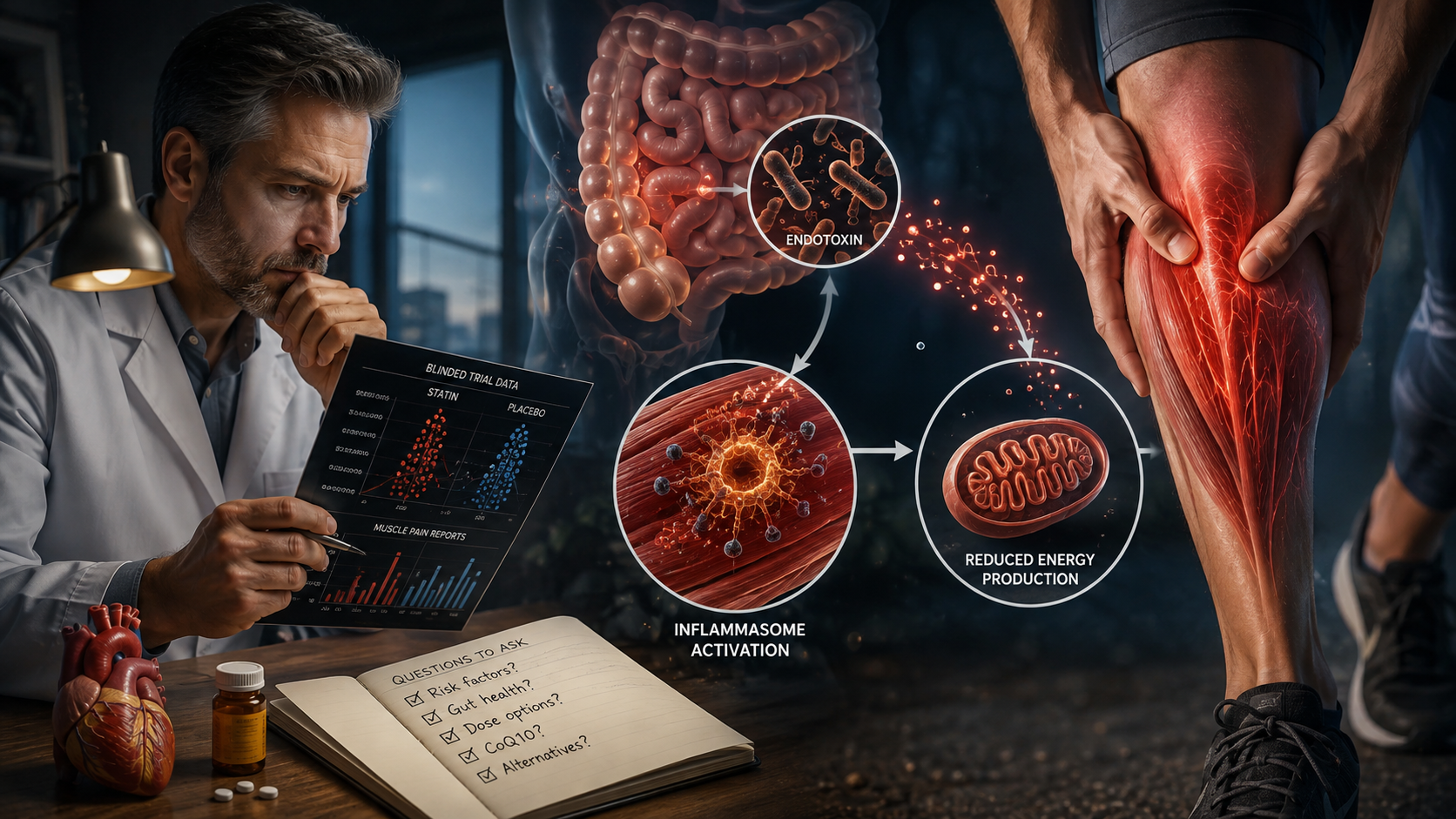
CoQ10 depletion is perhaps the most well-documented downstream consequence. Meta-analyses of randomized controlled trials confirm that statin therapy routinely lowers circulating CoQ10 levels. In skeletal muscle, this depletion directly impairs mitochondrial ATP production, the fundamental energy currency of every cell in your body. Research has shown that statin users often experience measurable reductions in muscle CoQ10 content, which correlates with the muscle pain and weakness that trials detect at rates of 11 per 1,000 person-years.
The exercise adaptation data is even more striking. In a randomized study of sedentary adults at metabolic risk, aerobic exercise training alone increased cardiorespiratory fitness by approximately 10%. Adding simvastatin blunted that improvement to just 1.5%. Skeletal muscle citrate synthase activity (a marker of mitochondrial content) increased 13% with exercise alone but dropped 4.5% with the statin-plus-exercise combination.
Consider the irony: the population now being targeted for earlier statin therapy is the exact population for whom lifestyle modification, particularly exercise, is the recommended first-line intervention. A prevention strategy that pharmacologically lowers LDL while simultaneously impairing the body's ability to benefit from exercise is not just paradoxical. It is metabolically counterproductive.
Vitamin K2 suppression creates another underappreciated risk. Without adequate K2, calcium that should be deposited in bones instead accumulates in soft tissues, including arterial walls. Some research suggests that long-term statin use may actually accelerate coronary artery calcification through this mechanism, potentially worsening the very cardiovascular outcomes the drug is prescribed to prevent.
Statin Risks in Young Adults: Hormones, Brain Function, and the 40-Year Question
Cholesterol is the precursor molecule for every steroid hormone in the body: testosterone, estrogen, progesterone, cortisol, DHEA, and aldosterone. A randomized-trial meta-analysis found that statins lowered testosterone in men by a mean of 0.66 nmol/L. While that average shift may appear clinically trivial in a five-year trial, the significance changes entirely when applied across 40 years of exposure in millions of younger adults.
For men in their 30s and 40s, testosterone is already on a natural decline trajectory. Adding a pharmaceutical that further suppresses the substrate for testosterone production introduces a compounding variable that no trial has accounted for over decadal timeframes. The same logic applies to progesterone, estrogen, and other hormones that regulate everything from fertility and bone density to mood stability and immune function.
The brain deserves particular attention. Neurosteroids, steroid compounds synthesized from cholesterol within the brain itself, play active roles in neural transmission, stress resilience, sleep architecture, and affective regulation. Reviews of sterol and steroid metabolism in the central nervous system confirm that brain cholesterol is metabolized to oxysterols and neurosteroids with biologically significant effects on receptor signaling.
There is no defensible trial-based NNH for "neurosteroid depletion syndrome." The evidence base is not mature enough for precise incidence estimates. But the underlying biology is plausible, the long-term trial evidence is thin, and the populations now being discussed for earlier treatment are exactly those who would accumulate the longest exposure. When we are discussing a drug class that interferes with the production of molecules the brain requires for normal function, the burden of proof for safety should be high, not assumed by default.
The Biospark Approach: Root Cause Metabolic Health Over Pharmaceutical Suppression
At Biospark Health, we approach cholesterol from an entirely different framework. Elevated cholesterol is not a disease. It is a signal. When your body increases cholesterol production, it is often responding to something: thyroid dysfunction that impairs cholesterol-to-hormone conversion, chronic inflammation that triggers protective lipoprotein responses, endotoxin exposure from compromised gut integrity, or mitochondrial inefficiency that disrupts normal lipid metabolism.
Suppressing cholesterol production with a statin does not address any of these root causes. It silences the signal while leaving the underlying metabolic dysfunction untouched.
The bioenergetic approach recognizes that cellular energy production drives everything. When mitochondria function optimally, cholesterol is efficiently converted into hormones, CoQ10 supports robust ATP generation, and the body's lipid metabolism operates in balance. When mitochondrial function is impaired, whether from nutrient deficiencies, thyroid suppression, environmental toxins, or chronic stress, cholesterol metabolism shifts accordingly.
Rather than asking "how do we lower this number," we ask: "why is the body producing this response, and what does it need to function properly?"
Ready to restore your metabolism at the cellular level?
The Bioenergetic Reset Program addresses root causes, not symptoms. Join 300+ members who've discovered what real metabolic health feels like.
- 9+ hours of comprehensive training
- Twice-monthly LIVE coaching calls
- Complete meal plans & protocols
- Direct email support
/month | Cancel anytime
Cholesterol and Metabolic Health Support in Reading & Berks County, PA
If you have been told your cholesterol is "too high" and that a statin is your only option, you are not alone. Many residents throughout Reading, Wyomissing, and Berks County are facing this exact conversation with their doctors, often without hearing about the full spectrum of risks or the metabolic root causes behind their lab numbers.
At Biospark Health, we serve clients throughout southeastern Pennsylvania, including Lancaster, Downingtown, Allentown, West Chester, and the greater Philadelphia suburbs. Dr. Presciutti takes a fundamentally different approach to cardiovascular risk: one that starts with understanding your metabolic health at the cellular level before reaching for a prescription pad.
Whether you are in King of Prussia, Montgomery County, or Chester County, our virtual and in-person options make it possible to get the metabolic assessment you need before making a decision about long-term medication.
Frequently Asked Questions
What are the new guidelines for starting statins?
The March 2026 ACC/AHA guidelines use the PREVENT-ASCVD risk equations to determine statin eligibility. Lipid-lowering therapy is recommended for adults with 10-year risk of 5% or greater, and is considered "reasonable" at 3% to under 5% after clinician-patient discussion. For younger adults aged 30 to 59 with low 10-year risk, a statin is reasonable if LDL is 160 to 189 or if 30-year PREVENT risk exceeds 10%. The guidelines are risk-stratified, not based on LDL alone, despite what headlines suggest.
Can your cholesterol go too low on statins?
Yes. Cholesterol is essential for cell membrane integrity, hormone production, vitamin D synthesis, and brain function. Very low cholesterol levels have been associated with increased risk of depression, hemorrhagic stroke, impaired vitamin absorption, and cognitive changes. The FDA requires statin labels to acknowledge reports of memory loss and confusion. Long-term effects of chronically suppressed cholesterol in younger adults have not been studied.
How young is too young to take statins?
The new 2026 guidelines extend statin consideration to adults as young as 30. However, no randomized trial has specifically tested multi-decade statin therapy initiated in low-risk 30-year-olds. The guidelines rely on extrapolation from trials conducted in older, higher-risk populations. For healthy young adults, lifestyle and metabolic optimization may address the root causes of elevated cholesterol without the risks of decades-long pharmaceutical exposure.
What is the controversy over taking statins?
The controversy centers on three issues. First, statins inhibit the entire mevalonate pathway, not just cholesterol, depleting CoQ10, vitamin K2, and other essential molecules. Second, the trials supporting statin use were designed for short-term cardiovascular endpoints in higher-risk populations, not for assessing 40 years of daily use in healthy 30-year-olds. Third, media translation of nuanced guidelines into simple LDL thresholds risks mass overprescribing in populations where the benefit-to-harm ratio has not been established.
Can statins cause long-term damage?
Documented statin-associated harms include muscle pain and weakness (11 excess events per 1,000 in year one), new-onset diabetes (approximately 1 per 1,000 per year), liver function abnormalities, CoQ10 depletion, and impaired exercise adaptation. The long-term effects of chronic cholesterol suppression on brain function, hormonal health, and mitochondrial capacity over decades have not been studied in randomized trials. The absence of evidence is not evidence of absence.
The Bottom Line
The 2026 cholesterol guidelines may represent sound cardiovascular risk management for some populations. But the gap between what the guideline says and how it will be implemented in the real world is where millions of people could be harmed. Small absolute risks, when multiplied across tens of millions of new statin prescriptions in young adults, produce large absolute numbers of adverse events.
More fundamentally, no one has studied what happens when you suppress a molecule essential to brain function, hormone production, cellular energy, and membrane integrity for 40 to 50 years starting in early adulthood. The responsible position is not to assume safety. It is to acknowledge the uncertainty, demand the evidence, and in the meantime, address the metabolic root causes that drive cholesterol elevation in the first place.
Your body is not broken because your LDL is 165. It is telling you something. The question is whether you listen to the signal or silence it with a pill.
Tags:
References & Citations
This article is supported by scientific research and peer-reviewed sources. Click citations to verify the evidence.
- [1]Qu H, Guo M, Chai H, et al.(2018)Effects of Coenzyme Q10 on Statin-Induced Myopathy: An Updated Meta-Analysis of Randomized Controlled Trials..Journal of the American Heart Association.View Source
- [2]Vinci P, Panizon E, Tosoni LM, et al.(2021)Statin-Associated Myopathy: Emphasis on Mechanisms and Targeted Therapy..International Journal of Molecular Sciences.View Source
- [3]Attardo S, Musumeci O, Velardo D, et al.(2022)Statins Neuromuscular Adverse Effects..International Journal of Molecular Sciences.View Source
- [4]Mantle D, Turton N, Hargreaves IP(2022)Depletion and Supplementation of Coenzyme Q10 in Secondary Deficiency Disorders..Frontiers in Bioscience (Landmark edition).View Source
- [5]Gill PK, Hegele RA(2023)Low cholesterol states: clinical implications and management..Expert Review of Endocrinology & Metabolism.View Source
- [6]Thompson PD, Panza G, Zaleski A, et al.(2016)Statin-Associated Side Effects..Journal of the American College of Cardiology.View Source
- [7]Tsushima Y, Hatipoglu B(2023)Statin Intolerance: A Review and Update..Endocrine Practice.View Source
- [8]Stroes ES, Thompson PD, Corsini A, et al.(2015)Statin-associated muscle symptoms: impact on statin therapy-European Atherosclerosis Society Consensus Panel Statement on Assessment, Aetiology and Management..European Heart Journal.View Source
All references have been reviewed for scientific accuracy and credibility. Citations follow standard academic format and link to original research where available.
About Dr. Steven Presciutti, MD
Founder & Health Coach at Biospark Health, specializing in bioenergetic health and metabolism optimization.