You're Eating a Credit Card of Plastic Every Week: How Microplastics Are Destroying Your Metabolism
Learn how microplastics disrupt your endocrine system, crash mitochondrial respiration, and cause transgenerational metabolic damage. Discover the bioenergetic approach to removing microplastics from your body.
Medical Disclaimer
This content is for informational and educational purposes only. It is not a substitute for professional medical advice, diagnosis, or treatment. Always seek the advice of your physician or other qualified health provider with any questions you may have regarding a medical condition.
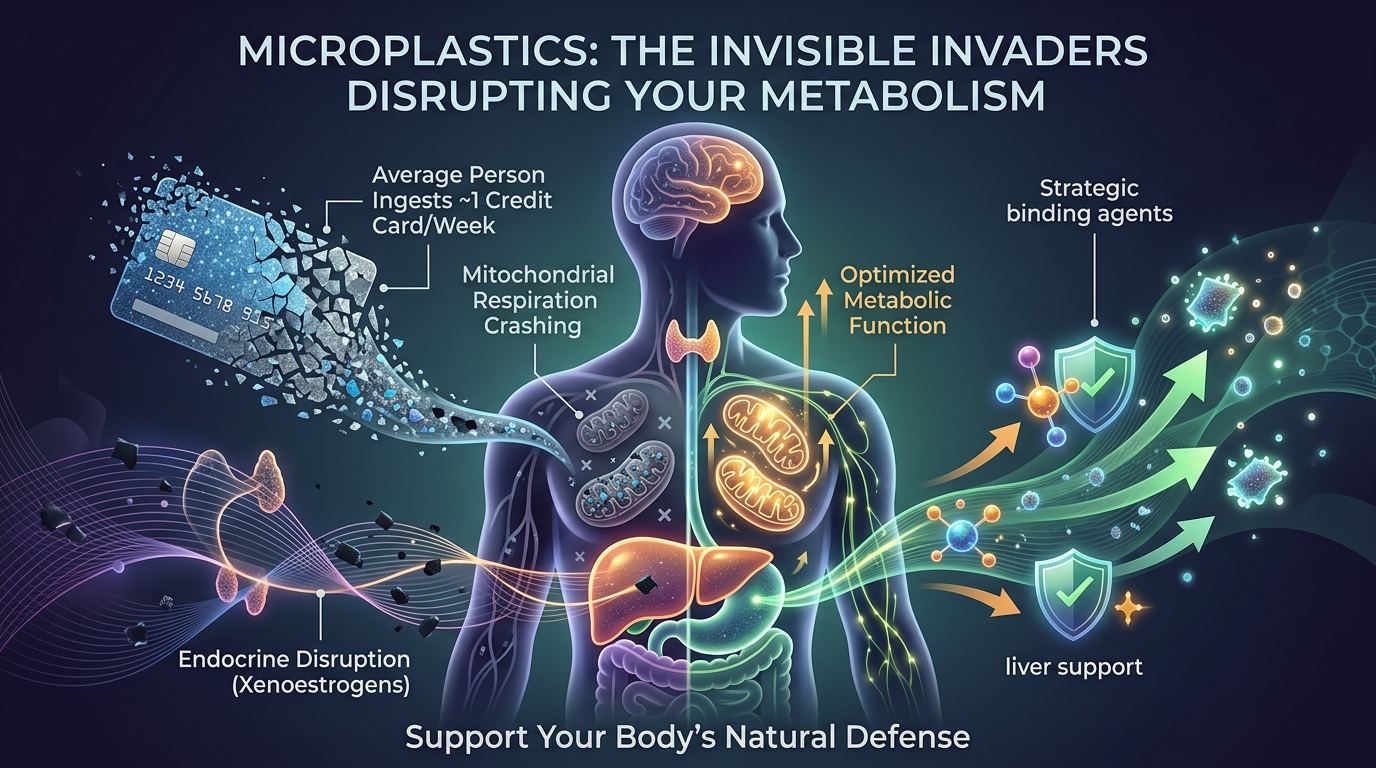
Every week, you eat approximately five grams of plastic. That is roughly the weight of a credit card. It enters your body through your drinking water, your food packaging, your seafood, even the air you breathe. And if you are wondering how to remove microplastics from your body, you are already ahead of most people, because the majority of the population has no idea this is happening. They are swallowing plastic particles with every sip of bottled water and every bite of takeout, completely unaware that these invisible fragments are quietly dismantling their metabolic health from the inside out.
This is not a theoretical future risk. Microplastics have already been found in human blood, lung tissue, placentas, and arterial plaque. The question is no longer whether they are inside you. The question is what they are doing once they get there, and whether your body has the metabolic capacity to deal with them. At Biospark Health, we believe the answer lies not in panic but in understanding: understanding the mechanism, understanding the real health effects, and understanding the bioenergetic strategies that can help your body process and eliminate what it was never designed to encounter.
Let me walk you through what the research actually shows, why this is fundamentally a metabolic problem, and what you can do about it starting today.
How Microplastics Get Into Your Body (And Why You Can't Avoid Them)
The scale of microplastic contamination is difficult to overstate. Between 10 and 40 million metric tons of plastic particles are released into the environment annually. These particles, defined as plastic fragments smaller than five millimeters, break down from larger plastic waste through sun exposure, mechanical wear, and chemical degradation. Once they enter the environment, they become essentially permanent residents of every ecosystem on the planet, including the ecosystem inside your body.
Your Water Is Full of Them
If you drink water from recyclable plastic bottles, studies show you are consuming up to 118 microplastic particles per liter. Tap water is not much better; municipal water systems were never designed to filter particles this small. Even "purified" bottled water has been found to contain significant microplastic loads. The particles leach from the bottle itself, especially when exposed to heat or sunlight, which is why that water bottle sitting in your car on a warm day is far more toxic than you think.
Your Food Is Contaminated
Microplastics in food and water represent a dual exposure pathway that is nearly impossible to eliminate entirely. Shellfish eaters consume an estimated 11,000 microplastic particles per year, because filter-feeding organisms concentrate whatever is in the water around them. Sea salt, honey, beer, and even fruits and vegetables contain measurable levels of microplastics. The particles are in the soil, in the irrigation water, and in the packaging that wraps nearly everything you buy.
Are Ziploc Bags Full of Microplastics?
This is one of the most common questions patients ask, and the answer matters. Polyethylene-based bags like Ziploc do shed microplastic particles, particularly when they are heated, reused, or exposed to acidic foods. Microwaving food in any plastic container, including "microwave-safe" bags, accelerates this shedding dramatically. The particles that break free are small enough to be absorbed through the gut lining and into your bloodstream. The practical takeaway: if you are storing or heating food, glass and stainless steel are the only truly safe options.
Is Coffee Full of Microplastics?
If you brew your coffee using single-serve plastic pods or run water through a machine with plastic internal components, the answer is yes. Studies have found that a single plastic coffee pod can release billions of nanoplastic particles into your cup. Paper filters are significantly safer, and a glass or stainless steel pour-over system eliminates this exposure pathway almost entirely. French presses with glass carafes are another excellent option.
The uncomfortable reality is that complete avoidance of microplastics is currently impossible. You can reduce your exposure significantly, and we will cover exactly how. But the more important question, the one most health authorities are ignoring, is what these particles do once they are inside you.
The Real Health Effects of Microplastics: More Than Just Inflammation
The mainstream narrative around microplastics tends to focus on vague warnings about "inflammation" and "toxicity." That framing dramatically understates the problem. The research emerging over the past two years paints a far more alarming picture, one that connects microplastic exposure directly to cardiovascular disease, neurological damage, and systemic metabolic disruption.
How Harmful Are Microplastics to the Human Body?
The most definitive answer to this question came from a landmark 2024 study published in the New England Journal of Medicine. Researchers examined arterial plaque removed from patients undergoing carotid endarterectomy and found that patients whose plaque contained microplastics and nanoplastics had a significantly higher risk of heart attack, stroke, and death compared to patients whose plaque was plastic-free. This was not a marginal difference. The presence of plastic particles in arterial tissue was associated with a dramatically elevated risk of major cardiovascular events over a 34-month follow-up period.
Think about what that means. Plastic particles are not just passing through your body. They are embedding themselves in the walls of your arteries, contributing to the formation and destabilization of plaque that can kill you.
Microplastics Reach Your Brain
A 2025 animal study using real-time imaging technology demonstrated something researchers had long suspected but never directly observed: microplastic particles can cross the blood-brain barrier, travel through cerebral vasculature, and physically block small blood vessels in the brain. The particles were tracked moving through living brain tissue, lodging in capillaries, and restricting blood flow to surrounding neurons.
Separately, Stanford researchers published findings in 2025 showing that microplastics cause "major changes in gene expression" in blood vessel cells. The cells exposed to microplastics shifted their genetic activity in ways consistent with inflammation, endothelial dysfunction, and accelerated aging of the vascular system.
Microplastics Have Been Found Everywhere Inside You
The evidence for systemic distribution is now overwhelming. A 2022 study published in Environment International documented microplastics in human blood for the first time, finding plastic polymers in 77% of tested subjects. A 2021 study found microplastics in human placental tissue on both the maternal and fetal sides, meaning babies are being exposed before they even take their first breath. Animal studies have confirmed accumulation in the liver, kidneys, and gut, with measurable changes in inflammatory biomarkers and organ function.
This is not a localized problem. It is a whole-body problem. And when you understand what these particles are actually made of, the metabolic implications become even more concerning.
Do Microplastics Affect Your Metabolism? The Endocrine Disruption Connection
Here is where the mainstream conversation about microplastics completely breaks down, because the real danger is not the plastic particle itself. The real danger is what the plastic is made of and what it does to your hormonal system once it enters your body.
Microplastics Are Xenoestrogens
The chemicals embedded in plastic polymers, including bisphenol A (BPA), bisphenol S (BPS), phthalates, and nonylphenol, are potent xenoestrogens. That means they mimic estrogen in your body, binding to estrogen receptors and activating hormonal signaling pathways that should not be activated. Research by Roy D. and colleagues demonstrated as early as 1997 that BPA and nonylphenol directly stimulate estrogen-receptor-mediated cellular responses. These are not weak signals. In sensitive tissues, these chemicals can be biologically active at extraordinarily low concentrations.
This is critical to understand: microplastics are highly estrogenic. Every particle that enters your body carries a payload of endocrine-disrupting chemicals that interfere with your thyroid function, your sex hormones, your insulin signaling, and your cortisol regulation. The cumulative effect is a slow, persistent suppression of your metabolic rate.
The Mitochondrial Connection
Here is where the bioenergetic framework becomes essential. Your mitochondria, the organelles that produce ATP (the energy currency of every cell), are exquisitely sensitive to estrogenic disruption. When xenoestrogens from microplastics flood your system, they interfere with mitochondrial electron transport chain function. The result is a measurable decline in cellular energy production.
BPA and BPS have been shown to alter cell cycle kinetics and cause chromosomal aberrations. They disrupt the precise hormonal signaling that mitochondria depend on to regulate energy production. When mitochondrial respiration crashes, everything downstream suffers: your thyroid slows, your body temperature drops, your ability to detoxify diminishes, and your cells shift toward inefficient, stress-driven metabolic pathways.
This creates a vicious cycle. Detoxification of xenoestrogens requires massive amounts of ATP. The liver's glucuronidation pathway, one of the primary routes for clearing estrogenic compounds, depends on abundant glucose and cellular energy to function. But if the xenoestrogens themselves are suppressing your mitochondrial output, you lack the very energy you need to clear them. Low metabolic rate equals toxin accumulation. Toxin accumulation equals lower metabolic rate. The cycle accelerates.
Transgenerational Damage: Your Grandchildren May Pay the Price
Perhaps the most disturbing finding in recent microplastics research comes from a 2025 study published in the Journal of the Endocrine Society, which demonstrated that microplastic-induced sperm damage causes transgenerational metabolic disease. The mechanism operates through epigenetic inheritance: chemical modifications to sperm DNA that alter gene expression in offspring without changing the genetic code itself.
In practical terms, this means that a father's microplastic exposure today can program his children and grandchildren for Type II diabetes, obesity, and metabolic syndrome. The damage is not limited to the individual. It propagates across generations through what researchers describe as hormonal imprinting, a process by which environmental exposures during critical developmental windows permanently alter metabolic programming.
Dr. Bernard Weiss at the University of Rochester has documented similar neurological effects, showing that endocrine disruptors operating during fetal development can produce behavioral and cognitive changes that persist across generations. This is not speculative. The epigenetic evidence is accumulating rapidly, and it suggests that the microplastic crisis is not just a problem for us. It is a problem we are silently passing to our descendants.
The Biospark Approach: How to Remove Microplastics From Your Body
Can the Human Body Flush Out Microplastics?
Yes, but only if your metabolism is running well enough to support the detoxification process. This is the point that virtually every "detox" guide on the internet gets wrong. They recommend fasting, juice cleanses, or extreme fiber protocols as ways to "flush" toxins. In reality, these approaches make the problem worse.
Fasting depletes liver glycogen. Without glycogen, the liver cannot perform glucuronidation, one of its primary detoxification pathways. Juice cleanses provide sugar without the protein and cofactors the liver needs to process estrogenic compounds. High-roughage "detox" diets can suppress thyroid function, further reducing the metabolic rate you need for effective clearance. These popular approaches do not accelerate detoxification. They paralyze it.
The bioenergetic approach to removing microplastics starts with the opposite strategy: fuel the system first.
Step 1: Support Liver Detoxification With Adequate Energy
Your liver needs glucose, amino acids, and specific cofactors to run its detoxification pathways at full capacity. This means consuming 80 to 100 grams of high-quality protein per day, paired with easily digestible carbohydrates that maintain liver glycogen stores. Key liver-supportive nutrients include Vitamin E (a powerful anti-estrogenic antioxidant), Vitamin A, B-vitamins (especially B6 and B12 for methylation), glycine, and taurine. These nutrients directly support the Phase I and Phase II liver pathways responsible for processing and excreting xenoestrogens.
Step 2: Bind Xenoestrogens in the Gut
A daily raw carrot salad is one of the most effective and underappreciated tools for binding estrogenic compounds in the digestive tract. The unique fiber structure of raw carrot resists digestion and acts as a selective binder for xenoestrogens and endotoxin in the gut, preventing reabsorption through the enterohepatic circulation. Prepare one medium carrot (shredded or grated) with a small amount of coconut oil and apple cider vinegar. Eat it between meals daily. Activated charcoal and bamboo shoots can serve as additional systemic binders, but should be taken well away from meals and supplements to avoid binding nutrients you actually need.
Step 3: Mobilize Through Sweat
Infrared sauna sessions are supported by research showing that sweat is a legitimate excretion pathway for certain environmental toxins, including heavy metals and lipophilic compounds. Microplastic-associated chemicals like BPA are lipophilic, meaning they concentrate in fatty tissues. Infrared sauna promotes mobilization from these stores through deep tissue heating, providing an additional clearance route beyond the liver and kidneys.
Step 4: Reduce Ongoing Exposure
While complete avoidance is impossible, significant reduction is achievable. Switch to glass or stainless steel containers for food storage and drinking. Never heat food in plastic of any kind. Install a carbon block or reverse osmosis water filter, as standard pitcher filters do not remove microplastic particles effectively. Avoid synthetic clothing when possible, as polyester and nylon garments shed microfibers with every wash cycle. Choose paper or stainless steel coffee filters over plastic pod systems.
What NOT to Do
Do not fast as a "detox" strategy. Do not rely on high-fiber "cleanse" protocols that suppress thyroid function. Do not assume that "BPA-free" products are safe, as the replacement chemical BPS has been shown to have equivalent estrogenic activity. And do not accept the argument that low-dose exposure is harmless through "hormesis." Hormesis applies to natural stressors that the body evolved to handle. Synthetic xenoestrogens are not natural stressors. They drain finite ATP reserves every time your body attempts to process them, with no adaptive benefit.
Reducing Microplastic Exposure in Reading and Berks County, PA
If you live in the Reading, Wyomissing, or greater Berks County area, your microplastic exposure profile has local dimensions worth understanding. Municipal water systems in Pennsylvania draw from surface water sources that receive agricultural runoff, industrial discharge, and stormwater carrying plastic debris from roads and urban surfaces. The Schuylkill River watershed, which supplies water to communities across the region, carries measurable microplastic loads that standard municipal treatment does not fully remove.
For Pennsylvania residents, home water filtration is not optional. It is essential. A quality carbon block or reverse osmosis system can dramatically reduce your family's microplastic ingestion from drinking and cooking water. Combined with the dietary and lifestyle strategies outlined above, these steps create a meaningful reduction in total body burden.
At Biospark Health, we work with clients throughout Reading, Lancaster, Allentown, West Chester, and the surrounding communities to assess environmental exposures and build personalized protocols for metabolic restoration. If you are dealing with unexplained fatigue, hormonal imbalance, weight resistance, or any of the downstream effects of chronic toxin accumulation, our bioenergetic approach addresses the root cause rather than masking symptoms with medications.
Frequently Asked Questions
Do microplastics affect metabolism?
Yes. Microplastics carry xenoestrogenic chemicals that directly suppress mitochondrial respiration, the process by which your cells produce energy. When mitochondrial output drops, your metabolic rate drops with it. This manifests as fatigue, weight gain, hormonal imbalance, cold body temperature, and impaired detoxification capacity. The relationship between microplastic exposure and metabolic dysfunction is not indirect or theoretical. It operates through well-characterized endocrine disruption pathways that have been documented in peer-reviewed research for over two decades.
Is "BPA-free" plastic actually safe?
No. When manufacturers removed BPA from products due to public pressure, most replaced it with bisphenol S (BPS) or other structural analogs. Research has consistently shown that BPS has equivalent estrogenic activity to BPA. In some assays, BPS is actually more potent. The "BPA-free" label gives consumers a false sense of safety while the fundamental problem, estrogenic leaching from plastic, remains unchanged. The only safe approach is to minimize contact between plastic and your food and beverages entirely.
Does fasting help detox microplastics?
No. This is one of the most harmful misconceptions in the wellness space. Fasting depletes liver glycogen, which the liver requires to run its glucuronidation pathway, a critical Phase II detoxification reaction. Without adequate glucose and ATP, the liver cannot conjugate and excrete xenoestrogenic compounds. Fasting does not "release stored toxins" in any beneficial way. It shuts down the machinery your body needs to process them. If you want to support detoxification, you need to feed the system, not starve it.
Can microplastics cross the placenta?
Yes. A 2021 study published in Environment International documented microplastic particles on both the maternal and fetal sides of human placentas. This means that prenatal exposure is occurring during the most critical windows of fetal development, when hormonal imprinting can permanently alter metabolic programming. The transgenerational implications are significant: maternal microplastic burden may contribute to metabolic disease risk in offspring through epigenetic mechanisms that persist across generations.
What is the best water filter for removing microplastics?
Standard pitcher-style carbon filters reduce some contaminants but are not effective at removing microplastic particles, which can be as small as one micrometer. Reverse osmosis systems are the most effective option, removing particles down to 0.0001 micrometers. Carbon block filters with sub-micron ratings (0.5 micrometer or smaller) offer a good middle ground. Regardless of which system you choose, filtering your drinking and cooking water is one of the single most impactful steps you can take to reduce daily microplastic ingestion.
Your Metabolism Is Your Best Defense
The microplastic crisis is real, and it is not going away. Plastic production continues to accelerate globally, and the particles already in the environment will persist for centuries. Waiting for regulatory action or technological solutions is not a viable health strategy.
But here is what the fear-driven headlines consistently miss: your body is not defenseless. It has sophisticated detoxification systems capable of processing and eliminating foreign compounds, including xenoestrogens from microplastics. The limiting factor is not willpower, supplements, or the latest "detox" trend. The limiting factor is energy.
When your mitochondria are producing adequate ATP, your liver has the fuel it needs to run its detoxification pathways. When your thyroid is functioning optimally, your metabolic rate supports efficient clearance. When your cells are well-nourished with the right proteins, fats, carbohydrates, vitamins, and minerals, the entire system works the way it was designed to.
This is the bioenergetic perspective that guides everything we do at Biospark Health. We do not treat microplastic exposure as a hopeless problem or a reason to live in fear. We treat it as a metabolic challenge, one that your body can rise to meet if you give it the raw materials and energetic support it needs.
The plastic is already inside you. The question is whether your metabolism is strong enough to handle it. And if it is not, the path forward is not restriction, deprivation, or panic. It is restoration. Feed the cell. Fuel the liver. Protect the mitochondria. That is how you fight back.
Tags:
References & Citations
This article is supported by scientific research and peer-reviewed sources. Click citations to verify the evidence.
- [1]Marfella R, Prattichizzo F, Sardu C, et al.(2024)Microplastics and Nanoplastics in Atheromas and Cardiovascular Events.New England Journal of Medicine.View Source
- [2]Ragusa A, Svelato A, Santacroce C, et al.(2021)Plasticenta: First evidence of microplastics in human placenta.Environment International.View Source
- [3]Leslie HA, van Velzen MJM, Brandsma SH, et al.(2022)Discovery and quantification of plastic particle pollution in human blood.Environment International.View Source
- [4]Deng Y, Zhang Y, Lemos B, Ren H(2017)Tissue accumulation of microplastics in mice and biomarker responses suggest widespread health risks of exposure.Scientific Reports.View Source
- [5]Yang Q, et al.(2025)Microplastic exposure and male reproductive health: mechanisms of sperm damage.Journal of the Endocrine Society.View Source
- [6]Lamoree MH, van Boxel J, Nardella F, et al.(2025)Health impacts of microplastic and nanoplastic exposure.Nature Medicine.View Source
- [7]Kannan K, Vimalkumar K(2021)A Review of Human Exposure to Microplastics and Insights Into Microplastics as Obesogens.Frontiers in Endocrinology.View Source
- [8]Zhao Q, Fang Z, Wang P, et al.(2025)Polylactic Acid Micro/Nanoplastic Exposure Induces Male Reproductive Toxicity by Disrupting Spermatogenesis and Mitochondrial Dysfunction in Mice.ACS Nano.View Source
- [9]Landrigan PJ, Raps H, Cropper M, et al.(2023)The Minderoo-Monaco Commission on Plastics and Human Health.Annals of Global Health.View Source
- [10]Shan S, Zhang Y, Zhao H, et al.(2022)Polystyrene nanoplastics penetrate across the blood-brain barrier and induce activation of microglia in the brain of mice.Chemosphere.View Source
- [11]Hunt K, Davies A, Fraser A, et al.(2024)Exposure to microplastics and human reproductive outcomes: A systematic review.BJOG.View Source
- [12]Prattichizzo F, Ceriello A, Pellegrini V, et al.(2024)Micro-nanoplastics and cardiovascular diseases: evidence and perspectives.European Heart Journal.View Source
All references have been reviewed for scientific accuracy and credibility. Citations follow standard academic format and link to original research where available.
About Dr. Steven Presciutti, MD
Founder & Health Coach at Biospark Health, specializing in bioenergetic health and metabolism optimization.