Your Chronic Disease Isn't a Mystery. It's a Confession: Why Single-Cause Medicine Is Collapsing
Modern medicine fails chronic disease because it was built for acute illness. Here's why single-cause medicine is collapsing, and what the body has been trying to tell us all along.
Medical Disclaimer
This content is for informational and educational purposes only. It is not a substitute for professional medical advice, diagnosis, or treatment. Always seek the advice of your physician or other qualified health provider with any questions you may have regarding a medical condition.
There is a moment in every patient's story when the maps run out.
The labs come back "normal." The specialist shrugs. The prescription gets refilled. And somewhere between the waiting room and the car, a quiet, terrible thought forms: maybe this is just how I am now.
If you have ever had that thought, I want you to know something. You are not broken. You are not a mystery. And your chronic illness is not the random misfortune your doctor keeps implying it is.
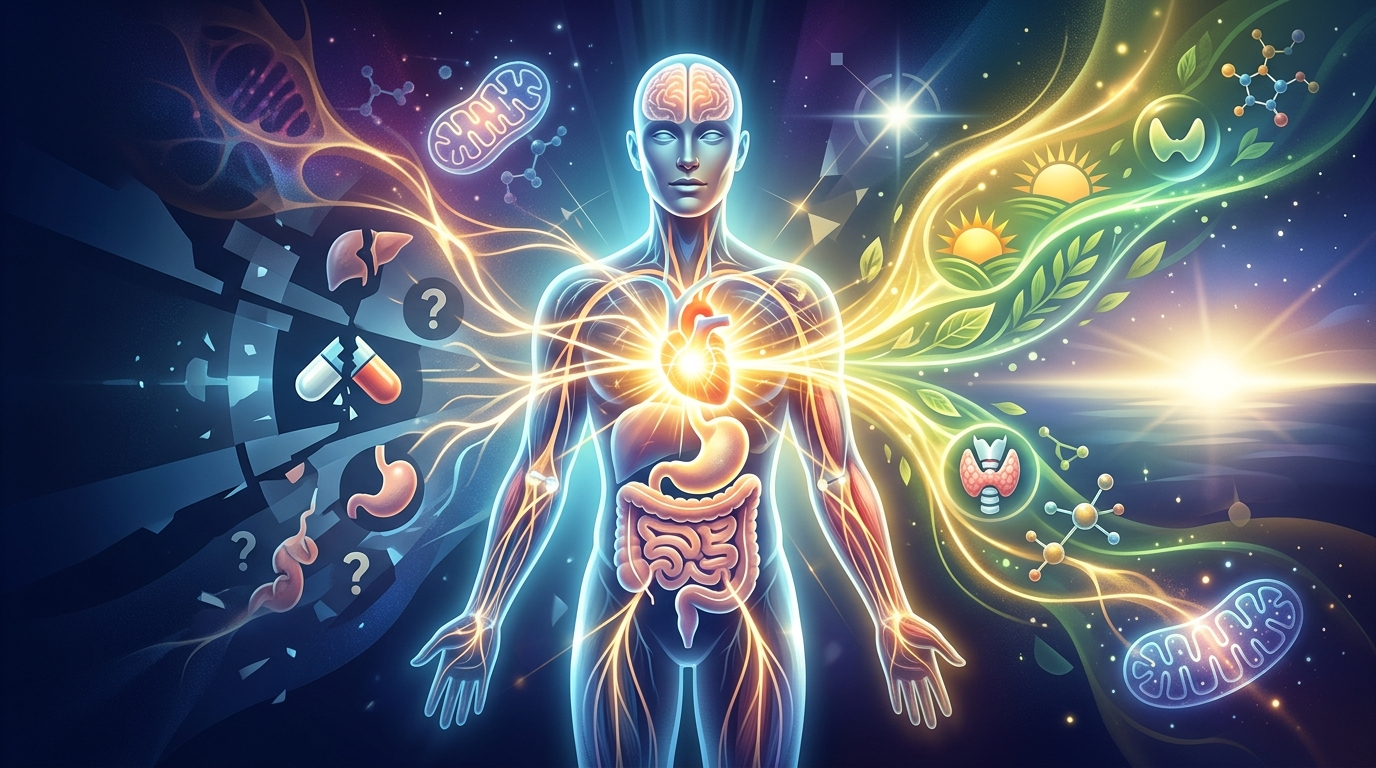
Your chronic disease is a confession. A confession that medicine has been reading one chapter of your biology and calling it the whole book. A confession that a system built to treat acute illness in bodies that recover has been deployed, badly, against chronic illness in bodies that are trying to tell us something. A confession that the reductionist paradigm, the one-cause-one-disease-one-drug model that has governed healthcare for three generations, was the wrong tool for the wrong era.
That paradigm is collapsing now. Not loudly. Not all at once. But in every chronic disease registry, in every treatment-resistant patient, in every "medically unexplained" syndrome that survives the full pharmacological arsenal and walks out of the clinic still sick. The data have been making the confession for decades. The question is whether medicine will finally listen, and what kind of care will rise in the space left behind.
This is about why modern medicine fails chronic disease. It is also about what the body has been trying to tell us, and what the next chapter of healing actually looks like.
Why Modern Medicine Fails Chronic Disease (It Was Built for a Different Problem)
Let me say something that may sound heretical coming from an MD: conventional medicine is extraordinary at what it was designed to do.
If you are hit by a car, you want a trauma surgeon, not a nutritionist. If you contract bacterial pneumonia, you want antibiotics, not affirmations. The germ theory revolution of the late 1800s, the antibiotic era that followed, the surgical and imaging advances of the twentieth century, these saved millions of lives. They deserve honor for what they accomplished.
But they were built on a specific assumption: one cause, one disease, one cure. Isolate the pathogen. Identify the mechanism. Patent the molecule. Cure the patient and send them home. That model worked magnificently against tuberculosis and cholera and the infections that had culled human populations for centuries.
Here is the problem. The dominant burden of illness has changed, and medicine has not changed with it.
Today, roughly six in ten American adults carry a chronic disease. Four in ten carry two or more. The chronic disease epidemic is not a collection of acute illnesses we haven't cured yet. It is a fundamentally different category of problem, multi-factorial, environmentally driven, developmentally anchored, and profoundly resistant to single-variable intervention.
You cannot prescribe your way out of a fifty-year accumulation of environmental toxins in the brain of a person who drank municipal water and breathed industrial air for decades. You cannot treat the post-viral patient whose immune and autonomic systems have been reorganized by an infection the diagnostic codes don't yet recognize. You cannot reductively analyze the autism phenotype when what you are actually looking at is the intersection of maternal immune activation, microbiome disruption, mitochondrial dysfunction, and a dozen environmental co-exposures that vary by zip code.
These are not diseases. They are weather systems. And you do not understand weather by studying individual air molecules.
This is why conventional medicine fails chronic disease. Not because the doctors aren't smart, most of them are brilliant. Not because the drugs don't work, many of them do what they were tested to do. It fails because the paradigm was built for one kind of problem and is being applied to another. It is trying to treat territories it was never designed to read.
The Poverty of Single Causes: Why Reductionist Medicine Is Collapsing
For fifty years, biomedical science has optimized for a specific kind of knowledge: the randomized controlled trial of a single molecule against a single disease in a population selected for clean signal.
It is elegant. It is publishable. It is also, increasingly, useless against the complex chronic illnesses that dominate modern clinical practice.
Here is why. Reductionist medicine assumes that if you isolate enough variables, control for enough confounders, and measure a narrow enough outcome, you will find "the" cause. But the body does not work that way. The body is a system, and systems have properties that disappear the moment you take them apart.
Consider a patient who arrives in the clinic with chronic fatigue, joint pain, brain fog, digestive distress, and a mood disorder. Conventional medicine will send that patient to five different specialists: rheumatology, gastroenterology, neurology, psychiatry, and endocrinology. Each specialist will run tests within their domain. Each will either find "nothing" or prescribe a medication for the symptom that falls within their jurisdiction. The patient will leave with five prescriptions, no unifying explanation, and a growing suspicion that something is being missed.
Something is being missed. The patient is not carrying five separate diseases. The patient is carrying one systemic problem that is expressing itself through five different tissues. The rheumatologist is seeing inflammation. The gastroenterologist is seeing dysmotility. The neurologist is seeing cognitive symptoms. The psychiatrist is seeing mood. The endocrinologist is seeing hormonal dysregulation. And none of them are seeing what is actually happening, because none of them were trained to see the system.
Ray Peat, the biologist whose work has quietly shaped modern bioenergetic medicine, put it this way: the old "lock and key" model of pharmacology, where a hormone signals a cell with a suitable receptor, fundamentally misreads how biology works. A cell's response to any signal depends on the state of the cell. Nutrients, metabolites, hormones, and neurotransmitters all modify the cell's sensitivity to its surroundings. When you change the cellular environment, you change the response to every molecule that enters it. This is not a minor footnote. It is the central fact that reductionism cannot accommodate.
The body has been running this experiment since before the Cambrian. It has been testing hypotheses about oxygen and inflammation, about fuel and structure, about stress and recovery, for hundreds of millions of years. It built a gut-brain axis with ten times more neurons in the enteric nervous system than in the spinal cord. It built a microbial ecosystem of three to four pounds that metabolizes compounds the human genome cannot process. It did this not because any NIH study group recommended it, but because survival across evolutionary time demanded nothing less.
The body already knows what ails it. The question is whether medicine has instruments subtle enough to ask the right questions, and honest enough to record the answers it didn't expect.
The Unifying Principle: What Every Chronic Disease Has in Common
Here is what fifty years of reductionist research has been obscuring, and what the bioenergetic model has been quietly documenting for just as long: seemingly unrelated chronic diseases share a common root.
That root is cellular energy failure.
It is not a slogan. It is a mechanism. At the mitochondrial level, fatigue, autoimmunity, diabetes, cancer, hypertension, neurodegeneration, depression, and the vast majority of chronic conditions are united by a single biological failure: the inability of the cell to efficiently oxidize glucose and produce adequate ATP, the molecule that powers every living process.
When mitochondrial respiration is impaired by stressors, and the list of stressors is long and modern: polyunsaturated fats, chronic psychological stress, poor sleep, environmental toxins, nutritional deficiencies, chronic undereating, a catastrophic cascade begins. The cell, unable to burn glucose cleanly, reverts to primitive glycolysis, producing lactic acid instead of protective carbon dioxide. Stress hormones flood the bloodstream to mobilize backup fuel. Free fatty acids, particularly unstable polyunsaturated fats, physically block the mitochondria from using glucose. This is the real mechanism behind what conventional medicine calls "insulin resistance." The cell is not broken. It is overloaded with fat and defensively rejecting glucose, leaving the tissue internally starved while sugar backs up in the blood.
ATP is not just fuel. It structures the water and proteins inside the cell into a cohesive gel. When energy fails, that structure breaks down. Potassium leaks out. Sodium and bulk water flood in. Cells swell. Tissues degrade. The immune system detects the structural damage and mounts an inflammatory response to clear it out. Mainstream medicine looks at this inflammation and calls it "autoimmunity." It prescribes immunosuppressants to silence the response.
But the immune system is not making a mistake. It is responding exactly as it should to a state of systemic energy failure and cellular starvation. Suppress the response, and the damage continues underneath, invisible. Restore the energy, and the response resolves on its own.
This is what Otto Warburg was describing when he documented the respiratory defect behind cancer in the 1920s. It is what Hans Selye was mapping when he described the General Adaptation Syndrome, "the syndrome of being sick," where chronic stress draws from the same finite adaptive energy pool regardless of whether the stressor is infection, psychological strain, starvation, or cold exposure. It is what Albert Szent-Gyorgyi, who discovered vitamin C, was getting at when he pioneered the study of the electronic properties of living tissue.
These were not fringe researchers. They were Nobel laureates. Their work was methodologically rigorous. And it was gradually buried under a reductionist tide that privileged patentable molecules over systemic understanding, because patentable molecules funded the research.
The bioenergetic model is not a rejection of science. It is science that was allowed to continue long enough to see the whole picture.
Why Your Labs Are "Normal" But You Still Feel Terrible
This is the question I hear most often in my clinic, and it deserves a direct answer.
You feel exhausted. Your hair is thinning. Your hands are cold. You can't concentrate. You gain weight despite doing everything "right." You don't sleep well. Your mood is fragile. You go to your doctor. Your TSH is in the normal range. Your CBC is fine. Your metabolic panel is unremarkable. You are told the labs are normal and the problem must be stress or aging.
The labs are lying to you. Not because the numbers are wrong, but because the interpretation is wrong.
Standard blood tests do not measure the energy being produced inside your cells. They measure circulating levels of a handful of markers in a snapshot in time. TSH, the thyroid stimulating hormone that most doctors treat as the definitive thyroid test, is produced by the pituitary. The pituitary can maintain "normal" TSH even when your peripheral tissues, the ones that actually need the thyroid hormone, are starving for active T3. Chronic stress and inflammation can suppress TSH further, making a sick person look like a healthy one on paper.
What actually tells you whether your metabolism is working? Your body temperature. Your resting pulse. Your hand temperature. Your energy after meals. Your sleep quality. Your hair, skin, and nail quality. Your mood stability between meals. These are not soft markers. They are direct reflections of cellular energy production, and they are exquisitely sensitive to changes that blood tests miss entirely.
A waking body temperature below 97.8 degrees Fahrenheit means your metabolic enzymes are running in slow motion. They are cold, literally, and cold enzymes cannot do their work. It does not matter what your TSH is. The temperature is telling you what the lab cannot.
This is why the bioenergetic clinician starts with functional markers. Temperature and pulse before meals. Temperature and pulse after meals. The pattern across the day. How the patient responds to a specific food or a specific time of day. These are the instruments of root cause medicine, and they are available to anyone with a thermometer and a second hand.
What Root Cause Medicine Actually Does Differently
I want to be careful here, because the phrase "root cause medicine" has been used so broadly that it risks becoming meaningless. Root cause medicine is not a vague promise to "find the underlying issue." It is a specific methodology with specific practices.
Here is what it actually looks like in a clinical setting.
First, we stop treating the symptom as the disease. A patient presents with high blood pressure. The conventional response is a prescription. The root cause response is a question: why is the blood pressure high? Is the patient dehydrated? Sodium-depleted? Running on stress hormones because of poor sleep and chronic undereating? Carrying a silent hypothyroid state that is driving vascular stiffness? The answer changes the treatment completely. A patient whose hypertension is driven by adrenaline surges from chronic energy deficit will not benefit from a medication that lowers blood pressure without addressing the deficit. They will simply trade one symptom for another.
Second, we treat the system, not the part. When a patient comes in with five symptoms in five organ systems, we do not refer them to five specialists. We look for the single systemic cause, usually cellular energy failure driven by a specific pattern of nutritional, hormonal, and environmental stressors, that is expressing itself through multiple tissues at once. When we correct the system, the symptoms resolve together. This is not magic. It is what happens when you treat the disease instead of the list.
Third, we use food as the first intervention, not the last. In a reductionist paradigm, "diet and exercise" is the line the doctor says before writing the prescription, with no actual guidance on what that means. In a bioenergetic paradigm, food is the most powerful metabolic tool available, and the specific composition of that food determines whether cellular energy is being supported or destroyed. This means adequate carbohydrate, specifically ripe fruit, fruit juice, honey, root vegetables, and white rice, to provide clean fuel for mitochondrial respiration and thyroid conversion. It means moderate protein, balanced with glycine-rich sources like bone broth and gelatin to prevent the inflammatory load of muscle meats. It means saturated fats, not polyunsaturated seed oils, because saturated fats are chemically stable and terminate the stress response while polyunsaturated fats amplify it. It means liberal salt, because sodium restriction triggers the same stress hormone cascade that reductionist medicine is trying to medicate away.
Fourth, we rebuild thyroid function as a foundation, not an afterthought. Hypothyroidism at the tissue level is the single most common driver of chronic disease I see, and it is also the most commonly missed, precisely because conventional testing cannot detect it. We use functional markers. We use dietary strategies that support T4 to T3 conversion in the liver. And when those are insufficient, we use physiological doses of thyroid hormone, often a combination of T4 and T3, to restore the metabolic foundation that every other system depends on.
Fifth, we respect the body's adaptive intelligence. Chronic disease is almost always an adaptive response to an inappropriate environment, not a random failure. When you treat it as adaptive, you start asking what the body is trying to do, and how to give it what it actually needs to stop doing it. This is the opposite of the reductionist instinct to suppress whatever the body is doing that the doctor doesn't like.
The Biospark Approach: Where Systems Medicine Meets Clinical Reality
At Biospark Health, this is not a philosophy we adopted because it was fashionable. It is the clinical reality that emerged when we stopped accepting that patients had to stay sick.
I trained in conventional medicine. I believed what I was taught. And then I spent years watching patients cycle through the specialist carousel, collecting diagnoses and prescriptions and never getting better, and I had to confront the fact that the tools I had been given were not equal to the problem in front of me. The patients were not failing treatment. The treatment was failing the patients.
What we do at Biospark is not alternative medicine. It is not "functional medicine" in the supplement-stacking sense that has become common. It is systems-based, bioenergetically-informed clinical care, grounded in the work of researchers like Ray Peat, Hans Selye, Otto Warburg, and the modern bioenergetic clinicians who have built on their foundation. We use functional testing alongside conventional testing. We prioritize food as the first intervention. We rebuild thyroid and metabolic function as a foundation. We address the root, and we let the symptoms resolve from the bottom up.
The results speak for themselves. Patients who had been told their fatigue was depression walking out with their energy back. Patients who had been on three blood pressure medications for a decade titrating off them in six months. Patients whose autoimmune markers had been rising for years watching them fall as we restored the cellular energy their immune system had been responding to all along.
This is not a miracle. It is what happens when you stop treating chronic disease like an acute problem and start treating it like what it actually is.
Ready to restore your metabolism at the cellular level?
The Bioenergetic Reset Program addresses root causes, not symptoms. Join 300+ members who've discovered what real metabolic health feels like, the kind that shows up in your temperature, your energy, your sleep, and your labs.
- 9+ hours of comprehensive training
- Twice-monthly LIVE coaching calls
- Complete meal plans and protocols
- Direct email support from our clinical team
$97/month | Cancel anytime
Root Cause Medicine in Reading & Berks County, PA
If you live in the Reading or Wyomissing area and you have spent the last several years collecting diagnoses without getting better, you are not alone. Many residents throughout Berks County and Lancaster County have been told their labs are "normal" while they remain exhausted, inflamed, hormonally disrupted, and quietly convinced something is being missed.
Something is being missed. And it is not something that shows up on the standard panel.
Biospark Health was founded to bring root cause, bioenergetically-informed medicine to southeastern Pennsylvania. We serve patients throughout the greater Reading area, including Wyomissing, Sinking Spring, Shillington, Wernersville, and the surrounding Berks County communities. We also see patients from Lancaster, Downingtown, West Chester, King of Prussia, Allentown, and the Philadelphia suburbs who are looking for the kind of integrative medicine Pennsylvania has historically lacked: rigorous, evidence-based, systems-informed care that treats the whole biology instead of the individual symptom.
Whether you are dealing with treatment-resistant fatigue, stubborn weight gain, hormonal dysregulation, autoimmune disease, or the fog of a chronic illness that no one has been able to name, we are here to help you find the pattern underneath the symptoms. And to do something about it.
Frequently Asked Questions
What is the root cause of chronic disease?
In the vast majority of chronic conditions, the root cause is a state of cellular energy failure driven by some combination of mitochondrial dysfunction, hypothyroidism at the tissue level, chronic stress, nutritional deficiencies, polyunsaturated fat accumulation, and environmental toxin burden. The specific combination varies from patient to patient, but the underlying pattern, an energy-starved cell that cannot maintain its structure or function, is remarkably consistent across conditions that look very different on the surface.
Why am I still sick despite normal lab results?
Because conventional labs were not designed to detect the kind of problem you have. Standard panels measure circulating markers in a snapshot in time, and they can miss tissue-level hypothyroidism, subtle metabolic dysfunction, and the systemic energy failure that drives most chronic illness. Functional markers like body temperature, resting pulse, and clinical response to specific interventions are often more sensitive than any blood test for detecting these states.
Can chronic disease actually be reversed?
Yes, in many cases. Chronic diseases are adaptive responses to an inappropriate environment, not inevitable decay. When you identify the specific stressors that are driving the adaptation and provide the body with what it needs to exit the stress response, the adaptation reverses. I have seen this clinically with insulin resistance, autoimmune disease, hypertension, chronic fatigue, depression, and many others. Reversal is not guaranteed, and it takes time, but it is possible far more often than conventional medicine suggests.
Is root cause medicine the same as functional medicine?
They overlap, but they are not identical. Functional medicine as it is commonly practiced has drifted toward expensive specialty testing and supplement stacking, which can be its own form of reductionism, just with different products. Root cause medicine as I practice it is more specifically systems-based and bioenergetically-informed, drawing on the work of researchers like Ray Peat, Hans Selye, and Otto Warburg to treat the underlying energy economy of the cell rather than chasing individual markers or symptoms.
Why aren't my medications, strict diets, or intense workouts working?
Because many of them are making the underlying problem worse. Most medications suppress a signal without fixing the reason the signal is being generated. Restrictive diets like keto, fasting, and chronic caloric restriction drain the finite adaptive energy pool and push the metabolism into deeper dysfunction. Intense exercise on an already stressed system pours stress hormones onto a fire. True healing requires stepping out of the stress response entirely by providing the body with abundant nourishment, adequate rest, and the specific nutrients that rebuild cellular energy production. It is often the opposite of what the wellness industry recommends.
The Window Is Open. The Question Is What We Do With It.
For fifty years, the dogma wore a white coat. It dismissed the root cause clinician as anecdotal, the environmental health researcher as alarmist, the bioenergetic physiologist as dated, the chronic disease patient as a management problem rather than an informative one. It protected its paradigm not through superior evidence but through institutional control, of funding, of journals, of what counted as "real" medicine.
That control is loosening. The funding landscape is shifting. The patients are no longer waiting to be told their lived experience doesn't match the chart. The clinicians who were practicing evolutionary, bioenergetic, systems-based medicine in the margins, often without institutional support and always without the funding the pharmaceutical paradigm commanded, are finding an audience that is ready to listen.
The window is real. It will not stay open forever.
If you are carrying a chronic illness that conventional medicine has not been able to explain, let alone resolve, your body is not a mystery. It is a confession. It has been telling you, in the language of symptoms and lab values and the particular exhaustion that settles over a person who has been fighting a battle no one can see, that something fundamental is being missed.
The answer is not to try harder within the paradigm that has already failed you. The answer is to find care that can read the chapter of your biology the old paradigm refused to open.
That is what we do. And if you are ready, we would be honored to help you write what comes next.
Tags:
References & Citations
This article is supported by scientific research and peer-reviewed sources. Click citations to verify the evidence.
- [1]Naviaux RK(2020)Perspective: Cell danger response Biology-The new science that connects environmental health with mitochondria and the rising tide of chronic illness.Mitochondrion.View Source
- [2]Shyer AE, Rodrigues AR(2025)Transcending the hegemony of the molecular machine through an organic renewal of biology and biomedicine.Cells & Development.View Source
- [3]Casanova A, Wevers A, Navarro-Ledesma S, Pruimboom L(2023)Mitochondria: It is all about energy.Frontiers in Physiology.View Source
- [4]Joyner MJ(2015)Has Neo-Darwinism failed clinical medicine: does systems biology have to?.Progress in Biophysics and Molecular Biology.View Source
- [5]Naviaux RK(2014)Metabolic features of the cell danger response.Mitochondrion.View Source
All references have been reviewed for scientific accuracy and credibility. Citations follow standard academic format and link to original research where available.
About Dr. Steven Presciutti, MD
Founder & Health Coach at Biospark Health, specializing in bioenergetic health and metabolism optimization.