Fish Oil Side Effects: Why the Omega-3 Supplement You Take for Your Heart Is Quietly Damaging It
The fish oil side effects nobody warns you about: new heart trials link high-dose omega-3 to atrial fibrillation, not protection. Here is what the science actually shows.
Medical Disclaimer
This content is for informational and educational purposes only. It is not a substitute for professional medical advice, diagnosis, or treatment. Always seek the advice of your physician or other qualified health provider with any questions you may have regarding a medical condition.
You were told it was the one supplement everyone should take. A daily fish oil capsule for your heart, your brain, your joints, your mood. It sits on tens of millions of kitchen counters as the closest thing the supplement aisle has to a sure bet. So it comes as a shock to learn that the fish oil side effects most people never hear about may include the exact thing the pills were supposed to prevent: a damaged, dysrhythmic heart.
This is not fringe speculation. Over the past decade, large randomized trials and meta-analyses pooling tens of thousands of patients have quietly dismantled the heart-health story. Some of the most rigorous data now links high-dose omega-3 supplementation to a significantly increased risk of atrial fibrillation, the most common serious heart rhythm disorder. Other reviews show no meaningful cardiovascular benefit at all.
At Biospark Health, we look at this through a different lens than most clinics. The problem with fish oil is not a dosing detail or a brand-quality issue. It runs deeper, down to the chemistry of the fat itself and what it does to your cells, your thyroid, and your metabolic rate. Once you understand that, the trial results stop looking like a surprise and start looking inevitable.
Fish Oil Side Effects Go Far Beyond Fishy Burps
Ask most people about fish oil side effects and you will hear about fishy aftertaste, mild stomach upset, or loose stools. Those are real, but they are trivial compared to what concerns us. The deeper issue is what these fats are made of.
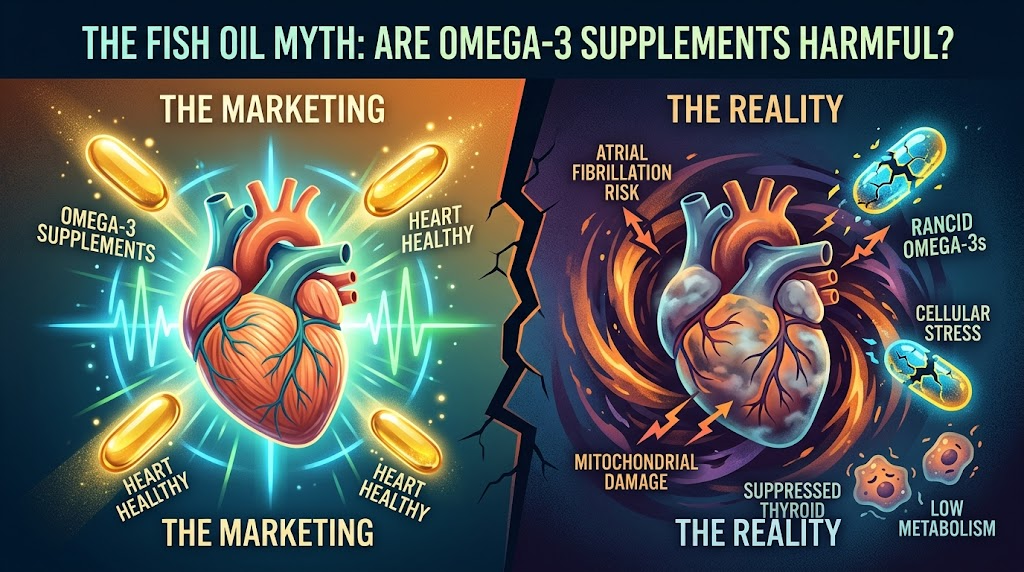
Omega-3 fatty acids like EPA and DHA are polyunsaturated fats, or PUFA. The word "polyunsaturated" describes their structure: they contain many double bonds, five to six of them in the case of EPA and DHA. Every one of those double bonds is a weak point, a site where the molecule can be attacked by oxygen. That gives omega-3s roughly three times as many vulnerable sites as the omega-6 fats people are so often warned about.
Why does this matter inside your body? Because your body runs at about 98.6 degrees Fahrenheit, in a warm, oxygen-rich, metabolically active environment. That is precisely the condition under which these fragile fats break down. The same property that once made these oils useful as paint and varnish, their tendency to oxidize and harden on contact with air, is the property that makes them dangerous in living tissue. They oxidize. They go rancid. And they do it while inside you.
When a polyunsaturated fat oxidizes, it does not simply disappear. It shatters into a family of reactive breakdown products with names like acrolein, malondialdehyde, and 4-hydroxynonenal. These are not inert. They damage proteins, cross-link DNA, and disrupt cell membranes. Research has shown that the lipid peroxidation of polyunsaturated fats damages proteins far faster than blood sugar does. The "age pigment" lipofuscin that accumulates in aging, failing tissue is largely the residue of this process.
So the most important fish oil side effects are not the ones you feel after lunch. They are the slow, invisible ones happening at the level of your cells every day the supplement sits in your tissues. And those fats do not flush out overnight. Once incorporated into your fat stores, omega-3s can take two to four years, sometimes longer, to fully clear.
Does Fish Oil Cause Heart Problems? What the Atrial Fibrillation Data Shows
For years the answer to "does fish oil cause heart problems" was assumed to be the opposite: fish oil prevents them. That assumption has not survived contact with the large trials.
The clearest signal is atrial fibrillation, an irregular and often rapid heart rhythm that raises the risk of stroke and heart failure. A systematic review and meta-analysis published in Circulation pooled randomized controlled trials of cardiovascular outcomes and found that marine omega-3 supplementation increased the risk of atrial fibrillation. The effect tracked with dose: people taking higher daily amounts carried the greatest risk. This is the opposite of a protective drug. A protective therapy lowers risk as you take more of it; fish oil did the reverse.
This was not a one-off. The fish oil and atrial fibrillation connection has now appeared across multiple independent analyses. When researchers reassessed the older claim that omega-3s stabilize heart rhythm, that idea did not hold up either. A critical reassessment in Pharmacology and Therapeutics concluded that the supposed antiarrhythmic benefit of omega-3 fatty acids was far from established, and that under some conditions these fats could actually promote dangerous rhythms rather than prevent them.
Then there is the bigger question of whether fish oil prevents heart attacks and cardiovascular death at all. Here the gold standard is the Cochrane review, the most rigorous form of evidence synthesis in medicine. The Cochrane analysis of omega-3 fatty acids for the primary and secondary prevention of cardiovascular disease, covering a huge body of randomized trials, found little or no meaningful effect on cardiovascular events or mortality. A separate large meta-analysis in EClinicalMedicine reached similarly underwhelming conclusions about the cardiovascular payoff.
Put plainly: the best evidence shows that for most people, fish oil does not protect the heart, and at higher doses it appears to provoke a serious arrhythmia. If a new prescription drug produced that profile, it would struggle to reach the market. Because fish oil is sold as a natural supplement, it gets a pass.
Why Would My Cardiologist Tell Me to Stop Taking Fish Oil?
A growing number of patients walk out of cardiology appointments confused, because their doctor told them to stop the fish oil they had taken faithfully for years. After the atrial fibrillation data, this advice makes sense. A cautious cardiologist who has read the trials does not want to hand a patient a supplement that may trigger the exact rhythm problem they are trying to avoid.
This is also why the omega-3 side effects conversation has shifted inside cardiology itself. The old reflex was to recommend fish oil to nearly everyone. The newer, evidence-aware position is more skeptical: reserve high-dose omega-3 for narrow, specific situations, and recognize that for the general patient the risks may outweigh a benefit that the trials cannot reliably find.
From the Biospark perspective, this is welcome but incomplete. Stopping a harmful supplement is good. But it leaves the more important question unanswered: if the fat in the capsule is unstable and anti-metabolic, what is it doing to the rest of your physiology while you take it? That is where the story moves from your heart rhythm to your metabolism.
The Hidden Mechanism: How Omega-3s Oxidize and Suppress Your Metabolism
Here is the part mainstream coverage almost always skips. The harm from fish oil is not limited to your heart rhythm. These fats interfere with the basic engine of your cells.
Start with the mitochondria, the structures that turn food and oxygen into usable energy. The inner membrane of every mitochondrion depends on a specialized fat called cardiolipin to keep the energy-producing machinery organized. When highly unstable omega-3s get built into that membrane in place of stable fats, the structure becomes disordered. Electrons leak. The production of reactive oxygen species climbs. And the breakdown products of these oxidizing fats can poison cytochrome c oxidase, one of the central enzymes of cellular respiration. The result is a cell that makes energy less efficiently and generates more internal damage doing it.
Now layer in the thyroid, the master regulator of your metabolic rate. The relationship between fish oil and thyroid function is striking once you look. A review in Frontiers in Endocrinology described the complicated, two-faced relationship between fish, omega-3 fats, and the thyroid gland. In the bioenergetic framework we use, polyunsaturated fats interfere with thyroid hormone at nearly every step: the release of hormone from the gland, its transport in the blood, its conversion from inactive T4 into active T3 in the liver, and its ability to bind its receptor inside the cell. Each blocked step nudges your metabolism lower. The classic downstream signs are familiar to anyone who has felt them: cold hands and feet, fatigue, a low body temperature, sluggish digestion, and stubborn weight that will not move.
This also explains one of the most misunderstood "benefits" of fish oil: lower triglycerides. Patients are told that falling triglyceride numbers prove the supplement is working. But there is a darker reading. When the toxic, oxidative breakdown of these fats damages the liver's ability to package and export fat into the bloodstream, your blood lipid numbers can drop simply because the liver is struggling. A lower number on a lab report is not always a healthier body. Sometimes it is a quieter signal of a stressed organ.
The same logic applies to inflammation. Fish oil is marketed as anti-inflammatory, and in the short term it can lower certain inflammatory markers. But it does this in large part by suppressing the immune response, not by fixing the underlying damage. Quieting an alarm is not the same as putting out the fire. Over the long run, the oxidative stress these fats generate can drive more tissue damage, not less.
This is the unifying point. Omega-3 fish oil is not a heart drug that happens to have a few side effects. It is an unstable, anti-metabolic fat whose effects on your heart rhythm, your mitochondria, and your thyroid all flow from the same root chemistry.
The Biospark Approach: From What Not to Eat to What To Eat
If the problem is a fragile, oxidation-prone fat, the solution is to build your diet around stable fats and a strong metabolism. This is the heart of how we work with clients at Biospark Health. We do not chase symptoms or lab numbers in isolation. We address the cellular environment that determines whether your heart, brain, and metabolism thrive or struggle.
The first move is simple: stop adding unstable fats. That means discontinuing omega-3 and fish oil supplements, and removing industrial seed oils such as soybean, corn, canola, safflower, and sunflower oil from your kitchen and your takeout habits. These are the same polyunsaturated fats in a different package.
The second move is to favor fats that stay stable at body temperature. Saturated fats are the gold standard here: coconut oil, butter, ghee, and tallow resist oxidation and actually support the cellular machinery that burns glucose for clean energy. Monounsaturated fats like olive oil and avocado oil are reasonable in moderation, ideally kept off high heat. For seafood lovers, the shift is from fatty, omega-3-dense fish toward leaner options like white fish and shellfish, which deliver protein and minerals without the unstable fat load.
The third move is to protect your cells while your tissues slowly release their stored PUFA over the next few years. In the bioenergetic model, several nutrients help: vitamin E shields stored fats from oxidizing, glycine from gelatin and bone broth calms inflammation and supports the liver, and steady metabolic support keeps your thyroid and energy production strong. None of this is exotic. It is food and physiology, applied deliberately.
The deeper Biospark philosophy is that a robust metabolism is your real cardiovascular insurance. A cell with abundant energy, a body that runs warm, and a thyroid that works are far more protective than any capsule. Root cause, not symptom suppression.
Now that you know what NOT to eat, learn what TO eat.
You just learned why the "heart-healthy" fish oil on your counter may be working against you. The harder, more useful question is what actually belongs on your plate to rebuild your metabolism and protect your heart from the inside out.
Our free Bioenergetic Roadmap lays it out in plain language:
- Which fats to cook with and which to throw away today
- How to support your thyroid and energy production through food
- The simple metabolic shifts that do more for your heart than any supplement
FREE | No commitment, just a clear starting point
Get Your Free Bioenergetic Roadmap →
Metabolic and Heart Health Support in Reading and Berks County, PA
If you have been faithfully taking fish oil for your heart and you are reading this in the Reading or Wyomissing area, you are not alone, and you are not at fault. The advice was everywhere. What is missing locally is access to practitioners who look past the supplement label to the metabolic root cause of cardiovascular and energy problems.
At Biospark Health, we serve clients throughout southeastern Pennsylvania, including Lancaster, Downingtown, Allentown, and the greater Philadelphia suburbs. Our root-cause approach has helped local residents stop guessing about supplements and start rebuilding the metabolic foundation that protects the heart, supports the thyroid, and restores daily energy.
Whether you are in West Chester, King of Prussia, or anywhere in the Berks County and Chester County area, our virtual and in-person options make it straightforward to get metabolic health support that takes your whole physiology into account, not just one number on a lab report.
Frequently Asked Questions
What are the negative side effects of taking fish oil?
Beyond the familiar fishy burps, mild stomach upset, and loose stools, the more serious concerns are internal. High-dose omega-3 supplementation has been linked in randomized trials to an increased risk of atrial fibrillation. The unstable fats also oxidize inside the body, generating reactive byproducts that stress the mitochondria, and they can suppress thyroid function and lower your metabolic rate over time.
Who should not take omega-3 fish oil?
Anyone with a history of atrial fibrillation or other heart rhythm problems should be especially cautious, since the trial data tie higher omega-3 doses to greater AFib risk. People on blood thinners, those with low metabolic rate or thyroid issues, and frankly most people seeking general "prevention" should question whether the supplement earns its place at all, given how thin the proven benefit is.
Is omega-3 good for the heart?
The most rigorous evidence, including a Cochrane review of many randomized trials, finds little or no meaningful protection against heart attacks or cardiovascular death from omega-3 supplements. Meanwhile, higher doses raise the risk of atrial fibrillation. So for most people the honest answer is no, the heart benefit is not there, and there is a real rhythm risk.
Do I need fish oil for my brain?
Conventional advice says DHA is essential for the brain, but the brain is also highly oxygen-rich, which means the unstable omega-3s stored there are especially prone to breaking down into toxic fragments. High levels of those breakdown products show up in degenerating brain tissue. Supporting brain health through stable fats, strong thyroid function, and good energy metabolism is a safer strategy than loading up on fragile DHA capsules.
What should I eat instead of taking fish oil?
Build meals around stable fats: coconut oil, butter, ghee, and tallow for cooking, with olive oil in moderation off the heat. Choose lean white fish and shellfish over fatty fish, favor ruminant meats like beef and lamb over high-PUFA conventional pork and chicken, and cut industrial seed oils entirely. This shifts your diet away from the fats that oxidize and toward the ones that fuel your metabolism.
The Bottom Line
The fish oil story is one of the cleanest examples of how a confident health narrative can outrun the evidence. The pills were sold as heart protection. The largest, most careful trials now show no reliable heart benefit and a real increase in atrial fibrillation at higher doses, and the underlying chemistry, fragile fats that oxidize inside a warm body, explains why.
You are not broken for having trusted the advice. The advice was wrong. The encouraging part is that the fix is not another supplement but a return to fundamentals: stable fats, a well-fed thyroid, and a metabolism with enough energy to defend itself. Your heart does not need a capsule. It needs a body that works. If you are ready to build that foundation, we would be glad to help you start.
Tags:
References & Citations
This article is supported by scientific research and peer-reviewed sources. Click citations to verify the evidence.
- [1]Gencer B, Djousse L, Al-Ramady OT, et al.(2021)Effect of Long-Term Marine Omega-3 Fatty Acids Supplementation on the Risk of Atrial Fibrillation in Randomized Controlled Trials of Cardiovascular Outcomes: A Systematic Review and Meta-Analysis.Circulation.View Source
- [2]Abdelhamid AS, Brown TJ, Brainard JS, et al.(2020)Omega-3 fatty acids for the primary and secondary prevention of cardiovascular disease.Cochrane Database of Systematic Reviews.View Source
- [3]Benvenga S, Fama F, Perdichizzi LG, et al.(2022)Fish and the Thyroid: A Janus Bifrons Relationship Caused by Pollutants and the Omega-3 Polyunsaturated Fatty Acids.Frontiers in Endocrinology.View Source
- [4]Khan SU, Lone AN, Khan MS, et al.(2021)Effect of omega-3 fatty acids on cardiovascular outcomes: A systematic review and meta-analysis.EClinicalMedicine.View Source
- [5]Billman GE(2013)The effects of omega-3 polyunsaturated fatty acids on cardiac rhythm: a critical reassessment.Pharmacology and Therapeutics.View Source
All references have been reviewed for scientific accuracy and credibility. Citations follow standard academic format and link to original research where available.
About Dr. Steven Presciutti, MD
Founder & Health Coach at Biospark Health, specializing in bioenergetic health and metabolism optimization.