Vitamin K2 and the Calcium Paradox: How to Put Calcium Where It Belongs
Calcium supplements without Vitamin K2 may calcify your arteries instead of strengthening your bones. Learn how K2 directs calcium to the right places and why most people are deficient.
Medical Disclaimer
This content is for informational and educational purposes only. It is not a substitute for professional medical advice, diagnosis, or treatment. Always seek the advice of your physician or other qualified health provider with any questions you may have regarding a medical condition.
For decades, the standard advice has been simple: take calcium for your bones.
But what if that calcium is ending up in your arteries instead of your skeleton?
This is the calcium paradox. The same people walking around with hardened, calcified arteries often have porous, fragile bones. They have too much calcium in the wrong places and not enough where it counts. And the missing piece of this puzzle is a vitamin most people have never heard of: Vitamin K2.
What Is the Calcium Paradox?
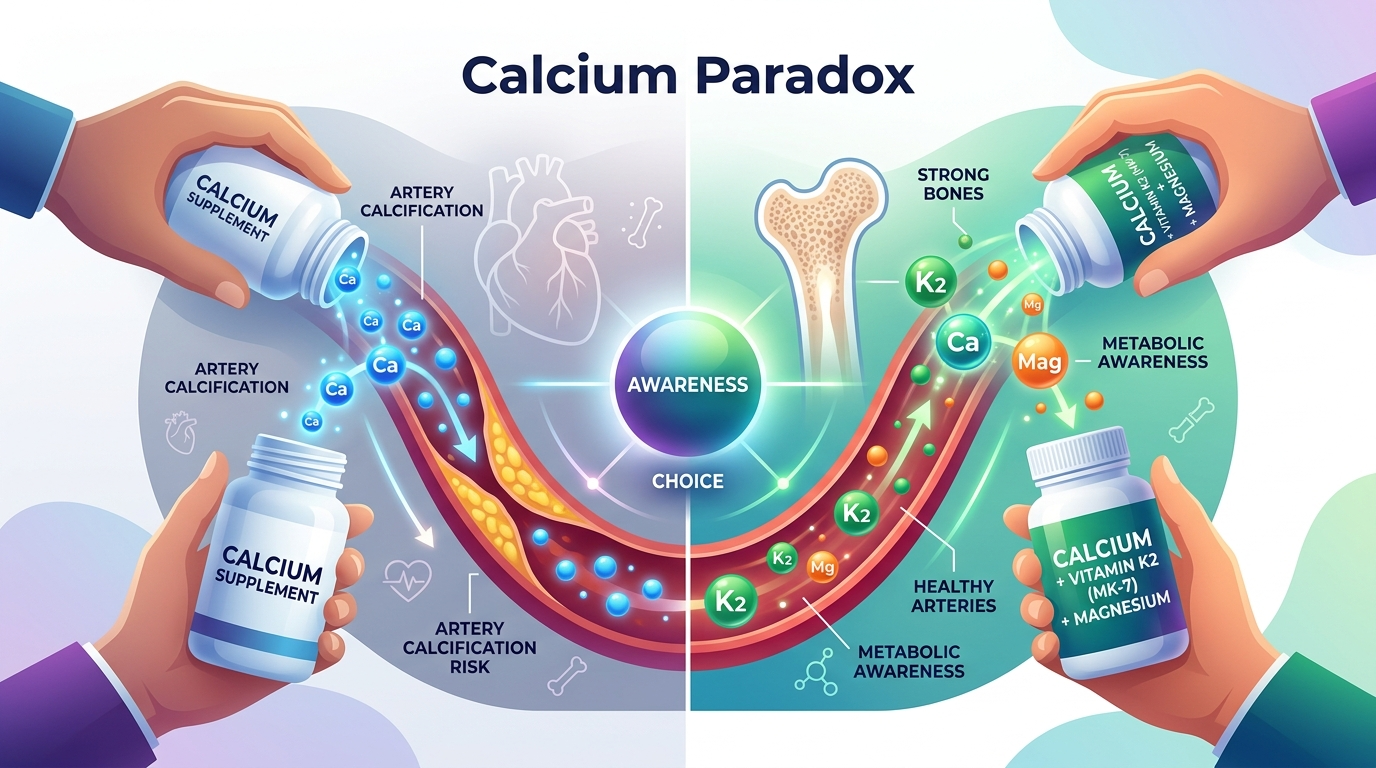
The calcium paradox describes a troubling pattern: individuals with significant arterial calcification frequently have low bone mineral density at the same time. Their arteries are stiffening with calcium deposits while their bones are losing it.
This is not a rare phenomenon. Studies published in Thrombosis and Haemostasis and Frontiers in Cardiovascular Medicine have documented this bone-vascular crosstalk extensively. The connection between vascular calcification and osteoporosis is well established in the research literature.
The problem is not calcium itself. Calcium is essential. Your bones, teeth, muscles, nerves, and heart all depend on it. The problem is what happens when calcium enters your body without a guidance system.
When you consume calcium through food or supplements, it gets absorbed into your bloodstream. From there, it needs to be directed into your bones and teeth, where it provides structural strength. But without adequate Vitamin K2, that calcium has no traffic cop. It drifts. It settles in soft tissues: your arterial walls, joint cartilage, kidneys, and even the brain.
Meanwhile, your bones and teeth lose density because the calcium never actually reaches them.
Why Vitamin K2 Is the Missing Traffic Cop
Vitamin K2 activates specific proteins that manage calcium distribution throughout your body. Two of the most important are osteocalcin and Matrix GLA Protein (MGP).
Osteocalcin and Bone Strength
Osteocalcin is a protein produced by your bone-building cells (osteoblasts). Its job is to bind calcium into your bone matrix, making bones denser and stronger. But osteocalcin is produced in an inactive form. Without Vitamin K2, it stays inactive. The calcium circulates in your blood but never gets locked into your bone structure.
When K2 is present, it activates osteocalcin through a process called carboxylation. Activated osteocalcin then binds calcium directly into the hydroxyapatite crystal structure of your bones. This is how bone mineralization actually works at the molecular level.
Matrix GLA Protein and Clear Arteries
MGP is produced in the walls of your blood vessels, and its function is the mirror image of osteocalcin. MGP actively prevents calcium from depositing in arterial walls and soft tissue. But like osteocalcin, MGP is synthesized in an inactive form.
Vitamin K2 activates MGP, which then patrols your vascular system, binding up free calcium and keeping it out of your artery walls. Without sufficient K2, MGP remains inactive, and calcium accumulates in your vessels year after year.
A landmark study published in Thrombosis and Haemostasis in 2015 demonstrated this mechanism in action. Postmenopausal women who supplemented with Vitamin K2 (as MK-7) for three years showed significant reductions in arterial stiffness compared to controls. The improvement was directly linked to increased activation of MGP.
Parathyroid Hormone and Calcium Regulation
There is another layer to this system. When dietary calcium is low, your parathyroid glands release parathyroid hormone (PTH). PTH pulls calcium out of your bones and into your bloodstream to maintain stable blood calcium levels. This is a survival mechanism, but it creates a problem: that mobilized calcium now needs to go somewhere.
Vitamin K2 is essential for managing where that PTH-mobilized calcium goes next. Without K2, the calcium released from your bones can deposit in your arteries rather than being properly utilized.
Can Vitamin K2 Reverse Arterial Calcification?
This is one of the most common questions people ask, and the research is encouraging.
While reversing established, heavy calcification is difficult, multiple studies have shown that Vitamin K2 supplementation can slow the progression of arterial calcification and, in some cases, reduce arterial stiffness. The key mechanism is through sustained activation of MGP.
A study in the Atherosclerosis journal found that six months of Vitamin K supplementation positively influenced serum calcification propensity, meaning it made the blood less likely to form calcium deposits in vessel walls.
The research suggests that the earlier you address K2 deficiency, the more effective the intervention. This is not a quick fix. The studies showing meaningful results used supplementation periods of six months to three years. But the mechanism is clear: activating MGP gives your body the tool it needs to keep calcium out of your arteries.
Why Magnesium Is K2's Essential Partner
Vitamin K2 does not work alone. It functions alongside magnesium, and the relationship between these two nutrients is critical for proper calcium metabolism.
Magnesium keeps calcium soluble in your blood. Without adequate magnesium, calcium tends to precipitate out of solution and form deposits in soft tissue. Magnesium acts as a natural calcium channel blocker at the cellular level, regulating how much calcium enters your cells.
When magnesium is deficient, even with adequate K2, the system is compromised. Calcium becomes less soluble, more prone to crystallizing, and harder for K2-activated proteins to manage effectively.
This is why supplementing calcium without both K2 and magnesium is problematic. You are introducing calcium into a system that lacks the infrastructure to direct it properly. The result is calcium in your arteries, kidneys, and joints rather than your bones.
The Right Form: Why MK-7 Matters
Not all Vitamin K2 is the same. The two primary forms you will encounter are MK-4 and MK-7, and they behave differently in your body.
MK-4 is the form naturally found in animal foods like pastured egg yolks, goose liver, and certain cheeses. It has a short half-life in the body, measured in hours. This means it needs to be consumed multiple times throughout the day to maintain therapeutic levels.
MK-7 is the form produced by bacterial fermentation, found in natto (fermented soybeans), certain aged cheeses, and most high-quality supplements. MK-7 has a significantly longer half-life, staying active in your bloodstream for up to 72 hours.
This difference matters in practice. A single daily dose of MK-7 maintains active osteocalcin and MGP levels for a full 24 hours. MK-4, despite being the "natural" animal-source form, simply cannot sustain those activation levels with once-daily dosing.
The 2015 Thrombosis and Haemostasis study that demonstrated reduced arterial stiffness used MK-7. Most of the clinical research showing benefits for bone density and cardiovascular health has also used the MK-7 form.
For practical supplementation, MK-7 at 90 to 180 micrograms daily provides sustained K2 activity that supports both bone mineralization and arterial protection around the clock.
Dental Health: The Overlooked Connection
Your teeth tell a story about your Vitamin K2 status that most practitioners miss.
K2 directs calcium into dentin and enamel through the same osteocalcin activation mechanism that builds bone. Weston Price documented this in his pioneering nutritional research in the 1930s, observing that populations consuming K2-rich foods had remarkably low rates of tooth decay and well-formed dental arches.
When K2 is deficient, dental health deteriorates even with adequate calcium intake. Cavities form more easily, enamel weakens, and teeth become more susceptible to decay. This is not a calcium deficiency problem. It is a calcium direction problem.
The connection runs deeper than most people realize. Dental health is a window into your overall calcium metabolism. If your teeth are struggling despite good oral hygiene, the issue may not be in your mouth. It may be in your K2 status.
The Biospark Approach to Calcium and Bone Health
At Biospark Health, we look at calcium metabolism through a fundamentally different lens than conventional medicine.
The standard approach to bone health is straightforward: measure bone density, recommend calcium supplements, and possibly add Vitamin D. But this approach ignores the critical question of where that calcium actually goes once it enters your body.
We assess calcium metabolism as part of a complete metabolic picture. This means evaluating not just calcium intake, but your K2 status, magnesium levels, Vitamin D3 levels, parathyroid function, and overall cellular energy production. Your bone health is not isolated from the rest of your metabolism. It is deeply connected to your thyroid function, hormonal balance, and mitochondrial efficiency.
Dr. Presciutti's approach focuses on addressing root causes. If your bones are losing density, we want to understand why at the cellular level. Is it a K2 deficiency? A magnesium insufficiency? A hormonal imbalance affecting calcium regulation? Simply throwing more calcium at the problem without answering these questions can make things worse.
Ready to restore your metabolism at the cellular level?
The Bioenergetic Reset Program addresses root causes, not symptoms. Join 300+ members who have discovered what real metabolic health feels like.
- 9+ hours of comprehensive training
- Twice-monthly LIVE coaching calls
- Complete meal plans and protocols
- Direct email support
/month | Cancel anytime
Vitamin K2 and Calcium Support in Reading and Berks County, PA
If you are dealing with bone density concerns, calcification issues, or metabolic health challenges in the Reading or Wyomissing area, you are not alone. Many residents throughout Berks County face similar problems, often after years of standard calcium supplementation advice that never addressed the underlying nutrient cofactors.
Biospark Health serves clients throughout southeastern Pennsylvania, including Lancaster, Downingtown, Allentown, and the greater Philadelphia suburbs. Our root cause approach to metabolic health has helped local residents understand why their calcium supplements were not working and what their bodies actually needed.
Whether you are in West Chester, King of Prussia, or anywhere in the Chester County area, our virtual and in-person options make it accessible to get the metabolic support you need.
Frequently Asked Questions
How long does it take for Vitamin K2 to clear arteries?
Research suggests meaningful changes in arterial stiffness take six months to three years of consistent K2 supplementation. The Thrombosis and Haemostasis study showed significant improvements after three years of daily MK-7 supplementation. Results depend on the severity of existing calcification, your overall metabolic health, and whether you are also addressing magnesium and Vitamin D3 status.
Is Vitamin K2 MK-7 safe to take daily?
Yes. MK-7 has an excellent safety profile. Clinical trials have used daily doses of 90 to 360 micrograms for periods of up to three years without adverse effects. The only caution is for people taking warfarin or other Vitamin K antagonist blood thinners, as K2 supplementation can interfere with these medications. Always inform your prescribing physician about all supplements.
What is the number one vitamin to rebuild bone density?
The question itself reveals a common oversimplification. Bone health requires a coordinated team of nutrients: Vitamin K2 (to direct calcium), Vitamin D3 (to absorb calcium), magnesium (to keep calcium soluble), and adequate dietary calcium. No single vitamin rebuilds bone density in isolation. K2 is arguably the most overlooked piece, but it functions within a system, not alone.
What is the downside of Vitamin K2?
For most people, there is no meaningful downside to K2 supplementation at appropriate doses. The primary interaction risk is with blood thinning medications like warfarin. Some people taking very high doses report mild digestive discomfort. K2 is fat-soluble, so it should be taken with a meal containing dietary fat for optimal absorption.
Can you get enough K2 from food alone?
It is possible but difficult in the standard American diet. The richest food source is natto (fermented soybeans), which is not commonly consumed in the US. Other sources include pastured egg yolks, grass-fed butter, certain aged cheeses (like Gouda and Brie), and goose liver. The challenge is that modern farming practices have dramatically reduced the K2 content of most animal foods compared to historically pasture-raised sources.
Conclusion
The calcium paradox is not a mystery. It is a predictable consequence of supplementing calcium without providing the nutrient infrastructure your body needs to direct it properly.
Vitamin K2 is that infrastructure. It activates the proteins that put calcium in your bones and keep it out of your arteries. Without it, calcium follows the path of least resistance into soft tissue, where it causes harm instead of providing strength.
If you have been taking calcium supplements for years without considering K2, magnesium, and the full picture of your metabolic health, it may be time for a different approach. Bone health is not just about calcium intake. It is about calcium direction, and that requires a metabolically aware strategy.
At Biospark Health, we help patients in Reading, Wyomissing, and throughout Pennsylvania understand their calcium metabolism and build a plan that actually puts nutrients where they belong. Your bones, arteries, and overall health depend on it.
Tags:
References & Citations
This article is supported by scientific research and peer-reviewed sources. Click citations to verify the evidence.
- [1]Knapen MH, Drummen NE, Smit E, et al.(2013)Three-year low-dose menaquinone-7 supplementation helps decrease bone loss in healthy postmenopausal women.Osteoporosis International.View Source
- [2]Sato T, Inaba N, Yamashita T(2020)MK-7 and Its Effects on Bone Quality and Strength.Nutrients.View Source
- [3]de Vries F, Bittner R, Maresz K, et al.(2025)Effects of One-Year Menaquinone-7 Supplementation on Vascular Stiffness and Blood Pressure in Post-Menopausal Women.Nutrients.View Source
- [4]Bjorklund G, Svanberg E, Dadar M, et al.(2020)The Role of Matrix Gla Protein (MGP) in Vascular Calcification.Current Medicinal Chemistry.View Source
- [5]Aaseth JO, Finnes TE, Askim M, et al.(2024)The Importance of Vitamin K and the Combination of Vitamins K and D for Calcium Metabolism and Bone Health: A Review.Nutrients.View Source
- [6]Hariri E, Kassis N, Iskandar JP, et al.(2021)Vitamin K2 - a neglected player in cardiovascular health: a narrative review.Open Heart.View Source
- [7]Wen Z, Zhen M, Wang J, et al.(2025)Habitual natto intake elevates serum MK-7 levels, enhances osteocalcin carboxylation, and supports bone density: a meta-analysis of Japanese evidence.Frontiers in Nutrition.View Source
- [8]Adams J, Pepping J(2005)Vitamin K in the treatment and prevention of osteoporosis and arterial calcification.American Journal of Health-System Pharmacy.View Source
All references have been reviewed for scientific accuracy and credibility. Citations follow standard academic format and link to original research where available.
About Dr. Steven Presciutti, MD
Founder & Health Coach at Biospark Health, specializing in bioenergetic health and metabolism optimization.