Rethinking Holiday Alcohol: Why That Nightly Glass of Wine Is Wrecking Your Metabolism (Not Just Your Sleep)
Uncover how holiday wine sabotages your metabolism, disrupts sleep, and derails health goals. Learn the hidden risks and reclaim your wellness this season.
Medical Disclaimer
This content is for informational and educational purposes only. It is not a substitute for professional medical advice, diagnosis, or treatment. Always seek the advice of your physician or other qualified health provider with any questions you may have regarding a medical condition.
The Holiday Alcohol Paradox: Why That Nightly Glass of Wine Is Wrecking Your Metabolism (Not Just Your Sleep)
By Dr. Steven Presciutti, MD | Biospark Health
The Toast That's Costing You Everything
Picture this: It's December 23rd. You're hosting your third holiday gathering this week. The house is finally clean, the cookies are frosted, and that first glass of wine feels like the reward you've earned.
By 9 PM, you're on glass two. Maybe three. You feel relaxed. Finally. The stress melts away. Sleep comes easier that night.
And when you wake up at 3:47 AM with your heart racing, brain spinning, body temperature plummeting to 96.3°F, you blame the stress. The sugar. The late meal. Anything but the wine.
Let me tell you about Jennifer. She came to me in January after the holidays, utterly defeated. "I don't understand," she said, holding out her food journal. "I ate clean all through the holidays. Avoided the desserts. Stuck to my meal plan. But I gained eight pounds and feel worse than ever."
Then I asked the question that changed everything: "How much did you drink?"
She paused. "Just wine with dinner. Maybe two glasses? It's the holidays. Everyone drinks during the holidays."
Here's what Jennifer (and maybe you) didn't know: Those "just wine" glasses were systematically destroying her metabolism, her thyroid function, her sleep architecture, and her body's ability to produce cellular energy.
The kicker? Her morning temperature had dropped from 98.2°F to 96.8°F. Her liver had essentially gone on strike. And every cell in her body was paying the price.
Your Liver Has Priorities (And You're Not One of Them)
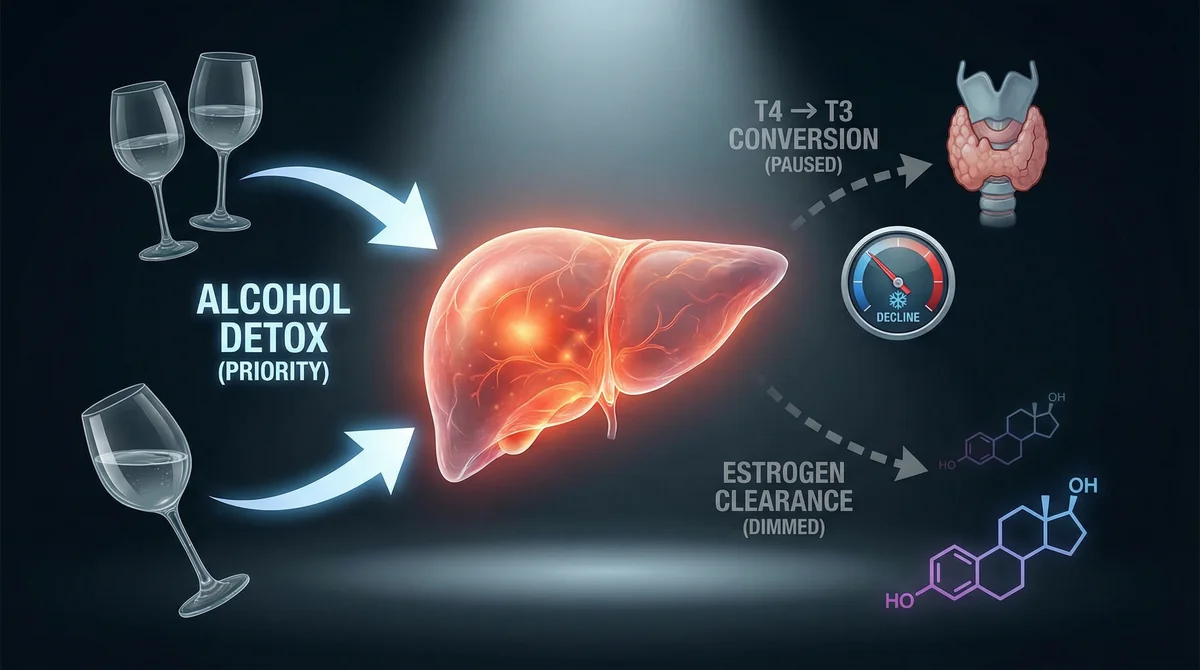
Here's the brutal truth about alcohol that the "health benefits of red wine" crowd doesn't want you to know: When ethanol enters your body, your liver treats it like the toxin it is and drops everything else to deal with it.
Every other critical metabolic function gets put on hold:
- Converting T4 to active T3 thyroid hormone? Suspended.
- Clearing estrogen from your bloodstream? Delayed.
- Processing nutrients from your dinner? Postponed.
- Manufacturing glucose to keep your brain fueled overnight? Interrupted.
Your liver isn't being dramatic. Alcohol is literally poisonous, and your body knows it. So it shifts into emergency detox mode, diverting all resources to breaking down ethanol before it causes more damage.[^1]
But here's where the metabolic disaster really begins.
The Thyroid Conversion Catastrophe
Remember that "normal" thyroid panel your doctor showed you? The one that says you're fine even though you're exhausted, cold, losing hair, and can't lose weight no matter what you do?
Your liver is responsible for converting about 60% of your inactive T4 thyroid hormone into active T3 (the form your cells actually use to produce energy). This conversion requires specific enzymes called deiodinases that function optimally only when your liver is healthy and unstressed.[^2]
Chronic alcohol consumption, even at "moderate" levels, devastates this conversion process. Multiple studies show that people with alcoholic liver disease have:[^3][^4]
- Up to 50% reduction in T4 to T3 conversion
- Significantly suppressed free T3 levels (the active hormone your cells need)
- Elevated TSH (your pituitary screaming at your thyroid to work harder)
- Normal or even high T4 levels (but who cares when it's not being converted?)
Translation: Your thyroid blood work looks "fine" to your doctor. But your cells are starving for active thyroid hormone because your liver is too busy processing Chardonnay to do its actual job.
And here's what makes this particularly insidious: This thyroid suppression persists even during periods of abstinence.[^4] The liver damage from chronic drinking creates a lasting impairment in thyroid hormone metabolism.
The Temperature Truth
At Biospark Health, we track something that conventional medicine ignores: morning body temperature. And we see the same pattern over and over:
Regular drinkers (even "moderate" ones) consistently run cold. 96.5-97.2°F. Sometimes lower.
Why does this matter? Your body temperature is a direct reflection of your cellular energy production. When your liver can't convert T4 to T3, your cells can't produce adequate ATP. Less ATP means less metabolic heat. Less heat means everything in your body slows down.
Jennifer's temperature drop from 98.2°F to 96.8°F represented millions of cells shifting from thriving to barely surviving. All because her liver was spending every night processing ethanol instead of supporting her metabolism.
The Sleep Architecture Nightmare You're Living Through
Remember last week's article about how sleep medications steal your memory by disrupting deep sleep? Alcohol does the exact same thing, but it's sneakier because people actually think it's helping them sleep.
Let me break down what's really happening when you have that nightcap:
The First Half of the Night: Fake Deep Sleep
A comprehensive 2024 study tracked 30 adults across consecutive nights of alcohol consumption before bed.[^5] Using high-resolution sleep monitoring, researchers discovered something fascinating and disturbing:
Alcohol increases slow-wave sleep (deep sleep) in the first third of the night.[^5] This is why you feel like you're sleeping "better." You pass out faster. You feel deeply relaxed. Your brain waves even show increased deep sleep activity initially.
But this isn't restorative deep sleep. It's sedation. Your brain is suppressed, not restored.
The Second Half: Complete Disaster
Here's where the wheels come off:[^5][^6]
- REM sleep gets decimated (reduced by up to 30% even at low doses of just two drinks)[^7]
- You wake up more frequently (fragmented sleep from blood sugar crashes)
- Deep sleep disappears (your body tries to "catch up" on REM, losing deep sleep in the process)
- Sleep efficiency plummets (you're in bed but not actually sleeping)
Think about what this means: You're losing the exact sleep stages where your brain consolidates memories, processes emotions, and clears out toxic proteins (like those Alzheimer's-causing amyloid plaques we discussed last week).
The research is unambiguous: Even low-dose alcohol consumption (just two drinks) significantly disrupts REM sleep.[^7] And the effect is dose-dependent. The more you drink, the worse your sleep architecture gets destroyed.
The 3 AM Wake-Up Call Your Body Is Screaming
Ever wonder why you wake up at 2 or 3 AM after drinking? It's not random. It's your body in metabolic crisis.
Here's the sequence:
- Alcohol blocks gluconeogenesis (your liver's ability to make new glucose from stored glycogen)
- Your blood sugar crashes around 2-4 AM (when liver glycogen is depleted)
- Stress hormones surge (adrenaline and cortisol spike to raise blood sugar via emergency measures)
- You wake up wired (heart racing, anxious, body temperature tanking)
Your body just went into survival mode. While you were sleeping. Because alcohol prevented your liver from doing its most basic job: keeping your blood sugar stable.
The Estrogen Domination Cycle
Here's something your doctor definitely didn't tell you about that nightly wine habit: Alcohol is estrogenic. And not in a good way.
Your liver clears excess estrogen from your bloodstream through a process called glucuronidation. When alcohol overwhelms your liver, estrogen clearance gets backlogged. The result?[^1]
- Estrogen accumulates in tissues (creating estrogen dominance)
- Progesterone gets depleted (cortisol steals its precursor, pregnenolone)
- Thyroid function drops further (excess estrogen blocks thyroid receptors)
- You gain weight around your hips, thighs, and abdomen (estrogenic fat storage pattern)
For women, this creates a vicious cycle:
→ Alcohol suppresses thyroid
→ Low thyroid raises stress hormones
→ Stress hormones deplete progesterone
→ Low progesterone = estrogen dominance
→ Estrogen dominance blocks thyroid further
→ Metabolism crashes harder
Men aren't immune either. Chronic alcohol consumption in men leads to:
- Elevated estrogen levels
- Decreased testosterone production
- Increased aromatase activity (converting testosterone to estrogen)
- The dreaded "beer belly" (estrogenic fat deposition)
Remember Jennifer? Her estrogen dominance symptoms (PMS, breast tenderness, mood swings, stubborn lower body fat) all vanished when she quit drinking. Not coincidentally, her temperature rose back to 98.4°F within eight weeks.
The "Moderate Drinking" Lie
The most dangerous myth in modern health is that "moderate drinking" is benign or even beneficial. Let's destroy that lie with science.
The oft-cited "health benefits" of red wine come from studies comparing moderate drinkers to heavy drinkers or people who quit drinking after destroying their health. When you compare moderate drinkers to lifetime abstainers? The benefits vanish.[^8]
More importantly, from a metabolic perspective, there's no safe dose when it comes to liver function and thyroid conversion.
Studies show thyroid suppression occurs at:[^3][^4]
- 1-2 drinks per day for women
- 2-3 drinks per day for men
That's the definition of "moderate drinking" according to health authorities. And it's enough to cause measurable metabolic damage.
The Dose-Response Reality
The 2024 meta-analysis examining alcohol's effects on sleep found a clear dose-response relationship:[^7]
- Low dose (≤0.50 g/kg, about 2 drinks): REM sleep disruption begins
- Moderate dose (0.50-0.85 g/kg, about 2-4 drinks): Significant REM suppression
- High dose (≥0.85 g/kg, about 5+ drinks): Complete sleep architecture destruction
Notice something? Even the "low dose" causes measurable harm. There is no free pass.
The Holiday Season Trap
Now let's talk about why the holidays are particularly devastating.
It's not just one night of drinking. It's consecutive nights. Office parties. Family gatherings. New Year's Eve. Night after night after night.
The same 2024 study that tracked sleep architecture looked at what happens over three consecutive nights of drinking.[^5] The findings:
Night 1: Massive REM suppression, increased wake time, deep sleep early then disrupted Night 2: Slightly less severe (your body develops tolerance) Night 3: Still significantly disrupted (the "adaptation" doesn't fully protect you)
But here's the critical part: This study only looked at three nights. Most people drink consistently from Thanksgiving through New Year's. That's five weeks of compounding metabolic damage.
Your liver doesn't get a break. Your thyroid conversion stays suppressed. Your temperature keeps dropping. Your sleep architecture remains destroyed. Your estrogen keeps accumulating.
And you wonder why you gain 8-15 pounds every holiday season and feel like absolute garbage by January 2nd.
What Your Body Actually Needs This Holiday Season
The good news? Your body is remarkably resilient when you stop poisoning it. Jennifer's transformation wasn't magic. It was metabolic restoration through strategic support:
1. Prioritize Your Liver Function
Your liver has approximately 500 metabolic functions. When you stop overwhelming it with alcohol detoxification, it can return to its actual jobs:
- Converting T4 to T3 (thyroid activation)
- Clearing estrogen (hormonal balance)
- Storing and releasing glucose (blood sugar stability)
- Processing nutrients (cellular fuel)
Action steps:
- If you drink daily, take breaks (aim for 4-5 alcohol-free days per week minimum)
- Support liver with glycine-rich foods: bone broth, gelatin, collagen
- Include liver-supportive nutrients: B vitamins, selenium, zinc, taurine
2. Stabilize Your Blood Sugar
The 3 AM wake-ups stop when you prevent the blood sugar crash that triggers them.
The Biospark bedtime protocol:
- 1 cup warm milk + 1 tablespoon honey + pinch of sea salt
- OR: 1/2 cup cottage cheese with berries
- OR: 4 oz orange juice mixed with 1 tablespoon gelatin
This provides easy-to-digest carbohydrates that keep liver glycogen stores full overnight. Your body stays in "rest and repair" mode instead of "emergency stress" mode.
3. Support Thyroid Conversion Naturally
Even if you've been drinking regularly, you can restore thyroid function through strategic nutrition:
Essential nutrients for T4→T3 conversion:
- Selenium: Brazil nuts (2-3 daily), seafood, eggs
- Zinc: Oysters, beef, pumpkin seeds
- Iodine: Sea salt, seafood, seaweed (in moderation)
- Vitamin A: Liver (weekly), egg yolks, butter, dairy
Foods that support liver-based conversion:
- Coconut oil (saturated fat supports hormone production)
- Orange juice (liver fuel for conversion)
- Bone broth (glycine protects liver cells)
- White rice (easy glucose without gut stress)
4. Restore Deep, Natural Sleep
When you stop disrupting your sleep with alcohol, you need to actively support natural sleep architecture:
Sleep optimization protocol:
- Environment: 65-68°F room temperature, complete darkness, no screens 1 hour before bed
- Timing: Consistent bedtime (trains circadian rhythm)
- Nutrition: Never go to bed on empty stomach (prevents stress hormone surge)
- Supplementation: Magnesium glycinate 200-400mg (supports deep sleep without sedation)
The goal is to restore your natural sleep cycles, not replace alcohol sedation with pharmaceutical sedation.
5. Track Your Temperature
This is non-negotiable. Your morning oral temperature (taken immediately upon waking, before getting out of bed) tells you everything about your metabolic health:
Temperature guide:
- 98.6°F or higher: Optimal metabolic function
- 98.0-98.5°F: Good, room for improvement
- 97.5-97.9°F: Metabolic suppression beginning
- 97.0-97.4°F: Significant thyroid/metabolic issues
- Below 97.0°F: Metabolic crisis (seek help immediately)
When Jennifer quit drinking and implemented our protocol, her temperature rose 0.1-0.2°F per week. Within eight weeks, she hit 98.4°F and stayed there. Her energy returned. Her weight normalized. Her sleep was restorative again.
The Social Pressure Strategy
I know what you're thinking: "But Dr. Steve, it's the holidays. Everyone drinks. How do I say no without being weird?"
Here's the truth: Your health matters more than other people's comfort with your choices.
But tactically, here's what works:
Strategy 1: The Medical Redirect "I'm working with my doctor on some metabolic issues, so I'm taking a break from alcohol." (No one argues with medical advice)
Strategy 2: The Reverse Pressure "I'm doing an experiment to see how it affects my energy. Want to join me?" (Shifts the dynamic from judgment to invitation)
Strategy 3: The Alternative Offer Have your own festive mocktail. Sparkling water with fresh lime and a splash of orange juice in a wine glass. No one notices you're not drinking wine.
Strategy 4: The Direct Truth "I feel so much better when I don't drink. My sleep is incredible, my energy is through the roof, and I finally feel like myself again." (Enthusiasm is contagious)
The people who care about you will support you. The people who pressure you to drink? They're uncomfortable with their own drinking and want you to validate their choices.
The January Advantage
Here's why right now, reading this in late December, is actually perfect timing:
You're about to enter the season of New Year's resolutions. Everyone is trying to "get healthy" in January. But most people are focused on the wrong things: restrictive diets, punishing exercise routines, expensive gym memberships they'll quit by February.
You're going to do something smarter: metabolic restoration through alcohol elimination and strategic nutrition support.
While everyone else is suffering through kale smoothies and 5 AM spin classes, you're going to:
- Sleep like a champion
- Watch your temperature rise naturally
- Feel energy you haven't felt in years
- Lose weight without trying
- Clear the brain fog permanently
And it will all happen because you stopped poisoning your liver and gave your thyroid the support it's been desperately craving.
Jennifer called me in February: "People keep asking what diet I'm on. When I tell them I just stopped drinking wine and started eating enough food, they don't believe me. They want it to be more complicated."
It's not more complicated. Your body wants to thrive. You've just been blocking it with ethanol.
You Came to the Right Place
At Biospark Health, we've helped thousands of people reclaim their metabolic health by addressing root causes instead of chasing symptoms. Alcohol is one of the most underrecognized metabolic disruptors in modern health.
Because here's the truth conventional medicine won't tell you: You're not deficient in wine. You're not broken. Your metabolism isn't mysteriously slow. Your cells are just too cold, too starved, and too overwhelmed with toxins to produce the energy you need.
Stop the alcohol. Support your liver. Feed your thyroid. Stabilize your blood sugar. Watch your temperature rise. Feel your life transform.
It's that simple. And that powerful.
Ready to reclaim your metabolism without the hangover? Start with our free Energy Roadmap Assessment to discover your specific metabolic blocks. Your liver is waiting to show you what it can really do.
Let's talk.
Tags:
References & Citations
This article is supported by scientific research and peer-reviewed sources. Click citations to verify the evidence.
- [1]Baumgartner, A., et al.(1994)The hypothalamic-pituitary-thyroid axis in patients with alcoholism.Alcoholism: Clinical and Experimental Research, 18(5), 1118-1122.
- [2]Bianco, A.C., et al.(2017)Metabolism of thyroid hormone.Endotext. MDText.com.View Source
- [3]Chopra, I.J., et al.(1979)Reduced peripheral conversion of thyroxine to triiodothyronine in patients with hepatic cirrhosis.Journal of Clinical Endocrinology & Metabolism, 48(4), 644-649.
- [4]Papineni, R., et al.(2017)Thyroid hormone levels in chronic alcoholic liver disease patients before and after treatment.Journal of Clinical and Diagnostic Research, 11(8), BC20-BC22.
- [5]McCullar, J.S., et al.(2024)Altered sleep architecture following consecutive nights of presleep alcohol.Sleep, 47(4), zsae003.View Source
- [6]Colrain, I.M., Nicholas, C.L., & Baker, F.C.(2018)Alcohol and the sleeping brain.Handbook of Clinical Neurology, 125, 415-431.
- [7]Gardiner, C., et al.(2024)The effect of alcohol on subsequent sleep in healthy adults: A systematic review and meta-analysis.Sleep Medicine Reviews, 80, 102030.View Source
- [8]Stockwell, T., et al.(2016)Do "moderate" drinkers have reduced mortality risk? A systematic review and meta-analysis of alcohol consumption and all-cause mortality.Journal of Studies on Alcohol and Drugs, 77(2), 185-198.
All references have been reviewed for scientific accuracy and credibility. Citations follow standard academic format and link to original research where available.
About Dr. Steven Presciutti, MD
Founder & Health Coach at Biospark Health, specializing in bioenergetic health and metabolism optimization.
Stop Burning Fat Under Stress- Save Your Mitochondria
Prefer video content? Watch this article in video format on our YouTube channel.