The Anxiety Lie: Why Your Panic Attacks Are a Metabolism Problem, Not a Mental Health Crisis
Uncover the metabolic truth behind panic attacks: Why your anxiety isn't in your head, but in your cellular oxygen exchange. Learn how to break free from anxiety.
Medical Disclaimer
This content is for informational and educational purposes only. It is not a substitute for professional medical advice, diagnosis, or treatment. Always seek the advice of your physician or other qualified health provider with any questions you may have regarding a medical condition.
The Anxiety Lie: Why Your Panic Attacks Are a Metabolism Problem, Not a Mental Health Crisis
Your therapist says it's trauma. Your psychiatrist says it's neurotransmitters. Your wellness coach says it's your chakras.
They're all wrong.
Your panic attacks aren't happening in your head... they're happening in your cells.
And once you understand this, everything changes.
The Metabolic Truth Nobody's Telling You
Every single panic attack follows the same physiological pattern, and it has nothing to do with your childhood or your stress levels or your "inability to cope."
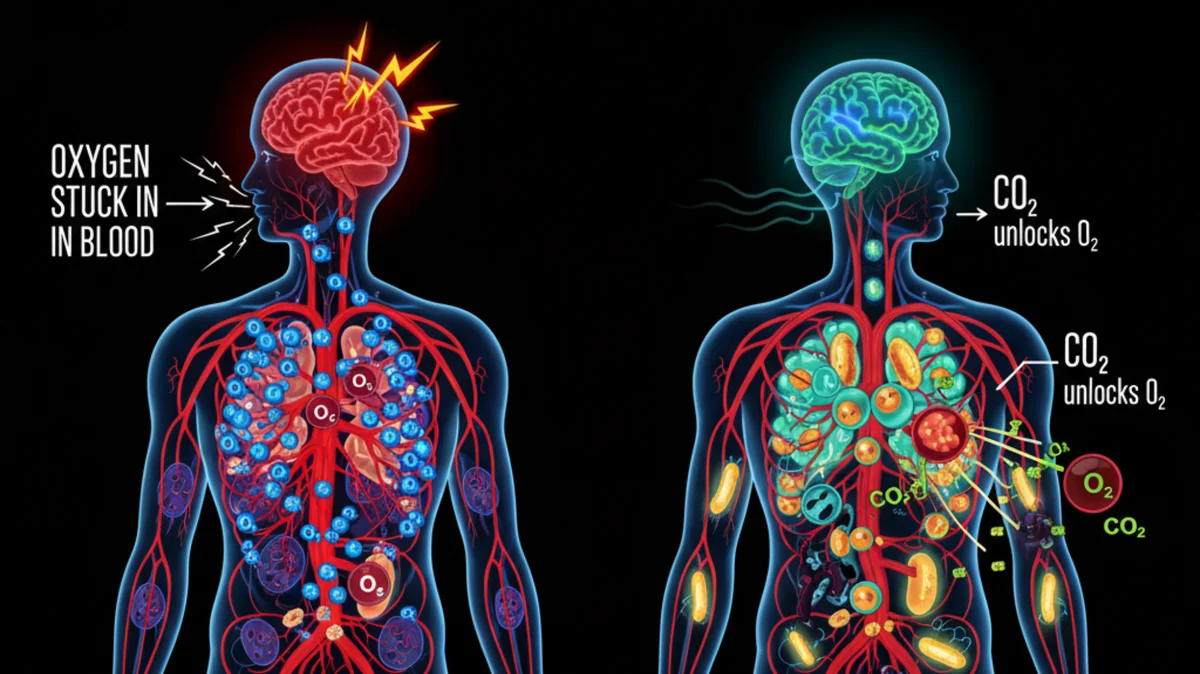
Here's what's actually happening:
Rapid breathing → CO₂ depletion → Oxygen can't leave your blood → Cellular suffocation → Emergency stress response
That's it. That's the panic cascade. Not because you're weak. Not because you're broken. Because your cells literally can't access oxygen despite you gulping in air like a drowning person.
The research is stunning: 97% of people with anxiety disorders are chronic hyperventilators. Not because they're anxious. They're anxious because they're hyperventilating.
Let that sink in.
The cause and effect has been backwards this entire time.
The Bohr Effect: Your Body's Hidden Superpower
Here's the paradox that changes everything:
When you breathe rapidly during panic, you flood your blood with oxygen. Your oxygen saturation might be 98-99%. Perfect, right?
Wrong.
Your cells can't access it.
This is called the Bohr Effect, discovered in 1904 and systematically ignored by modern psychiatry. Carbon dioxide, the "waste gas" you've been taught to expel, is actually the key that unlocks oxygen from hemoglobin.
High CO₂ → Oxygen RELEASES from blood → Cells get energy
Low CO₂ → Oxygen STAYS STUCK → Cells suffocate with "plenty" of oxygen
You're not lacking oxygen. You're lacking the CO₂ that tells oxygen to let go and enter your cells.
This is why the paper bag trick works. You're not "calming yourself down". You're literally re-breathing your CO₂ to restore the biochemical balance that allows cellular respiration.
The Research That Changes Everything
Scientists have known for decades that panic attacks aren't primarily psychological. Here's what actually triggers identical panic symptoms in controlled laboratory settings:
The Lactate Connection
When researchers infuse lactate (a metabolic stress marker) into people's veins, it creates panic attacks indistinguishable from "psychological" panic. Same racing heart. Same air hunger. Same terror.
Why? Because lactate signals metabolic crisis. Your cells are struggling to make energy, switching from efficient glucose oxidation to emergency glycolysis. It's a red alert: We're running on fumes.
Panic isn't a thought disorder. It's an energy crisis with psychological symptoms.
The Thyroid Factor
Here's data your psychiatrist probably doesn't know:
Patients with TSH >2.5 have 3× higher anxiety rates than those with optimal thyroid function.
Not because "low thyroid causes anxiety" in some vague hormonal way. Because when your thyroid is sluggish, your cells can't make energy efficiently. They produce less CO₂. They struggle to use oxygen. They signal danger.
A study across the Mid-Atlantic region, including areas like Berks County and Chester County, PA, found that subclinical hypothyroidism is dramatically under-diagnosed. It's very common for people to be walking around with a TSH of 3, 4, even 5, being told they're "fine" while experiencing daily panic.
The Mineral Catastrophe
Your calcium-to-phosphorus ratio matters more than you'd believe.
Modern diets run about 1:4 (one part calcium to four parts phosphorus). The optimal ratio? 2:1.
This imbalance creates cellular hyperexcitability. Your neurons are literally oversensitive from mineral dysregulation. It's like having the gain turned up on every nerve signal.
Add magnesium deficiency (epidemic in modern populations), and you have a nervous system running on a hair trigger, ready to interpret any minor stress as a full-blown emergency.
One of our clients from Reading, PA discovered her anxiety vanished when she simply started taking 1,500mg of quality calcium daily. Not because calcium is "calming", but because it restored the electrical stability her cells needed to function normally.
The SSRI Scandal Nobody's Discussing
Selective Serotonin Reuptake Inhibitors don't fix serotonin deficiency.
They create it.
Here's what they're not telling you: Serotonin is made from the amino acid tryptophan, which requires adequate glucose, vitamin B6, and thyroid hormone to convert. When your metabolism is suppressed - when you're cold, tired, and running on stress hormones - you can't make serotonin efficiently.
SSRIs artificially trap whatever serotonin you do make in the synapses, creating a temporary illusion of improvement. Meanwhile, they do absolutely nothing for the underlying metabolic crisis preventing serotonin production.
The result?
Initial "relief" (finally some serotonin in your synapses) followed by tolerance (your brain downregulates receptors in response), dose escalation (chasing the initial effect), and eventually worse baseline anxiety when attempting discontinuation (your natural production is even more impaired).
It's a biochemical treadmill, and the only winner is the pharmaceutical company.
Geographic and Environmental Metabolic Suppressors
If you live anywhere with long, dark winters - Pennsylvania, upstate New York, the northern Midwest - you're dealing with an additional metabolic burden.
Reduced sunlight → Vitamin D deficiency → Impaired thyroid function → Lower cellular energy → Anxiety
One practitioner in Wyomissing, PA noted that her anxiety clients' symptoms consistently worsen from November through March. Not because of "seasonal depression." Because their cells literally can't make as much energy when vitamin D drops and thyroid function slows.
Add the economic stress common in post-industrial regions (chronic cortisol elevation), the processed food environments typical of suburban areas (seed oil overload that tanks metabolism), and the indoor heating that creates dry air and respiratory strain, and you have a perfect metabolic storm.
These aren't "in your head" problems. They're cellular energy problems with geographic and environmental triggers.
The 7-Day Cellular Calm Protocol
Here's what actually works, not because it's "calming," but because it fixes the underlying metabolic crisis:
1. Nasal Breathing Only
Your mouth is for eating. Your nose is for breathing.
Nasal breathing naturally slows your respiratory rate and conserves CO₂. It's impossible to hyperventilate through your nose.
- Day practice: Conscious nose breathing, especially during stress
- Night practice: Medical tape over mouth (yes, really... it's called "mouth taping" and it's transformative)
- Exercise: Breathe through nose only, even when it's challenging
One client from Downingtown initially thought this was ridiculous. One week later: "I can't believe how much calmer I feel just from this single change."
2. Strategic Eating (Never Go >3 Hours Without Food)
Blood sugar crashes trigger massive cortisol spikes. Cortisol triggers air hunger and anxiety.
Every. Single. Time.
Eat within 30 minutes of waking. Never skip meals. Include a snack between main meals.
This isn't about calories. It's about signaling metabolic security to your cells. When blood sugar is stable, stress hormones stay low.
3. Calcium Dominance
1,500mg daily of quality calcium (from eggshell powder, dairy, or high-quality supplements).
Calcium suppresses overactive stress signaling. It stabilizes cell membranes. It literally lowers the excitability threshold of your nervous system.
Combined with lowering dietary phosphorus (less processed meat, fewer grains, fewer nuts), this rebalances the ratio that keeps your nerves from firing on a hair trigger.
4. Bedtime Insurance
Warm milk + honey 30 minutes before sleep
This prevents the 3am cortisol surge that wakes you with racing heart and panic.
Why? The combination provides:
- Tryptophan (from dairy) for serotonin production
- Glucose (from honey) to maintain blood sugar overnight
- Calcium (from milk) for nervous system stability
- Warmth (liquid temperature) to signal safety
It's not "old-fashioned." It's biochemically brilliant.
5. CO₂ Retention Walks
4-count inhale through nose → 7-count hold → 8-count exhale
Do this while walking, 10-15 minutes daily.
You're training your body to tolerate higher CO₂ levels, which means better oxygen delivery, which means calmer cellular function.
The first few days feel weird. By week two, you'll notice your baseline anxiety dropping significantly.
6. Temperature Tracking
Your morning basal temperature tells you everything.
Under 97.8°F? Your metabolism is suppressed, and anxiety is the predictable result.
Track it daily. Watch it rise as you implement these strategies. As temperature climbs toward the optimal 98.6°F, anxiety symptoms systematically vanish.
It's not magic. It's thermodynamics.
Real Results: Marcus's Story
Marcus was 34, a software engineer working in the Philadelphia suburbs. Six years of panic attacks. Four different SSRIs. Therapy twice weekly. Emergency room visits when the attacks got severe. Still waking at 3am with racing heart, convinced he was dying.
His doctor said it was "treatment-resistant anxiety" and suggested adding a benzodiazepine.
We measured his metrics:
- Morning temperature: 96.2°F (severely hypothyroid)
- TSH: 3.8 (his doctor said "normal")
- Calcium:Phosphorus ratio: 1:3 (dangerously imbalanced)
- Diet: Skipping breakfast, low-calorie (1,600/day), high in chicken and nuts (PUFA bombs)
His panic attacks weren't psychological. His cells were in constant metabolic crisis.
The Protocol:
- Increased eating frequency (never >3 hours without food)
- Added 1,500mg calcium daily
- Implemented nasal breathing and mouth taping at night
- Supported thyroid with adequate calories and selenium
- Eliminated seed oils and high-PUFA foods
- Started temperature tracking
Week 1:
Slept through the night for the first time in months.
Week 4:
Morning temperature 97.8°F. Zero panic attacks.
Week 8:
"I forgot I used to have anxiety. Seriously. I was stuck in traffic yesterday, something that would have triggered a full panic attack, and I was just... annoyed. Like a normal person. My daily commute doesn't feel like a war zone anymore. I can't believe this was fixable."
His psychiatrist was baffled. Wanted to know what medication he'd added.
Marcus hadn't added anything. He'd removed the metabolic barriers to his cells making energy.
Understanding the Seasonal Component
For those of us in areas with distinct seasons, anxiety often follows a predictable pattern:
September-October: Symptoms start increasing November-March: Peak anxiety, especially in January-February April-May: Gradual improvement Summer: Often the best months
This isn't "seasonal affective disorder" as if it's a separate condition. It's your metabolism responding to environmental factors:
- Reduced daylight → Lower vitamin D → Impaired thyroid
- Cold temperatures → Increased metabolic demand → Energy deficit
- Indoor heating → Dry air → Respiratory stress → CO₂ dysregulation
- Holiday stress + less sunlight → Cortisol spikes during lowest metabolic function
Clients in West Reading and Wyomissing often report their worst anxiety during the dark winter months. Not because winter is "depressing," but because their cells struggle to maintain energy production when every environmental factor is working against them.
The solution isn't light therapy alone (though it helps). It's comprehensive metabolic support through the challenging months.
The Gut-Anxiety Connection Nobody Understands
Your gut produces endotoxin (lipopolysaccharide/LPS) every time you eat. When your gut barrier is compromised - and if you have anxiety, it probably is - this endotoxin enters your bloodstream and triggers systemic inflammation.
Inflammation suppresses metabolism. Suppressed metabolism triggers stress hormones. Stress hormones create anxiety.
This is why so many anxiety sufferers also have digestive issues. They're not separate problems; they're the same metabolic crisis expressing in different systems.
Supporting gut health isn't about probiotics (which often make things worse by feeding bacterial overgrowth). It's about:
- Reducing bacterial load (less raw fiber, less fermentation)
- Supporting barrier function (adequate vitamin A, zinc, gelatin)
- Lowering inflammation (stable saturated fats, eliminating PUFAs)
- Ensuring adequate stomach acid (for proper protein digestion)
Why Cold Exposure Is Making You Worse
The biohacking community loves cold showers and ice baths.
For anxiety? They're metabolic poison.
Cold exposure is a massive stressor. It triggers:
- Cortisol release (stress hormone)
- Adrenaline surge (panic hormone)
- Thyroid suppression (metabolic slowdown)
- Increased energy demand without providing fuel
You're literally training your body to associate stress with normalcy.
One client from Exton was doing cold showers every morning, thinking it would "build mental toughness." Her panic attacks were getting worse, not better.
We switched her to hot baths in the evening. Within two weeks, her anxiety had dropped by 70%.
Warmth signals safety. Cold signals danger.
Your cells respond accordingly.
The Bottom Line
Your anxiety isn't in your head. It's in your mitochondria.
Every panic attack, every racing thought, every moment of unexplained dread... it's your cells screaming that they can't make energy efficiently.
Fix the cellular energy crisis, and the "mental" symptoms resolve on their own.
Stop medicating symptoms. Start feeding cells.
The panic attacks you've been told you'll "have to manage forever"? They're not a life sentence. They're a metabolic problem with a metabolic solution.
Your brain is an energy-hungry organ. When it can't get what it needs, it freaks out. Feed it properly, not with SSRIs, but with glucose, oxygen, CO₂, and hormonal support, and watch the anxiety melt away.
You're not broken. You're just running on empty.
Time to fill the tank.
References
-
Kyriakoulis P, Kyrios M. Biological and cognitive theories explaining panic disorder: A narrative review. Frontiers in Psychiatry. 2023;14:957515.
-
Yang R, Du X, Li Z, et al. Association of Subclinical Hypothyroidism With Anxiety Symptom in Young First-Episode and Drug-Naïve Patients With Major Depressive Disorder. Frontiers in Psychiatry. 2022;13:920723.
-
Ueda Y, Aizawa M, Takahashi A, Fujii M, Isaka Y. Exaggerated compensatory response to acute respiratory alkalosis in panic disorder is induced by increased lactic acid production. Nephrology Dialysis Transplantation. 2009;24(3):825-828.
-
Johnson PL, Truitt WA, Fitz SD, Lowry CA, Shekhar A. Neural pathways underlying lactate-induced panic. Neuropsychopharmacology. 2008;33(9):2093-2107.
Biospark Health serves clients throughout Pennsylvania, including Reading, West Reading, Wyomissing, Downingtown, Exton, and surrounding areas in Berks County and Chester County. We also work with clients nationwide through virtual consultations, helping people everywhere understand that their anxiety isn't a psychological failing... it's a metabolic problem with a metabolic solution.
Ready to stop managing anxiety and start eliminating it? Let's talk. Your cells are waiting for the right fuel.
Tags:
References & Citations
This article is supported by scientific research and peer-reviewed sources. Click citations to verify the evidence.
- [1]Kyriakoulis P, Kyrios M(2023)Biological and cognitive theories explaining panic disorder: A narrative review.Frontiers in Psychiatry.View Source
- [2]Yang R, Du X, Li Z, et al.(2022)Association of Subclinical Hypothyroidism With Anxiety Symptom in Young First-Episode and Drug-Naïve Patients With Major Depressive Disorder.Frontiers in Psychiatry.View Source
- [3]Ueda Y, Aizawa M, Takahashi A, Fujii M, Isaka Y(2009)Exaggerated compensatory response to acute respiratory alkalosis in panic disorder is induced by increased lactic acid production.Nephrology Dialysis Transplantation.View Source
- [4]Johnson PL, Truitt WA, Fitz SD, Lowry CA, Shekhar A(2008)Neural pathways underlying lactate-induced panic.Neuropsychopharmacology.View Source
All references have been reviewed for scientific accuracy and credibility. Citations follow standard academic format and link to original research where available.
About Dr. Steven Presciutti, MD
Founder & Health Coach at Biospark Health, specializing in bioenergetic health and metabolism optimization.