Why Impatient People Age Faster: The Telomere Connection Your Doctor Never Mentioned
Would you rather have $100 now or $120 in a month? Your answer reveals something profound about how fast you're aging. Research shows impatient people have shorter telomeres and biologically older cells. Here's the science.
Medical Disclaimer
This content is for informational and educational purposes only. It is not a substitute for professional medical advice, diagnosis, or treatment. Always seek the advice of your physician or other qualified health provider with any questions you may have regarding a medical condition.
Would you rather have $100 right now or wait one month and get $120?
Your answer to this simple question might reveal something profound about how fast you're aging. Not just wrinkles or gray hair. Something deep inside your DNA.
Researchers at the National University of Singapore asked over 1,000 college students this exact question. They were measuring something called delayed gratification. Then they measured the length of protective caps on their DNA called telomeres.
What they found blew everyone's minds.
The people who said "Give me the $100 now" had shorter telomeres. Their cells were biologically older. The people who could wait for the extra $20 had cells that looked younger, like they were aging in slow motion.
Your patience, or the lack of it, is showing up in your DNA.
What Telomeres Actually Tell Us About Your Health
Think of your DNA like a shoelace. You know those little plastic tips at the end that keep the lace from fraying. Those are basically what telomeres are for your chromosomes. They are protective caps at the end of your DNA strands.
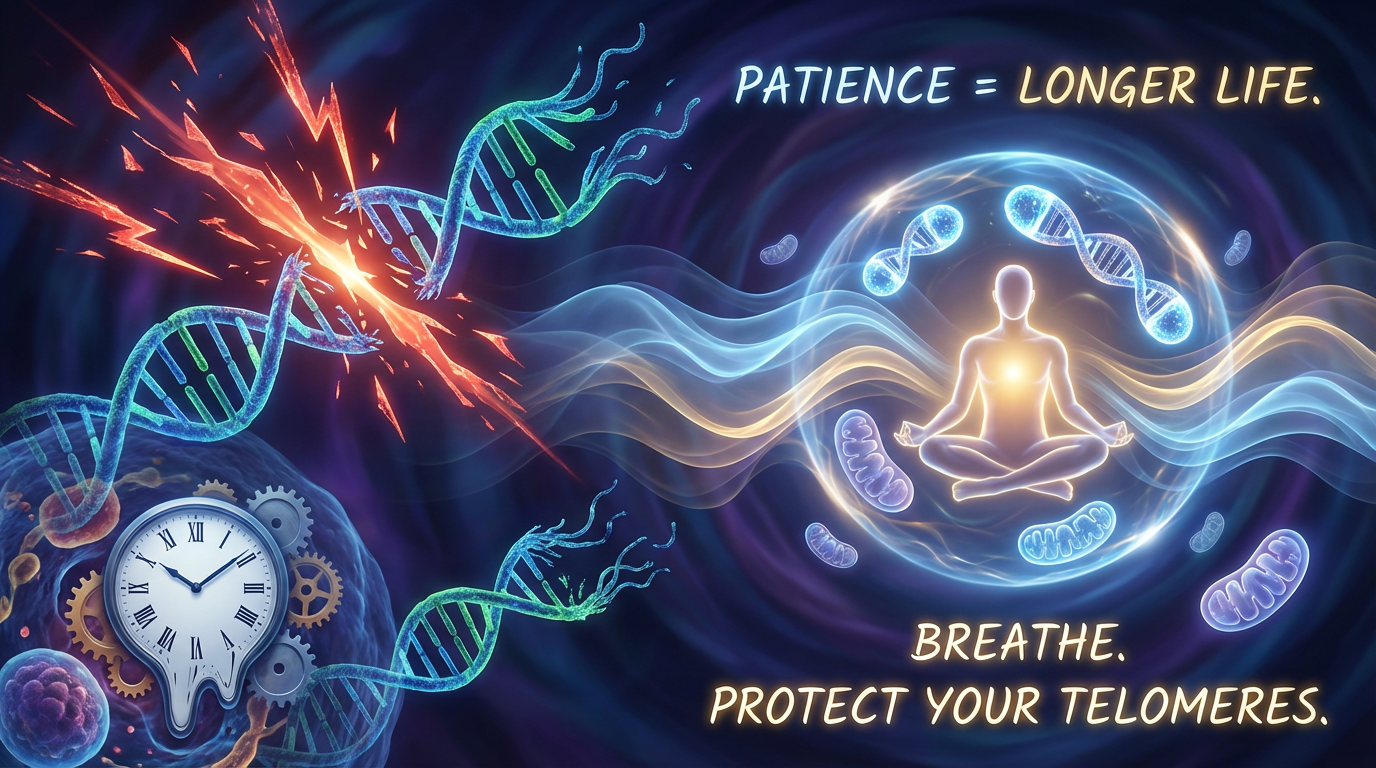
Every time your cells divide, which they're doing constantly to keep you alive, those telomeres get a little bit shorter. It's nature's biological clock. When they get too short, your cells can't divide anymore. They age and they die.
This is one of the leading theories of cellular aging.
The NUS study found that impatient people had significantly shorter telomeres than their patient counterparts. Professor Richard Ebstein, who led the research, explained it with two hypothetical students.
Alex insists on taking the $100 right now, saying "I might need it for a night out." Sam waits for the $120, thinking "It's just a month. I'll treat myself later."
On average, the Alexes, the impatient ones, had shorter telomeres. Their cells were biologically older.
Ebstein put it perfectly. "Patience isn't just virtuous. It might be a secret to staying younger inside and out."
Why Impatience Ages Your Cells
This isn't about one impatient moment killing you. That's not how it works. The study shows a correlation, not direct causation. But when you're habitually impatient, that's when the damage compounds.
When you're impatient, your body treats that delay like a threat. It triggers a fight or flight response.
Think of your body like a city. A little bit of stress is like a small rainstorm. The city can handle it. But chronic impatience is like a flood that never stops. The roads crack. The infrastructure starts breaking down.
That's what happens in your cells when you're chronically impatient.
Your cortisol stays chronically elevated. Your cells get flooded with oxidative damage, basically cellular rust. Inflammation becomes your body's default state. All of this chips away at your telomeres, making you biologically older than you should be.
The Stress That Shortens Your Telomeres
Here's what's happening at the metabolic level. When you're impatient, your body releases stress hormones. Cortisol. Adrenaline. Maybe even growth hormone.
These hormones do something profound that most doctors never talk about. They disrupt your mitochondria.
Your mitochondria are the power plants of your cells. They produce ATP, the energy currency of life. When stress hormones flood your system, they block electron transport chains. They reduce ATP production. They increase reactive oxygen species.
This forces your body into inefficient metabolism. You start burning fat in a way that produces more oxidative stress. You produce more lactic acid. Your cellular energy plummets.
Research from the bioenergetic perspective shows that chronic stress and elevated stress hormones are fundamentally aging. Growth hormone, often praised in anti-aging circles, is actually a stress hormone that accelerates aging. It causes edema, vascular leakiness, and contributes to insulin resistance.
The patient person, by contrast, maintains better metabolic function. Their cells produce energy efficiently. Their oxidative stress is lower. Their telomeres stay longer longer.
The Research That Should Change Everything
The telomere research is compelling on its own. But it gets even intense when you look at what happens when impatience becomes a chronic pattern.
Research from Nobel Prize winner Elizabeth Blackburn and health psychologist Elissa Epel has shown that psychological stress is directly linked to telomere shortening. In their groundbreaking studies of stressed mothers, they found that those reporting higher stress had significantly shorter telomeres and lower telomerase activity, the enzyme that helps maintain telomere length.
This isn't just about feeling stressed in the moment. This is about measurable changes at the cellular level. The psychological toll of chronic impatience and time urgency shows up in your DNA.
The patient person might sip tea mindfully during a wait, cook a balanced meal, and sleep better. Their cells reflect that. The impatient person skips meditation, procrastinates on sleep, and goes for fast food rather than cooking. All these things independently accelerate telomere shortening.
The Vicious Cycle Nobody Talks About
Think about the vicious cycle here. Impatience leads to chronic stress. Chronic stress leads to poor health choices. You sleep less, eat worse, and skip exercise.
Poor choices accelerate cellular aging. The accelerated aging can make you feel worse physically and mentally, making you more impatient.
It's a downward spiral. And it might be difficult to even notice that you're in it.
When you're stuck in this pattern, your cells are literally aging faster. Your telomeres are shortening more rapidly. Your mitochondria are struggling to produce energy. And your body interprets all of this as more stress, which accelerates the process further.
Breaking out requires addressing the root cause. Not just trying harder to be patient. But supporting the metabolic foundations that make patience possible.
The Breathing Connection That Protects Your DNA
Here's something fascinating that connects patience to cellular protection. When you're impatient, you tend to breathe shallow and rapid. When you're patient, you breathe slower and deeper.
This matters more than you might think.
Carbon dioxide is incredibly protective in biological systems. It acts as an antioxidant and inhibitor of oxidative stress. High CO2 levels promote efficient oxidative metabolism while reducing lactic acid production.
Animals with higher CO2 levels, like bats and naked mole rats, tend to live longer and have lower cancer rates. During REM sleep, CO2 accumulates, potentially triggering stem cell and mitochondria multiplication.
Chronic stress reduces CO2 production while increasing lactate, contributing to aging processes.
When you practice patience, you naturally breathe differently. You take slower breaths. You maintain better CO2 levels. You protect your cells.
Why Some Waiting Feels Unbearable
Not all waiting feels equal. Understanding why some waits feel unbearable while others feel fine can help us become more patient.
There's a researcher named David Maister who wrote a famous essay called "The Psychology of Waiting Lines." He identified principles that completely change how we experience time.
Principle one: occupied time passes faster than unoccupied time. The philosopher William James said, "A watched pot never boils." When you're just staring at time passing, it feels like torture. But when you're engaged in something, time flies.
Principle two: uncertain waits feel longer than known waits. When you don't know how long something will take, the wait becomes agonizing.
Principle three: unexplained waits feel longer than explained ones. This is why your doctor tells you they'll be with you shortly.
Principle four: unfair waits feel unbearable. If someone cuts in line, the wait becomes pure torture.
Understanding these principles gives us power. We can manage our own impatience strategically.
The Biospark Approach
At Biospark Health, we look at patience and aging differently than conventional medicine. We don't see impatience as a character flaw. We see it as a metabolic signal.
When you're impatient, your body is telling you something. Your cellular energy is low. Your stress hormones are high. Your mitochondria need support.
The conventional approach might tell you to practice mindfulness or try harder to be patient. We take a different approach. We support the metabolic foundations that make patience possible.
This means addressing root causes. Why is your cortisol elevated? Why are your mitochondria struggling? What's driving the cellular energy crisis that makes waiting feel unbearable?
The answers often lie in metabolism. Thyroid function. Nutritional status. Cellular energy production. When we support these systems, patience becomes easier. Not because you're trying harder, but because your cells aren't in constant emergency mode.
We've seen this approach work consistently. When people restore their metabolic health, they naturally become more patient. They handle stress better. They sleep more deeply. Their energy stabilizes.
These aren't willpower issues. They're metabolic issues. And they respond to metabolic solutions.
Ready to restore your cellular energy and resilience?
The Energy Reset Essentials program delivers a complete metabolic transformation in just 5 days, without eliminating foods or complicated protocols.
- 2 hours of focused video training
- Simple daily protocols that restore mitochondrial function
- The "Eat MORE, Not Less" strategy for lasting energy
$97 one-time | 30-day money-back guarantee
Stress & Patience Support in Reading & Berks County, PA
If you're struggling with stress, impatience, or low energy in the Reading or Wyomissing area, you're not alone. Many residents throughout Berks County face similar challenges, often without access to practitioners who understand the metabolic roots of these issues.
At Biospark Health, we serve clients throughout southeastern Pennsylvania, including Lancaster, Downingtown, Allentown, and the greater Philadelphia suburbs. Our bioenergetic approach has helped local residents finally address stress and aging at their source.
Whether you're in West Chester, King of Prussia, or anywhere in the Chester County area, our virtual and in-person options make it easy to get the metabolic support you need.
Five Tools To Build Patience And Protect Your Telomeres
Tool number one is simple reframing. When you feel impatient, shift your perception from loss to gratitude. Stuck in traffic? At least you have a good podcast and plenty of gas. It sounds simple, but it works.
Tool number two is to manage your expectations. If you leave during rush hour, expect delays. If you expect a delay, you're much less likely to respond impatiently.
Tool number three is a 20-second pause. When impatience flares, pause for 20 seconds. Take two deep breaths. Inhale for four seconds and then exhale for six seconds.
This activates your vagus nerve and literally lowers your stress hormones in real time. Research shows that just five minutes of daily slow breathing lowers oxidative stress markers, the same markers that shorten your telomeres.
Tool number four is a future self exercise. Once a week, write for five minutes. What's one thing I can do today that future me will thank me for? This strengthens the delayed gratification circuits in your prefrontal cortex, rewiring your brain to be more patient at a neurological level.
Tool number five is a micro-challenge. Pick one thing, like waiting at the elevator or making coffee, and practice doing nothing. No phone, no multitasking. Just observe. Can you tolerate 60 seconds of boredom?
This teaches your brain that waiting isn't an emergency you have to escape from. Studies show that avoiding boredom and constant multitasking actually increase impulsivity. By embracing these tiny moments of nothing, you're building tolerance for bigger delays.
Frequently Asked Questions
Do longer telomeres mean longer life?
Research shows that individuals with longer telomeres have been reported to have a longer subsequent lifespan in some studies. However, results in humans have been mixed. Telomere length is one marker of biological aging, but it's not the only factor that determines longevity. Metabolic health, mitochondrial function, and stress levels all play crucial roles in how long you live and how well you age.
How does stress shorten telomeres?
Stress triggers the release of cortisol and other stress hormones that flood your cells with oxidative damage. Chronic stress keeps your body in fight or flight mode, which accelerates cellular aging. Stress hormones also disrupt mitochondrial function, reduce ATP production, and increase reactive oxygen species. All of this damages telomeres and accelerates the shortening process. Supporting metabolic health and reducing chronic stress is key to protecting your telomeres.
Can patience be learned?
Absolutely. Patience isn't just a fixed trait you're born with. It's a skill that can be developed with practice. The tools mentioned above, breathing exercises, reframing, and micro-challenges, all help strengthen the neural circuits that support patience. Research shows that practices like slow breathing can actually change your brain structure over time, making patience more natural and automatic.
What is the paradox of aging?
The paradox of aging is that while physical health tends to decline as we age, mental health often improves. Older adults frequently report better mental health than younger adults. Believe it or not, there are upsides to getting older. We often become more patient, more emotionally regulated, and better at managing stress. This might partly explain why patience correlates with slower cellular aging.
Does impatient behavior actually cause aging?
The research shows a correlation between impatience and shorter telomeres, not direct causation. However, we know that chronic stress, which often accompanies habitual impatience, does accelerate cellular aging. Impatience also tends to lead to poorer health choices like skipping sleep, eating fast food, and avoiding exercise. All of these factors independently accelerate telomere shortening. So while impatience itself might not directly age you, the lifestyle and metabolic patterns that go with it certainly do.
Conclusion
The next time you're stuck in traffic, waiting in line, or feeling that urge to hurry, remember the $100 question. Your response says something about your cells, not just your personality.
Patience isn't just a virtue. It's a metabolic strategy. It's a way of being that protects your telomeres, supports your mitochondria, and quite possibly helps you live longer.
The science is clear. Impatient people age faster at the cellular level. But the good news is that patience can be learned. Your cells can change. Your telomeres can be protected.
How you wait shapes who you become, all the way down to your DNA.
Ready to age more slowly by becoming more patient? Start with your metabolism. Support your cellular energy. Breathe deeper. Wait better.
Tags:
References & Citations
This article is supported by scientific research and peer-reviewed sources. Click citations to verify the evidence.
- [1]Ebstein R, et al.(2016)Impatience is associated with shorter telomere length in young adults.Proceedings of the National Academy of Sciences (PNAS).View Source
- [2]Blackburn EH, Epel ES, Lin J(2015)Human telomere biology: A contributory and interactive factor in aging, disease risks, and protection.Science.View Source
- [3]Epel ES, Blackburn EH, Lin J, et al.(2004)Accelerated telomere shortening in response to life stress.Proceedings of the National Academy of Sciences.View Source
- [4]Ding Y, Gui X, Chu X, et al.(2023)MTH1 protects platelet mitochondria from oxidative damage and regulates platelet function and thrombosis.Nature Communications.View Source
- [5]Beglaryan N, Hakobyan G, Nazaretyan E(2024)Vitamin C supplementation alleviates hypercortisolemia caused by chronic stress.Stress and Health.View Source
- [6]Ray Peat(N/A)Protective CO2 and aging.RayPeat.com.View Source
All references have been reviewed for scientific accuracy and credibility. Citations follow standard academic format and link to original research where available.
About Dr. Steven Presciutti, MD
Founder & Health Coach at Biospark Health, specializing in bioenergetic health and metabolism optimization.