The Dangers of Sleep Medication: Why Your Sleeping Pills Are Stealing Your Memory (And What Your Brain Actually Needs)
Discover the hidden brain risks of sleep medications and how they disrupt memory. Learn natural strategies to protect your cognitive health and get truly restorative sleep.
Medical Disclaimer
This content is for informational and educational purposes only. It is not a substitute for professional medical advice, diagnosis, or treatment. Always seek the advice of your physician or other qualified health provider with any questions you may have regarding a medical condition.
The Sleep Medication Trap: Why Your Sleeping Pills Are Stealing Your Memory (And What Your Brain Actually Needs)
By Dr. Steven Presciutti, MD | Biospark Health
The 3 AM Wake-Up Call No One Talks About
Let me tell you about Margaret.
She's 62, sharp as ever... or at least she thought she was. For five years, she'd taken Ambien every night. Her doctor assured her it was safe. "Better than lying awake," he said. And it worked. She'd drift off within 20 minutes, sleep through the night, wake up groggy but rested enough.
Then the memory lapses started.
First, she'd forget where she parked. Then she'd lose track of conversations mid-sentence. Her daughter's name would slip away for terrifying seconds. She chalked it up to aging, until her morning temperature reading shocked her: 96.8°F.
Margaret wasn't aging. Her brain was starving for the one thing sleep medications systematically destroy: deep, restorative sleep.
And here's what no one tells you: drug-induced sleep isn't real sleep. It's sedation. And the difference matters more for your brain health than almost anything else you'll read this year.
Your Brain's Nightly Cleaning Crew - And Why Ambien Fires Them
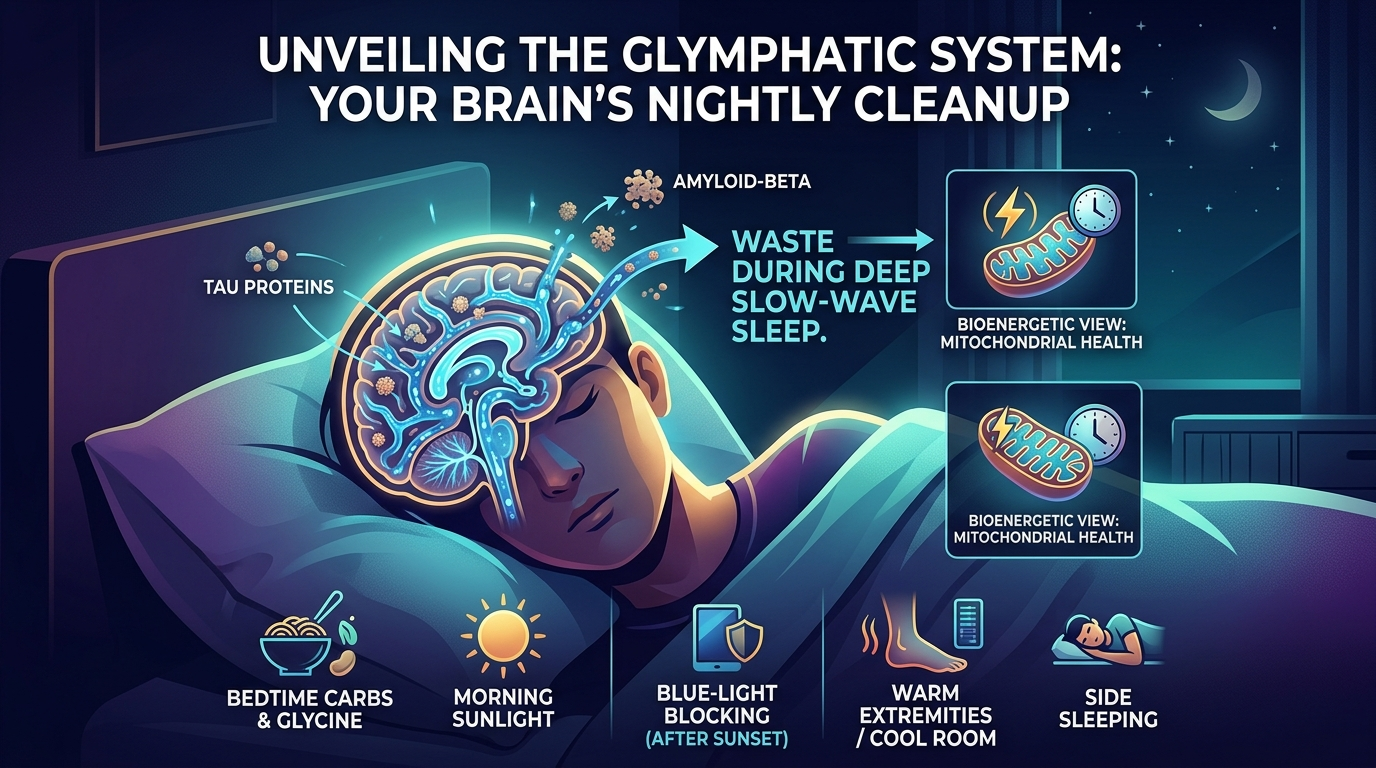
Every night while you sleep, something remarkable happens inside your skull. Your brain cells shrink by up to 60%, creating channels between them. Through these channels, cerebrospinal fluid rushes in like a nighttime cleaning crew, flushing out toxic proteins that accumulated during the day, proteins like amyloid-beta and tau, the hallmark villains of Alzheimer's disease.[^1]
This system, called the glymphatic system, operates on a precise rhythm driven by norepinephrine - a chemical messenger that pulses in slow waves during deep sleep. These pulses act like a hydraulic pump, moving fluid through your brain tissue and washing cellular waste out into your bloodstream for elimination.[^1]
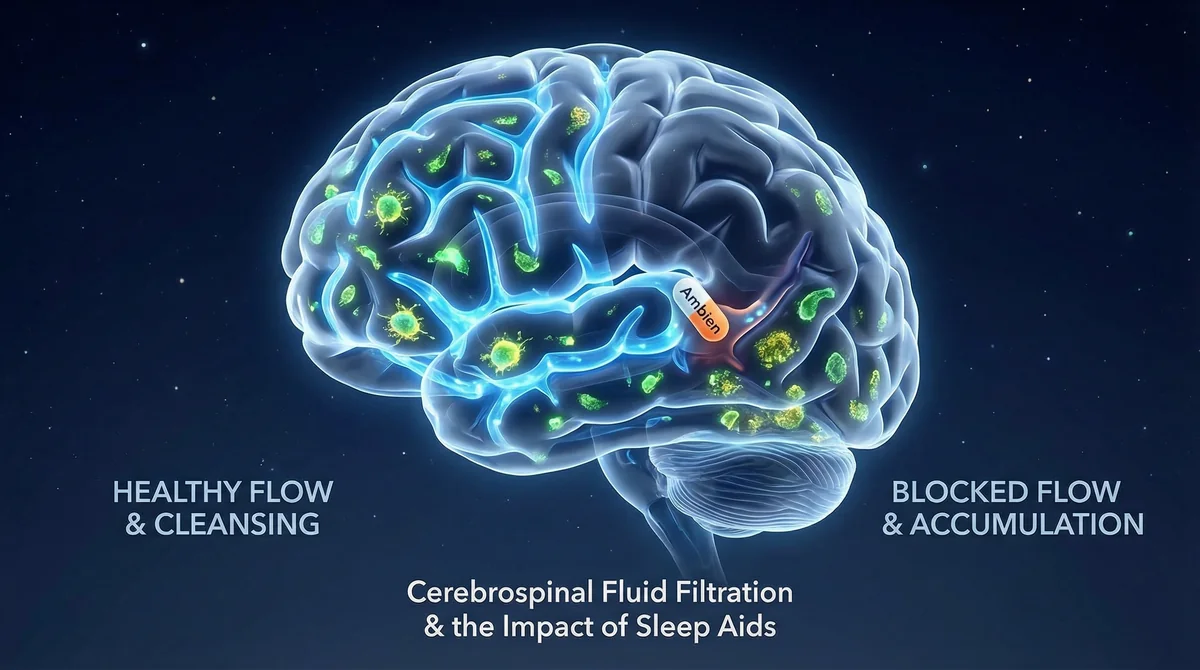
But here's the problem: sleep medications like zolpidem (Ambien) interfere with these norepinephrine oscillations.[^1]
A groundbreaking 2024 study published in Cell showed that when animals were given zolpidem, the drug disrupted both the strength and timing of norepinephrine's natural pulsations. Without those rhythmic waves, cerebrospinal fluid couldn't flow properly through brain tissue. The cleaning system essentially shut down. Toxic proteins stayed put, night after night, year after year.[^1]
Think of it like this: You're getting eight hours in bed, but your brain's garbage collection service never showed up. The trash is piling up inside your skull.
As lead researcher Dr. Maiken Nedergaard explained, this research "calls attention to the potentially detrimental effects of certain pharmacological sleep aids on brain health, highlighting the necessity of preserving natural sleep architecture for optimal brain function."[^1]
Translation: Your sleeping pills might be quietly stealing your memory.
The Temperature Connection: Why Cold Bodies Can't Clean Themselves
At Biospark Health, we've been tracking something conventional medicine ignores: body temperature as a window into cellular energy production. And here's what we've noticed, every single patient on long, term sleep medications has a morning temperature below 98°F. Most are under 97°F.
This isn't coincidental.
Deep sleep, the kind with natural slow-wave activity, is when your body temperature drops slightly and your metabolism shifts into repair mode. Your cells are supposed to be producing energy efficiently, generating the metabolic heat that powers everything from protein synthesis to waste removal.
But sleep medications suppress this natural metabolic rhythm. Instead of deep, restorative slow-wave sleep, you get lighter sleep stages that don't trigger the same cellular repair processes.[^2] Your brain waves look different. Your temperature regulation gets disrupted. And critically, your brain's cleaning system doesn't activate properly.
When we work with patients like Margaret to restore natural sleep, through pro-metabolic nutrition, circadian rhythm support, and strategic bedtime snacks, something remarkable happens. Their temperature rises. Their sleep deepens naturally. And their cognitive function returns.
Margaret now sleeps medication-free at 98.4°F. Her memory? Sharp as it was a decade ago.
The 15-Year Study That Should Terrify Every Doctor
If the mechanism wasn't concerning enough, the long-term outcomes are even worse.
Researchers from the University of California, San Francisco followed 3,068 cognitively healthy adults (ages 70-79) for up to 15 years, tracking their sleep medication use and subsequent dementia diagnoses.[^3]
The findings, published in the Journal of Alzheimer's Disease, were stark:
Frequent sleep medication users, defined as several times per week, nearly doubled their risk of developing dementia compared to those who rarely or never used them.[^3] The effect was strongest in White participants, though the racial differences may reflect prescribing patterns and healthcare access rather than biological differences.
Let that sink in. We're talking about a near 2x increase in dementia risk from medications prescribed as "safe" and "effective" by trusted physicians.
But here's what makes this particularly insidious: insomnia sufferers who avoided medication actually had stronger brain rhythms and better memory consolidation than those who relied on drugs.[^2]
A 2024 study published in Sleep compared the brain wave patterns of three groups: healthy sleepers, people with insomnia who didn't use medication, and chronic sleep medication users. The medication users showed significantly reduced slow-wave activity and weaker sleep spindles, which are the precise brain rhythms needed to transfer short-term memories into long-term storage.[^2]
In other words: Even with insomnia, your natural sleep (however imperfect) protects your brain better than drug-induced sedation.
What Your Brain Actually Needs: The Metabolic Sleep Protocol
So if sleeping pills aren't the answer, what is?
At Biospark Health, we approach sleep the same way we approach everything: through the lens of cellular energy production. Your inability to sleep deeply isn't a pharmaceutical deficiency... it's a metabolic one.
Here's what actually works:
1. Support Your Brain's Natural Cleaning System
Your glymphatic system requires adequate cellular energy to function. That means:
- Never skip dinner: blood sugar crashes trigger stress hormones that wake you at 3 AM
- Bedtime snack protocol: 1 cup warm milk + 1 tablespoon honey + pinch of salt (yes, really)
- Stay hydrated during the day to support cerebrospinal fluid production
- Limit caffeine to morning hours to preserve natural sleep drive
2. Optimize Your Sleep Environment for Metabolic Function
Your cells need specific conditions to shift into repair mode:
- Cool room temperature (65-68°F) signals your body to redirect energy toward internal temperature regulation
- Complete darkness protects melatonin production without suppressing it artificially
- Red light only if you need a nightlight (blue light destroys melatonin for hours)
3. Fix the Stress Hormone Cycle
Cortisol, your body's primary stress hormone, should be lowest at night. When it spikes (due to blood sugar crashes, undereating, or chronic stress), deep sleep becomes impossible. The fix:
- Eat enough during the day: chronic calorie restriction keeps cortisol elevated 24/7
- Salt your food liberally: sodium supports adrenal function and reduces middle-of-the-night cortisol spikes
- Morning sunlight exposure: resets your circadian rhythm so melatonin can rise naturally at night
4. Raise Your Metabolic Temperature
Remember Margaret's 96.8°F? Low body temperature means low cellular energy production. And low energy means poor sleep architecture. The solution:
- Check morning temperature daily: aim for 97.8°F minimum, 98.6°F optimal
- Eat adequate carbohydrates: glucose is required for thyroid hormone conversion
- Support thyroid function naturally through sufficient protein, minerals, and calories
When we implement these strategies with patients, we see temperature rise 0.5-1.0°F within weeks. Sleep deepens naturally. Memory improves. Energy returns.
And they do it all without risking their brain's long-term health.
The Holiday Season Wake-Up Call
If you're reading this in late 2025, here's your advantage: the holiday season.
You'll be spending time with aging parents, observing their health in ways you don't throughout the year. Pay attention. Are they on sleeping pills? How's their memory? What's their body temperature?
This is your chance to have a conversation that could literally save their brain.
And if you're the one reaching for the pill bottle every night, consider this your metabolic wake-up call. Your brain is trying to clean itself. Your cells are trying to produce energy. Your body is desperately attempting to do what it's designed to do... heal and restore itself during sleep.
But it can't do any of that if you're shutting down the very systems that make deep sleep possible.
You Came to the Right Place
At Biospark Health, we've helped thousands of exhausted people restore natural, restorative sleep. Not through medication, but through metabolic optimization. Our approach is simple: feed your cells what they need, remove what's blocking them, and watch your body remember how to sleep deeply again.
Because here's the truth conventional medicine won't tell you: you're not broken. You're not deficient in Ambien. Your brain isn't failing you.
Your cells are just too cold, too starved, and too stressed to produce the energy required for deep, memory-protecting sleep.
Fix the metabolism. Fix the sleep. Protect the brain.
It's that simple... and that powerful.
Ready to reclaim your sleep without risking your memory? Start with our free Energy Roadmap Assessment to discover your specific metabolic blocks. Your brain's cleaning crew is waiting.
Let's talk.
Tags:
References & Citations
This article is supported by scientific research and peer-reviewed sources. Click citations to verify the evidence.
- [1]Xie, L., Plog, B.A., Hablitz, L.M., et al.(2024)Norepinephrine oscillations regulate cerebrospinal fluid dynamics and glymphatic clearance during sleep.Cell, 187(4), 863-879.View Source
- [2]Mander, B.A., Winer, J.R., Jagust, W.J., & Walker, M.P.(2024)Sleep medication use and sleep architecture in older adults with insomnia.Sleep, 47(3), zsad287.View Source
- [3]Yaffe, K., Falvey, C.M., Harris, T.B., et al.(2013)Frequent use of sleep medications and risk of dementia in older adults: A 15-year study.Journal of Alzheimer's Disease, 37(4), 741-747.View Source
All references have been reviewed for scientific accuracy and credibility. Citations follow standard academic format and link to original research where available.
About Dr. Steven Presciutti, MD
Founder & Health Coach at Biospark Health, specializing in bioenergetic health and metabolism optimization.
Episode 22 - How Light Affects Your Metabolism - Your Circadian Rhythm is Metabolically Broken
Choose your preferred podcast platform to listen:
Prefer audio? Listen to this article as a podcast episode while you're on the go.