Why Your Genes Are Not Your Destiny: The Complete Guide to Epigenetic Control
Your doctor says 'it's genetic' like it's a life sentence. But genes only control about 25% of your health outcomes. Discover the revolutionary science of epigenetics and how you can rewrite your genetic expression through diet, lifestyle, and bioenergetic optimization.
Medical Disclaimer
This content is for informational and educational purposes only. It is not a substitute for professional medical advice, diagnosis, or treatment. Always seek the advice of your physician or other qualified health provider with any questions you may have regarding a medical condition.
Why Your Genes Are Not Your Destiny: The Complete Guide to Epigenetic Control
Your doctor says "it's genetic" like it's a life sentence. Like you drew the short straw in the genetic lottery and there's nothing you can do about it. Heart disease? Genetic. Thyroid issues? Genetic. Weight gain? Genetic. The ultimate medical cop-out that leaves you feeling like a victim of your own biology.
But what if I told you that genes only control about 25% of your health outcomes? What if the other 75% is completely under your control?
This isn't motivational rhetoric. It's scientific fact, proven by decades of epigenetic research. And once you understand it, everything changes about how you approach your health.
The 25/75 Truth That Changes Everything
Here's the metaphor that changed everything for me. DNA is your hardware. Epigenetics is your software.
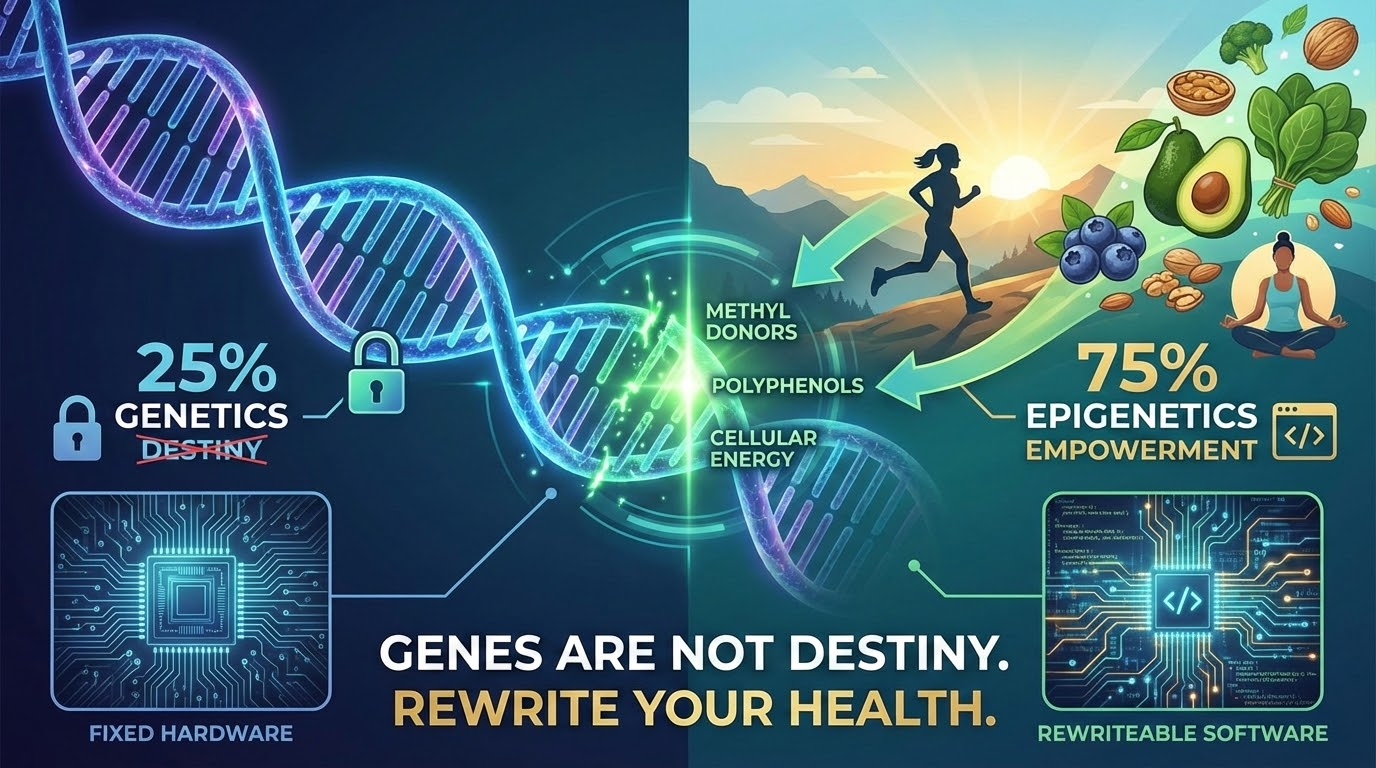
Think about it. Your computer hardware, the processor, the memory, the hard drive, that's fixed. You can't change it. But the software? The operating system? The programs that run on that hardware? That's completely flexible. You can upgrade it. You can optimize it. You can rewrite it entirely.
That's the difference between DNA and epigenetics.
Your DNA sequence is the hardware. You inherited it from your parents. Half from mom, half from dad. That sequence is fixed. You can't change it.
But epigenetics? That's the software. That's which genes are turned on and which genes are turned off. That's how your DNA is expressed. And here's the revolutionary part. That software is completely rewriteable.
You're upgrading or downgrading your epigenetic software every single day. With every meal. With every sleepless night. With every stressful thought. With every decision you make.
Can Epigenetics Change Gene Expression?
Yes. And the science is undeniable.
There's a landmark study from 2005 that completely changed how we understand genetics. Fraga and colleagues looked at identical twins. These are monozygotic twins, twins who developed from a single fertilized egg, so they have the exact same DNA sequence. The exact same hardware.
When these twins were young, just 3 years old, their epigenetic profiles were almost indistinguishable. Essentially identical. Their software was the same.
But here's what happened as they aged. The researchers looked at these same twins decades later, at 50 years old. And what they found changed everything.
The older twin pairs showed substantial variations in their epigenetic profiles. Massive differences in DNA methylation patterns. Huge differences in gene expression.
Remember, same DNA. Same hardware. But completely different software. One twin might have genes associated with cancer turned on. The other twin might have those same genes turned off. One twin might have inflammatory genes activated. The other twin might have those same genes silenced.
Same hardware. Different software. Different health outcomes.
The researchers found that for 35% of twin pairs, there were significant epigenetic differences. That's not a small number. That's more than one in three identical twins who started with the same DNA but ended up with completely different gene expression.
What caused the difference? Environment. Lifestyle. Diet. Stress. Toxins. All the factors that conventional medicine likes to dismiss as "not genetic."
But here's the thing. Those environmental factors ARE genetic. Because they're epigenetic. They're changing HOW your genes are expressed.
How Epigenetic Control Works
Let me explain the mechanism simply. It's called DNA methylation. Think of it like this. Your DNA has these little chemical tags called methyl groups that sit on top of your genes. These methyl groups act like switches.
When a gene is methylated, when it has these methyl groups attached, it's typically turned off. Silenced. The gene is still there, but it's not being expressed. It's not producing proteins.
When a gene is unmethylated, when those methyl groups are removed, it's typically turned on. Active. The gene is being expressed. It's producing proteins.
And here's the key. You can't change your DNA sequence, but you CAN change which genes are methylated. You CAN change which genes are expressed.
That's what epigenetics means. "Epi" means "above" or "on top of." Epigenetics means "above genetics." It's the layer of control sitting on top of your DNA, determining which genes are active and which are silent.
And this layer? This epigenetic layer? It's completely dynamic. Completely responsive to your environment. Completely under your control.
Studies have shown that DNA methylation heritability ranges from only 3-20%. That means somewhere between 80-97% of your epigenetic profile is determined by non-genetic factors. Environment. Lifestyle. Diet.
You're not a victim of your genes. You're the author of your genetic expression. And once you understand this, everything changes.
How to Change Gene Expression Through Food
Every meal you eat sends signals to your genes. Every bite is information. Every nutrient is a message.
Your cells are constantly asking: "What's the environment like? Are we safe? Are we nourished? Should we grow or should we protect ourselves?"
And the answer comes from your food. From the nutrients you provide.
Let me give you a specific example. Methyl donors.
These are nutrients that literally donate methyl groups to your DNA. They provide the raw materials for DNA methylation, those epigenetic switches I told you about.
The key methyl donors are:
Folate. The active form is 5-methyltetrahydrofolate. This is what your body uses to methylate homocysteine and convert it back to methionine. It's essential for the methylation cycle. Found in leafy greens like spinach, kale, and romaine lettuce.
Vitamin B12. This is the cofactor that works with folate. You need B12 to activate folate and make it usable. Without B12, folate gets trapped in an inactive form and can't do its job. Found exclusively in animal foods like meat, eggs, dairy, and fish.
Choline. This is found in egg yolks and liver. Two foods we've been told to avoid for decades. Egg yolks because of cholesterol. Liver because, well, I'm not sure why. Maybe because it's "weird"?
But choline is critical. Your body can convert choline into betaine, which is another methyl donor. Choline is especially critical during pregnancy for proper neural development. But it's not just for babies. It's for everyone.
Methionine. This is an essential amino acid found in protein. Meat, fish, eggs, dairy. Your body converts methionine into SAM-e, S-adenosymethionine, which is the primary methyl donor in your body. SAM-e is what actually donates those methyl groups to your DNA.
Vitamin B6. Found in potatoes, bananas, chickpeas, and fish. B6 is a cofactor in the methylation cycle. It helps convert homocysteine back to methionine, keeping the cycle moving.
Now, here's what most people don't understand. Methylation requires energy.
Specifically, it requires ATP. Every time SAM-e donates a methyl group to DNA, it becomes SAH, S-adenosylhomocysteine. Your body then has to use ATP to convert SAH back to SAM-e so it can donate another methyl group.
Low energy production? Impaired methylation. Impaired gene expression.
This is why metabolic health IS genetic health. This is why your mitochondria, your cellular energy producers, are directly connected to your epigenetic expression.
Let me give you a concrete example. I had a client, Sarah, who came to me with the diagnosis "it's just genetic."
Sarah was 34, running a body temperature of 97.2F, exhausted all the time, hair falling out, TSH at 6.8. Her endocrinologist had her on Synthroid, but she still felt terrible. The doctor told her, "Some people just have bad thyroids. It's genetic. You'll need medication forever."
Her mother had thyroid problems. Her grandmother had thyroid problems. It "ran in the family."
But Sarah didn't have bad genes. She had bad epigenetic software.
We optimized her methyl donor intake. We added 2-3 egg yolks daily for choline. Big salads with leafy greens for folate. Adequate protein from grass-fed beef for methionine and B12. We supported her mitochondrial energy production with traditional fats, butter, ghee, coconut oil, and eliminated seed oils completely.
We structured her meals to support circadian cortisol rhythms. Protein and fat within an hour of waking. Lunch as the biggest meal. Dinner lighter and earlier.
After 6 weeks, her body temperature rose to 98.4F. Her TSH normalized to 2.1. Her energy transformed. She wasn't just surviving anymore. She was thriving.
Was it genetic? Yes. Was it destiny? No. It was epigenetic. And that meant she could change it.
The food she ate provided the methyl donors that rewrote her gene expression. The fats she ate provided the ATP that powered methylation. The timing of her meals supported the hormonal rhythms that regulated gene expression.
Food is code. And she learned how to write better code.
Polyphenols: Epigenetic Regulators Beyond Methylation
But methyl donors aren't the whole story. There's another class of nutrients that act as epigenetic regulators, compounds that can modify gene expression through multiple pathways beyond just DNA methylation.
These are called polyphenols. And they're powerful.
Curcumin from turmeric promotes histone acetylation, leading to gene expression activation. Histones are the proteins that DNA wraps around. When histones are acetylated, DNA becomes more accessible, genes can be expressed more easily.
Curcumin has been shown to modulate DNMT activity, that's DNA methyltransferase, the enzyme that adds methyl groups to DNA. It can inhibit excessive methylation of tumor suppressor genes, essentially turning anti-cancer genes back on.
Resveratrol from grapes, berries, and red wine activates SIRT1, sirtuin 1, which is an enzyme that deacetylates histones and regulates gene expression related to aging and longevity. SIRT1 activation is associated with improved mitochondrial function, reduced inflammation, and enhanced DNA repair.
Quercetin from onions and apples can modulate DNA methylation and histone modifications. It's been shown to influence the expression of genes involved in inflammation and cell survival.
One study found that quercetin could reverse aberrant DNA methylation patterns in cancer cells, essentially reprogramming them back toward normal gene expression.
EGCG from green tea can inhibit DNMT activity, preventing excessive DNA methylation. This can reactivate silenced genes, particularly tumor suppressor genes.
EGCG has also been shown to modulate histone modifications, influencing gene expression patterns related to cell growth and differentiation.
Now, here's what's fascinating. These polyphenols work synergistically with methyl donors.
Methyl donors provide the raw materials, the methyl groups themselves. Polyphenols regulate the enzymes that add or remove those methyl groups. They work together to optimize gene expression.
Think of it like writing software. Methyl donors are the code, the actual programming. Polyphenols are the code editors, they help optimize and refine how that code gets written and executed.
Let me give you another client example. Mark was a 45-year-old executive with chronic inflammation. High CRP. Joint pain. Brain fog. He'd been told he had "inflammatory genes," that it was just his genetic makeup.
But we looked at his diet. He was eating a standard inflammatory diet. Seed oils, processed foods, very few vegetables. No polyphenols.
We added polyphenol-rich foods to his diet. Berries every morning. Onions and apples in salads. Green tea in the afternoon. Turmeric in his cooking.
We also optimized his methyl donors. Egg yolks for choline. Leafy greens for folate. Quality protein for methionine and B12.
After 8 weeks, his CRP dropped from 8.2 to 2.1. His joint pain resolved. His brain fog lifted.
Did we change his genes? No. We changed his gene expression.
The inflammatory genes he was born with? We turned them down. The anti-inflammatory genes? We turned them up.
Not with drugs. Not with expensive treatments. With food. With information coded into every bite.
Food is code. And Mark learned how to write code that turned off inflammation and turned on healing.
The Energy-Epigenetic Connection They Don't Tell You
But here's what most epigenetics researchers miss. You can't have proper epigenetic regulation without energy.
Let me say that again. You cannot have proper gene expression without adequate cellular energy.
Why? Because DNA methylation requires ATP.
Every time SAM-e donates a methyl group to DNA, it becomes SAH. Your body has to use ATP to convert SAH back to methionine, and then to SAM-e again. This is called the methylation cycle, and it's energy-intensive.
Low mitochondrial function? Low ATP production? Impaired methylation. Impaired gene expression.
This is why optimizing mitochondrial function IS epigenetic optimization. They're not separate. They're the same thing.
Let me explain the connection more deeply.
Mitochondria produce ATP. ATP is the energy currency of your cells. Every cellular process requires ATP, from muscle contraction to nerve signaling to DNA methylation.
SAM-e donates methyl groups. This is how your body adds those epigenetic tags to DNA. Methylation turns off harmful genes. Proper methylation is protective.
The cycle requires ATP. After SAM-e donates a methyl group, it becomes SAH. Your body must use ATP to convert SAH back to methionine, and then to SAM-e again. Without adequate ATP, this cycle slows down. Methylation becomes impaired.
Low energy equals bad gene expression. When your mitochondria aren't producing enough ATP, your cells can't properly methylate DNA. Inflammatory genes stay turned on. Protective genes stay turned off. You develop symptoms.
This is why temperature is such a powerful proxy for epigenetic health.
Your body temperature is a direct reflection of your metabolic rate, of your mitochondrial energy production. Higher temperature equals better energy production equals better methylation equals better gene expression.
I had a client, Jennifer, who came to me with a multitude of symptoms. Fatigue. Hair loss. Cold hands and feet. Depression. Her body temperature was averaging 96.8F.
She'd been to numerous doctors. Multiple specialists. Every test came back "normal." She was told it was all in her head. Maybe depression. Maybe anxiety. Here's an antidepressant.
But her temperature told the real story. 96.8F. That's not depression. That's low energy production. That's mitochondrial dysfunction.
We didn't start with methyl donors. We started with energy.
We optimized her diet for ATP production. Adequate carbohydrates to fuel mitochondria without spiking insulin. Quality protein to provide amino acids. Saturated fats, butter, ghee, coconut oil, to support mitochondrial membranes.
We eliminated PUFA, polyunsaturated fatty acids from seed oils, because they damage mitochondrial function and reduce energy production.
We structured her eating to support circadian rhythms. Breakfast with protein and fat within an hour of waking. Lunch as the biggest meal. Dinner lighter and earlier.
We added simple movement after meals, 10-minute walks, to improve glucose uptake and mitochondrial efficiency.
After 4 weeks, her temperature rose to 98.0F. Her energy improved. Her mood lifted.
Then we added methyl donor optimization. Egg yolks. Leafy greens. Quality protein.
After another 4 weeks, her temperature was consistently 98.4F. Her fatigue resolved. Her hair stopped falling out. Her depression lifted.
Was it just the methyl donors? No. Was it just the energy optimization? No.
It was both.
Because here's the key. You can provide all the methyl donors in the world, but if your cells don't have enough energy to use them, they won't do any good.
Jennifer's cells weren't methylating properly because they didn't have the ATP to power the methylation cycle. Once we restored her energy production, her cells could use the methyl donors from her diet to rewrite her gene expression.
Food is code. But you need energy to run the programming.
This is why the bioenergetic approach to health is fundamentally an epigenetic approach. When you optimize mitochondrial function, you're optimizing your body's ability to regulate gene expression.
When you raise your body temperature, you're not just improving metabolism. You're improving epigenetic regulation.
When you eliminate seed oils and add traditional fats, you're not just reducing inflammation. You're optimizing the energy production required for DNA methylation.
Everything is connected. Energy IS epigenetics. And epigenetics IS energy.
How to Reprogram Your Epigenetics: Your 7-Day Reset
So let's make this practical. How do you actually reprogram your epigenetics? How do you change which genes are turned on and which genes are turned off?
Here's your 7-day epigenetic reset protocol.
Day 1: The Methyl Donor Audit
For 3 days, track your methyl donor intake. Did you eat egg yolks for choline? Did you eat leafy greens for folate? Did you eat quality protein for methionine and B12? Did you eat foods rich in B6 like potatoes, bananas, or fish?
Most people are deficient in at least 2-3 of these. Identify your gaps.
Day 2: The Polyphenol Add
Add ONE polyphenol-rich food to your diet daily. Berries like blueberries, raspberries, or blackberries. Colorful vegetables like bell peppers, beets, or carrots. Onions and garlic for quercetin. Green tea for EGCG. Turmeric in your cooking for curcumin.
Don't overcomplicate it. Pick one. Add it daily.
Day 3: The Temperature Check
Track your body temperature for 5 days. Take it upon waking, before getting out of bed. Take it mid-morning. Take it mid-afternoon.
What's the average? If it's below 98.0F, your energy production is compromised. Your epigenetic regulation is impaired. Focus on supporting ATP production. Adequate food. Traditional fats. Regular meals.
Day 4: Eliminate the Energy Killers
Remove seed oils from your diet. Soybean oil, canola oil, corn oil, vegetable oil. These damage mitochondrial function and reduce ATP production.
Replace them with traditional fats. Butter, ghee, coconut oil, olive oil. These support mitochondrial function and epigenetic regulation.
Day 5: Optimize Meal Timing
Eat within an hour of waking. Breakfast shifts your body from catabolic, breakdown, to anabolic, building. It provides the amino acids and methyl donors needed for the day's methylation cycles.
Make lunch your biggest meal. Your digestive function and metabolic rate are highest midday. This is when your body can best absorb and utilize nutrients.
Keep dinner lighter and earlier. Eating 3-4 hours before sleep allows your body to complete digestion before bed. This improves sleep quality, which is critical for epigenetic regulation.
Day 6: Support Your Mitochondria
Add foods that specifically support mitochondrial function. CoQ10-rich foods like organ meats and beef. Alpha-lipoic acid from spinach and broccoli. Acetyl-L-carnitine from red meat and dairy.
These nutrients support the energy production that powers your methylation cycles.
Day 7: The Complete Epigenetic Meal
Here's what a complete epigenetic-supporting meal looks like:
6-8 oz grass-fed beef or pastured chicken for methionine, B12, and choline.
Big salad with mixed greens for folate.
Colorful vegetables like bell peppers, carrots, and beets for polyphenols.
Half an avocado for choline and healthy fats.
Olive oil and vinegar dressing for additional polyphenols.
Half cup roasted root vegetables for additional folate and polyphenols.
This meal provides the complete methyl donor package. Choline from egg yolks. Folate from greens. Methionine and B12 from animal protein. Polyphenols from colorful vegetables. Healthy fats for ATP production.
This isn't just food. It's information. It's code that reprograms your genetic expression.
The Biospark Approach
At Biospark Health, we take a fundamentally different approach to health. We don't see you as a victim of your genes. We see you as the author of your genetic expression.
Conventional medicine looks at your DNA sequence and tells you what you can't change. We look at your epigenetic software and show you what you CAN change.
We address root causes, not symptoms. We don't just manage your thyroid levels or cholesterol numbers. We ask why your genes are expressing themselves that way in the first place.
We optimize your cellular energy production. Because without adequate ATP, your cells can't maintain proper epigenetic control. They can't keep the right genes turned on and the right genes turned off.
We provide the methyl donors your cells need. Folate, B12, choline, methionine, B6. The raw materials for DNA methylation.
We incorporate epigenetic-regulating polyphenols. Curcumin, resveratrol, quercetin, EGCG. The compounds that modulate how your genes are expressed.
We structure your lifestyle to support epigenetic regulation. Meal timing. Sleep patterns. Stress management. Movement. All of these influence your epigenetic software.
And we do it all with a focus on the energy-epigenetic connection that most practitioners miss. Because we understand that you can't have proper gene expression without adequate cellular energy.
This is why our clients see transformations that conventional medicine says are impossible.
Thyroid conditions resolving without lifelong medication. Cholesterol normalizing without statins. Inflammatory markers dropping without anti-inflammatory drugs.
Not because we changed their DNA. But because we helped them rewrite their epigenetic software.
Ready to restore your metabolism at the cellular level?
The Bioenergetic Reset Program addresses root causes, not symptoms. Join 300+ members who've discovered what real metabolic health feels like.
- 9+ hours of comprehensive training
- Twice-monthly LIVE coaching calls
- Complete meal plans & protocols
- Direct email support
$133/month | Cancel anytime
Epigenetic Health Support in Reading & Berks County, PA
If you're struggling with "genetic" health issues in the Reading or Wyomissing area, you're not alone. Many residents throughout Berks County have been told their health problems are genetic and there's nothing they can do.
But that's not the full story.
At Biospark Health, we serve clients throughout southeastern Pennsylvania, including Lancaster, Downingtown, Allentown, and the greater Philadelphia suburbs. Our epigenetic approach has helped local residents finally address health challenges at their source.
Whether you're dealing with thyroid issues, autoimmune conditions, or metabolic dysfunction, we help you understand that your genes aren't your destiny. We show you how to rewrite your genetic expression through targeted nutrition, lifestyle optimization, and bioenergetic support.
If you're in West Chester, King of Prussia, or anywhere in the Chester County area, our virtual and in-person options make it easy to get the metabolic support you need.
Frequently Asked Questions
What causes epigenetic changes?
Epigenetic changes are caused by environmental factors that modify gene expression without changing the DNA sequence. These include diet, stress, sleep, exercise, toxins, and even light exposure. The most well-studied mechanism is DNA methylation, where methyl groups attach to DNA and turn genes on or off. Other mechanisms include histone modification and non-coding RNA. The remarkable thing is that many epigenetic changes are reversible, which means you can change your gene expression throughout your life.
How long does it take to change gene expression through epigenetics?
Research shows that DNA methylation patterns can change in a matter of weeks to months with lifestyle interventions. Some studies have demonstrated significant epigenetic changes in just 6-8 weeks of dietary intervention. For example, studies on methyl donor-rich diets have shown changes in DNA methylation patterns within 2 months. However, the timeline varies depending on the individual, their starting point, and the consistency of the intervention. The key is consistency. Every meal is either upgrading or downgrading your epigenetic software.
Can you pass epigenetic changes to your children?
Yes, epigenetic patterns can be heritable. Research on the Dutch Hunger Winter showed that famine exposure during pregnancy affected the health of not just the immediate children, but the grandchildren too. However, this isn't just about passing down trauma. It's also about passing down healing. When you optimize your own epigenetic patterns, you're potentially benefitting your children and grandchildren. You're breaking cycles of disease that may have plagued your family for decades.
What is the difference between genetic and epigenetic?
Genetic refers to your DNA sequence, the hardware you inherited from your parents. This sequence is fixed and can't be changed. Epigenetic refers to the layer of control sitting on top of your DNA that determines which genes are turned on or off. This is your software, and it's completely dynamic and responsive to your environment. Think of it this way. Genetics is the piano. Epigenetics is the music being played on it. The piano stays the same, but the music can change dramatically.
Can stress change your gene expression?
Yes, stress is one of the most powerful epigenetic regulators. Chronic stress activates the HPA axis and increases cortisol, which directly influences DNA methylation patterns. Stress can activate endonucleases, enzymes that break up DNA chains, and increase genetic variability. This is why stress management isn't just about feeling better. It's about protecting your genetic expression. Techniques like meditation, breathwork, and even adequate sleep can help mitigate the epigenetic effects of stress.
Conclusion
Everything I've shared today changes the fundamental question. Instead of asking "what's wrong with my genes?", we should be asking "what's wrong with my epigenetic software?"
Because here's the truth. You can't change your DNA sequence. That hardware is fixed. But you CAN change your epigenetic software. You CAN change which genes are expressed. You CAN rewrite the code of your health.
This is the revolution that mainstream medicine doesn't want you to understand. Because once you understand that genes aren't destiny, their entire narrative falls apart. Once you understand that you have control, you're no longer a victim. You're an active participant in your health.
Your cells are reading instructions right now. You wrote them with your last meal. Your last sleepless night. Your last stressful thought.
The question is, what message are you sending?
Are you telling your genes to express health? Or are you telling them to express disease?
The choice is yours. Not your doctor's choice. Not your genetics' choice. YOUR choice.
Every meal is a message. Every lifestyle decision is programming your future health.
What message will you send?
You came to the right place. Let's talk.
Tags:
References & Citations
This article is supported by scientific research and peer-reviewed sources. Click citations to verify the evidence.
- [1]Fraga MF, Ballestar E, Paz MF, et al.(2005)Epigenetic differences arise during the lifetime of monozygotic twins.Proceedings of the National Academy of Sciences.View Source
- [2]Anderson OS, Sant KE, Dolinoy DC(2012)Nutrition and epigenetics: An interplay of dietary methyl donors, one-carbon metabolism and DNA methylation.Current Opinion in Clinical Nutrition & Metabolic Care.View Source
- [3]Wallace S(2010)Energetics, epigenetics, mitochondrial genetics.Epigenomics.View Source
- [4]Ayissi RA, Etoh T, Wu Y, et al.(2014)Epigenetic effects of natural polyphenols: A focus on SIRT1.BioFactors.View Source
- [5]Bekdash RA, Johnson AA, Ziegler FS, et al.(2023)Methyl Donors, Epigenetic Alterations, and Brain Health.Brain Sciences.View Source
All references have been reviewed for scientific accuracy and credibility. Citations follow standard academic format and link to original research where available.
About Dr. Steven Presciutti, MD
Founder & Health Coach at Biospark Health, specializing in bioenergetic health and metabolism optimization.