Why Your Testosterone Levels Don't Match Your Age (And What's Really Going On)
Discover why testosterone levels by age are plummeting across generations. Learn why 'normal' lab ranges hide metabolic dysfunction and what actually causes low testosterone in young men.
Medical Disclaimer
This content is for informational and educational purposes only. It is not a substitute for professional medical advice, diagnosis, or treatment. Always seek the advice of your physician or other qualified health provider with any questions you may have regarding a medical condition.
You're 32 years old. You should be in your prime. Instead, you're exhausted by 3 PM, your brain feels like it's moving through fog, and you can't remember the last time you woke up actually feeling rested.
So you finally get your testosterone checked. The results come back: 380 ng/dL. Your doctor glances at the lab report and says, "You're within normal range. Everything looks fine."
But here's what that doctor didn't tell you: that "normal" level would have been considered clinically low just 30 years ago. And those reference ranges? They're based on a population that's getting sicker by the decade.
The truth is, testosterone levels by age have been plummeting across generations. A 30-year-old man today has roughly 20% less testosterone than a 30-year-old man in 1990. And the decline is accelerating.
This isn't about vanity or gym performance. This is about why young men are feeling like they're 70: the crushing fatigue, the brain fog, the stubborn weight gain, the disappearing motivation, the mood swings that came out of nowhere.
Your testosterone levels don't match your age because something is fundamentally wrong with how we're living. And until you understand the real cause, no amount of supplements, injections, or "testosterone boosters" will fix it.
The Generational Collapse: Testosterone Levels by Age Are Falling Fast
Let's start with the data that should be making headlines but isn't.
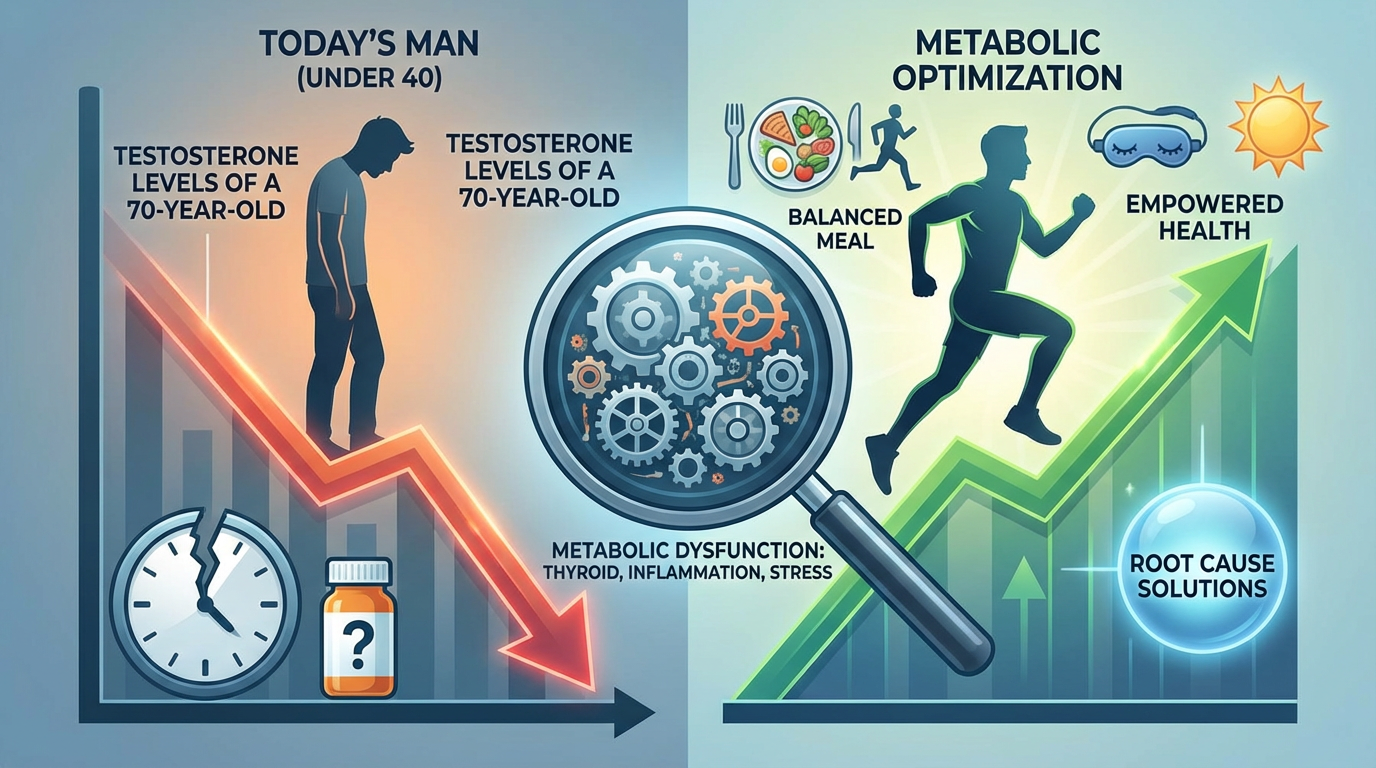
A landmark study published in the Journal of Clinical Endocrinology & Metabolism tracked testosterone levels across different generations of American men. The findings were alarming: testosterone levels have been declining by roughly 1% per year since at least the 1980s. That's not 1% over a lifetime. That's 1% every single year, independent of age.
This means a 35-year-old man in 2024 has significantly lower testosterone than a 35-year-old man in 1994, who had lower levels than a 35-year-old in 1974.
The "normal" reference range on your lab report (typically 270-1070 ng/dL) was established using population data that includes this declining trend. So when your doctor says you're "normal," what they really mean is: you're normal compared to an increasingly unhealthy population.
Here's what testosterone levels by age actually looked like historically versus today:
Historical Averages (1980s data):
- Age 25-34: 600-900 ng/dL
- Age 35-44: 500-800 ng/dL
- Age 45-54: 450-700 ng/dL
Current "Normal" Ranges:
- Age 25-34: 400-600 ng/dL (considered "healthy")
- Age 35-44: 350-550 ng/dL (considered "healthy")
- Age 45-54: 300-500 ng/dL (considered "healthy")
See the problem? What was considered borderline low in 1985 is now considered perfectly normal. The goalposts have moved, and nobody told you.
Why Your Doctor Missed It: The "Normal Range" Lie
When you get bloodwork done, your results are compared against a reference range. But here's what most people don't understand: those ranges are statistical, not optimal.
Reference ranges are typically set to include 95% of the "healthy" population. But if the entire population is getting sicker, the reference range shifts to accommodate that sickness.
It's like measuring the "normal" weight of Americans and concluding that obesity is healthy because most people are obese. The math works, but the logic is catastrophically flawed.
For testosterone, this creates a dangerous situation. Men walk into their doctor's office with all the classic symptoms of low testosterone: fatigue, brain fog, low libido, depression, muscle loss, weight gain. They get tested. Their levels come back at 350 ng/dL. And they're told everything is fine.
But 350 ng/dL at age 35 is not fine. It's a metabolic crisis masquerading as normalcy.
The symptoms you're experiencing are real. Your body is telling you something is wrong. And no lab reference range should be allowed to gaslight you out of that reality.
What's Really Causing the Testosterone Decline
Here's where conventional medicine gets it completely backwards.
Most doctors, when confronted with low testosterone, immediately think about the testicles. Are they producing enough? Should we supplement with external testosterone?
But testosterone production is downstream of something far more fundamental: your metabolic health.
Your body doesn't produce testosterone in isolation. It produces testosterone when it has the energy, the raw materials, and the metabolic signaling that says, "We're thriving. It's safe to invest in reproduction and vitality."
When your metabolism is suppressed, when your cells can't produce adequate energy, when your body is in a chronic state of stress, testosterone production gets deprioritized. Your body is too busy surviving to invest in thriving.
The real drivers of low testosterone in young men:
Chronic Energy Deficit
Your Leydig cells (the testosterone-producing cells in your testes) are incredibly energy-demanding. They need robust ATP production to synthesize testosterone. When cellular energy production is compromised, testosterone synthesis is one of the first things to go.
This is why chronic dieters, over-exercisers, and men with poor sleep often have tanked testosterone. Their bodies are in energy conservation mode.
Thyroid Dysfunction
Your thyroid controls your metabolic rate. When thyroid function is low (even "subclinically" low), everything slows down, including testosterone production.
Here's the connection most doctors miss: the same lifestyle factors that suppress testosterone also suppress thyroid function. They're two symptoms of the same underlying problem: metabolic dysfunction.
Many men with "low testosterone" actually have undiagnosed or undertreated thyroid issues. Fix the thyroid, and testosterone often improves without any direct intervention.
Chronic Inflammation
Inflammation is a testosterone killer. Inflammatory cytokines directly suppress the hypothalamic-pituitary-gonadal (HPG) axis, the hormonal cascade that controls testosterone production.
Where does chronic inflammation come from? Poor diet (especially seed oils and processed foods), gut dysfunction, chronic infections, obesity, lack of sleep, and chronic stress.
Endocrine Disruptors
We're swimming in chemicals that mimic or block hormones. Plastics, pesticides, personal care products, flame retardants, and countless other modern chemicals have documented effects on testosterone production.
The average person today has measurable levels of hundreds of synthetic chemicals in their bloodstream that didn't exist 100 years ago. Many of these are known endocrine disruptors.
Chronic Stress and Cortisol
When you're chronically stressed, your body prioritizes cortisol production over testosterone production. They compete for the same precursor hormone (pregnenolone), and cortisol wins every time.
This is called the "pregnenolone steal." Your body literally steals the raw materials that would have become testosterone and uses them to make stress hormones instead.
Modern life is a cortisol-production machine: chronic work stress, financial anxiety, relationship problems, constant digital stimulation, poor sleep, over-exercise. Your body thinks it's fighting for survival 24/7.
The Symptoms Nobody Connects to Testosterone
Low testosterone doesn't just affect your libido. It affects virtually every system in your body. But because the symptoms are so diffuse, most men (and their doctors) never connect them to hormonal dysfunction.
Brain fog and cognitive decline: Testosterone is neuroprotective. Low levels are associated with difficulty concentrating, memory problems, and mental fatigue.
Depression and anxiety: Testosterone influences neurotransmitter function. Men with low testosterone have significantly higher rates of depression and anxiety.
Fatigue that sleep doesn't fix: Even when you get 8 hours, you wake up exhausted. Your cells don't have the hormonal signaling they need to produce energy efficiently.
Stubborn weight gain: Testosterone helps regulate body composition. Low levels make it easier to gain fat and harder to build or maintain muscle.
Loss of motivation: That drive you used to have? It's not just "getting older." Testosterone is directly linked to motivation and goal-directed behavior.
Poor recovery: You used to bounce back from workouts, late nights, or stress. Now everything takes longer to recover from.
Temperature dysregulation: Feeling cold all the time? Low testosterone often correlates with low thyroid function and poor metabolic heat production.
The TRT Trap: Why Replacement Therapy Isn't Always the Answer
When men finally get diagnosed with low testosterone, the standard medical response is testosterone replacement therapy (TRT): gels, injections, or pellets that provide external testosterone.
And here's the uncomfortable truth: for many men, TRT works. They feel better. Energy improves. Brain fog lifts. Mood stabilizes.
But TRT doesn't fix the underlying problem. It just bypasses it.
When you take external testosterone, your body reduces its own production. Your testicles, sensing adequate testosterone in the bloodstream, downregulate their activity. This is why men on TRT often experience testicular atrophy.
More importantly, TRT doesn't address why testosterone was low in the first place. The metabolic dysfunction, the thyroid issues, the chronic inflammation, the endocrine disruptor exposure: all of that continues unchecked.
TRT is a lifetime commitment. Once you start, your body becomes dependent on the external supply. Stopping TRT means crashing harder than before you started.
For some men, TRT is genuinely necessary and life-changing. But for many others, it's a band-aid solution that creates new problems while masking the old ones.
The better question isn't "How do I raise my testosterone?" It's "Why is my body not producing adequate testosterone, and how do I fix that?"
How to Actually Increase Testosterone Naturally
Here's the good news: for most men, testosterone can be significantly improved without replacement therapy. It requires addressing root causes rather than symptoms.
Fix Your Metabolism First
Your testosterone production is downstream of your metabolic health. If your cells aren't producing energy efficiently, your body won't prioritize testosterone synthesis.
Key metabolic interventions:
- Eat enough calories. Chronic undereating suppresses testosterone. Your body needs adequate fuel to produce hormones.
- Prioritize saturated fats. Cholesterol is the precursor to all steroid hormones, including testosterone. Low-fat diets are testosterone killers.
- Avoid seed oils. Polyunsaturated fatty acids accumulate in tissues and impair cellular respiration. Stick to butter, coconut oil, olive oil, and animal fats.
- Support thyroid function. Adequate iodine, selenium, and vitamin A. Avoid goitrogens. Consider a complete thyroid panel (not just TSH).
Optimize Sleep
Testosterone is produced primarily during deep sleep. Poor sleep quality directly suppresses testosterone production.
Sleep optimization priorities:
- Consistent sleep schedule. Your hormones follow circadian rhythms.
- Complete darkness. Any light exposure during sleep disrupts melatonin and downstream hormone production.
- Cool temperature. 65-68 degrees Fahrenheit is optimal for sleep quality.
- No alcohol before bed. Alcohol destroys sleep architecture and directly suppresses testosterone synthesis.
Manage Stress Intelligently
Chronic cortisol elevation steals pregnenolone from testosterone production. Stress management isn't optional.
Practical stress interventions:
- Morning sunlight exposure. Regulates cortisol rhythm.
- Blood sugar stability. Reactive hypoglycemia triggers cortisol spikes.
- Boundaries with work. Constant availability creates chronic stress.
- Strategic rest. Recovery is when adaptation happens.
Reduce Endocrine Disruptor Exposure
You can't eliminate all exposure, but you can reduce it significantly.
High-impact changes:
- Filter your water. Many municipal water supplies contain endocrine disruptors.
- Avoid plastic food storage. Especially don't heat food in plastic.
- Choose clean personal care products. What goes on your skin enters your bloodstream.
- Eat organic when possible. Especially for the "dirty dozen" highest-pesticide foods.
Train Smart, Not Excessive
Exercise can boost testosterone, but excessive exercise suppresses it. The key is intensity, not volume.
Testosterone-supporting exercise:
- Resistance training. Heavy compound movements stimulate testosterone production.
- Short, intense sessions. 45-60 minutes maximum. Marathon gym sessions spike cortisol.
- Adequate recovery. More is not better. Overtraining crashes testosterone.
- Avoid chronic cardio. Long-duration endurance exercise is particularly suppressive.
The Biospark Approach: Root Cause Over Band-Aid
At Biospark Health, we see the testosterone crisis for what it is: a symptom of widespread metabolic dysfunction, not a standalone disease requiring pharmaceutical intervention.
Our approach starts with understanding your unique metabolic picture. We look at thyroid function (the complete panel, not just TSH), inflammatory markers, metabolic indicators, and lifestyle factors that conventional medicine ignores.
We don't start with testosterone replacement. We start with the question: why isn't your body producing adequate testosterone?
For many men, optimizing metabolism, supporting thyroid function, addressing inflammation, and improving lifestyle factors produces dramatic improvements in testosterone, naturally, without creating dependence on external hormones.
When TRT is genuinely indicated, we use it strategically as part of a comprehensive protocol, not as a standalone solution.
The goal isn't just to get your testosterone numbers up. It's to restore the metabolic health that allows your body to produce testosterone naturally, sustainably, and in balance with all your other hormones.
Testosterone Optimization in Reading & Berks County, PA
If you're a man in the Reading, Wyomissing, or greater Berks County area struggling with fatigue, brain fog, weight gain, or low motivation, and you suspect testosterone might be part of the picture, you need a practitioner who looks deeper than standard lab ranges.
At Biospark Health in Wyomissing, we work with men throughout southeastern Pennsylvania who've been told their testosterone is "normal" while they continue to feel terrible. We serve clients from Lancaster, Allentown, Downingtown, West Chester, and the greater Philadelphia suburbs.
Our approach to testosterone optimization addresses root causes rather than simply prescribing replacement therapy. Whether you're in King of Prussia, the Main Line, or anywhere in Chester County, we offer both in-person and virtual consultations to help you understand what's really driving your symptoms.
For Pennsylvania men seeking comprehensive testosterone evaluation and metabolic health support, Biospark Health provides the thorough assessment and personalized protocols you won't find in conventional medicine.
Frequently Asked Questions
What is a good testosterone level for my age?
The "normal" ranges you see on lab reports are statistical averages from an increasingly unhealthy population. Optimal testosterone for a man in his 30s is typically 600-900 ng/dL, not the 350-500 ng/dL that labs consider "normal." Symptoms matter more than numbers: if you have classic low testosterone symptoms, your levels may be suboptimal even if they fall within the reference range.
Can low testosterone cause brain fog and fatigue?
Absolutely. Testosterone is neuroprotective and plays a crucial role in energy production and cognitive function. Brain fog, difficulty concentrating, and persistent fatigue are among the most common symptoms of low testosterone, yet they're often attributed to stress, aging, or depression rather than hormonal dysfunction.
Should I start testosterone replacement therapy?
TRT can be life-changing for men who genuinely need it, but it shouldn't be the first option. Many cases of low testosterone can be significantly improved by addressing underlying metabolic dysfunction, thyroid issues, chronic inflammation, and lifestyle factors. TRT creates lifelong dependence and doesn't address root causes. A thorough evaluation should precede any decision about replacement therapy.
Why is testosterone declining in younger men?
Multiple factors contribute to the generational decline: increased endocrine disruptor exposure, chronic stress, poor sleep, processed food diets, sedentary lifestyles, and widespread metabolic dysfunction. The decline is environmental and lifestyle-driven, not genetic, which means it's largely reversible with the right interventions.
How quickly can testosterone improve naturally?
With comprehensive metabolic optimization, many men see improvements within 8-12 weeks. However, sustainable results require ongoing attention to the factors that suppressed testosterone in the first place. Quick fixes don't exist, but meaningful improvement is absolutely achievable for most men.
Conclusion
Your testosterone levels don't match your age because you're living in an environment that's hostile to hormonal health. The generational decline is real, the symptoms are real, and the dysfunction is real, even if your lab results say you're "normal."
But here's the empowering truth: this isn't inevitable. Your body wants to produce testosterone. It wants to give you energy, clarity, strength, and vitality. It just needs the right conditions.
Stop chasing testosterone boosters and questioning whether you need TRT. Start asking the deeper question: what's preventing your body from producing the testosterone it's designed to make?
Fix the metabolism. Support the thyroid. Reduce the inflammation. Optimize the lifestyle. Give your body what it needs, and watch your hormones respond.
Your testosterone levels can match your age again. You just need to address what's really going on.
Tags:
References & Citations
This article is supported by scientific research and peer-reviewed sources. Click citations to verify the evidence.
- [1]Travison TG, Araujo AB, O'Donnell AB, et al.(2007)A population-level decline in serum testosterone levels in American men.The Journal of Clinical Endocrinology and Metabolism.View Source
- [2]Harman SM, Metter EJ, Tobin JD, et al.(2001)Longitudinal effects of aging on serum total and free testosterone levels in healthy men.The Journal of Clinical Endocrinology and Metabolism.View Source
- [3]Whittaker J, Wu K(2021)Low-fat diets and testosterone in men: Systematic review and meta-analysis of intervention studies.The Journal of Steroid Biochemistry and Molecular Biology.View Source
- [4]Ide H(2023)The impact of testosterone in men's health.Endocrine Journal.View Source
- [5]Yilmaz B, Terekeci H, Sandal S, et al.(2020)Endocrine disrupting chemicals: exposure, effects on human health, mechanism of action, models for testing and strategies for prevention.Reviews in Endocrine and Metabolic Disorders.View Source
- [6]Smith SJ, Lopresti AL, Fairchild TJ(2023)The effects of alcohol on testosterone synthesis in men: a review.Expert Review of Endocrinology and Metabolism.View Source
- [7]Pencina KM, Travison TG, Cunningham GR, et al.(2024)Effect of Testosterone Replacement Therapy on Sexual Function and Hypogonadal Symptoms in Men with Hypogonadism.The Journal of Clinical Endocrinology and Metabolism.View Source
All references have been reviewed for scientific accuracy and credibility. Citations follow standard academic format and link to original research where available.
About Dr. Steven Presciutti, MD
Founder & Health Coach at Biospark Health, specializing in bioenergetic health and metabolism optimization.