Cortisol and Weight Gain: Why Stress Is Making You Store Fat (Not Burn It)
Cortisol and weight gain are linked at the cellular level. Stress hormones don't burn fat, they store it. Learn the bioenergetic root cause and how to fix it.
Medical Disclaimer
This content is for informational and educational purposes only. It is not a substitute for professional medical advice, diagnosis, or treatment. Always seek the advice of your physician or other qualified health provider with any questions you may have regarding a medical condition.
You cut your calories. You added more steps. You swore off carbs after 6pm. And somehow, the scale crept up anyway, especially around your midsection. If that sounds familiar, the problem is almost certainly not your willpower. It is your cortisol.
The link between cortisol and weight gain is one of the most misunderstood stories in modern health. The popular version says stress releases cortisol, cortisol makes you eat donuts at midnight, and that is how you get fat. The real story is far stranger, and far more fixable. Cortisol does not need a donut to store fat. It can reorganize your entire metabolism toward fat storage all on its own, even in a calorie deficit, because it is responding to an energy problem at the cellular level.
In this article we are going to look at what cortisol actually does to your fat tissue, why the strategies you have been told to try (eat less, fast more, train harder) tend to make cortisol and weight gain worse, and what a bioenergetic, root-cause approach looks like instead. If you have been told your labs are "normal" while your waistline keeps growing, this is the missing piece.
The Real Mechanism Behind Cortisol and Weight Gain
Cortisol is your body's primary stress hormone, released by the adrenal glands whenever your brain perceives that energy demand has outpaced energy supply. Notice the phrasing. Cortisol is not released only by psychological stress. It is released by anything the body reads as an energy threat: skipping meals, undereating carbohydrates, overtraining, poor sleep, infection, toxins, or chronic worry. The common thread is always the same. The cell is not getting enough fuel.
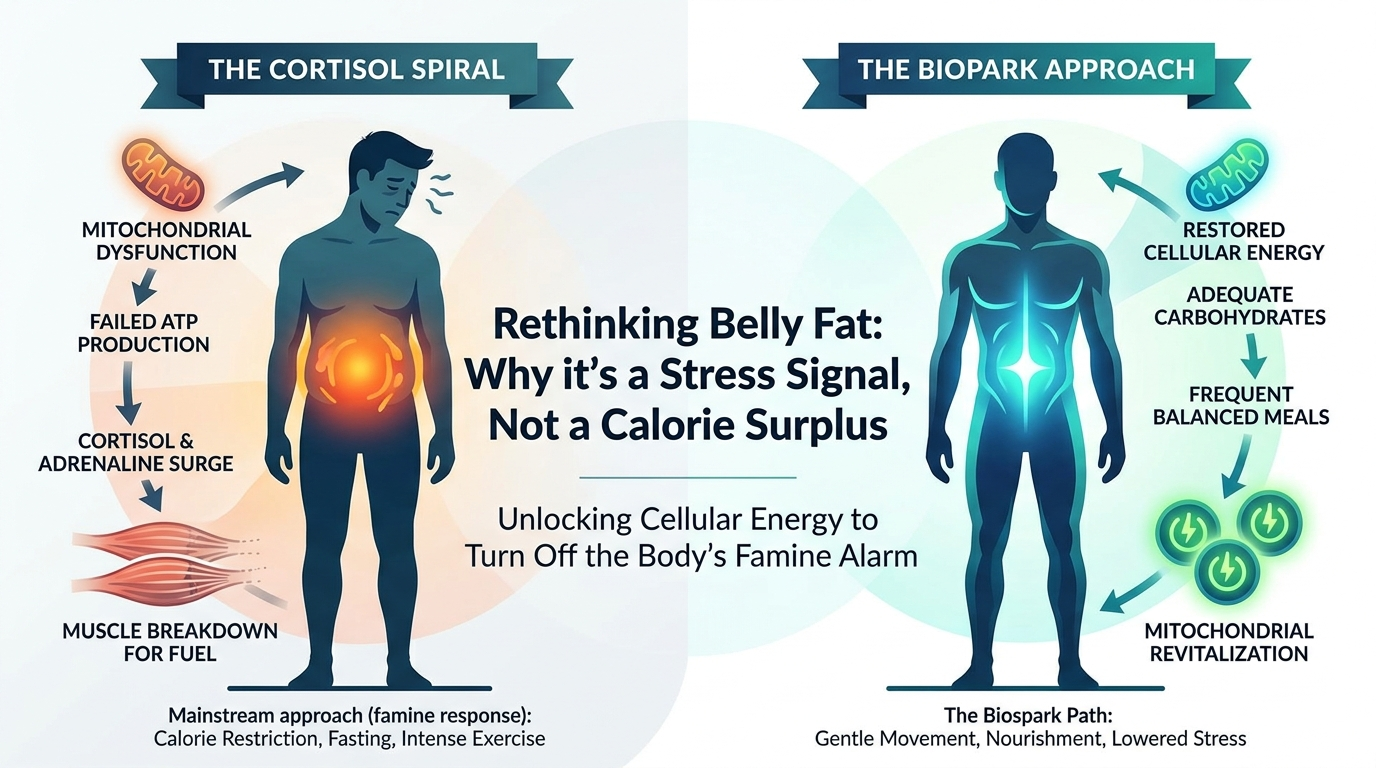
Here is the part most people miss. In the bioenergetic model, cortisol-driven weight gain begins with a cellular energy deficit, not a calorie surplus. When your mitochondria cannot produce enough ATP (the energy currency of the cell) to meet demand, your body releases cortisol as an emergency workaround. Cortisol's job is to break down your own tissue, mostly muscle and organ protein, and convert it into glucose to keep your brain alive. That is a brilliant short-term survival move and a terrible long-term metabolic strategy.
The problem is what cortisol does next. As it tears down your muscle for fuel, it simultaneously suppresses active thyroid hormone (T3), the hormone that sets your metabolic rate. Less T3 means a slower metabolism, a colder body, and less energy burned at rest. At the same time, cortisol directs incoming calories away from muscle and toward visceral fat storage around your organs, the stubborn "cortisol belly" that resists every diet. Your body is essentially hoarding fuel in the safest possible place because it believes, biochemically, that a famine is underway.
Modern endocrinology quietly confirms this mechanism. Cushing's syndrome, a condition of extreme cortisol excess, produces a textbook body composition: a round face, fat across the upper back, and heavy visceral abdominal fat, often with muscle wasting in the arms and legs. As Pivonello and colleagues documented in their landmark review, the complications of chronic cortisol excess include central obesity, insulin resistance, and muscle loss, the exact pattern millions of people develop gradually without ever being diagnosed with a cortisol disorder.
The deeper molecular story is even more revealing. Inside your fat tissue sits an enzyme called 11β-hydroxysteroid dehydrogenase type 1, or 11β-HSD1. Its job is to reactivate inactive cortisone back into active cortisol right at the local level. Research by Staab and Maser showed that 11β-HSD1 is a critical regulator at the interface of obesity and inflammation, meaning fat tissue essentially generates its own cortisol supply. This is why visceral fat is so metabolically destructive and so hard to lose. It is not passive storage. It is an active cortisol factory that lowers mitochondrial activity and reduces adiponectin, a protective hormone.
Pharmaceutical companies understand this perfectly. Both Pfizer and Merck have pursued obesity and diabetes drugs whose primary mechanism is blocking 11β-HSD1. In other words, the same industry that publicly frames obesity as a willpower problem is privately betting billions that cortisol reactivation in fat tissue is a root cause. You do not need their drug. You need to understand why your body is stuck in cortisol mode and how to switch it off.
Why Your Cortisol Belly Isn't About Calories
If cortisol and weight gain were simply about eating too much, then eating less would reliably fix it. It does not. In fact, aggressive calorie restriction is one of the fastest ways to deepen a cortisol belly, and the reason comes straight back to cellular energy.
When you slash calories, your cells register an immediate fuel shortage. Cortisol rises to compensate. That cortisol begins breaking down metabolically active muscle tissue for emergency glucose. You lose weight on the scale, yes, but a large portion of it is muscle, not fat. Because muscle is the engine that burns fuel, losing it crashes your resting metabolic rate. Active thyroid hormone drops. Your body runs cooler. You feel tired, foggy, and hungry. And when you inevitably eat normally again, your newly suppressed metabolism channels those calories straight into visceral fat as a protective buffer against the next "famine" it now expects. This is the physiology of yo-yo dieting, and it is driven by cortisol, not by character flaws.
This also explains the menopause pattern. Cortisol weight gain in menopause is not mysterious once you see the energy picture. As estrogen and progesterone decline, women lose two of their main anti-stress, pro-metabolic hormones. Cortisol's voice gets louder relative to the hormones that used to balance it. Sleep fragments, thyroid conversion slows, and visceral fat accumulates, even with no change in diet. The conventional advice to "eat less and do more cardio" pushes an already stressed system harder, which raises cortisol further and accelerates exactly the storage pattern women are trying to escape.
The insulin story is similarly backwards. The dominant mainstream narrative blames carbohydrates and insulin for fat storage, which leads people to cut carbs, fast, or go keto. But here is the energetic truth: carbohydrates are the one macronutrient that actively lowers cortisol. When you remove them, your brain still demands glucose, and the only way to get it is to manufacture it from your own tissue through a cortisol-driven process called gluconeogenesis. Low-carb diets can look like they "work" short term because blood sugar stabilizes, but that stability is often an illusion maintained by chronic cortisol elevation. Over months, that cortisol dominance suppresses thyroid, reduces insulin sensitivity, and signals the body to store visceral fat. Mazgelytė and Karčiauskaitė's recent work on cortisol in metabolic syndrome lays out exactly how chronic cortisol exposure drives the cluster of insulin resistance, central obesity, and dyslipidemia.
So how do you know if weight gain is from cortisol? The signature is central distribution (fat around the midsection and upper back rather than hips and thighs), loss of muscle or strength, fatigue that worsens with dieting and exercise, cold hands and feet, poor sleep, and a sense that the harder you try, the worse it gets. If that pattern sounds like yours, your problem is not discipline. It is that your body is marinating in stress hormones because it cannot make enough energy.
The Habits That Spike Cortisol and Store Fat
Once you understand that cortisol and weight gain are an energy problem, the "healthy" habits that backfire become obvious. The body does not distinguish between voluntary discipline and actual starvation. To your cells, a skipped breakfast, a 16-hour fast, and a famine are all the same signal: fuel is scarce, release cortisol.
Fasting is the most celebrated and most misunderstood of these. Yes, intermittent fasting lowers insulin. It also rapidly depletes liver glycogen, your ready energy reserve, and once that glycogen is gone, the body fires cortisol and adrenaline to keep blood sugar stable. The mental clarity and energy people feel while fasting is real, but it is not a healing signal. It is an adrenaline and cortisol high, the same chemistry of a body under threat. Sustained over time, chronic fasting eats lean mass, lowers T3, and primes rebound visceral fat storage. The rebound weight that follows a fast is not a failure of the fast. It is the cortisol bill coming due.
Intense exercise tells the same story. High-intensity interval training and long cardio sessions are pitched as the ultimate fat burners because of the "afterburn" effect. But sustained, high-heart-rate effort is read by the body as a life-or-death emergency, and it triggers a massive cortisol release. During that effort, cortisol drives gluconeogenesis, cannibalizing muscle to fuel the workout, while blocking the conversion of T4 into active T3. That celebrated afterburn is not a healthy metabolic boost. It is the inflammatory footprint of a body frantically recovering from oxidative damage and cortisol overload. This is why so many people gain weight despite training hours a day. They have induced a state that researchers describe as exercise-induced hypothyroidism.
The same applies to under-sleeping, over-caffeinating, and chronic dieting. Each one is a cortisol amplifier. None of them burn fat in a lasting way. They all deepen the energy deficit that started the problem. If your plan for losing your cortisol belly involves eating less, fasting longer, and training harder, you are prescribing the exact stressors that created it.
The good news is that the fix is the mirror image of the cause. Because cortisol weight gain is an energy deficit problem, the answer is not less fuel and more punishment. It is abundant, easily used fuel, delivered often, in a body that finally feels safe.
The Biospark Approach
At Biospark Health, we do not treat cortisol and weight gain by attacking the fat or suppressing the appetite. We treat it the way you fix any alarm system that will not stop ringing: you address the fire it is responding to. In this case, the fire is cellular energy deficiency, and the alarm is cortisol.
The first principle is that you cannot starve a body into feeling safe. So we start by restoring fuel. That means an absolute minimum of 150 grams of carbohydrates daily, ideally closer to 200 to 300 grams from easily digestible, nutrient-dense sources: ripe fruit, fresh juice, raw honey, and well-cooked root vegetables like potatoes, squash, and carrots. Carbohydrates are the fastest way to tell your cells that fuel is plentiful, which directly lowers the demand for cortisol. We pair them with moderate protein balanced by gelatin or collagen (a cup of bone broth or 10 to 20 grams of gelatin with muscle meat) to offset the inflammatory amino acids that otherwise raise stress hormones.
Meal timing matters as much as macros. We have patients eat a real breakfast within 30 to 60 minutes of waking, because the morning cortisol surge is exactly when the body most needs reassurance that food is coming. Then we build in balanced meals every 3 to 4 hours, plus a small bedtime snack of carbohydrate and protein (milk and honey, or cheese and fruit) to prevent the overnight blood-sugar dips that trigger 3am cortisol spikes. A daily raw carrot salad (one shredded carrot, a teaspoon of coconut oil, a teaspoon of vinegar, and a pinch of salt) helps reduce endotoxin and estrogen load, both of which amplify cortisol's effects.
We use salt liberally, because sodium is a natural anti-stress mineral. We replace punishing workouts with 20 to 30 minutes of daily walking, especially after meals, plus brief, sensible strength training twice a week. We optimize light: 10 to 15 minutes of morning sunlight to set the circadian rhythm, and blue-light blocking in the evening so the body can wind down instead of staying in daytime cortisol mode.
For patients who need more support, we layer in targeted supplements that help the cell produce energy and buffer stress: niacinamide, low-dose aspirin, and where appropriate, bioidentical progesterone, pregnenolone, or thyroid support to raise the metabolic rate. Every recommendation points the same direction: give the cell the fuel and signaling it needs to make ATP, so the body no longer needs cortisol as a crutch.
This is what Dr. Presciutti and our team do differently. We do not hand you a 1,200-calorie plan and a step goal. We read your labs, your symptoms, and your story through the bioenergetic lens, find the energy bottleneck, and remove it. When the cell can finally breathe, cortisol falls on its own, and the body stops defending its fat stores.
Ready to restore your metabolism at the cellular level?
The Bioenergetic Reset Program addresses root causes, not symptoms. Join 300+ members who have discovered what real metabolic health feels like.
- 9+ hours of comprehensive training
- Twice-monthly LIVE coaching calls
- Complete meal plans and protocols
- Direct email support
/month | Cancel anytime
Cortisol and Weight Gain Support in Reading and Berks County, PA
If you are stuck in a cortisol belly here in the Reading or Wyomissing area, you are far from alone. Across Berks County, we see the same pattern every week: people working hard, eating less, exercising more, and watching their waistlines grow anyway, while being told their labs look fine.
Biospark Health was built for exactly this. We serve clients throughout southeastern Pennsylvania, including Reading, Wyomissing, Lancaster, Downingtown, Allentown, and West Chester. Our bioenergetic approach looks past the calorie math and asks the real question: why is your body stuck in stress-storage mode? Once we answer that, the cortisol weight gain finally has somewhere to go but down.
Whether you want in-person guidance or virtual support from anywhere in the greater Philadelphia region, we will meet you where you are and build a plan around your actual metabolism, not a generic template. If you have been told your cortisol is "normal" while your symptoms scream otherwise, that is precisely the gap we exist to fill.
Frequently Asked Questions
How do you get rid of cortisol weight gain?
You do not get rid of it by cutting calories or training harder, because those raise cortisol. You reverse it by feeding the cell: adequate carbohydrates (150 to 300 grams daily), frequent balanced meals, a real breakfast, generous salt, gentle movement, and good sleep. The goal is to signal abundance so the body stops defending its fat stores. Targeted support like progesterone, thyroid, or niacinamide can help when diet alone is not enough.
How do I reduce my cortisol levels?
Cortisol falls naturally when energy is plentiful and the body feels safe. Eat enough, especially carbohydrates, never skip breakfast, avoid prolonged fasting and intense overtraining, get morning sunlight, block blue light at night, and prioritize sleep. Salt, gelatin, and mineral-rich foods all help buffer the stress response.
What is the best supplement to lower cortisol levels?
There is no single best supplement, because cortisol is a symptom of an energy deficit, not a deficiency in a pill. That said, niacinamide helps cells produce energy efficiently, progesterone opposes cortisol directly, and pregnenolone supports the stress-hormone system. The right supplement depends on your labs and symptoms, which is why we assess before recommending.
Does cortisol cause weight gain or weight loss?
Both, which is why it is so confusing. In the short term and in small amounts, cortisol can break down tissue and cause weight loss on the scale. Chronically elevated, it shifts the body toward muscle loss and visceral fat gain, so you lose the wrong kind of weight and gain it back as belly fat. The pattern most people experience is weight loss followed by rebound central fat storage.
Conclusion
Cortisol and weight gain are not a story about laziness or excess. They are a story about a body that cannot make enough energy and is doing its best to keep you alive. Every pound of visceral fat, every lost pound of muscle, every diet that stopped working, is your metabolism asking for fuel, not punishment.
The mainstream playbook of eating less, fasting more, and training harder is built on the assumption that fat is surplus energy waiting to be burned. It is not. Visceral fat is a cortisol-driven storage program, and you cannot out-discipline a hormone that believes you are starving. The way out is the opposite of what got you here: abundant fuel, steady meals, gentle movement, and a metabolism that finally feels safe enough to let go.
If your cortisol belly has resisted every conventional approach, that is not a personal failure. It is a signal that the real root cause has never been addressed. At Biospark Health, we help people across Reading, Berks County, and the broader Pennsylvania region fix that root cause for good. The fat is not the enemy. The energy deficit is. Fix the energy, and the cortisol takes care of itself.
Tags:
References & Citations
This article is supported by scientific research and peer-reviewed sources. Click citations to verify the evidence.
- [1]Martinez GJ, Appleton M, Kipp ZA, et al.(2024)Glucocorticoids, their uses, sexual dimorphisms, and diseases: new concepts, mechanisms, and discoveries.Physiological Reviews.View Source
- [2]Staab CA, Maser E(2010)11beta-Hydroxysteroid dehydrogenase type 1 is an important regulator at the interface of obesity and inflammation.Journal of Steroid Biochemistry and Molecular Biology.View Source
- [3]Pivonello R, Isidori AM, De Martino MC, et al.(2016)Complications of Cushing's syndrome: state of the art.Lancet Diabetes and Endocrinology.View Source
- [4]Mazgelyte E, Karčiauskaitė D(2024)Cortisol in metabolic syndrome.Advances in Clinical Chemistry.View Source
- [5]Peeke PM, Chrousos GP(1995)Hypercortisolism and obesity.Annals of the New York Academy of Sciences.View Source
- [6]Tirabassi G, Muscogiuri G, Colao A, et al.(2016)Dysregulation of the hypothalamic-pituitary-adrenal axis increases central body fat accumulation in males affected by diabetes mellitus and late-onset hypogonadism.Endocrine Practice.View Source
All references have been reviewed for scientific accuracy and credibility. Citations follow standard academic format and link to original research where available.
About Dr. Steven Presciutti, MD
Founder & Health Coach at Biospark Health, specializing in bioenergetic health and metabolism optimization.