How to Increase Progesterone Naturally: The Daily Routine That Actually Works (It Starts With Breakfast)
How to increase progesterone naturally through your daily routine. Why progesterone is built inside your mitochondria, and why ovulation is a metabolic event.
Medical Disclaimer
This content is for informational and educational purposes only. It is not a substitute for professional medical advice, diagnosis, or treatment. Always seek the advice of your physician or other qualified health provider with any questions you may have regarding a medical condition.
You are wiped out for the ten days before your period. You wake at three in the morning with your heart going and no reason for it. Your hands are cold in a warm room, you bloat until your rings do not fit, and the week before your period you feel like a different person living in the same body.
Someone has probably told you that you have low progesterone. That part is likely true. What almost nobody tells you is why, and the answer changes everything about how to increase progesterone naturally.
Here is the short version. Progesterone is not something your ovaries decide to make or not make. It is manufactured, from raw materials, inside your mitochondria. That manufacturing line requires cholesterol as the input, active thyroid hormone to switch on the transport protein that carries the cholesterol in, vitamin A as a cofactor for the enzyme that makes the first cut, and enough oxygen and energy to run the whole thing. Take away any one of those and production stops, no matter how healthy your ovaries are.
Which means low progesterone is rarely a reproductive failure. It is usually an energy shortage that your body is responding to intelligently.
Every article you have read on this topic gives you the same list: manage stress, take magnesium, try vitex, do seed cycling. Some of that helps a little. One of those items actively makes it worse. And the single highest-leverage intervention, the one that changes what your ovaries can do by tomorrow morning, is not on any of those lists.
It is what you eat within an hour of waking up.
Your Progesterone Problem Is an Energy Problem, Not an Ovary Problem
Start with the manufacturing line, because once you see it you cannot unsee it.
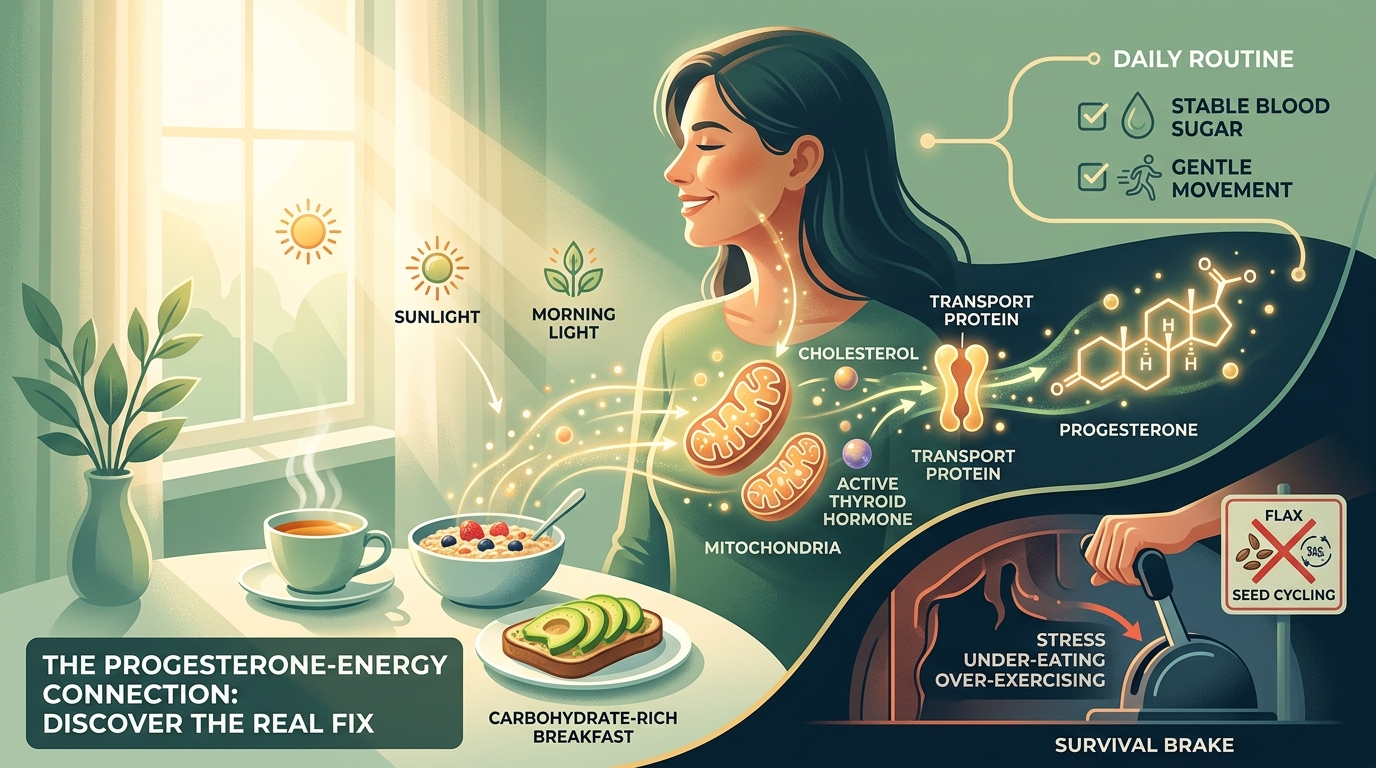
Every steroid hormone in your body begins as cholesterol. To become a hormone, that cholesterol has to physically get inside the mitochondrion, which is the energy-producing compartment of the cell. It cannot drift in on its own. It has to be carried, and the carrier is a molecule called StAR, short for steroidogenic acute regulatory protein. This step is the bottleneck for the entire process.
StAR is regulated by active thyroid hormone. When T3 is present, StAR is expressed and cholesterol moves in. When T3 is low, the carrier is not there in sufficient quantity and the cholesterol sits outside the door. Laboratory work on steroid-producing cells has traced this pathway in detail, showing thyroid hormone driving StAR expression and steroid output together, though that particular work was done in mouse cells rather than human ovaries.
The human evidence is more direct and considerably more interesting. In 1998, researchers took luteal cells from human ovaries, the exact cells responsible for making progesterone after ovulation, and exposed them to thyroid hormone. Progesterone release went up. The thyroid hormone was not acting on the brain or the pituitary in that experiment. It was acting on the progesterone factory itself.
Once cholesterol is inside, an enzyme called P450scc makes the first cut and turns it into pregnenolone, the parent molecule for progesterone. That enzyme needs vitamin A. A 2024 study in granulosa cells found retinoic acid enhancing ovarian steroid production specifically through the STAR and CYP11A1 pathway, which is the same machinery described above. That work was done in cells and animals rather than in women, so treat it as mechanism rather than proof, but it lines up with what clinicians in this field have observed for decades.
Ray Peat, whose work informs much of the bioenergetic model, put the practical version of this plainly in his article on menopause. Progesterone synthesis, he wrote, is prevented by deficiencies in thyroid function, vitamin A, and LDL cholesterol, and interfered with by prolactin, ACTH, estrogen, and cortisol.
Read that list again. Two of the items are nutrients. One is thyroid function. Three are stress hormones. Not one of them is your ovary.
Does Low Progesterone Mean You Are Not Ovulating?
This is the question that brings most women to this topic, and the mainstream answer is a flat yes: low progesterone on a day 21 blood draw means you did not ovulate, or you have something called luteal phase defect.
Peat pushed back on the certainty behind that framing:
"Ovulation is one thing, and the production of hormones is another thing. You can't determine whether ovulation has occurred by measuring the hormones."
The practical upshot is that a low progesterone reading tells you the manufacturing line is underperforming. It does not, on its own, tell you the egg never released, and it certainly does not tell you your ovaries are defective.
What it does tell you is that your body has applied a brake. Ovulation and the luteal phase are metabolically expensive. Your body will not spend that energy if it believes energy is scarce, because starting a pregnancy during a famine is a way to lose both the mother and the child. This is not malfunction. This is the system working exactly as designed.
The human research here is solid. A 2021 study following female runners through a period of training overload found that when energy availability dropped, ovarian function was suppressed alongside markers of non-functional overreaching. A 2021 review of functional hypothalamic amenorrhoea traced the same shutdown in women facing psychological stress, restrictive eating, excessive exercise, or some combination. And the mechanism connecting stress to the shutdown was demonstrated back in 1988, when researchers documented elevated cortisol in women with stress-driven loss of cycles.
One honest caveat. A 2024 critical review examined whether menstrual disturbance really turns on a clean energy availability threshold and concluded the evidence for a single tidy cutoff is weaker than it is often presented. Individual variation is large. The direction of the relationship is well supported. A precise number that applies to every woman is not, and anyone selling you one is overstating what we know.
The Free Test You Can Run Tomorrow Morning
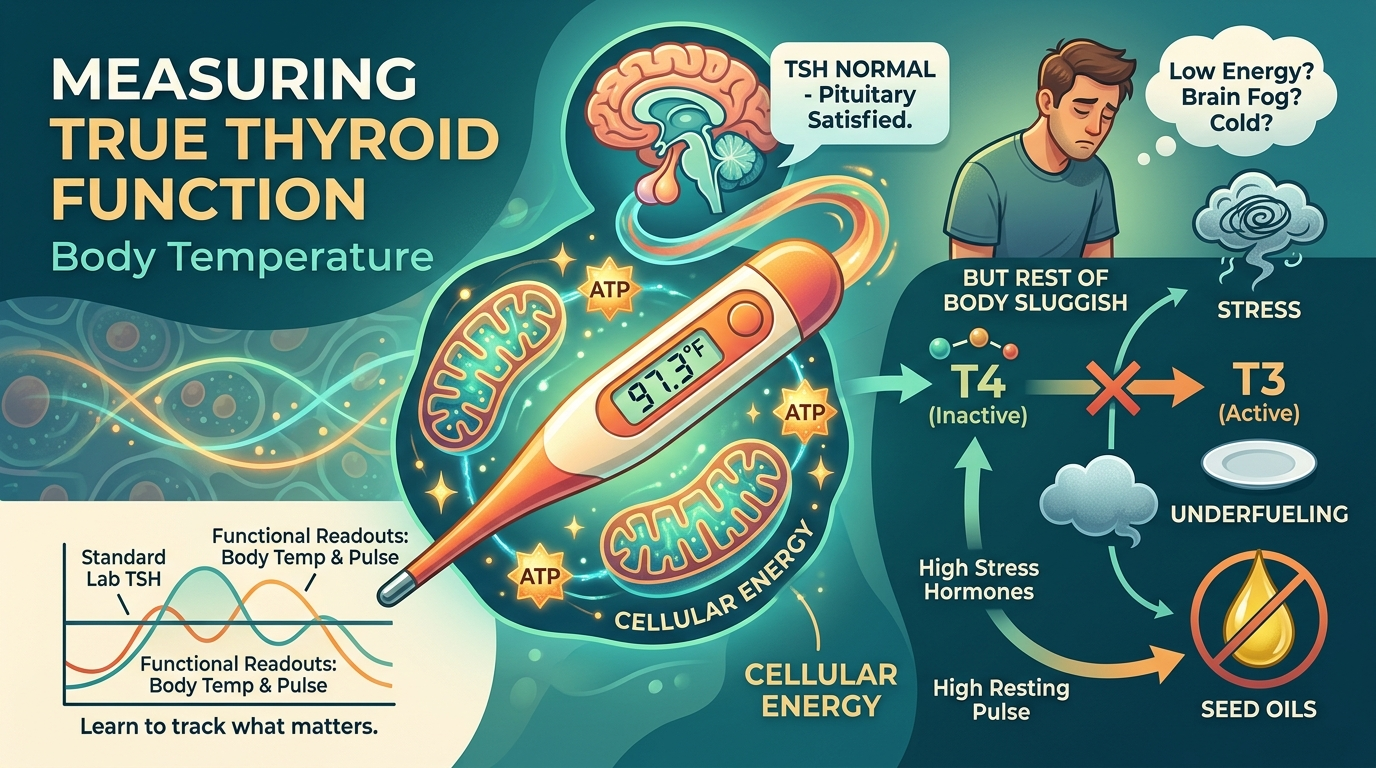
The enzymes that build progesterone are temperature sensitive, which is why body temperature is one of the more useful signals you have access to without a lab.
Take your temperature before you get out of bed, before you speak, before coffee. In the follicular phase, a healthy waking temperature generally sits in the neighborhood of 97.8 degrees Fahrenheit, and after ovulation progesterone should push it noticeably higher, because progesterone is thermogenic. Peat noted this directly: estrogen lowers body temperature, progesterone raises it.
If you are waking at 96.8 and your temperature barely moves after ovulation, that is information. It suggests low metabolic rate and low progesterone at the same time, from the same underlying cause. We have written about why that reading often matters more than your lab result in Your "Normal" TSH Is Lying: What Your Body Temperature Reveals About Your Thyroid.
How to Increase Progesterone Naturally in the Morning (The Part Everyone Gets Backwards)
Search this topic and you will find the same morning advice repeated across every article: get sunlight, skip the alarm if you can, and eat a protein and fat rich breakfast.
Two of those three are right. The third is half an instruction, and the missing half is the whole point.
Eat within thirty to sixty minutes of waking, and include carbohydrate. Overnight you run on stored liver glycogen. When that runs low toward morning, your body maintains blood sugar with cortisol and adrenaline instead. That is why so many women wake between three and five in the morning wide awake and anxious, and why they wake up already stressed. Eating promptly ends that catabolic pattern.
But there is a second reason, and it is the mechanistic one. Your liver performs most of your T4 to T3 conversion, and it requires glycogen to do it. Glycogen comes from carbohydrate. No carbohydrate means depleted glycogen, which means poor T3 production, which means insufficient StAR, which means the cholesterol never makes it into the mitochondrion.
That is the chain. Skipping carbohydrate at breakfast does not just leave you hungry. It removes the signal that switches the progesterone factory on.
A protein and fat only breakfast is popular advice because it does keep blood sugar flat, and flat blood sugar feels better than a spike and crash. But flat is not the goal. Fueled is the goal. Eggs cooked in butter with fresh orange juice and a pinch of salt, or eggs with fruit and a piece of sourdough, gives you the cholesterol and vitamin A for the raw material and the carbohydrate for the thyroid conversion in one meal.
Get outside in the first hour. Morning light sets the master clock, which produces a healthy cortisol curve that peaks in the morning and falls through the day. That curve is what allows the luteinizing hormone surge to happen on schedule, and no LH surge means no corpus luteum, and no corpus luteum means no meaningful progesterone. There is also a direct effect, since red and near infrared wavelengths in early sunlight interact with cytochrome c oxidase in your mitochondria. We covered that mechanism in The Light Switch for Your Metabolism.
Do not exercise before you eat. Fasted training is a compound stressor: low glycogen plus physical demand plus, usually, low morning temperature. Your body reads that combination as famine with predators. If you train in the morning, eat first.
What Foods Increase Progesterone (And Three Popular Ones That Lower It)
This is where the mainstream advice and the bioenergetic view part ways completely, so let me be specific about the disagreement.
The Foods That Supply the Raw Materials
Egg yolks, butter, ghee, and full fat dairy. These deliver cholesterol, which is the literal substrate for progesterone, along with true vitamin A as retinol. If you have been avoiding yolks and butter for cholesterol reasons, you have been restricting the input to your own hormone production. We took that argument apart in Why Everything You Know About Saturated Fat Is Wrong.
Liver, roughly three to four ounces once a week. The richest food source of retinol. Beta carotene from carrots and sweet potatoes is not a reliable substitute, since conversion to retinol is variable between individuals and poor in many, particularly when thyroid function is already low. Peat listed carotene itself among the things that interfere with progesterone synthesis.
Oysters, scallops, and mussels. Zinc and selenium, both required by the deiodinase enzymes that convert T4 into active T3. Selenium in particular is the cofactor for that conversion, and without it the whole downstream chain suffers.
Ripe fruit, honey, maple syrup, white rice, and well cooked root vegetables. These refill liver glycogen. Every one of them is doing thyroid work, not just providing calories.
Salt your food. Adequate sodium lowers adrenaline and aldosterone. Undersalting is a quiet driver of the stress state that suppresses ovulation, which we covered in The Salt Sweet Spot.
The Three Popular Foods That Work Against You
Flaxseed. Recommended in nearly every hormone balancing article and in most seed cycling protocols. Flax is both highly estrogenic and extremely high in polyunsaturated fat. If your working problem is too much estrogen relative to progesterone, adding a concentrated source of plant estrogen and unstable fat is moving in the wrong direction.
Soy. Same problem, plus a well documented history of interference with thyroid function. When the goal is more active T3 so that StAR can do its job, soy is a poor choice.
Seed oils. Canola, soybean, corn, sunflower, safflower, and cottonseed. Polyunsaturated fats interfere with thyroid hormone at multiple points, including production, transport, and cellular response. Linoleic acid also behaves at the estrogen receptor. The full case is in Coconut Oil vs Seed Oils and in Fish Oil Side Effects.
I want to be careful here, because seed cycling is popular and sincerely recommended by people trying to help. The theory is reasonable on its face. The problem is that the specific foods chosen work against thyroid function and add plant estrogens to a system already struggling with estrogen dominance. The intention is right. The ingredients are wrong.
The Raw Carrot Salad
One medium raw carrot, shredded lengthwise, with a little coconut oil, vinegar, and salt. Eaten daily between meals.
The mechanism is mechanical rather than nutritional. Raw carrot fiber resists fermentation and binds both bacterial endotoxin and the estrogen your liver has already processed into bile. Without something to bind it, a meaningful portion of that estrogen gets reabsorbed in the colon and recirculated, so your liver has to do the same work twice. Reducing that recirculating load lightens the burden on the liver, which is the same organ doing your T4 to T3 conversion.
It is a strange sounding intervention. It is also cheap, harmless, and one of the more consistently useful things women report in practice.
The Rest of the Day: The Signals That Say You Are Safe
Progesterone responds to safety, and safety is not a feeling. It is a set of physiological signals.
Eat every three to four hours. Long gaps drop blood sugar, and falling blood sugar raises cortisol and adrenaline. Sustained cortisol suppresses GnRH pulsatility from the hypothalamus, which is the upstream signal that ultimately drives ovulation. This is the mechanism documented in the functional hypothalamic amenorrhoea literature, and it does not require a diagnosis to apply to you. It operates on a spectrum. Full loss of cycles is one end. A short luteal phase and rough PMS is much earlier on the same continuum.
Trade grinding cardio for lifting and walking. Strength training two or three times a week and daily walking support metabolic rate without draining glycogen. Long high intensity sessions do the opposite. If your cycle has shortened or your temperature has dropped since you increased training volume, those two facts are related.
Reduce plastics and thermal receipts. Xenoestrogens occupy the same receptors and add to a load your liver already has to clear. Glass and stainless steel instead of plastic is a genuinely useful change, and we went deep on it in You're Eating a Credit Card of Plastic Every Week.
Sleep in real darkness. Light at night raises prolactin, and prolactin directly suppresses ovarian progesterone production. This is not a minor pathway. Prolactin is one of the most underappreciated hormones in women's health, which is why we gave it its own article in The Stress Hormone Your Doctor Never Tests. Blackout curtains and covering the LEDs in your bedroom cost almost nothing.
Have something before bed if you wake at 3am. A small amount of slow carbohydrate with a little salt keeps blood sugar stable overnight and prevents the cortisol surge that wakes you. Warm milk with honey works. So does a few bites of fruit.
The Biospark Approach
At Biospark Health, we start with a question conventional hormone care rarely asks: what is your body accomplishing by lowering your progesterone?
The conventional path is to measure progesterone on day 21, find it low, and supplement it or prescribe a progestin. That can be appropriate, and for some women it is genuinely the right call. But it treats the reading as the problem. If your progesterone is low because your thyroid is underperforming and your liver glycogen is chronically empty, adding progesterone from outside does not fix the thyroid, does not refill the glycogen, and does not address the reason your body applied the brake in the first place.
It is also worth understanding that synthetic progestins are not the same molecule as progesterone. They occupy the same receptor family and produce some overlapping effects, but they behave differently in the body, including effects on thyroid function and body temperature that run counter to what you are trying to accomplish. If you are considering hormone therapy, that distinction is worth a real conversation with a clinician who can look at your full picture, not something to sort out from a blog post.
What we do instead is look at the whole production line. Waking body temperature across the cycle. Whether temperature rises after ovulation and holds. Thyroid function evaluated on more than TSH alone. Whether you are eating enough, and specifically whether you are eating enough carbohydrate to support T4 to T3 conversion. Prolactin, which almost nobody checks. The load of polyunsaturated fat and environmental estrogen your liver is clearing. Iron status, since excess iron drives the oxidative damage that Peat specifically flagged as interfering with progesterone synthesis in the corpus luteum.
Then we restore the inputs and let the body resume production on its own, which is what it wants to do the moment it stops receiving famine signals.
Dr. Presciutti's background as a physician who left a conventional practice model matters here, because the standard fifteen minute visit cannot accommodate this kind of assessment. Discovering that a woman's progesterone is low takes one blood draw. Discovering why takes an actual conversation.
Not sure where your energy production is breaking down?
Take our free Cellular Energy Assessment to find your metabolic pattern and get personalized recommendations for where to start.
- Takes 10 to 15 minutes
- Instant results
- No commitment
If you are actively trying to conceive and want structured support, our Fertility Program applies this same metabolic framework to conception specifically.
Progesterone Support in Reading and Berks County, PA
If you are in Reading or Wyomissing and have been told your hormone panel looks fine while you feel anything but fine, you are in a large group. Women across Berks County describe the same sequence: a day 21 progesterone draw, a normal or borderline result, and an offer of birth control to regulate the cycle. Nobody checks the thyroid past TSH. Nobody asks what she eats before eleven in the morning.
Biospark Health serves clients throughout southeastern Pennsylvania, including Lancaster, Downingtown, Allentown, West Chester, and the greater Philadelphia suburbs. We work virtually and in person, which matters for this kind of care, because restoring progesterone production is not one appointment. It is a set of daily changes tracked over two or three cycles, with someone looking at your temperature data alongside your labs.
For women in the Chester County and Montgomery County area looking for hormone support that starts with metabolism rather than with a prescription pad, that is the work we do.
Frequently Asked Questions
How can I raise my progesterone levels quickly?
You cannot force fast production from an energy depleted system, but you can remove the brake quickly. The fastest single change is eating a real breakfast that includes carbohydrate within an hour of waking, every day, without exception. That refills liver glycogen, ends the overnight cortisol pattern, and restores the T3 production that switches on the transport protein your ovaries need. Most women notice changes in sleep and premenstrual symptoms within one to two cycles, though the full picture takes longer.
What are three possible signs of low progesterone?
A short luteal phase, meaning fewer than ten to twelve days between ovulation and your period. Waking at three or four in the morning, since progesterone metabolites support the calming GABA system. And a waking body temperature that fails to rise meaningfully after ovulation. Beyond those, look for premenstrual bloating and water retention, hormonal migraines, breast tenderness, and anxiety that tracks the second half of your cycle.
Am I ovulating if my progesterone is low?
Possibly. Low progesterone means the corpus luteum is underproducing, which happens along a spectrum from slightly weak to fully anovulatory. Tracking waking temperature across a full cycle tells you more than a single blood draw, because a sustained temperature rise held for at least ten days is direct evidence of a functioning corpus luteum.
Do progesterone creams work?
Wild yam creams do not, because the human body lacks the enzymes to convert the diosgenin in wild yam into progesterone. Products containing actual bioidentical progesterone are a different matter, and delivery method and timing both substantially affect what reaches your tissues. If you are considering supplemental progesterone, that is a conversation to have with a clinician who understands your cycle, not a decision to make from a product label.
Should I try seed cycling?
The theory behind seed cycling is sound: support each phase of the cycle with targeted nutrients. The chosen foods are the problem. Flax and sesame are high in polyunsaturated fat and, in flax's case, strongly estrogenic. If you want the phase-based approach, use liver, oysters, egg yolks, and adequate carbohydrate instead. Same idea, better ingredients.
The Short Version
Progesterone is not a hormone your ovaries either produce or fail to produce. It is a manufactured product, and the factory sits inside your mitochondria. It runs on cholesterol as the input, thyroid hormone as the switch, vitamin A as the cofactor, and enough total energy to justify the expense.
When that factory slows down, your body is not broken. It is making a decision, and the decision is a reasonable one given the information it has. Chronic undereating, low carbohydrate intake, hard training, poor sleep, and a heavy load of polyunsaturated fat and environmental estrogen all say the same thing to a body: conditions are not safe enough to reproduce.
The way to change the answer is to change the information. Eat early and eat enough. Include carbohydrate. Get morning light. Move without grinding yourself down. Sleep in the dark. Supply the raw materials your ovaries have been asking for.
Do that consistently and progesterone tends to come back on its own, because your body was never trying to withhold it. It was waiting for permission.
If you want help finding which input is missing in your case, the free Cellular Energy Assessment is a reasonable place to start.
Tags:
References & Citations
This article is supported by scientific research and peer-reviewed sources. Click citations to verify the evidence.
- [1]Mackenzie SH, Roberts MM, Liu JH(1998)Thyroid hormone stimulates progesterone release from human luteal cells by generating a proteinaceous factor.The Journal of Endocrinology.View Source
- [2]Woods AL, Garvican-Lewis LA, Lundy B, et al.(2021)Decreased energy availability during training overload is associated with non-functional overreaching and suppressed ovarian function in female runners.Applied Physiology, Nutrition, and Metabolism.View Source
- [3]Morrison AE, Fleming S, Levy MJ(2021)A review of the pathophysiology of functional hypothalamic amenorrhoea in women subject to psychological stress, disordered eating, excessive exercise or a combination of these factors.Clinical Endocrinology.View Source
- [4]De Souza MJ, Mallinson RJ, Strock NCA, et al.(2024)Are menstrual disturbances associated with an energy availability threshold? A critical review of the evidence.Applied Physiology, Nutrition, and Metabolism.View Source
- [5]Suh BY, Liu JH, Berga SL, et al.(1988)Hypercortisolism in patients with functional hypothalamic-amenorrhea.The Journal of Clinical Endocrinology and Metabolism.View Source
- [6]Zhang H, Wang S, Liu M, et al.(2024)Retinoic acid enhances ovarian steroidogenesis by regulating granulosa cell proliferation and MESP2/STAR/CYP11A1 pathway.Journal of Advanced Research.View Source
- [7]Manna PR, Kero J, Tena-Sempere M, et al.(1999)Molecular mechanisms of thyroid hormone-stimulated steroidogenesis in mouse Leydig tumor cells. Involvement of the steroidogenic acute regulatory (StAR) protein.The Journal of Biological Chemistry.View Source
All references have been reviewed for scientific accuracy and credibility. Citations follow standard academic format and link to original research where available.
About Dr. Steven Presciutti, MD
Founder & Health Coach at Biospark Health, specializing in bioenergetic health and metabolism optimization.