
Your 'Normal' TSH Is Lying: What Your Body Temperature Reveals About Your Thyroid
Told your TSH is normal but you still feel hypothyroid? Why normal TSH but hypothyroid symptoms happen, and how body temperature reveals your thyroid.
Medical Disclaimer
This content is for informational and educational purposes only. It is not a substitute for professional medical advice, diagnosis, or treatment. Always seek the advice of your physician or other qualified health provider with any questions you may have regarding a medical condition.
You did everything right. You noticed the fatigue that sleep does not fix, the cold hands, the thinning outer eyebrows, the constipation, the brain fog that makes your own name feel far away. You went to your doctor, you asked for thyroid testing, and the result came back with a single word that was supposed to end the conversation: normal. If you have normal TSH but hypothyroid symptoms, you are not imagining things, and you are not alone. Millions of people are told their thyroid is fine while their bodies keep behaving as though it is anything but.
The problem is that a single number on a lab slip is being asked to represent something enormously complex: whether every cell in your body is actually getting the active thyroid signal it needs to burn fuel and make heat. TSH does not measure that. It measures what your pituitary gland thinks, and your pituitary is a poor spokesperson for the rest of you.
There is a tool that gets much closer to the truth, and you already own it. Your body temperature is a live readout of your metabolic rate. To understand why a thermometer can out-diagnose a lab panel, you have to go down to the level of the mitochondria, where thyroid hormone actually does its work. This article will show you why a normal TSH can miss real hypothyroidism, how to track your temperature and pulse the way physician Broda Barnes did for decades, and the one nuance that most articles get badly wrong.
Why You Can Have a Normal TSH but Hypothyroid Symptoms
TSH stands for thyroid stimulating hormone, and here is the first thing almost nobody explains: it is not made by your thyroid. It is made by your pituitary gland, a pea-sized structure at the base of your brain. When the pituitary senses it needs more thyroid activity, it releases more TSH to prod the thyroid. When it senses plenty, TSH falls. The logic seems airtight. If TSH is normal, the pituitary must be satisfied, so you must be fine.
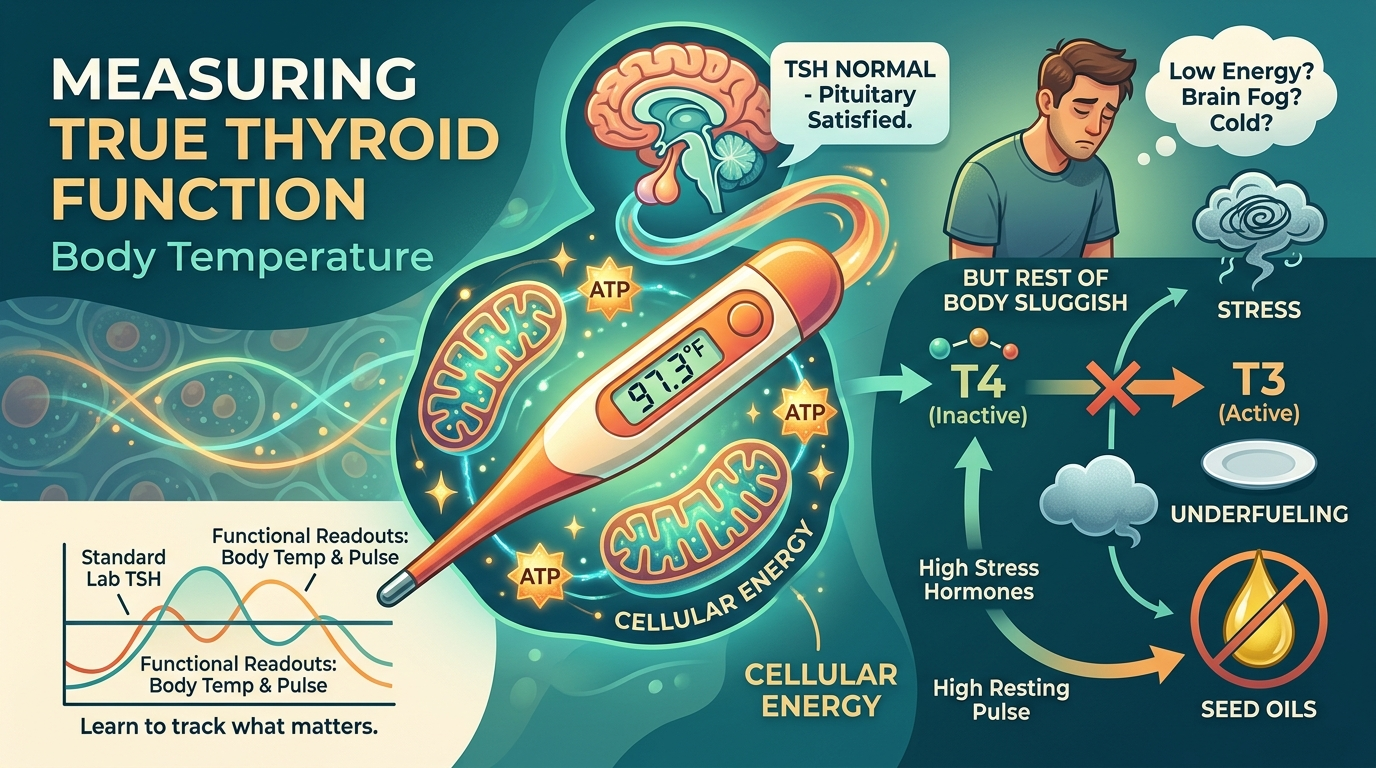
The flaw is that the pituitary does not experience thyroid hormone the way the rest of your body does. Your thyroid mostly produces T4, a storage form that is nearly inactive. The active hormone, the one that actually turns up metabolism, is T3, and most of your T3 is made outside the thyroid by an enzyme called deiodinase that strips an iodine atom off T4. The catch is that the pituitary contains an unusually high concentration of one particular version, D2 deiodinase, and it makes its own private supply of T3 locally, on site. So the pituitary can be swimming in T3 while your liver, muscle, brain, and gut are starved of it. TSH stays normal. You stay symptomatic. This is what many call cellular hypothyroidism: a conversion failure downstream of a gland that looks fine on paper.
Stress makes it worse. Cortisol, the main hormone of a body under pressure, can suppress TSH secretion, and chronic stress blunts the whole axis. So a chronically stressed person can have a low or low-normal TSH that looks reassuring and actually reflects a nervous system running on fumes. Reference ranges compound the confusion. The "normal" range was built statistically from a population that includes a great many people with undiagnosed thyroid problems, which drags the upper boundary higher than it should be. Endocrinologists themselves have been arguing about this for years. Biondi and colleagues, in their 2019 JAMA review of subclinical hypothyroidism, laid out how much genuine disagreement exists over where treatment thresholds should sit, and how nonspecific the symptoms of mild thyroid dysfunction can be (Biondi et al., 2019). Hegedus and colleagues went further in 2022, documenting that a substantial fraction of patients remain symptomatic and dissatisfied even when their labs are pushed into the textbook range (Hegedus et al., 2022).
So yes, you can have hypothyroid symptoms with normal labs, and normal TSH but hypothyroid symptoms is far more common than you have been told. The lab is measuring the wrong altitude. It is checking the thermostat in the hallway while every room in the house stays cold.
The Body-Temperature and Pulse Method
In the middle of the twentieth century, a physician named Broda Barnes grew frustrated with exactly this gap between how his patients felt and what the blood tests of his era showed. He turned to something more direct: temperature. His reasoning was elegant. Thyroid hormone sets the pace of metabolism, metabolism produces heat, so temperature is a functional readout of thyroid status in a way no single hormone level can be.
Here is why that is not folklore but chemistry. Every reaction in your body is run by an enzyme, and every enzyme has a temperature at which it works best. Warm the system and reactions accelerate. Cool it and they slow down, sometimes sharply. As you drift down toward the low 97s Fahrenheit, whole categories of cellular function begin to stall. Digestion slows, immune cells move sluggishly, the liver detoxifies less efficiently, and the mitochondria produce less energy, which produces less heat, which slows the enzymes further. Low body temperature and thyroid function are not loosely associated. Temperature is the visible surface of the same fire that thyroid hormone stokes.
To use this yourself, you track two numbers with an ordinary thermometer and two fingers on your wrist. This is the basal body temperature thyroid test, and it is completely safe to do on your own.
Take your temperature first thing on waking, before you get out of bed, before coffee, before anything. A robust metabolism tends to wake at roughly 97.8 degrees Fahrenheit or higher. Then take it again in the mid to late afternoon, when metabolic rate normally peaks. A healthy afternoon reading tends to land near 98.6 degrees Fahrenheit. Alongside temperature, count your resting pulse. A well-fueled thyroid usually keeps a resting pulse in the neighborhood of 75 to 85 beats per minute, not the "athletic" 50s that are often mistaken for fitness but can equally signal a metabolism that has quietly powered down.
Track for a couple of weeks, because a single reading tells you little and a pattern tells you almost everything. Women should note that temperature rises after ovulation, so compare like with like across the cycle. What you are looking for is not a single perfect number but the shape of the trend: where you start in the morning, how far you climb by afternoon, and how steady your pulse sits. That pattern is a far richer picture of your metabolism than a lone TSH drawn on a random Tuesday. This is how you get a real answer to the question of whether you have hypothyroid symptoms with normal labs.
Normal TSH but Hypothyroid Symptoms: The Nuance Almost Everyone Misses
Here is where most articles go wrong, and where you can get much smarter than the internet. Low temperature does not automatically mean low thyroid. What it means depends entirely on what your pulse is doing at the same time, and this is exactly what mimics hypothyroidism when it is really something else.
Picture two people, both with a chilly morning temperature. The first also has a low, slow pulse. That combination, low temperature plus low pulse, is the classic true hypothyroid signature: the whole system is idling, producing little heat and beating slowly because there simply is not enough active thyroid signal to drive it. The second person has a low temperature but a fast, pounding pulse, perhaps in the 90s, sometimes with anxiety, poor sleep, and a sense of being wired and tired at once. That is a very different animal. That is a sluggish thyroid being whipped along by stress hormones.
When your thyroid cannot keep you warm, your body does not simply give up. It reaches for the emergency backup: adrenaline and cortisol. These stress hormones can raise your heart rate, mobilize sugar, and squeeze some heat out of you, papering over the underlying deficit. The result is a body that looks metabolically active on the surface, running hot on borrowed money, while the real engine sputters underneath. This is the adrenaline mask, and it is one of the most common reasons people are told their thyroid is fine.
There is a beautifully simple way to catch it. Take your temperature before breakfast, then eat a real breakfast with some carbohydrate and protein, and take it again about 45 minutes later. In a healthy person, eating nudges temperature up as fuel comes in. If your temperature drops after breakfast, that morning warmth was likely adrenaline-driven, not true metabolic heat. Feeding you removed the need for the stress hormones, the adrenaline receded, and the borrowed warmth went with it, exposing the low baseline underneath.
This single distinction resolves the paradox that stumps so many people. It explains why you can feel hypothyroid, run a normal or even elevated pulse, and get told everything is fine. It explains why one person needs metabolic support and calm while another is being flogged by their own stress response. And it is why pulse and temperature together, read as a pair, tell you what a thermometer alone cannot.
Why the Machinery Fails
If the problem is usually conversion rather than the gland itself, the obvious question is why the conversion of T4 to active T3 breaks down. Several mechanisms converge, and they reinforce each other.
The first is reverse T3. When your body is stressed, ill, fasting, or underfed, it can strip the wrong iodine atom off T4, producing reverse T3 instead of active T3. Reverse T3 is metabolically inactive, but it is not inert. It behaves like a decoy, occupying the space where real T3 would act and blunting the signal. In serious illness this is well documented as part of what is called non-thyroidal illness syndrome or euthyroid sick syndrome, where circulating T3 falls and reverse T3 rises even though the thyroid gland is structurally fine (Van den Berghe, 2014). Halsall and Oddy reviewed the clinical and laboratory picture of reverse T3 and the real limits of measuring it, a useful corrective to overselling any single number (Halsall and Oddy, 2021). The everyday, subclinical version of this shunt is what many people live in: not hospital-sick, just chronically stressed and underfueled, tilting the balance toward the inactive decoy.
The second mechanism is fuel. Converting T4 to T3 depends on a well-fueled liver, with its glycogen stores kept topped up. When you skip meals, fast for long stretches, or eat very low carbohydrate, those stores run down. The body reads an underfueled liver as an emergency and raises cortisol to keep blood sugar up, and cortisol pushes T4 toward reverse T3. This is the quiet engine behind a great deal of stubborn low body temperature and thyroid trouble: a liver too fuel-starved to make active hormone, night after night.
The third is the fats you eat. Polyunsaturated fatty acids, the seed and vegetable oils that dominate the modern diet, have been proposed, largely from laboratory work, to interfere with thyroid function at several points: the gland's output, the transport of hormone through the blood, conversion in the liver, and the binding of T3 at the receptor. Saturated fats appear more inert here, in part because they are chemically stable and do not oxidize into the same reactive fragments. Ray Peat spent decades arguing this point from the biochemistry. Whether or not every step holds up, thyroid hormone clearly does its real work at the cellular and receptor level, not merely as a number in the bloodstream (Cheng et al., 2010).
All of this explains the clinical frustration. When the failure is downstream, in conversion and receptor sensitivity, giving more T4 alone, which is what standard levothyroxine does, can leave a real subset of patients still symptomatic. This is not a fringe claim. Ross reviewed the nuance in treating subclinical hypothyroidism and the case for looking beyond levothyroxine monotherapy in selected patients (Ross, 2022), and Hegedus and colleagues documented the persistent dissatisfaction that drives so many people to keep searching (Hegedus et al., 2022). Levothyroxine is not useless. But for the people it fails, the reason is often that the bottleneck was never T4 supply in the first place.
The Biospark Approach
If the machinery fails for want of fuel, stability, and the right raw materials, then the repair is bioenergetic: give your metabolism what it needs to convert and use thyroid hormone, and stop doing the things that block it. This is educational, not a prescription, and any decision about thyroid hormone itself belongs with a qualified clinician who can see your full picture.
Start with fuel, because a fuel-starved liver cannot make active T3. That means adequate carbohydrate from sources your body handles gracefully: ripe fruit, honey, well-cooked roots and tubers, and for many people some milk. Keeping the liver's glycogen topped up is one of the most direct ways to blunt the overnight cortisol and reverse T3 shunt, which is exactly why eating breakfast matters so much. Do not train your body to spend the small hours running on adrenaline. Eat regular meals, and do not skip the first one.
Balance the protein. Muscle meats are rich in the amino acids that, in excess and without balance, can burden the liver, so pair them with the gelatin and glycine found in slow-cooked cuts, broth, and skin-on preparations. Get enough total protein to support metabolism without leaning entirely on lean muscle meat.
Take the brakes off. Reduce polyunsaturated seed and vegetable oils as far as you reasonably can, and lean on stable saturated fats instead. Salt your food to taste rather than fearing it, since sodium supports the very metabolic and adrenal balance we are trying to restore. A daily raw carrot is a small, almost quaint intervention with a real rationale: its fiber helps carry off bacterial endotoxin and excess estrogen from the gut, both of which otherwise burden the liver and depress thyroid function.
Use light. Morning sunlight helps set the daily cortisol rhythm so it does the right work at the right time, and red and near-infrared light applied to the front of the neck has a plausible mechanistic basis for supporting the tissue and its energy production. None of this is exotic. If you have been wondering how to raise body temperature naturally, this is the answer: the boring, physiological work of making it easier for your cells to burn fuel, which is also how you address normal TSH but hypothyroid symptoms at the root. If, after all this, you and your clinician decide that thyroid hormone belongs in the picture, you will be adding it to a metabolism that can finally use it, rather than pouring T4 into a system too stressed and underfed to convert it.
Ready to restore your metabolism at the cellular level?
The Bioenergetic Reset Program addresses root causes, not symptoms. Join 300+ members who've discovered what real metabolic health feels like.
- 9+ hours of comprehensive training
- Twice-monthly LIVE coaching calls
- Complete meal plans and protocols
- Direct email support
$97/month | Cancel anytime
Thyroid and Metabolic Health Support in Reading and Berks County, PA
For patients across Reading and the surrounding communities of Berks County, the gap between how you feel and what your labs say is a daily frustration, and it deserves a more complete answer than "your TSH is normal." At Biospark Health, the focus is on the whole bioenergetic picture: conversion, fuel, stress, and the temperature and pulse patterns that reveal what a single number hides. If you have been searching for thyroid Reading PA support that takes your symptoms seriously, or for metabolic health Pennsylvania guidance grounded in how cells actually make energy, this approach was built for exactly that.
Patients travel from Wyomissing, Lancaster, Downingtown, Allentown, and West Chester because a functional, root-cause view of thyroid and metabolism is still hard to find. Whether you are looking for a hormone specialist Wyomissing residents can work with or metabolic support anywhere in southeastern Pennsylvania, the goal is the same: to stop chasing a lab reference range and start restoring the warmth, energy, and clarity that a well-fueled metabolism produces. Your thermometer can start that conversation today, wherever in Berks County you call home.
Frequently Asked Questions
Can your TSH be normal but you still have hypothyroidism?
Yes. TSH reflects what your pituitary senses, and the pituitary makes its own local T3 using D2 deiodinase, so it can stay satisfied while the rest of your body runs short of active hormone. Stress hormones can also suppress TSH directly, producing a reassuring number over a struggling metabolism. This is why people with normal TSH but hypothyroid symptoms are so often dismissed. Tracking temperature and pulse gives a functional readout the blood test cannot.
Why do I have thyroid symptoms when my labs are normal?
Because most labs check hormone supply, not delivery to your cells. The active hormone T3 is mostly made outside the thyroid by converting T4, and that conversion can fail from stress, underfueling, low glycogen, or a diet high in polyunsaturated oils. You end up with hypothyroid symptoms with normal labs because the bottleneck sits downstream of everything the standard panel measures.
Does low body temperature mean thyroid problems?
Often, but not always, and this is the crucial nuance. Low temperature with a low pulse points toward true hypothyroidism. Low temperature with a high, pounding pulse usually means stress hormones are compensating for a sluggish thyroid. Check your pulse alongside your temperature, and check whether temperature rises or falls after breakfast, to tell these two situations apart.
What is the biggest indicator of hypothyroidism?
Functionally, the most telling everyday indicator is a persistently low body temperature paired with a low resting pulse, tracked over a couple of weeks rather than measured once. Broda Barnes built his clinical work around exactly this. A morning temperature drifting below roughly 97.8 degrees Fahrenheit with a slow pulse and classic symptoms is a stronger real-world signal than a single in-range TSH.
What mimics hypothyroidism symptoms?
Chronic stress is the great imitator. When the thyroid underperforms, adrenaline and cortisol step in to keep you going, which can produce fatigue, anxiety, poor sleep, and a fast pulse while masking the low metabolic baseline underneath. This adrenaline mask is why the temperature-after-breakfast test is so useful: it exposes the borrowed warmth for what it is.
Conclusion
For years you may have been handed a single number and told to stop worrying. But you live in your body, and your body has been sending clear signals: the cold hands, the afternoon crash, the mind that will not quite come online. Those signals are data. The thermometer in your bathroom drawer and the pulse under your fingertips give you a window into your actual metabolism that a random TSH cannot, and reading them together, temperature and pulse, before and after breakfast, turns confusion into a pattern you can understand.
A 2020 Stanford analysis found that average human body temperature has fallen by roughly a full degree Fahrenheit since the 1800s. The causes are debated, but it is at least suggestive of a population-level shift in metabolism, and W.D. Denckla once hypothesized that aging itself involves cells growing resistant to thyroid rather than merely making less of it, an idea that was never confirmed. The good news is that the levers are largely in your hands: fuel, stability, the right fats, light, and lowered stress. Start tracking this week. Bring the pattern, not just the lab, to a clinician who will actually look at it. You are not broken and you are not imagining it. You are metabolically underfueled, and that is something you can begin to change.
Tags:
References & Citations
This article is supported by scientific research and peer-reviewed sources. Click citations to verify the evidence.
- [1]Biondi B, Cappola AR, Cooper DS(2019)Subclinical Hypothyroidism: A Review.JAMA.View Source
- [2]Hegedus L, Bianco AC, Jonklaas J, et al.(2022)Primary hypothyroidism and quality of life.Nature Reviews Endocrinology.View Source
- [3]Van den Berghe G(2014)Non-thyroidal illness in the ICU: a syndrome with different faces.Thyroid.View Source
- [4]Halsall DJ, Oddy S(2021)Clinical and laboratory aspects of 3,3',5'-triiodothyronine (reverse T3).Annals of Clinical Biochemistry.View Source
- [5]Ross DS(2022)Treating hypothyroidism is not always easy: when to treat subclinical hypothyroidism, TSH goals in the elderly, and alternatives to levothyroxine monotherapy.Journal of Internal Medicine.View Source
- [6]Cheng SY, Leonard JL, Davis PJ(2010)Molecular aspects of thyroid hormone actions.Endocrine Reviews.View Source
All references have been reviewed for scientific accuracy and credibility. Citations follow standard academic format and link to original research where available.
About Dr. Steven Presciutti, MD
Founder & Health Coach at Biospark Health, specializing in bioenergetic health and metabolism optimization.


