How to Improve Mitochondrial Function: What Actually Moves the Needle
How to improve mitochondrial function without falling into biohacking overload. The lifestyle factors with real evidence, and why more exercise sometimes backfires.
Medical Disclaimer
This content is for informational and educational purposes only. It is not a substitute for professional medical advice, diagnosis, or treatment. Always seek the advice of your physician or other qualified health provider with any questions you may have regarding a medical condition.
If you've searched "how to improve mitochondrial function," you've probably landed on a list of a dozen biohacks: cold plunges, fasting protocols, supplement stacks, and expensive gadgets. Some of it has a kernel of real physiology behind it. Most of it is more complicated than it needs to be, and some of it actively backfires for people who are already running on empty. The lifestyle factors with the strongest evidence base for mitochondrial support are, refreshingly, less exotic than the biohacking world would have you believe: light exposure, the right kind and amount of movement, sleep, nutrient-dense food, and stress reduction. This piece walks through what actually has evidence behind it, why more isn't always better, and what a realistic starting point and timeline look like.
The Lifestyle Factors With the Strongest Evidence
Light exposure, particularly regular sunlight and consistent light-dark cycles, plays a documented role in circadian regulation, which in turn affects mitochondrial activity. Mitochondria don't just passively produce energy around the clock; their output follows circadian rhythms, and disrupted light exposure (too little daylight, too much artificial light at night) has been associated with impaired metabolic and mitochondrial function in the research.

Movement, but the right type and amount, supports mitochondrial density and efficiency over time. Regular, moderate movement is consistently linked to better mitochondrial function. The nuance, which we'll get to below, is that movement intensity and volume need to match your current energy capacity, not exceed it.
Sleep is when a substantial amount of cellular repair and mitochondrial maintenance occurs. Poor sleep duration and quality are associated with impaired glucose metabolism and reduced mitochondrial efficiency. This is one of the most evidence-backed and most overlooked levers in the entire mitochondrial-support conversation.
Nutrient density matters because mitochondria require specific cofactors, B vitamins, magnesium, and others, to run the biochemical pathways of energy production. This is a composition question, not a restriction question, which is the next section's focus.
Stress reduction rounds out the list because chronic stress and the cortisol elevation that comes with it directly interfere with mitochondrial efficiency and thyroid hormone conversion, undoing gains made elsewhere.
None of these are novel. What's notable is how consistently the research keeps returning to these fundamentals rather than to the more exotic interventions that dominate biohacking content.
Why "More Exercise" Can Backfire
This is one of the more counterintuitive and most important points for anyone starting from a depleted baseline. If your mitochondria are already underperforming, whether from chronic stress, inadequate food intake, thyroid dysfunction, or long-term overtraining, adding more high-intensity exercise doesn't rebuild capacity. It demands more from a system that's already struggling to keep up.
Intense exercise is a real physiological stressor. It raises cortisol, increases oxidative load, and requires substantial energy investment for recovery. In someone with adequate mitochondrial reserve, this stress is exactly what stimulates adaptation and improvement over time. In someone who's already energy-depleted, that same stress can tip the system further into a stress-dominant state, worsening fatigue, disrupting sleep, and suppressing thyroid conversion rather than improving it. This is a pattern we discuss in more depth in our piece on the biohacks that quietly make people weaker: pushing harder is not automatically the same as building capacity.
The practical implication: if you're starting from significant fatigue or a depleted baseline, gentler, more consistent movement (walking, light strength work) tends to serve mitochondrial rebuilding better than aggressive training programs, at least initially. Intensity can increase later, once baseline capacity has actually been rebuilt.
Diet Composition, Not Restriction
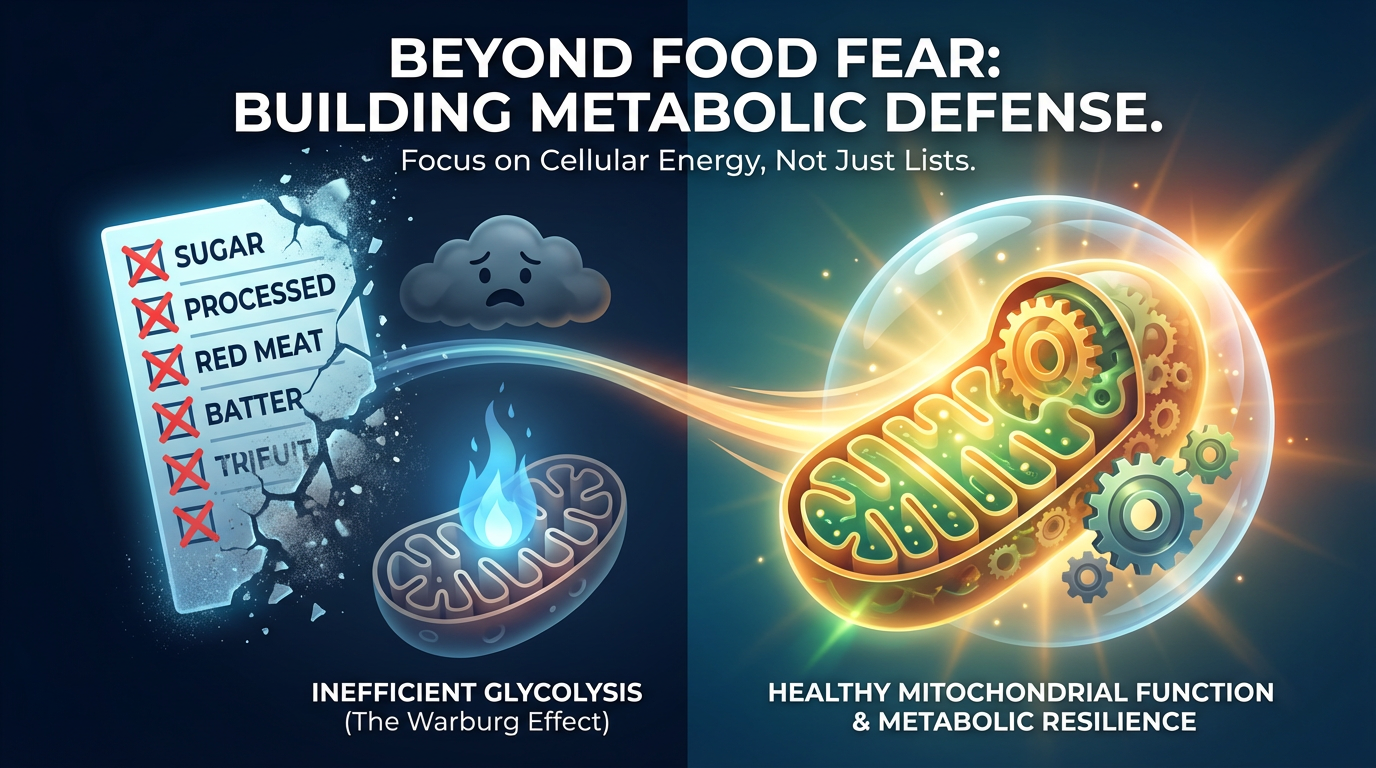
The pro-metabolic framing of nutrition for mitochondrial support centers on composition and adequacy rather than restriction. Mitochondria need a steady, sufficient supply of usable fuel plus the cofactors mentioned above to run efficiently. Chronic caloric restriction, prolonged fasting, or very low-carbohydrate approaches can each, in their own way, signal scarcity to the body, which triggers the same stress-hormone response that undermines mitochondrial function rather than supporting it.
This doesn't mean any specific food is magic. It means the more useful question is usually "am I eating enough, consistently enough, with enough nutrient density" rather than "what should I cut out." For someone already dealing with fatigue or a depleted energy baseline, restriction-focused approaches are frequently counterproductive, adding another stress signal on top of an already-taxed system.
How Chronic Stress Undoes Everything Else
Here's the piece that trips up a lot of well-intentioned mitochondrial-support efforts: you can optimize light, movement, sleep, and food, and still not see the expected improvement if chronic stress is left unaddressed. Elevated cortisol directly interferes with thyroid hormone conversion (turning T4 into the active T3 your cells actually use) and independently affects mitochondrial efficiency. A body under chronic stress treats every other input, food, movement, even sleep, through a lens of "is it safe to invest energy in repair right now," and the answer under chronic stress is often no.
This is why stress reduction isn't a soft, optional add-on to the list above; it's often the factor that determines whether the other four actually translate into improved mitochondrial function. Addressing stress doesn't necessarily mean eliminating stressors from your life (often not realistic), but building in genuine recovery: adequate sleep, appropriate light exposure, movement that matches your capacity, and enough food to signal safety rather than scarcity.
A Realistic Timeline
If you're starting from a genuinely depleted baseline, meaningful improvement in mitochondrial function is a matter of weeks to months of consistent input, not days. Early changes (better sleep, more stable energy through the day) often show up first, while deeper capacity rebuilding, actual improvements in mitochondrial density and efficiency, tends to take longer and depends heavily on how depleted the starting point was. This is one of the most common places generic biohacking advice sets people up for disappointment: promising fast, dramatic results from a stack of interventions when the underlying biology simply takes longer to rebuild, especially after months or years of chronic under-fueling or stress.
Generic Biohacking vs. a Structured, Individualized Plan
The difference between generic biohacking content and a structured bioenergetic plan comes down to sequencing and individualization. Generic advice tends to hand everyone the same list regardless of starting point: the same fasting protocol, the same cold exposure routine, the same supplement stack, whether you're already resilient or already running on fumes. A structured approach starts by actually assessing where someone's mitochondrial and hormonal baseline sits, then sequences interventions accordingly, addressing stress and adequacy first for someone who's depleted, rather than layering more stressors onto an already-struggling system.
The Biospark Approach
At Biospark Health, improving mitochondrial function starts with figuring out where you actually are, not handing you a generic checklist. For some people, that means building back adequate food intake and addressing chronic stress before intensifying movement. For others, it means optimizing light and sleep patterns that have quietly been undermining everything else. Our Bioenergetic Reset Program walks through this systematically, sequenced to your actual starting point rather than a one-size-fits-all biohacking list.
If you've tried the standard advice and still feel like your energy hasn't budged, that's often a sign the sequencing was off, not that you didn't try hard enough.
Want a plan built around your actual starting point? Book a free discovery call and let's figure out what your mitochondria actually need.
Frequently Asked Questions
What is the fastest way to improve mitochondrial function?
There isn't a fast way in the sense of days, but the highest-leverage starting points are consistent sleep, adequate and nutrient-dense food intake, regular light exposure, and movement matched to your current capacity. For someone starting from a depleted baseline, addressing stress and adequacy typically needs to come before intensifying exercise.
Does exercise always improve mitochondrial function?
Not automatically. Appropriately dosed movement supports mitochondrial density and efficiency, but intense exercise layered onto an already energy-depleted system can add more stress than the body can currently handle, worsening fatigue rather than building capacity. Matching intensity to your current baseline matters more than simply "doing more."
How long does it take to improve mitochondrial function?
It depends heavily on your starting point. Some improvements, like more stable energy through the day, can show up within weeks of consistent changes. Deeper rebuilding of mitochondrial capacity, especially after long-term chronic stress or under-fueling, typically takes longer and benefits from an individualized, sequenced approach rather than a generic timeline.
Conclusion
Improving mitochondrial function doesn't require an elaborate biohacking stack. The evidence consistently points back to fundamentals: adequate light exposure, movement matched to your actual capacity, real sleep, nutrient-dense (not restrictive) food, and genuine stress reduction. The factor most likely to undermine all the others, chronic stress and its effect on cortisol and thyroid conversion, is also the one most often left off generic lists. Getting the sequencing right, starting where you actually are rather than where a generic protocol assumes you are, is what separates a plan that works from one more stack of biohacks that doesn't.
Tags:
About Dr. Steven Presciutti, MD
Founder & Health Coach at Biospark Health, specializing in bioenergetic health and metabolism optimization.