The Serotonin Myth: Why the 'Happiness Hormone' Is Actually a Stress Signal
Low serotonin symptoms like fatigue and brain fog are real, but the happiness hormone story is backwards. Why serotonin is an energy-braking stress signal.
Medical Disclaimer
This content is for informational and educational purposes only. It is not a substitute for professional medical advice, diagnosis, or treatment. Always seek the advice of your physician or other qualified health provider with any questions you may have regarding a medical condition.
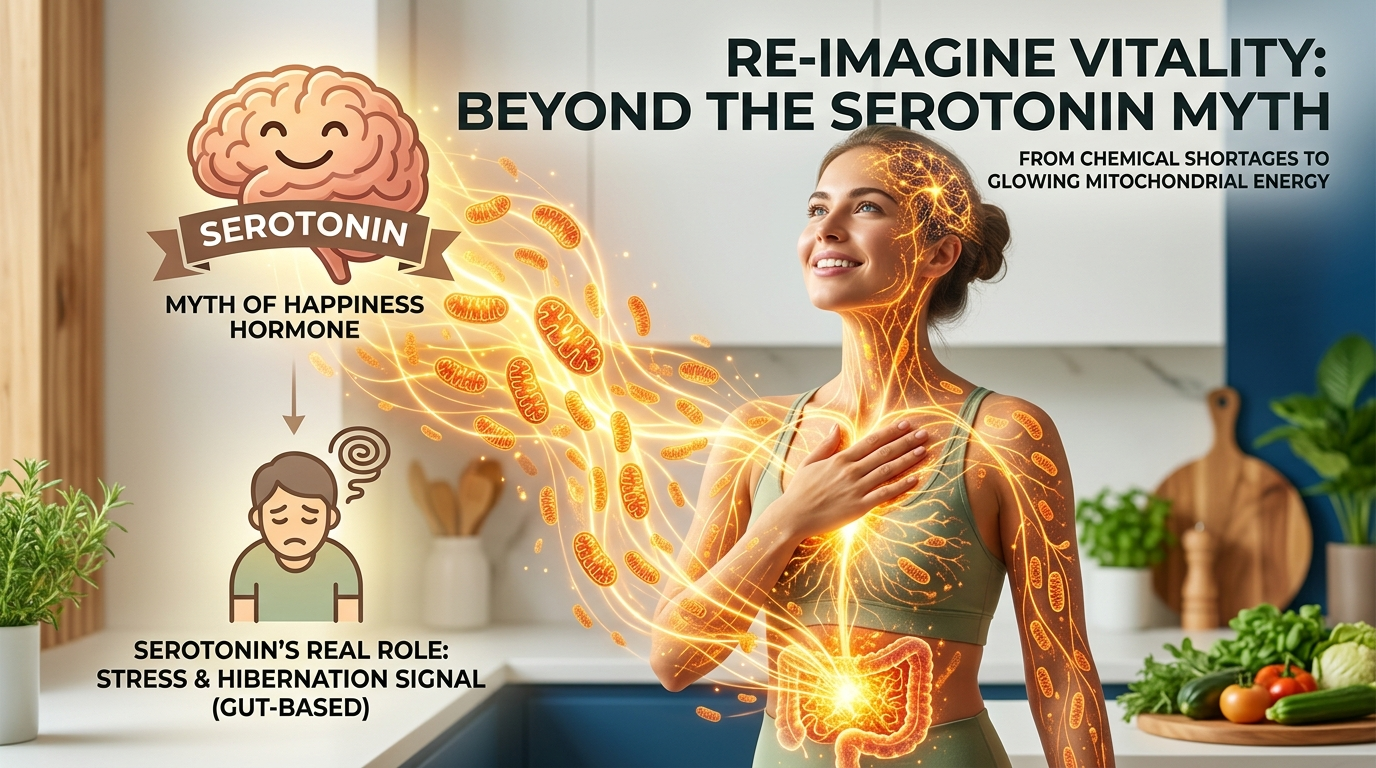
You have been told a simple story your whole life. Serotonin is the happiness hormone. It makes you calm, content, and emotionally steady. When you feel low, foggy, or exhausted, the story says your brain is running short on this feel-good chemical, and the fix is to top it back up. It is a tidy narrative, printed on supplement bottles and repeated in doctor's offices for decades. It is also, when you look at the actual biology, almost exactly backwards. The cluster of complaints people describe as low serotonin symptoms, the fatigue, the flat mood, the mental fog, the loss of drive, is real. What is wrong is the explanation. In many cases those symptoms track with a body that is holding on to too much serotonin, not too little, and doing so as part of a stress and shutdown program that suppresses your cellular energy.
This is not a fringe opinion anymore. In 2022, a major umbrella review of the entire serotonin-and-depression literature found no consistent evidence that depression is caused by low serotonin (Moncrieff et al., 2023). To understand what is actually going on, you have to stop thinking about mood as a chemical soup in your skull and start thinking about it as a bioenergetic state: how well your cells are turning food and oxygen into usable energy. Serotonin, it turns out, is far more of an energy brake than a happiness switch. This article walks through where the happiness hormone story came from, what serotonin really does in your body, why your low serotonin symptoms are better understood as an energy problem, how antidepressants actually work, and what a metabolism-first approach looks like.
Where the Serotonin Happiness Hormone Story Came From
The serotonin happiness hormone idea was never a discovery. It was a marketing hook that grew up alongside a class of drugs. In the late 1980s and 1990s, the arrival of selective serotonin reuptake inhibitors, the SSRIs, needed a simple explanation the public could grasp. If the drug blocks the reabsorption of serotonin and leaves more of it floating between nerve cells, and if the drug helps some people feel better, then surely depression must be a state of too little serotonin. The chemical imbalance story was born from the mechanism of the pill, not from any measurement of a deficiency in patients.
The problem is that no one ever reliably found that deficiency. For thirty years, researchers looked for evidence that depressed people have lower serotonin, lower serotonin metabolites, fewer serotonin receptors, or genes that lower serotonin, and the results never lined up into a coherent picture. The 2022 umbrella review, published in Molecular Psychiatry, pooled the strongest available research across all these angles and concluded there is no convincing evidence that depression is associated with, or caused by, reduced serotonin activity (Moncrieff et al., 2023). Some analyses even pointed the other way. This is the strongest anchor in the whole debate, and it is worth sitting with: the foundation of the serotonin and depression theory, the thing that justified telling millions of people their brains were low on a happy chemical, did not hold up when it was finally examined as a whole.
Why did the story survive so long anyway? Partly because it was useful. It reduced the stigma of depression by framing it as a medical deficiency, no different from low iron. It gave clinicians a fast, reassuring explanation to offer in a short appointment. And it fit the deeper cultural wish for a single molecule that dials happiness up and down. But a story being comforting and a story being true are different things. When you strip away the marketing, serotonin looks less like a reward chemical and more like an ancient signaling molecule your body uses to manage stress, threat, and the rationing of energy. To see that, you have to follow it out of the brain and into the gut, where the vast majority of it is actually made.
What Serotonin Actually Does: A Stress and Slowdown Signal
Start with a fact that surprises almost everyone. Only a small fraction of your serotonin lives in your brain. Roughly 95 percent of it is made in your gut, and your gut bacteria help regulate how much gets produced (Yano et al., 2015). This alone should make you suspicious of the happiness hormone framing. A molecule concentrated in your intestines, released by cells lining your gut, is not primarily in the business of managing your emotions. It is in the business of managing your body's response to what is happening inside it, especially stress and inflammation.
Serotonin was not even named for mood. When it was first isolated, it was called by names that described what it did to tissue: it made blood vessels constrict and it affected clotting. It is a potent vasoconstrictor, which means it squeezes down the diameter of blood vessels. Squeeze a vessel and you reduce blood flow, and reduce blood flow and you starve the downstream tissue of oxygen. That is the opposite of what you want if the goal is vitality. At the level of the cell, serotonin has been reported to inhibit mitochondrial respiration, the process your mitochondria, the tiny engines inside your cells, use to burn fuel efficiently with oxygen. When that clean-burning pathway is suppressed, cells fall back on a cruder, less efficient way of making energy that produces lactic acid and drives inflammation. In plain terms, serotonin can push your cells toward a low-energy, inflamed, oxygen-starved state.
That makes far more sense once you see the role serotonin plays in the animal kingdom. It is deeply involved in hibernation and torpor, the shutdown programs animals use to survive famine and cold. When a body needs to conserve, serotonin helps suppress appetite, slow breathing, lower body temperature, and drop the overall metabolic rate. It is a rationing signal. It says, times are hard, spend less, slow down, wait it out. Notice how closely that overlaps with the symptoms of an underactive thyroid and, for that matter, with depression itself: low temperature, low appetite regulation, low drive, low energy. These are features of a metabolism that has been told to power down.
The gut connection ties it together. The cells that pump out serotonin in your intestine, the enterochromaffin cells, release it in response to signals of trouble, including bacterial endotoxin, the inflammatory debris from certain gut bacteria. That gut-derived serotonin has been directly linked to visceral pain and anxiety-like behavior in the body (Bayrer et al., 2023). And when serotonin acts on tissue over time, it can drive the activation of the cells that lay down scar tissue, a process linked to fibrosis (Dolivo et al., 2018). None of this looks like a happiness molecule. It looks like a stress and slowdown signal that, when chronically elevated, quietly taxes your energy and your tissues.
The Real Meaning of Low Serotonin Symptoms: An Energy Problem
Now we can reframe the whole complaint. When you search your fatigue, your flat mood, your brain fog, and your lost motivation and land on a list of low serotonin symptoms, you are describing something genuine. But the label misdiagnoses the cause. Those are the symptoms of a body running low on cellular energy, and as we just saw, high serotonin is one of the things that lowers cellular energy. So the very state people try to fix by raising serotonin can, in some cases, be a state of serotonin already doing too much braking.
Consider fatigue, the most common of the low serotonin symptoms. There is a phenomenon called central fatigue, in which rising serotonin activity in the brain appears to contribute to the sense of exhaustion during prolonged effort, essentially a signal telling you to stop (Davis et al., 2000). Serotonin is not fighting your tiredness here. It is generating it. That is exactly what you would expect from a molecule whose job is to ration energy and enforce rest under stress.
Now look at mood. Some of the most striking research comes from studies of learned helplessness, the state where an animal exposed to stress it cannot escape simply gives up and stops trying, a widely used model of depression. When researchers measured brain serotonin during some of these experiments, the helpless, shut-down state was associated with elevated serotonin, not depleted serotonin. A similar pattern has been reported in the most severe, melancholic human depressions, which tend to run with high stress hormones like cortisol alongside what some researchers read as elevated serotonin activity. The flat, hopeless, immobilized feeling that people most want to escape is not obviously a deficiency of a happy chemical. It looks more like a saturation of a shutdown chemical.
This is also where the popular serotonin vs dopamine framing gets interesting, and where it gets corrected. People imagine both as feel-good chemicals, with serotonin as the calm one and dopamine as the excited one. But temperament research paints a sharper contrast. Higher serotonin activity is linked to behavioral inhibition and harm avoidance, the tendency to freeze, worry, and pull back. Lower serotonin activity is linked to novelty-seeking, curiosity, and exploration, the tendency to reach out and engage with the world. Read that again, because it upends the whole marketing story. In the serotonin vs dopamine matchup, the exploratory, engaged, curious states that most of us recognize as feeling alive are not the high-serotonin states. Boosting serotonin is not obviously boosting happiness. It may be boosting caution and restraint. If your low serotonin symptoms include feeling stuck, joyless, and unable to engage, the answer may not be more of the molecule associated with inhibition. It may be restoring the energy that lets you engage in the first place.
There is a hormonal wrinkle here worth naming, because it helps explain why women are diagnosed with depression at higher rates. Estrogen can reduce the activity of MAO-A, one of the main enzymes your body uses to clear serotonin, which may let serotonin stay elevated. Progesterone and thyroid hormone tend to push the other way. This is one more thread pointing to the same picture: chronically elevated serotonin, tied to a low-energy, high-stress physiology, rather than a simple shortage.
How SSRIs Really Work, Honestly
None of this means antidepressants are worthless or that people who feel better on them are imagining it. Plenty of people do feel better, and that experience is real and deserves respect. But if the low-serotonin theory is wrong, then the standard explanation for how these drugs work cannot be right either, and the honest version is more interesting.
Here is the puzzle that has always sat quietly inside the field. SSRIs raise serotonin levels in the synapse within hours of the first dose. Yet the mood benefit, when it comes, typically takes weeks. If the problem were a simple shortage and the drug simply refilled it, relief should track the levels. It does not. That long delay is a clue that the drug is not correcting a deficiency but rather forcing the system to adapt. One reading, consistent with the collapse of the deficiency theory, is that the delayed benefit comes not from the extra serotonin itself but from the brain's response to being flooded, dialing down its own serotonin production and desensitizing its own serotonin receptors over time. In that reading, part of what helps is the body pushing serotonin activity back down, which is the opposite of what the original story claimed.
This also reframes the withdrawal problem in a more compassionate way. Because the brain adapts to the drug, coming off it can produce genuine, sometimes severe, withdrawal effects, and these have been underestimated for years. The reality is that many people need to taper very slowly, often in progressively smaller steps, to come off safely, and the abruptness of standard tapering guidance has caused real harm (Horowitz and Taylor, 2019). This is not an argument to stop a medication. Stopping or changing an antidepressant should only ever happen in partnership with the prescribing clinician, and stopping suddenly can be dangerous. It is an argument for humility about a class of drugs whose mechanism we clearly did not understand as well as the marketing implied.
The responsible takeaway is measured. Depression is real, serious, and sometimes life-threatening, and for some people medication is a genuinely useful tool. But the story that it works by fixing a serotonin shortage does not survive contact with the evidence. And if the target was wrong, it is worth asking what the right target is. The answer, from a bioenergetic point of view, is energy itself.
The Biospark Approach to Low Serotonin Symptoms
If your low serotonin symptoms are downstream of a body that is low on cellular energy and stuck in a stress and slowdown program, then the goal is not to chase serotonin at all. The goal is to restore your metabolism so your cells can make abundant, clean energy again. When energy is plentiful, the shutdown signals quiet down on their own. Everything below is general education to explore with a qualified provider, not a prescription, and nothing here is a reason to stop a medication on your own. For moderate or severe depression, these metabolic strategies are a complement to proper treatment, not a substitute for it.
Start with fuel. A stressed, energy-starved body runs on stress hormones, so the first move is to make glucose reliably available. That means eating enough, eating regularly, and not fasting your way into deeper stress. Well-tolerated carbohydrates from ripe fruit, fruit juice, and honey give your cells the sugar they burn most cleanly (if you have diabetes or blood sugar issues, work with your clinician on the right sources and amounts for you). This directly opposes the physiology that keeps serotonin elevated, because a body that feels fed stops broadcasting famine signals.
Next, balance your protein. Muscle meats are rich in tryptophan, the raw material for serotonin. You do not need to avoid meat, but you can balance it. Gelatin and collagen-rich foods, bone broths, and slow-cooked cuts are high in glycine, an amino acid that helps offset tryptophan and has its own calming, anti-inflammatory character. The traditional pairing of muscle meat with broth and gelatinous cuts is bioenergetic wisdom, not just cooking.
Attend to the fats. Favor stable saturated fats and keep the delicate polyunsaturated oils, the industrial seed oils, low, since these fragile fats oxidize easily and feed the inflammation that keeps the stress state running. Add enough salt to taste, which supports metabolic rate and blunts stress hormones (salt needs are individual, so if you have high blood pressure or kidney disease, follow your clinician's guidance).
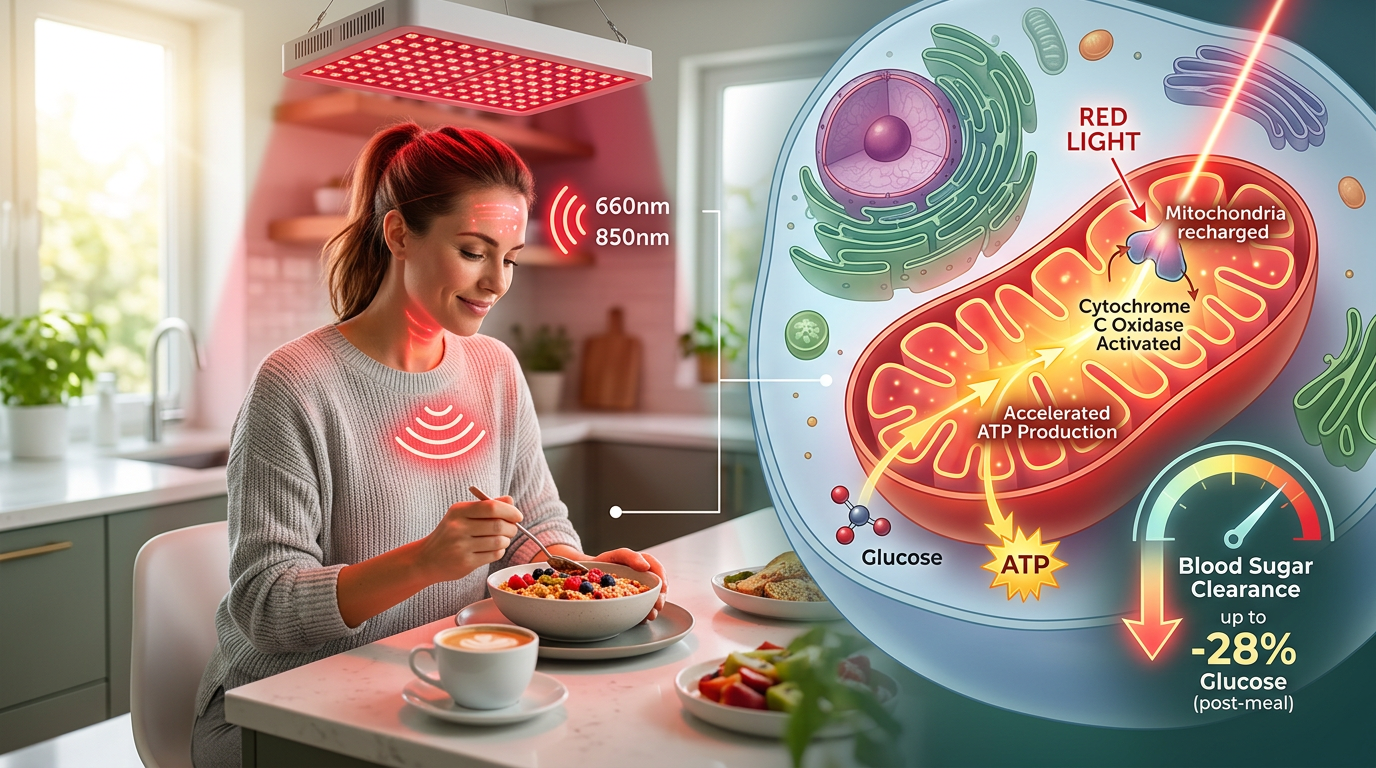
Then quiet the gut. Because most serotonin is made there in response to bacterial endotoxin, calming gut inflammation lowers the signal at its source. A simple, well-known tool in this world is the raw carrot eaten daily, whose fiber helps sweep endotoxin-producing material through and out. Support the pillars that raise cellular energy directly: healthy thyroid function, daily exposure to natural and red light, and the metabolic byproduct carbon dioxide, all of which push your mitochondria back toward efficient, oxygen-based energy production. And work to lower the load of chronic stress and excess estrogen, which as we saw keeps serotonin from being cleared. Restore the energy, and the brake releases.
Ready to restore your metabolism at the cellular level?
The Bioenergetic Reset Program addresses root causes, not symptoms. Join 300+ members who've discovered what real metabolic health feels like.
- 9+ hours of comprehensive training
- Twice-monthly LIVE coaching calls
- Complete meal plans and protocols
- Direct email support
$97/month | Cancel anytime
Serotonin, Mood, and Metabolic Health in Reading and Berks County, PA
Caring for patients across Reading and the wider Berks County area, I see the same pattern again and again. People arrive convinced their fatigue and low mood mean their brain is short on a happy chemical, and they leave understanding that their energy metabolism is the real lever. This shift matters especially in southeastern Pennsylvania, where long grey winters, high-stress schedules, and standard processed-food eating patterns quietly push metabolism into that slowdown state. Whether you are in Wyomissing, Lancaster, Downingtown, Allentown, or West Chester, the underlying biology is the same, and so is the opportunity.
Focusing on metabolic health Pennsylvania patients can actually feel means addressing thyroid function, blood sugar stability, gut inflammation, and light exposure together, rather than reaching for a single molecule. As a hormone specialist Wyomissing and greater Berks County residents can work with directly, my emphasis is on restoring cellular energy first and letting mood, drive, and mental clarity follow. If you live in the Reading area and have cycled through explanations that never quite fit, a bioenergetic evaluation may finally connect your symptoms to their real cause.
Frequently Asked Questions
What are the signs of low serotonin?
The classic list, fatigue, low mood, brain fog, poor sleep, and low motivation, is what most people mean by low serotonin symptoms. Here is the twist. These same symptoms overlap heavily with a high-serotonin, low-energy stress state, since serotonin acts as an energy brake and a shutdown signal. So the signs are real, but treating them as a serotonin shortage often misses the cause, which is more often a cellular energy problem than a chemical deficiency.
Can you be happy without serotonin?
Happiness is not the output of one molecule. The idea of serotonin as the sole happiness hormone does not hold up, since higher serotonin activity is actually linked to behavioral inhibition and caution rather than joy. Genuine wellbeing depends far more on having abundant cellular energy, stable blood sugar, healthy thyroid function, good sleep, and real human connection. You can absolutely feel content and engaged without chasing serotonin levels at all.
What happens if you have too much serotonin?
Too much serotonin is not a comfortable, blissful state. Acutely and dangerously, serotonin excess causes serotonin syndrome, a medical emergency with agitation, rapid heartbeat, high temperature, and muscle rigidity. More subtly, chronically elevated serotonin constricts blood vessels, can suppress mitochondrial energy production, and has been associated in some research with the shut-down, inflamed, low-metabolism states seen in learned helplessness and severe depression. More is not better with this molecule.
Which makes you happier, dopamine or serotonin?
In the serotonin vs dopamine question, the two are not interchangeable feel-good chemicals. Dopamine drives motivation, curiosity, and the pursuit of rewards, the engaged reaching-out that most people recognize as feeling alive. Serotonin leans toward inhibition, restraint, and harm avoidance. Neither is a happiness dial you should try to max out, but the exploratory, motivated states people usually want are more dopamine-flavored than serotonin-flavored.
What foods are high in serotonin, and should I chase them?
Foods rich in tryptophan, the building block, include turkey, other meats, eggs, and cheese, and some fruits like bananas contain small amounts of serotonin itself. But deliberately eating to boost serotonin can backfire, since the goal is not more of an energy-braking stress signal. A better strategy for how to increase serotonin balance is to support overall metabolism: eat enough well-tolerated carbohydrate, balance tryptophan-heavy muscle meat with glycine-rich gelatin and broth, and calm gut inflammation.
The Takeaway: Fix the Engine, Not the Warning Light
For decades you were handed a story with a clear villain and a clear cure: too little serotonin, so top it up. The evidence never really supported it, and when researchers finally examined the whole body of work, the low-serotonin theory of depression did not hold (Moncrieff et al., 2023). What emerges in its place is more hopeful, not less. Serotonin is best understood as an ancient stress and slowdown signal, a brake on cellular energy, mostly made in your gut in response to inflammation. Your fatigue, fog, and flat mood are the warning light on a low-energy engine, not a sign you are missing a happiness chemical.
That reframing changes what you do about it. Instead of chasing a single molecule, you rebuild the energy your cells are supposed to make in abundance, through steady fuel, balanced protein and fat, a calmer gut, healthy thyroid function, light, and less chronic stress. When the engine runs clean, the warning lights go dark on their own, and mood, drive, and clarity tend to return as a consequence rather than a target. None of this is a reason to abandon a medication or go it alone, and any change belongs in a conversation with a qualified provider. But it is a reason for optimism. If you have felt stuck inside the old serotonin story, there is a more accurate and more empowering one waiting, and it starts at the level of your mitochondria.
Tags:
References & Citations
This article is supported by scientific research and peer-reviewed sources. Click citations to verify the evidence.
- [1]Moncrieff J, Cooper RE, Stockmann T, et al.(2023)The serotonin theory of depression: a systematic umbrella review of the evidence.Molecular Psychiatry.View Source
- [2]Bayrer JR, Castro J, Venkataraman A, et al.(2023)Gut enterochromaffin cells drive visceral pain and anxiety.Nature.View Source
- [3]Yano JM, Yu K, Donaldson GP, et al.(2015)Indigenous bacteria from the gut microbiota regulate host serotonin biosynthesis.Cell.View Source
- [4]Davis JM, Alderson NL, Welsh RS.(2000)Serotonin and central nervous system fatigue: nutritional considerations.American Journal of Clinical Nutrition.View Source
- [5]Horowitz MA, Taylor D.(2019)Tapering of SSRI treatment to mitigate withdrawal symptoms.The Lancet Psychiatry.View Source
- [6]Dolivo DM, Larson SA, Dominko T.(2018)Tryptophan metabolites kynurenine and serotonin regulate fibroblast activation and fibrosis.Cellular and Molecular Life Sciences.View Source
All references have been reviewed for scientific accuracy and credibility. Citations follow standard academic format and link to original research where available.
About Dr. Steven Presciutti, MD
Founder & Health Coach at Biospark Health, specializing in bioenergetic health and metabolism optimization.