Hypothyroidism Symptoms: The Full Checklist Your Labs Might Be Missing
The complete hypothyroidism symptoms checklist, from fatigue to cold hands to brain fog, and why your doctor might dismiss each one individually.
Medical Disclaimer
This content is for informational and educational purposes only. It is not a substitute for professional medical advice, diagnosis, or treatment. Always seek the advice of your physician or other qualified health provider with any questions you may have regarding a medical condition.
If you are tired despite sleeping, cold when others are comfortable, gaining weight without eating more, losing the outer third of your eyebrows, constipated, foggy-headed, and told your labs are "normal," you are looking at a classic hypothyroidism symptom cluster. No single symptom proves anything. The pattern, taken together, is what matters, and it is worth bringing to a doctor as a full list rather than one complaint at a time.
Why One Symptom at a Time Gets Dismissed
Fatigue alone gets blamed on poor sleep or a busy life. Weight gain alone gets blamed on diet. Brain fog alone gets blamed on stress or age. Cold hands alone get blamed on circulation or the weather. Each symptom, examined in isolation during a fifteen-minute visit, has a dozen plausible explanations that have nothing to do with the thyroid. That is exactly how a slow-moving, whole-body metabolic problem slips past a system built to evaluate one complaint per visit.

Hypothyroidism is not really a disease of the thyroid gland alone. It is what happens when cells throughout the body stop receiving enough active thyroid signal to run their metabolism at full speed, a description that lines up with how Chaker and colleagues frame hypothyroidism in their 2017 Lancet review: a slowing of essentially every tissue's energy production (Chaker et al., 2017). When metabolism slows everywhere, symptoms show up everywhere, which is precisely why a checklist across body systems is more useful than chasing any single complaint.
The Full Hypothyroidism Symptoms Checklist
Energy and Sleep
- Fatigue that persists even after eight or more hours of sleep
- An afternoon energy crash that coffee barely touches
- Needing a nap to get through the day
- Waking up feeling as tired as when you went to bed
Temperature and Circulation
- Cold hands and feet, even in a warm room
- Feeling cold when people around you are comfortable
- A low resting body temperature (see our companion piece on tracking this at home)
Weight and Metabolism
- Weight gain, or difficulty losing weight, without a change in eating
- Puffiness or water retention, especially in the face and around the eyes
- Elevated cholesterol on routine bloodwork despite no change in diet
Skin, Hair, and Nails
- Dry, rough, or flaky skin
- Thinning hair, or hair that falls out more than usual
- Loss of the outer third of the eyebrows
- Brittle nails that split or break easily
Digestive
- Constipation that is new or has worsened
- A general slowing of digestion
Cognitive and Emotional
- Brain fog, or a sense of moving through mental molasses
- Trouble concentrating or finding words
- Low mood or a flattened emotional range
- Irritability without an obvious trigger
Reproductive and Hormonal
- Irregular or heavier-than-usual menstrual cycles
- Reduced libido
- Difficulty conceiving
Muscular and Physical
- Muscle aches, stiffness, or weakness
- A hoarser voice than usual
- A slower heart rate
Garber and colleagues, in the widely used clinical guidelines for hypothyroidism in adults, list many of these same domains, underscoring that clinicians are trained to look across systems, even when a rushed visit does not always allow it (Garber et al., 2012). If you recognize several items across more than two or three of these categories, that pattern is worth documenting and bringing to your doctor as a whole, not piecemeal.
Why Symptoms Differ Between Women and Men
Hypothyroidism is diagnosed far more often in women, and the symptom picture reflects that. Women more commonly report menstrual cycle changes, hair thinning, and mood shifts alongside the classic fatigue and cold intolerance, in part because thyroid hormone interacts closely with reproductive hormone signaling. Men more often present with the physical and metabolic symptoms alone: fatigue, weight changes, low libido, and muscle weakness, sometimes without the hair or cycle-related clues that prompt women to seek testing sooner. This is one reason hypothyroidism symptoms in men are frequently missed longer; the symptom set looks less distinctly "thyroid" without those additional signals.
Subclinical Versus Overt: Two Different Symptom Pictures
Overt hypothyroidism, where standard labs are clearly abnormal, tends to produce the full, unmistakable cluster: significant fatigue, marked cold intolerance, visible puffiness, slow reflexes. Subclinical hypothyroidism, where TSH is mildly elevated but T4 is still within range, or where labs sit at the edge of normal entirely, tends to produce a quieter version of the same list: mild fatigue, subtle brain fog, a few pounds that will not budge, hair that seems to be thinning just slightly faster than before. Biondi and colleagues' review of subclinical hypothyroidism describes exactly this gray zone, where symptoms are real but nonspecific enough to be waved away (Biondi et al., 2019).
This is also where the checklist becomes most useful. A single vague symptom in the subclinical range is easy to dismiss. Six or eight of them, tracked together, are much harder to explain away as coincidence.
When Symptoms and Labs Do Not Match
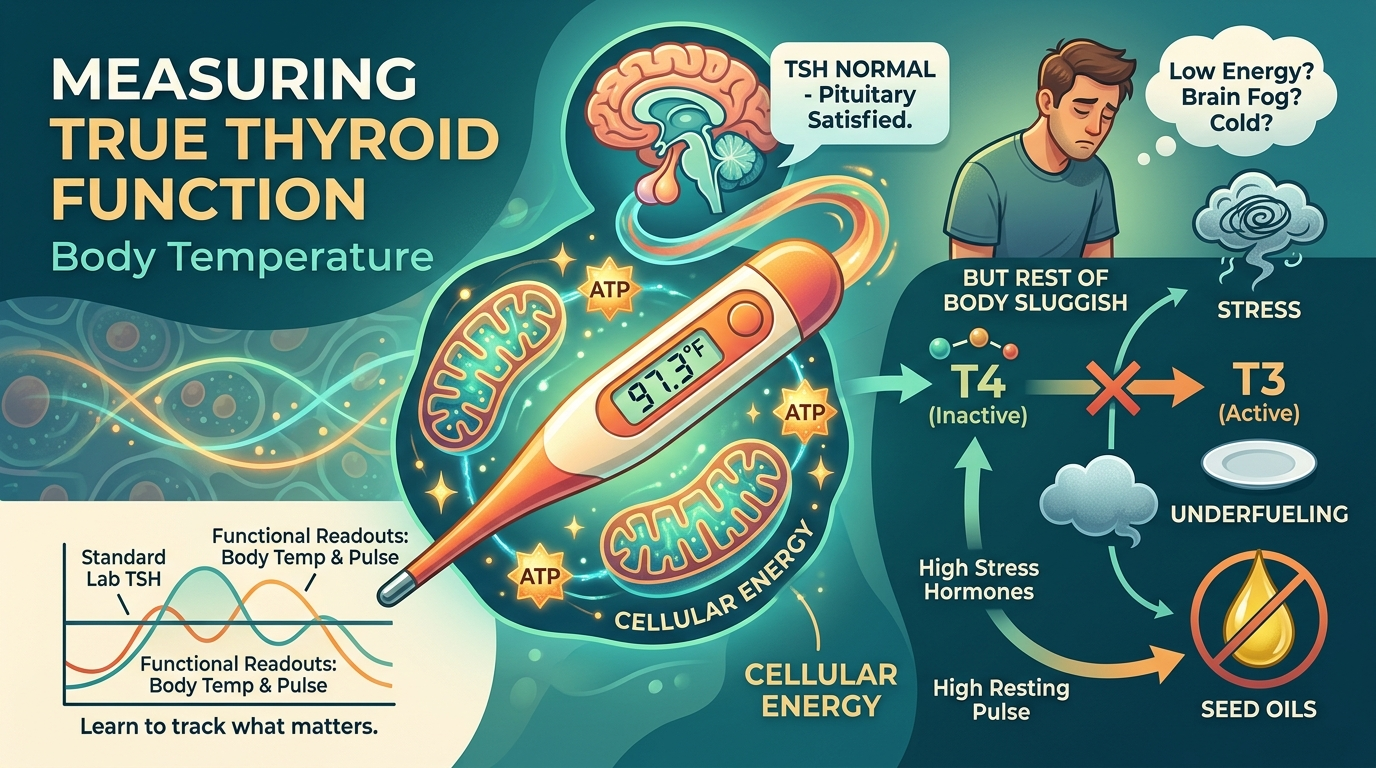
Here is the piece most checklists leave out: it is entirely possible to have most of the items on this list and still be told your TSH is "normal." TSH measures what your pituitary gland senses, not what every cell in your body is actually receiving, and the two do not always agree. We cover the mechanism behind this gap, and a simple at-home way to get a clearer functional picture using body temperature and pulse, in our companion article on normal TSH with hypothyroid symptoms. If this checklist describes you and your labs still came back unremarkable, that piece is the natural next step.
The bottom line: hypothyroidism symptoms rarely arrive as one clean complaint. They arrive as a pattern across energy, temperature, skin, digestion, mood, and hormones. Recognizing the pattern in yourself is the first real step, whether that leads to a more thorough conversation with your doctor or a closer look at your own metabolic function.
This article is for educational purposes and is not a diagnosis. Only a qualified clinician evaluating your full history and labs can determine whether you have hypothyroidism.
If this checklist sounds like your daily experience, a Free Discovery Call is a low-pressure way to talk through what you are noticing and what a root-cause, bioenergetic approach to thyroid and metabolic health could look like for you.
Tags:
References & Citations
This article is supported by scientific research and peer-reviewed sources. Click citations to verify the evidence.
- [1]Biondi B, Cappola AR, Cooper DS(2019)Subclinical Hypothyroidism: A Review.JAMA.View Source
- [2]Chaker L, Bianco AC, Jonklaas J, Peeters RP(2017)Hypothyroidism.Lancet.View Source
- [3]Hegedus L, Bianco AC, Jonklaas J, et al.(2022)Primary hypothyroidism and quality of life.Nature Reviews Endocrinology.View Source
- [4]Garber JR, Cobin RH, Gharib H, et al.(2012)Clinical practice guidelines for hypothyroidism in adults.Endocrine Practice.View Source
All references have been reviewed for scientific accuracy and credibility. Citations follow standard academic format and link to original research where available.
About Dr. Steven Presciutti, MD
Founder & Health Coach at Biospark Health, specializing in bioenergetic health and metabolism optimization.