Methylene Blue Side Effects: Who It Helps, Who It Hurts, and Who Should Never Touch It
Methylene blue side effects, from blue urine to serotonin toxicity. An MD on who it helps, who it hurts, the SSRI interaction, and why we do not give doses.
Medical Disclaimer
This content is for informational and educational purposes only. It is not a substitute for professional medical advice, diagnosis, or treatment. Always seek the advice of your physician or other qualified health provider with any questions you may have regarding a medical condition.
Somewhere right now, someone is squeezing blue drops into a glass of water because a podcast told them it feeds the mitochondria. They are also taking Lexapro. Nobody on the podcast asked.
That combination has a federal safety warning attached to it. In 2011 the FDA told clinicians that methylene blue can cause serious central nervous system reactions in people on serotonergic psychiatric drugs. The cases behind that warning include confusion, fever, muscle rigidity and at least one death. Of all the methylene blue side effects, this is the one nobody on the podcast mentions. Methylene blue is a potent inhibitor of the enzyme that clears serotonin.
I am an MD in the bioenergetic lineage, so I take the mitochondrial story seriously. The molecule really does carry electrons. But the side effects that matter are not the blue urine everyone jokes about. They are the ones you cannot see coming, and they land on a predictable list of people that almost no supplement seller screens for.
So this is a piece about who. Who it helps, who it hurts, who should never touch it, why "methylene blue dosage" is the wrong question, and where the bioenergetic view actually lands.
What Methylene Blue Actually Does in Your Cells
Your cells make energy by moving electrons from food down a chain of proteins to oxygen. The chain is where the work happens, and where things jam.
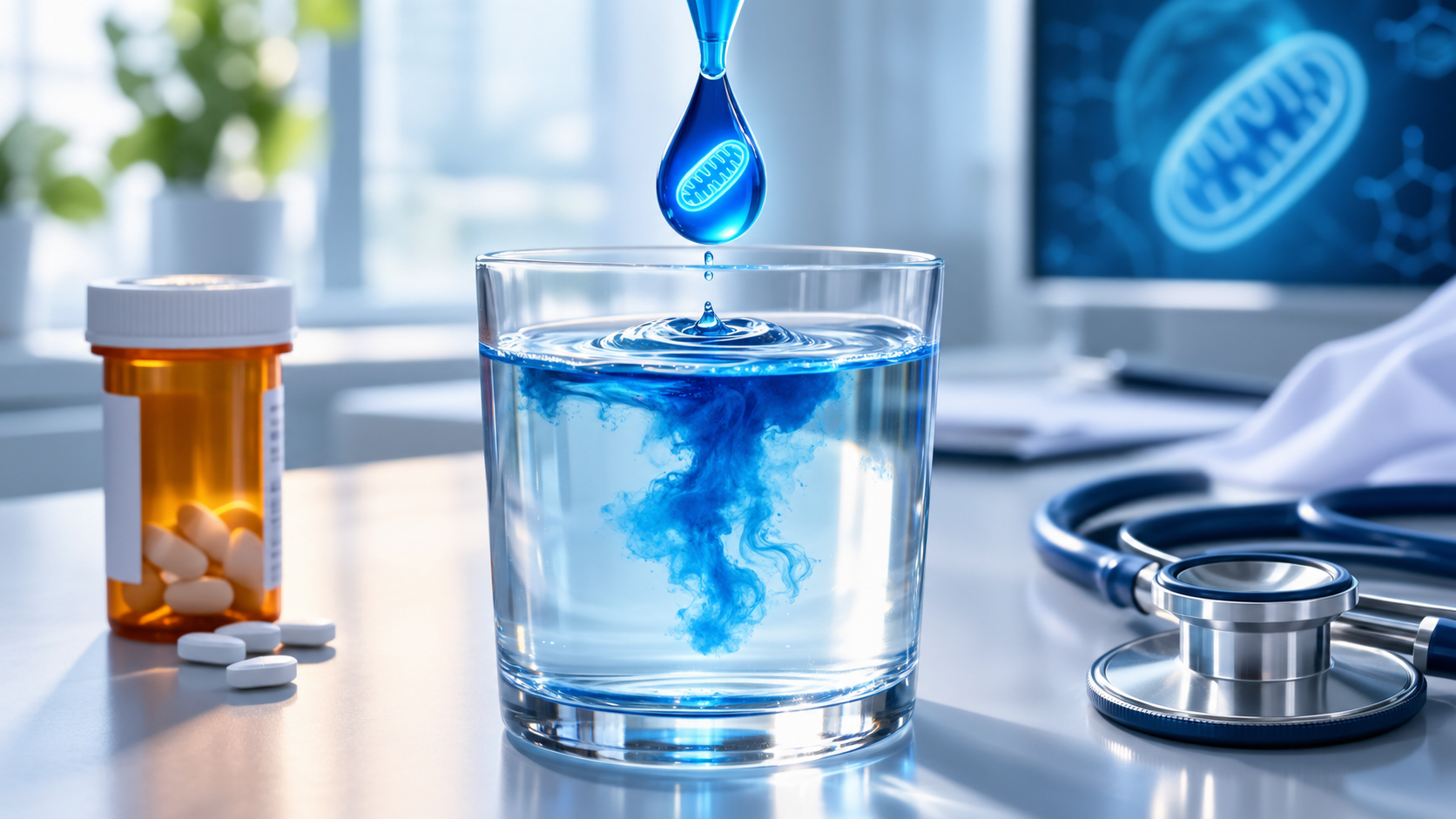
Methylene blue is an electron carrier that can step into that chain. In cell and animal studies, it accepts electrons directly from NADH and hands them to cytochrome c, skipping the front section of the chain where the most common blockages occur (Wen et al., 2011). A version of the molecule with its redox center disabled does nothing, which is how we know the electron shuttling is the active part.
Here is the part that sets up every side effect in this article. Methylene blue has two faces, and the dose picks which one you get. At low concentrations it cycles electrons and quenches oxidants. At higher concentrations it autoxidizes and becomes a source of oxidants itself. Rojas, Bruchey and Gonzalez-Lima (2012) call this a hormetic dose response, with opposite effects at low and high doses. Almost all of that evidence is rodent and in vitro. Say that every time, because the forums do not.
Two more properties follow from the same chemistry. Methylene blue needs a cellular reducing agent called NADPH to become its active, reduced form. Without it, the molecule stays oxidized and behaves as an oxidant. And methylene blue is a potent, reversible inhibitor of monoamine oxidase A, the enzyme that breaks down serotonin (Ramsay, Dunford and Gillman, 2007). At the blood levels reached by intravenous dosing, that inhibition is essentially complete.
One molecule, three consequences: it carries electrons, it turns pro-oxidant at higher exposure, and it shuts down serotonin clearance. Everything else here is those three facts meeting a specific person.
Why the Hype: The Human Evidence, Honestly
The cell biology is strong. The human evidence is small, and the gap between them is where the marketing lives.
The single best "supplement for healthy people" trial is Rodriguez and colleagues (2016) in Radiology. Twenty-six healthy adults, double-blind, placebo-controlled, one low oral dose. Methylene blue increased fMRI activity in the insula and prefrontal cortex and improved memory retrieval by about 7 percent. Real effect, real controls. Also one dose, in 26 people, measured the same day.
The psychiatric trials are older and still small: 31 people with bipolar disorder on lithium (Naylor, 1986) and 37 on lamotrigine (Alda et al., 2017), both showing lower depression scores as a monitored adjunct to a mood stabilizer, with Naylor's own authors noting that blinding is doubtful when everyone can see the color of their urine.
Then there is Alzheimer's, where the biggest claims come from. A methylene blue derivative called LMTM went through three large phase 3 trials, and the results are not close. Gauthier and colleagues (2016) enrolled 891 patients and missed the co-primary endpoints. Wilcock and colleagues (2018) enrolled 800 and reported benefit only in a post-hoc monotherapy subgroup that, in the paper's own words, was not randomized and requires a further suitably randomized trial. The 2026 LUCIDITY trial (Wischik et al.) enrolled 598 and again could not show a difference on the co-primary endpoints at 52 weeks. Three trials, zero primary endpoints met, and the sponsor's explanation each time is that the low-dose control arm was itself active.
That post-hoc subgroup is the source of the "85 percent reduction in cognitive decline" figure on bioenergetic blogs. It is a non-randomized re-analysis of a trial that failed. An interesting lead, not a result.
The honest summary: mechanism well supported in cells and animals, human benefit small and supervised, largest trials failed. A molecule worth studying, not one worth putting in your morning water on a podcast's say-so.
Methylene Blue Side Effects: What Everyone Gets, What Some Get, and What Almost Kills People
I sort methylene blue side effects into three tiers, because the visible ones are the least important.
What everyone gets. Blue-green urine, blue-tinged stool, sometimes a blue cast to the whites of the eyes. None of it is harmful. The one that matters clinically: methylene blue makes a pulse oximeter read falsely low, so in a hospital or an ambulance the oxygen number on the monitor is wrong, and the people treating you may not know why.
What some get. Nausea and stomach upset are the most common forum complaints. Headache. And a restless, wired discomfort people call "the serotonin feeling," which is exactly what you would predict from a molecule that inhibits serotonin breakdown. Methylene blue also raises blood pressure, which is why hospitals infuse it as a vasopressor in shock (Arias-Ortiz and Vincent, 2024). Useful when pressure has collapsed. Not a neutral property in a supplement.
What almost kills people. Three things.
Serotonin toxicity, which gets its own section below.
Hemolysis in people with G6PD deficiency. G6PD makes the NADPH that activates methylene blue in red blood cells, and without it the molecule stays oxidized and attacks the cell instead of helping it. Muller and colleagues (2013) pooled four trials in more than a thousand West African children treated with methylene blue for malaria. Hemoglobin dropped further in the G6PD-deficient children, with two episodes of frank hemolysis, and the authors concluded "limited clinical relevance but needs to be monitored." The point is not universal catastrophe. The point is that the risk is real, it varies by person, and roughly 400 million people carry the deficiency, most without knowing.
And the strangest one: methemoglobinemia, a state where hemoglobin cannot carry oxygen. Methylene blue is the hospital antidote for it, and at high doses the oxidized molecule causes the very condition it treats, which is why the Gauthier trial excluded anyone on methemoglobinemia-risk drugs. The antidote becomes the poison.
What happens if you take methylene blue every day?
Nobody knows. There is no long-term trial of daily methylene blue in healthy people. What we have is the biphasic curve, which says the dose that helped today is not guaranteed to keep helping, and a pointed line from Chris Masterjohn, who has written more carefully about this molecule than almost anyone: if your mitochondria work well, regular methylene blue will make them work less efficiently. A bypass around a functioning chain is not an upgrade. It is a detour.
Can You Take Methylene Blue With Antidepressants? Methylene Blue and SSRIs Explained
The short answer is no, and the reason is pharmacology, not caution.
Serotonin is cleared by monoamine oxidase A. SSRIs like Lexapro (escitalopram), Zoloft (sertraline) and Prozac (fluoxetine) raise serotonin by blocking its reuptake. Methylene blue raises serotonin by blocking its breakdown. Stack the two and serotonin has nowhere to go. That is serotonin toxicity: agitation, confusion, fever, rapid heart rate, rigidity and tremor. In severe cases it kills.
Ramsay, Dunford and Gillman (2007) confirmed the mechanism with human enzyme kinetics. Ng and Cameron (2010) then pulled together every published case of confusion after methylene blue infusion. Twenty-six cases. Twenty-four were on a serotonin reuptake inhibitor and one more was on clomipramine, a strongly serotonergic tricyclic. That is 25 of 26 on a serotonergic drug. Top and Gillman (2014) reported a death.
The FDA responded in July 2011 with a Drug Safety Communication warning that serious CNS reactions are possible when methylene blue is given to patients taking certain psychiatric medications. The prescription label now lists serotonergic drugs as a contraindication and advises a two-week washout after stopping most of them.
The methylene blue and SSRI interaction is the headline, but the list is longer. SNRIs like venlafaxine (Effexor) and duloxetine (Cymbalta) have their own case reports, and the label extends the warning to bupropion (Wellbutrin), tramadol, triptans, MAOI antidepressants, the antibiotic linezolid and St. John's wort. If you are not sure of a drug's class, ask a pharmacist.
Now the honest caveat. Every one of those published cases is intravenous and surgical, at doses far above anything in a dropper bottle, and there is no published case series from oral supplement doses. That does not mean the combination is safe at supplement doses. It means nobody is counting. Supplement users do not get case reports written about them, and the pharmacology does not know what route the molecule arrived by.
So: can you take Lexapro and methylene blue? Not without a prescriber who knows both drugs, and in my experience that prescriber will say no.
Methylene Blue Side Effects: Who Should Never Touch It
The tiers above sort into a hard list. If you are on it, the mechanism is not a reason to try anyway.
Anyone on a serotonergic drug, or within two weeks of stopping one. SSRIs, SNRIs, bupropion, tramadol, triptans, MAOIs, linezolid, St. John's wort.
Anyone with G6PD deficiency, and anyone who has not been tested. The deficiency is most common in people of Mediterranean, African, Middle Eastern, South Asian and Southeast Asian ancestry, and most carriers have never had a symptom. Youngster and colleagues (2010) list methylene blue among the drugs to avoid. A G6PD level is an inexpensive, routine blood test. If you have not had one, you do not know which group you are in.
Pregnancy and breastfeeding. Cragan's 1999 teratogen update documented intestinal atresia, fetal death and neonatal hemolytic anemia after methylene blue was injected into the amniotic sac during amniocentesis. The route was intra-amniotic, not oral, and I will not pretend otherwise. The label contraindication follows anyway, because nobody will run the trial that would refine it.
Kidney impairment. Methylene blue is cleared by the kidneys. Slower clearance means longer exposure, which pushes you toward the pro-oxidant face of the curve.
Anyone relying on pulse oximetry, or taking a drug that can cause methemoglobinemia such as dapsone or benzocaine.
Anyone who has not had the first two checked. This covers most people buying it online.
Why We Do Not Give a Methylene Blue Dosage
"Methylene blue dosage" is one of the most searched phrases around this molecule, and a number in a blog post is the most dangerous thing I could publish.
Start with the curve. The useful window is biphasic, and where it sits depends on body weight, G6PD status, serotonergic load, kidney function and what you are trying to fix. A single number cannot carry all of that, and a number in a blog post reaches a G6PD-deficient reader on Lexapro as surely as anyone else.
Then look at the spread inside the bioenergetic community itself. Ray Peat, in a 2015 interview transcribed on the forums, talked about the useful range in micrograms and compared it to thyroid hormone dosing. Commercial drops are sold at hundreds of micrograms per drop. Hans Amato's recent megadose experiment used 25 milligrams alongside two other redox compounds, with no safety screening mentioned in the free portion of the post. That is a spread of several hundred fold inside one community. Those figures are what people did, not what you should do.
Then the product. Prescription methylene blue is made to a pharmacopeial purity standard. Much of what is sold online is not, and some is aquarium grade, a fish medication with no purity requirement for human use. I looked for a published study of the purity of over-the-counter or aquarium-grade methylene blue and could not find one. That is not a reassurance. It is an absence.
So the question I would rather you ask is not "how much" but "why." Why is your electron chain congested in the first place? That answer usually does not involve a dye.
Why Don't Doctors Prescribe Methylene Blue?
Why don't doctors prescribe methylene blue? They do. That is the part the question gets wrong. It is a hospital drug, given intravenously for methemoglobinemia, for vasoplegic shock after cardiac surgery, and as a surgical dye. Every one of those uses happens in a monitored setting, after a drug-interaction screen, with a pulse oximeter the team knows to distrust. Physicians prescribe it to the right patient, for a defined problem, for a defined duration.
What they do not do is hand it out as an outpatient supplement, and the reasons are a ledger, not a conspiracy. The molecule is over a century old and off patent, so no sponsor will fund the outpatient trial that would establish a dose and duration. The three large trials that were run failed their primary endpoints. The serotonin interaction creates real liability with the most prescribed class of psychiatric drugs in the country. And the healthy-volunteer benefit is a 7 percent memory bump after a single dose. "Does something in cells" is not a prescription.
The Bioenergetic View: Fix the Chain, Then Decide If You Need a Bypass
Here is where I land, and it is not a shrug.
Methylene blue works, where it works, by patching electron flow around a congested chain. The bioenergetic question is why the chain is congested. In the people I see, the reasons are ones the dye does not touch: a heavy load of polyunsaturated fat delivering electrons in a form the chain cannot clear, low thyroid function slowing the whole apparatus, endotoxin from a struggling gut, and years of undereating carbohydrate so the body runs on its own mobilized fat. The chain is jammed and the overflow leaks out as oxidants. A bypass around the jam does not clear it. It lets you ignore it a little longer.
Peat's approach to new compounds, in his words, was "to find what the smallest amount does and then work up in stages." He used methylene blue in tiny amounts, mainly as an anti-inflammatory, and the forum record of his position is that it is not something people should simply take as a supplement. The people taking a hundred times what he described, and then selling it, are not following Peat.
So paint the two arms plainly. The reflex is to buy the blue drops, bypass the block, and feel a lift for a while, with a real risk of serotonin toxicity or hemolysis if you are on the wrong list. What we do instead is find out what is congesting the chain and clear it: carbohydrate restored to adequacy, thyroid function measured and supported, the polyunsaturated fat load brought down over months, the gut addressed so endotoxin stops arriving. If, after that, a clinician who knows your medication list and your G6PD result still thinks a bypass is warranted, that is a different conversation.
Which arm carries which weight: the cited findings are the electron-carrier mechanism in cells and animals, the hormetic curve, the MAO-A inhibition and the case series behind it. The recommendation to clear the chain first is the house position, reasoned from those mechanisms. No trial has compared the two approaches.
The Biospark Approach
At Biospark Health we start with the question the supplement skips: is your cellular energy actually short, and if so, why?
That means measurement before molecules. Waking body temperature and resting pulse, taken daily, because they are the cheapest readout of metabolic rate you own. A full thyroid picture rather than TSH alone. A medication list read for serotonergic drugs before any conversation about mitochondrial support. And for anyone curious about methylene blue, a G6PD level, because the test costs less than the bottle.
Most people who come to me interested in methylene blue are not short on electron carriers. They are short on fuel, short on thyroid hormone, running cold, and carrying a fat load their chain cannot clear. Fixing those things produces the lift they were hoping to buy. Root cause, not symptom.
Not sure where to start?
Take our free Cellular Energy Assessment to discover your unique metabolic pattern and get personalized recommendations.
- 10-15 minutes
- Instant results
- No commitment
Methylene Blue Questions We Hear in Reading and Berks County, PA
The methylene blue questions that reach our Reading office mostly arrive after someone has already bought the bottle.
"I am on Zoloft. Is a tiny amount safe?" That is a question for a prescriber who knows both drugs. Read the antidepressant section before you take anything.
"Can I get tested for G6PD deficiency?" Yes. It is a routine blood test available through any lab in Berks County, and it belongs before the first drop, not after the first symptom.
"My urine turned blue. Is that dangerous?" No. That is expected. The dangerous methylene blue side effects are the ones you cannot see.
We serve clients across southeastern Pennsylvania, including Wyomissing, Lancaster, Downingtown, Allentown, West Chester and the greater Philadelphia suburbs, in person and virtually. If you want metabolic health support in Pennsylvania that starts with why your energy is low rather than which molecule to add, that is what we do.
Frequently Asked Questions
What does methylene blue do to serotonin?
Methylene blue is a potent, reversible inhibitor of monoamine oxidase A, the enzyme that breaks serotonin down (Ramsay et al., 2007). At intravenous blood levels that inhibition is essentially complete. Serotonin accumulates, which is why combining it with any drug that also raises serotonin can produce serotonin toxicity, and why the FDA issued its 2011 safety communication.
Can you take Lexapro and methylene blue?
Not without a prescriber who knows both drugs, and that prescriber will almost certainly say no. In a systematic review of 26 published cases of confusion after methylene blue, 25 patients were on a serotonergic antidepressant (Ng and Cameron, 2010). The prescription label lists these drugs as a contraindication with a two-week washout. The methylene blue and SSRI interaction is the best documented, but SNRIs, bupropion, tramadol, MAOIs, linezolid and St. John's wort are all on the list.
What happens if you take methylene blue every day?
No trial has answered that in healthy people. The dose response is biphasic, meaning a dose that helps at one exposure can become pro-oxidant at a higher one (Rojas et al., 2012), and daily use accumulates exposure in ways single-dose trials never tested. Masterjohn's caution stands: if your mitochondria already work well, a chronic bypass makes them run less efficiently.
Conclusion
Methylene blue is a real drug with a real mechanism. In cells and animals it carries electrons around a blocked chain, and in 26 healthy adults a single dose nudged memory by 7 percent. What is marketing is the leap from those facts to a bottle of blue drops, sold to people nobody screened for the antidepressant in their cabinet or the enzyme deficiency in their blood.
The methylene blue side effects that matter are the invisible ones. Serotonin toxicity in anyone on a serotonergic drug. Hemolysis in the 400 million people carrying G6PD deficiency, most undiagnosed. A pro-oxidant flip at exposures nobody can define for you, from a product whose purity nobody has tested. That is why there is no dosage in this article.
The reflex is to bypass the jam. What we do instead is clear it. Put the carbohydrate back, measure and support the thyroid, bring the polyunsaturated fat load down, calm the gut, and let the chain run the way it was wired. The man this movement is named after used the molecule in tiny amounts and did not consider it a supplement. He was right. Fix the chain first. Then, with a clinician, a medication list and a G6PD result in hand, decide whether you ever needed a bypass at all.
Tags:
References & Citations
This article is supported by scientific research and peer-reviewed sources. Click citations to verify the evidence.
- [1]Ramsay RR, Dunford C, Gillman PK(2007)Methylene blue and serotonin toxicity: inhibition of monoamine oxidase A (MAO A) confirms a theoretical prediction.British Journal of Pharmacology.View Source
- [2]Ng BK, Cameron AJ(2010)The role of methylene blue in serotonin syndrome: a systematic review.Psychosomatics.View Source
- [3]Rojas JC, Bruchey AK, Gonzalez-Lima F(2012)Neurometabolic mechanisms for memory enhancement and neuroprotection of methylene blue.Progress in Neurobiology.View Source
- [4]Rodriguez P, Zhou W, Barrett DW, et al.(2016)Multimodal randomized functional MR imaging of the effects of methylene blue in the human brain.Radiology.View Source
- [5]Muller O, Mockenhaupt FP, Marks B, et al.(2013)Haemolysis risk in methylene blue treatment of G6PD-sufficient and G6PD-deficient West-African children with uncomplicated falciparum malaria: a synopsis of four RCTs.Pharmacoepidemiology and Drug Safety.View Source
- [6]Gauthier S, Feldman HH, Schneider LS, et al.(2016)Efficacy and safety of tau-aggregation inhibitor therapy in patients with mild or moderate Alzheimer's disease: a randomised, controlled, double-blind, parallel-arm, phase 3 trial.Lancet.View Source
All references have been reviewed for scientific accuracy and credibility. Citations follow standard academic format and link to original research where available.
About Dr. Steven Presciutti, MD
Founder & Health Coach at Biospark Health, specializing in bioenergetic health and metabolism optimization.