Should I Take Daily Aspirin? The 2026 Trial That Changed Our Answer
Should I take daily aspirin? ASPREE-XT followed 19,114 adults over 70 for 8.6 years. What it found, what it did not test, and what we correct from August.
Medical Disclaimer
This content is for informational and educational purposes only. It is not a substitute for professional medical advice, diagnosis, or treatment. Always seek the advice of your physician or other qualified health provider with any questions you may have regarding a medical condition.
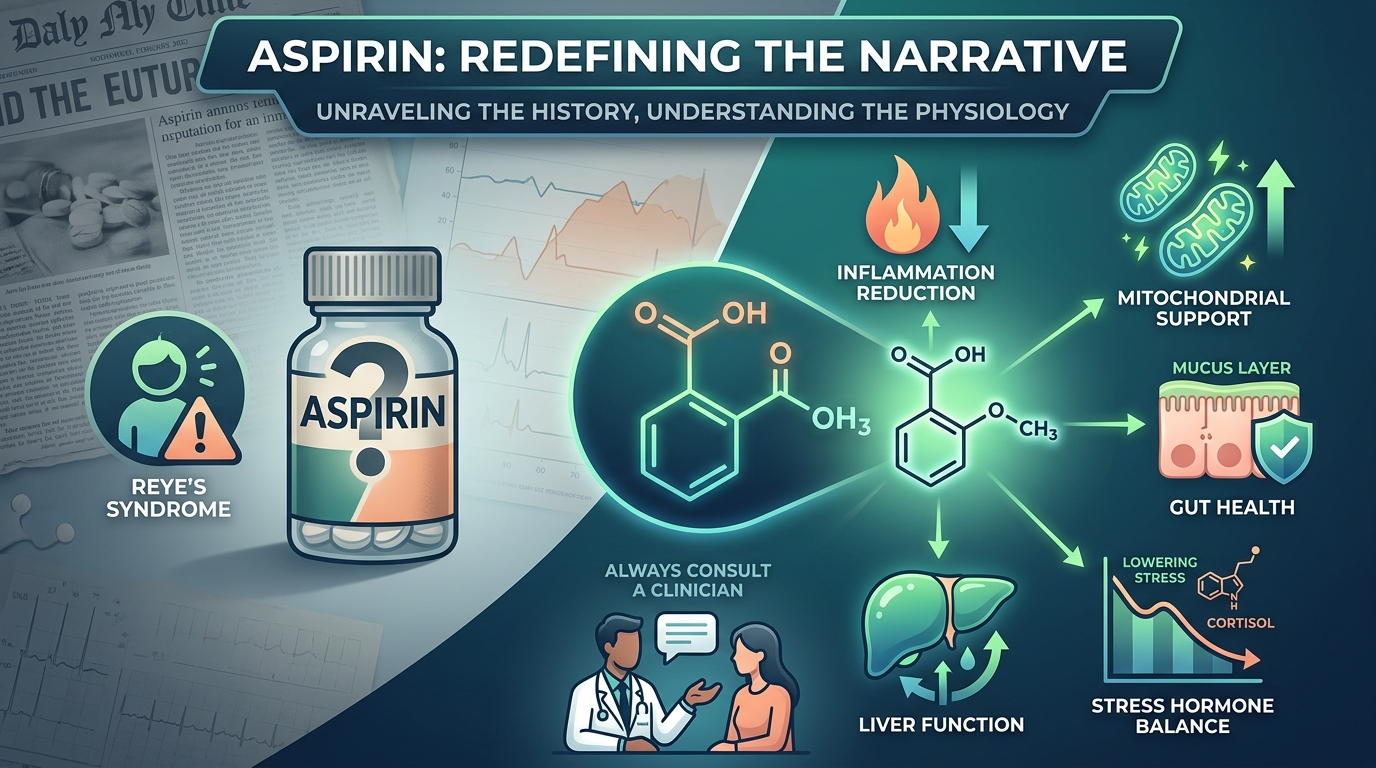
In August we published a defense of aspirin. It argued that the drug's bad reputation came from a 1980s advertising war, and that what salicylate does inside a cell looks more like metabolic support than a painkiller. Eight weeks later I am writing the correction, because a trial says we were wrong about one thing and partly wrong about several others.
Should I take daily aspirin? If you are over 70 and nobody has prescribed it for a diagnosed heart problem, the largest randomized trial ever to ask that question published its ten-year results in JAMA Oncology this January. It is called ASPREE-XT. Nobody in the bioenergetic corner of the internet has answered it. This is our answer, and the honest version includes the sentences we are taking back.
Two ground rules. There is no dose and no start-or-stop instruction anywhere in this article; if you take aspirin, the person who prescribed it holds your chart. And I am going to quote our August sentences back, one at a time, and say which ones stand.
Why Is Daily Aspirin No Longer Recommended?
Three large randomized trials, all published in 2018, tested low-dose aspirin in people who had never had a heart attack or stroke. None found enough benefit to pay for the bleeding.

ARRIVE gave it to 12,546 adults at moderate cardiovascular risk: no difference in cardiovascular events, and gastrointestinal bleeding doubled. ASCEND gave it to 15,480 people with diabetes and found a 12 percent drop in serious vascular events against a 29 percent rise in major bleeding, benefits the authors called "largely counterbalanced by the bleeding hazard." ASPREE, the trial this article is about, gave it to healthy adults over 70 and found no cardiovascular benefit at all, alongside a 38 percent rise in major hemorrhage (McNeil 2018).
A 2019 meta-analysis in JAMA pooled 13 trials and 164,225 people and put the arithmetic on one line. Treat 265 people to prevent one cardiovascular event. Treat 210 to cause one additional major bleed (Zheng and Roddick 2019).
In 2022 the US Preventive Services Task Force turned that into a guideline. It recommends against starting low-dose aspirin for primary prevention at age 60 or older, and calls it an individual decision between 40 and 59 for people whose ten-year cardiovascular risk is at least 10 percent (USPSTF 2022). The word that matters is starting. The recommendation is about initiation, and it says nothing about people already on aspirin because of a stent, a stroke, or a heart attack.
Should I Take Daily Aspirin to Prevent Cancer? What ASPREE-XT Found
ASPREE enrolled 19,114 community-dwelling adults in Australia and the United States, aged 70 and over (65 and over for US Black and Hispanic participants), with no history of cardiovascular disease, dementia, or physical disability. Half took the trial's dose, 100 milligrams of enteric-coated aspirin daily, and half took placebo, for a median of 4.7 years, until the trial was stopped for futility. ASPREE-XT then followed them through 2022, a median of 8.6 years (Orchard 2026).
| Outcome | Aspirin vs placebo | Source |
|---|---|---|
| Any incident cancer, 8.6 years | HR 0.98 (0.92 to 1.05), null | ASPREE-XT |
| Colorectal cancer | HR 1.01 (0.84 to 1.21), null | ASPREE-XT |
| Cancer death, full 8.6 years | HR 1.15 (1.03 to 1.29) | ASPREE-XT |
| Cancer death, trial years only | 3.1% vs 2.3%, HR 1.31 (1.10 to 1.56) | McNeil 2018 |
| Metastatic at diagnosis, trial years | HR 1.19 (1.00 to 1.43) | McNeil 2021 |
| Stage 4 at diagnosis, trial years | HR 1.22 (1.02 to 1.45) | McNeil 2021 |
| Cancer death, post-trial only | HR 1.02 (0.83 to 1.25), null | ASPREE-XT |
| Melanoma | HR 0.77 (0.62 to 0.94) | ASPREE-XT subgroup |
| Major hemorrhage, trial years | 8.6 vs 6.2 per 1,000 person-years, HR 1.38 | McNeil 2018 |
| Death, dementia, or disability | HR 1.01, null | McNeil 2018 |
Read it from the top. Aspirin did not cause more cancers. Incidence was flat overall, flat by type, and flat for colorectal cancer, the tumor the older literature said aspirin prevents best. What moved was death. During the trial years, people on aspirin were 31 percent more likely to die of cancer, and the 2021 stage analysis showed why: their cancers were more often metastatic or stage 4 when found (McNeil 2021). The investigators wrote that aspirin "may accelerate the progression of cancer" in older people.
Then the pills stopped. Among the 14,907 people still cancer-free at the end of the trial, the mortality difference vanished afterward: hazard ratio 1.02. No legacy harm, and no legacy benefit either (Orchard 2026). Across the full 8.6 years the cancer-mortality hazard ratio settled at 1.15, driven entirely by the years people were taking the drug.
Can aspirin increase the risk of cancer? Not the risk of getting one, in this trial. The risk of dying from a cancer you already have, in adults who started aspirin after 70, yes. Both halves of that have to travel together.
What ASPREE Did Not Test
A trial answers the question it asked. Here is what ASPREE did not ask.
- Anyone under 70. The typical participant was in their mid-seventies. Age at initiation is the variable the investigators themselves keep flagging.
- Any other dose or formulation. One dose, enteric-coated, swallowed whole. Not dissolved in water, not with food, not paired with vitamin K. None of those have outcome data in either direction, so nobody gets to claim them.
- Any metabolic endpoint as a primary outcome. Liver fat, body temperature, thyroid function, carbon dioxide, endotoxin: none were measured. Diabetes was a post hoc analysis, and it did move, 15 percent fewer new diagnoses, alongside a 44 percent rise in major bleeding in the same people. That is the only randomized dataset with both sides of the metabolic ledger.
- People taking aspirin for a diagnosed reason. Excluded by design.
- Perfect adherence. By the final year 62 percent of the aspirin group were still taking it. You might expect that to dilute the harm. A 2023 compliance-adjusted reanalysis found the opposite: correcting for it made the cancer-mortality, bleeding, and all-cause estimates larger.
So ASPREE cannot tell a 45-year-old anything. It can tell a healthy 74-year-old quite a lot.
The Fair Counter-Reading
Honesty means giving the other side its strongest form, and it is not weak.
The ASPREE-XT authors wrote the limitation into their own paper: "Given the multiple analyses undertaken without statistical control for multiple testing, the possibility that findings have arisen by chance or from outcome ascertainment bias must also be considered." The lead author, Suzanne Orchard, told Healio she suspects the overall mortality excess "is a residual effect coming from the clinical trial phase," and that with longer follow-up "it would be quite likely that that risk will fall back down to zero." Follow-up is funded through 2030.
Three findings in the same dataset point the other way. No legacy harm once the drug stopped. Melanoma 23 percent lower on aspirin. And in the post-trial years, metastatic disease at diagnosis was lower in the former aspirin group, hazard ratio 0.77, the mirror image of the in-trial signal.
Then there is the older literature, which is large and real. Rothwell's 2011 pooled analysis of eight trials found a 21 percent reduction in cancer death, appearing only after five years of use. The Lynch syndrome trial CAPP2 found a 35 percent reduction in colorectal cancer. Notice what those studies share: Rothwell's participants started in their forties, fifties, and sixties and were followed for twenty years, and CAPP2's mean age was 45. ASPREE's participants started at 74. The two literatures are not in conflict. They are about different people, and "age of initiation" is Orchard's framing, not ours.
No formal editorial or published critique of ASPREE-XT existed when I wrote this. The counter-reading above is built from the paper's own limitations, the lead author's interview, and the National Cancer Institute's 2020 commentary on the original trial, which called the mortality finding "unexpected and unexplained" and said prescribed users should not stop on the strength of it without talking to their doctor.
Where does that leave us? The counter-reading keeps the question genuinely open under 60. It does not rescue initiation at 70. A signal that survives compliance adjustment, shows up as later-stage disease, and comes with a 38 percent bleeding excess is not something I can wave off as chance while asking you to scrutinize everyone else's citations.
What We Said in August, and What Changes
Here are the sentences from our August post, quoted, with a verdict on each. The original stays up with a note pointing here, because editing it quietly would defeat the purpose.
"Almost everything the average American believes about aspirin's safety traces back to a public relations campaign in the early 1980s." Partly stands, mostly withdrawn. The Reye's syndrome history and the acetaminophen story hold up as written. But the reason a physician in 2026 hesitates over daily aspirin is not Tylenol advertising. It is ARRIVE, ASCEND, and ASPREE. We called randomized evidence marketing. That was wrong.
"Aspirin interrupts that loop at several points: it blunts the cytokine response" to endotoxin. Withdrawn for humans. In the only two studies that injected endotoxin into healthy volunteers and gave aspirin, the claim went the wrong way. In 2019, Leijte and colleagues gave 30 healthy men a standard low dose before intravenous endotoxin, and TNF-alpha rose 53 percent, IL-6 rose 91 percent, and the anti-inflammatory IL-10 fell 40 percent against placebo (Leijte 2019). In 1999, Jilma's group used a full-strength dose and found aspirin "had no influence" on the endotoxin response. The one positive human study, Hamid 2017, used inhaled endotoxin and found lower neutrophils and TNF-alpha in the lung only. So the honest claim is narrow: aspirin blunts endotoxin-driven inflammation in the airway, and in cell and animal work. In the human bloodstream, the best evidence says it amplifies it.
"Aspirin has been shown to raise ATP levels in intact neurons and in isolated brain mitochondria" and to enhance cytochrome c oxidase. Withdrawn. We could not find the study. A claim we cannot trace to a paper does not belong in a sentence that begins "has been shown." Until someone hands me the PMID, that sentence is gone.
"It also behaves as a mild uncoupler, which sounds bad and mostly is not." Stands, relabelled. The evidence is Smith 2016 in Diabetes: mice and isolated mitochondria, at salicylate concentrations in the clinical range. No human outcome data. We should have said mice.
"The aspirin did not create the fragility. It exposed it." Withdrawn. That line said bleeding on aspirin is mostly a readout of hidden vitamin K deficiency. ASPREE screened out people with bleeding disorders and still found 8.6 major hemorrhages per 1,000 person-years on aspirin against 6.2 on placebo. Bleeding is a drug effect. Vitamin K status is one modifier among several, next to age, Helicobacter pylori, ulcer history, and other blood thinners.
"Guidelines on primary prevention have changed more than once in the last decade." True, and evasive. The fact we skipped: initiation at 60 or older carries a task force D recommendation, meaning recommended against.
"The reasons most people believe they should avoid it do not hold up well, and the reasons that do hold up are specific, listable, and probably do not apply to most people who repeat them." Withdrawn. For adults 70 and older with no cardiovascular indication, a randomized reason now holds up, and that is a large group.
The 50 percent diabetes figure. We did not print it, but it circulates in our corner from an observational cohort. The randomized number, from inside ASPREE, is 15 percent, with the 44 percent rise in major bleeding attached.
What stands: the Reye's epidemiology, the acetaminophen mechanism, the salsalate trials in prediabetes, the 2024 randomized trial in fatty liver disease, and the contraindication list, with one line added. Age 70 or older with no cardiovascular indication now belongs on it as a raise-it-with-your-doctor item.
Is It Safe to Take Aspirin Every Day?
The honest answer is absolute numbers, not slogans. In the 2019 meta-analysis, daily low-dose aspirin added roughly one major bleed per 210 people treated, in a population with a median age of 62. In ASPREE, over 70, the excess was 2.4 major hemorrhages per 1,000 person-years. Those are not enormous numbers. They are also not zero, and in the populations tested they bought nothing in exchange.
One nuance our August post reached for and the literature does support: fatal gastrointestinal bleeding is not increased on aspirin. Major GI bleeds rise about 55 percent, but the ones that kill do not. The substantive fatal risk is bleeding into the brain, roughly one death and one disabling stroke per 1,000 people over ten years. That is the strongest honest form of "the bleeding risk is overstated," and it is still a real harm.
Where the Bioenergetic Rationale Survives, Narrowed
I am not abandoning the mechanism, because the mechanism did not fail. What failed was the leap from mechanism to outcome in one population.
What survives, with its label attached. Salicylate uncouples mitochondria and shifts fuel use toward glucose: mice and isolated mitochondria (Smith 2016). Salsalate lowers glucose in prediabetes: human trials, short. Aspirin lowered liver fat in a six-month randomized trial in fatty liver disease: human, real, six months. Aspirin blunted endotoxin-driven inflammation in the airway: human, one study. Aspirin reversed high-fat-diet depression: male mice, and Georgi Dinkov's write-up of that paper, human-equivalent dose included, is still a mouse result.
Ray Peat's essay on aspirin, brain, and cancer still reads as serious thinking about respiration and carbon dioxide. His claim that aspirin prevents cancer is the one claim ASPREE tested directly, in people over 70, and did not find. We will not repeat it in that population.
The framing I find most useful comes from Jay Feldman and Mike Fave, who are inside this tradition: a respiration stimulant is a gas pedal. Press it in a system with fuel, thyroid, and an intact gut, and it may help. Press it in a system without those, and you have made a stressed system work harder. Fave has watched people wreck their stomachs on heroic doses. Foundations first is not a hedge. It is the mechanism, applied honestly.
What we no longer say: that aspirin is a general anti-aging or anti-cancer strategy for older adults; that bleeding is mostly a vitamin K readout; that it blunts the cytokine response to endotoxin in humans.
Should I Take Daily Aspirin? Questions to Bring to Your Doctor
Only the questions I would want a patient of mine to walk in with.
- Am I on aspirin for a diagnosed reason, or "just in case"? Secondary and primary prevention have different evidence.
- What is my ten-year cardiovascular risk, and does my age put me in the group where the task force says there is no net benefit?
- What is my bleeding risk? Helicobacter pylori, ulcer history, other blood thinners, kidney function, platelet count.
- Am I current on age-appropriate cancer screening? ASPREE's signal was late-stage disease at diagnosis, which is what screening catches.
- If I take it for a metabolic reason, liver fat or glucose, what endpoint are we tracking, and when do we reassess?
If a doctor prescribed it, that doctor answers these. Not a blog, including this one.
The Biospark Approach
What interested us about aspirin in August still interests me: the four levers its mechanism points at. Glucose oxidation. Mitochondrial respiration. Gut-derived endotoxin. Stress mediators. Those are the work. The drug was only ever a demonstration that they matter, and a demonstration is not a prescription.
The house view has not moved. A body in trouble is a body short on energy, and the job is to restore its capacity to make energy rather than to chemically push a system that cannot. Aspirin, at its best, pushes. In a person eating enough, with adequate thyroid function at the tissue level and a gut that is not leaking endotoxin into the liver, a respiration stimulant has something to work with. In a person who is cold, under-fed, and running on cortisol, it is one more demand.
So at Biospark Health the questions with a new client have not changed. Is thyroid function adequate where it counts, not just on a TSH? Is the gut barrier intact? Is there enough available carbohydrate that the body is not living on free fatty acids and adrenaline? Those answers come from labs, temperature, pulse, and a history, not from a bottle. We do not start or stop medications, and we coordinate with the clinicians who do. Our work is the part underneath: the fuel, the thyroid, the gut, and the fat load.
Not sure where to start?
Take our free Cellular Energy Assessment to discover your unique metabolic pattern and get personalized recommendations.
- 10-15 minutes
- Instant results
- No commitment
Metabolic Health Support in Reading and Berks County, PA
If you are in Reading, Wyomissing, or anywhere in Berks County and have taken a daily aspirin since a doctor mentioned it years ago, the first step is not to stop. It is to bring the questions above to whoever prescribed it, and to find out whether your metabolism gives that drug anything to work with.
Biospark Health works with clients across southeastern Pennsylvania, including Lancaster, Downingtown, Allentown, West Chester, and King of Prussia, in person and virtually. We offer metabolic health support in Pennsylvania that sits alongside your medical care: tissue-level thyroid function, gut barrier integrity, energy availability, and the stress signaling that ties them together. We coordinate with your prescribing clinicians and never make medication decisions for them.
Frequently Asked Questions
Do cardiologists recommend aspirin?
For people who have had a heart attack, stroke, or stent, yes. That is secondary prevention, and nothing in ASPREE changes it. For healthy people starting aspirin to prevent a first event, most cardiologists now follow the 2022 task force guidance: not after 60, and an individual decision between 40 and 59 when ten-year cardiovascular risk is high. The pill is the same. The patient is not.
Can aspirin increase the risk of cancer?
In ASPREE, aspirin did not increase the number of cancers diagnosed in adults over 70. It did increase the chance a cancer was metastatic or stage 4 when found, and the chance of dying from cancer during the trial, by about 31 percent. After the drug stopped, that excess did not persist. Earlier trials in people who started aspirin in their forties and fifties found fewer cancer deaths after five or more years of use. Age at initiation appears to matter.
Why do I feel so good after taking aspirin?
Salicylate lowers serotonin release from platelets, reduces free fatty acid release, and in animal work shifts cells toward burning glucose. Any of those can feel like warmth or clarity. That is a mechanism, not an outcome. A noticeable response to any drug is information, and it is worth telling your doctor about.
Conclusion
The bioenergetic rationale for aspirin is narrowed, not abandoned, and it is no longer oversold. Salicylate does push cells toward oxidizing glucose, does uncouple mitochondria in the lab, and did lower liver fat in a six-month human trial. It also, in the best trial ever run in healthy adults over 70, produced no gain in survival, disability, or dementia, more bleeding, and more deaths from cancer while people were taking it. Both paragraphs are true, and a site that prints only one of them is a supplement blog.
Here is where we land. One reflex reaches for a cheap old drug because its mechanism is beautiful. The other files aspirin under dangerous and stops thinking. We do neither. A body short on energy needs its capacity to make energy restored, through fuel, thyroid, gut, and the fat load, and a stimulant of respiration pressed onto a system without those is a stressor, whatever the molecule. In younger adults the older trials remain favorable and untested by ASPREE. In adults starting fresh at 70, a randomized reason to hesitate now exists, and we say so.
We publish corrections because the alternative is to become the thing we argue against. Start with the free assessment above if you want to know what your own metabolism has to work with, and bring the questions from this article to the person who holds your chart.
Tags:
References & Citations
This article is supported by scientific research and peer-reviewed sources. Click citations to verify the evidence.
- [1]Orchard SG, Lockery JE, Broder JC, et al.(2026)Long-Term Effects of Aspirin on Cancer Incidence and Mortality in Older Adults: Extended Follow-Up of the ASPREE Randomized Clinical Trial.JAMA Oncology.View Source
- [2]McNeil JJ, Nelson MR, Woods RL, et al.(2018)Effect of Aspirin on All-Cause Mortality in the Healthy Elderly.The New England Journal of Medicine.View Source
- [3]McNeil JJ, Gibbs P, Orchard SG, et al.(2021)Effect of Aspirin on Cancer Incidence and Mortality in Older Adults.Journal of the National Cancer Institute.View Source
- [4]US Preventive Services Task Force(2022)Aspirin Use to Prevent Cardiovascular Disease: US Preventive Services Task Force Recommendation Statement.JAMA.View Source
- [5]Zheng SL, Roddick AJ(2019)Association of Aspirin Use for Primary Prevention With Cardiovascular Events and Bleeding Events: A Systematic Review and Meta-analysis.JAMA.View Source
- [6]Leijte GP, Kiers D, van der Heijden W, et al.(2019)Treatment With Acetylsalicylic Acid Reverses Endotoxin Tolerance in Humans In Vivo: A Randomized Placebo-Controlled Study.Critical Care Medicine.View Source
All references have been reviewed for scientific accuracy and credibility. Citations follow standard academic format and link to original research where available.
About Dr. Steven Presciutti, MD
Founder & Health Coach at Biospark Health, specializing in bioenergetic health and metabolism optimization.