Why Do Statins Cause Muscle Pain? What the New Gut Study Actually Shows
Why do statins cause muscle pain? A June 2026 study points to gut endotoxin, lost isoprenoids and blocked muscle glucose use, not cholesterol. What to ask.
Medical Disclaimer
This content is for informational and educational purposes only. It is not a substitute for professional medical advice, diagnosis, or treatment. Always seek the advice of your physician or other qualified health provider with any questions you may have regarding a medical condition.
Thighs that ache on the stairs. Shoulders that feel bruised after carrying groceries. A heaviness in your legs that showed up a few weeks after the new prescription and has not left. You mention it, and you get one of two answers. The cardiologist says it is age. The internet says the pill is poisoning your mitochondria.
Neither answer is good enough, and both are partly right. So why do statins cause muscle pain in some people and not others?
A study published in June 2026 in Science Advances gives the clearest mechanistic answer so far, and it is not the one circulating online. It does not show that statins leak bacterial toxin out of your gut. It shows something more useful: the amount of that toxin already in your system may set the dose at which a statin starts to hurt your muscle, and the damage has nothing to do with cholesterol.
I have written before about the 2026 cholesterol guidelines and about why cholesterol rises in the first place. This one is about the muscle: how common the pain really is, what the study found, where the gut fits, whether muscles recover, and what to ask your prescriber.
Why Do Statins Cause Muscle Pain? The Short Answer
Most reported statin muscle pain is not caused by the drug. In blinded trials, people on placebo report muscle symptoms at almost the same rate as people on the statin.
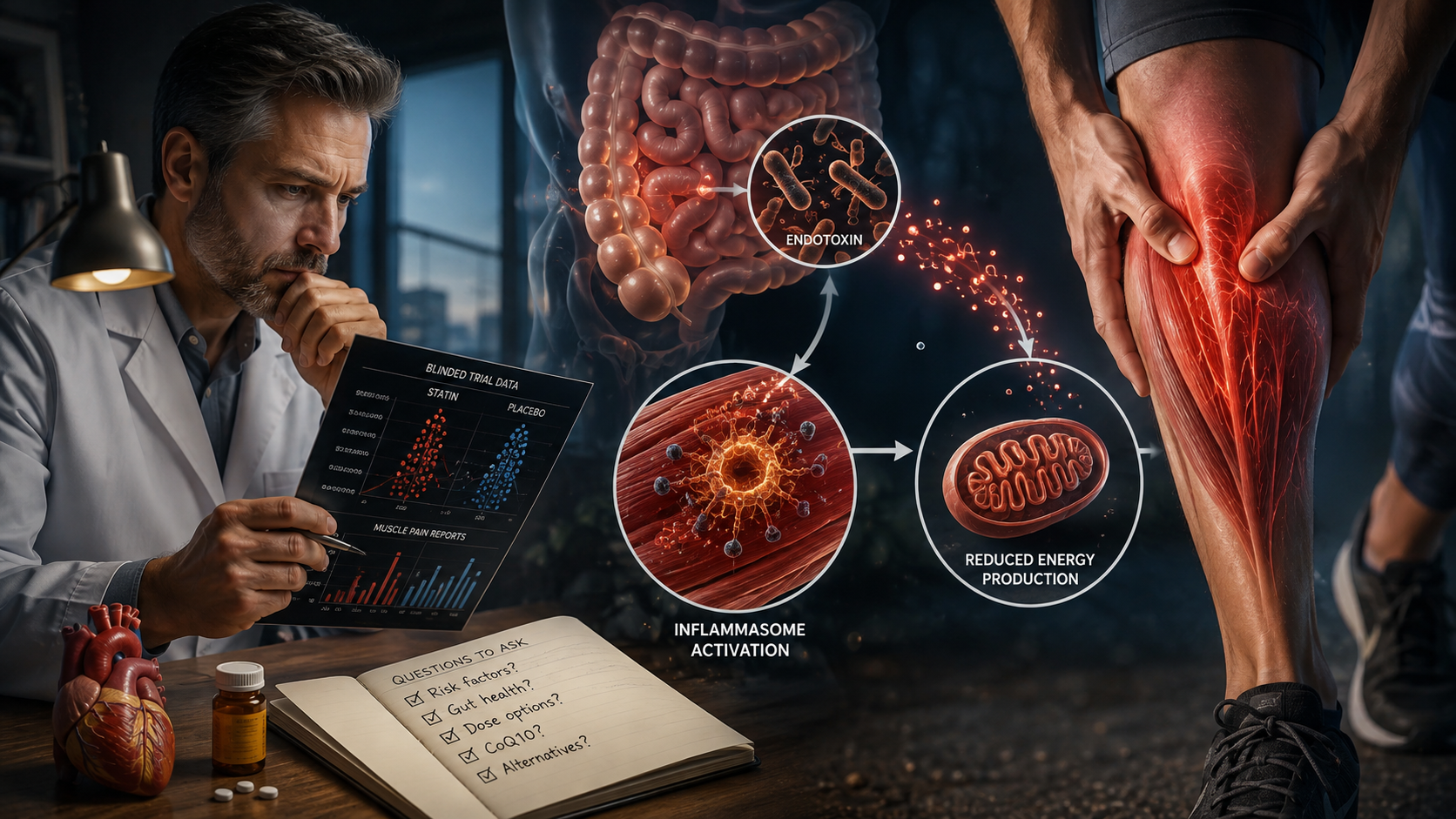
A real minority is caused by the drug. Risk rises with dose and intensity, with a common gene variant that slows the drug's clearance, with low thyroid function, with low vitamin D, and with interacting medications. In the blinded data the excess is concentrated in the first year.
In that minority, the mechanism does not run through cholesterol. Statins block an enzyme high up in a production line called the mevalonate pathway. Cholesterol is one product of that line. So are coenzyme Q10 and a family of molecules called isoprenoids that muscle cells use to anchor proteins to their membranes. The 2026 study found that giving a statin-damaged muscle cell its cholesterol back changes nothing; giving it the isoprenoids back stops the damage (Robin 2026). The muscle was short on the other things the drug took with it, and short on the ability to burn glucose.
That third layer is where gut endotoxin enters.
How Common Is Statin Muscle Pain, Really? The Nocebo Steelman
Any honest piece on statin side effects has to start with the data that cuts against the alarm, because it is strong.
In 2022 the Cholesterol Treatment Trialists' Collaboration pooled individual patient data from 19 double-blind trials covering 123,940 people (CTT 2022). Over full follow-up, statin users reported muscle symptoms 3% more often than placebo users. In the first year the excess was 7% relative, or 11 extra people with muscle symptoms per 1,000 person-years. After the first year there was no detectable excess. The authors concluded that more than 90% of muscle complaints on statins would have happened on placebo.
Then there is SAMSON, a crossover trial I find genuinely clever. Sixty people who had quit a statin because of side effects took a standard dose of atorvastatin, an identical placebo, and nothing at all, four months each in random order, scoring symptoms daily (Howard 2021). Average symptom score: 8 on nothing, 16 on statin, 15 on placebo. Statin and placebo were statistically indistinguishable, and symptoms started and stopped just as fast on placebo. The nocebo ratio was 0.90: 90% of the symptom burden blamed on the statin was reproduced by a sugar pill.
That is the steelman, and I am leaving it intact. The "one in ten" figure comes from open-label registries. The blinded number is closer to one in ninety, in year one.
Now the limits. The CTT trials pre-screened for tolerability and under-enrolled the older, frailer, more medicated patients now being prescribed. And blinded reproduction is not zero: in a 2015 crossover study of 120 people with a history of statin myalgia, 36% reproduced their symptoms on the statin and not on placebo (Taylor 2015). One in three is not most. It is also not nobody.
How do I know if my muscle pain is from statins? Drug effect tends to be symmetric, in large muscles, starting within weeks of a start or dose increase, worse with exertion, sometimes with a raised creatine kinase. The only tool that settles it is a structured blinded stop-and-restart run by your prescriber. Self-experiments cannot, because the nocebo effect works as well on you as it did in SAMSON.
Why Do Statins Cause Muscle Pain at the Cellular Level? What the June 2026 Study Actually Found
This paper has been badly summarized online, so I will be precise. It comes from Jonathan Schertzer's lab at McMaster University, published June 19, 2026 (Robin 2026), and it was done in muscle cells in a dish and in mice. No human biopsies, no human cohort. Every finding below is a cell and mouse finding until someone reproduces it in people.
Statins cut the muscle cell's ability to burn glucose. Glycolysis fell, and it fell because the cell had lost protein prenylation, the process that uses isoprenoids to anchor signaling proteins to membranes.
That energy loss registers as danger. The authors call it "metabolic danger." A cell that cannot make energy the normal way trips an internal alarm called the NLRP3 inflammasome, an immune sensor inside the muscle cell itself. Once tripped, it drove cell death, a breakdown marker up, a growth signal down, and an atrophy program on. Blocking NLRP3 prevented all of it.
Endotoxin lowers the threshold. When the researchers primed the NLRP3 sensor with lipopolysaccharide, the endotoxin from the outer wall of gut bacteria, a lower dose of statin was enough to cause damage. In the authors' words, priming the inflammasome with bacterial components "lowered the dose of statins that caused side effects in muscle cells."
Cholesterol is irrelevant to the harm. Restoring isoprenoids rescued the cells. Restoring cholesterol did not. The paper calls it a myopathy pathway "independent of cholesterol," and Schertzer told Verywell Health the pathway "was completely separate from the cholesterol-lowering benefits."
What the study did not find. It did not measure gut permeability, and it did not show that statins increase endotoxin absorption from the gut. That claim, from a widely shared July 2026 post, is a misreading. The one human randomized trial that looked directly, a 48-week rosuvastatin trial in adults with HIV, found no change in the standard blood markers of endotoxin exposure or gut leakiness.
So the accurate sentence is: gut endotoxin primes the muscle's alarm, and a statin trips it. Not "statins leak endotoxin." The difference changes what you would fix first.
The Gut Endotoxin Connection: Why Two People on the Same Dose Get Different Results
The mouse finding would be a curiosity if endotoxin did not already have a human track record in muscle. It does. Infuse a small dose of purified endotoxin into healthy volunteers and their insulin sensitivity drops within hours. More directly, a 2013 study measured plasma endotoxin in lean, obese and type 2 diabetic adults, found it higher in the obese and diabetic groups, and found it tracked inversely with how well their muscle responded to insulin (Liang 2013). The same group then exposed human muscle cells to endotoxin and watched insulin-stimulated glucose transport fall. Blocking the endotoxin receptor, TLR4, prevented it.
Put the human and mouse data side by side. A person carrying a higher endotoxin load already has muscle that struggles to burn glucose. The 2026 study says that same endotoxin lowers the statin dose at which the muscle's alarm goes off, and that the statin's first effect is to cut glucose burning further. Two hits on one fuel line, in a tissue already short.
That much is cited: in humans for the endotoxin-glucose link, in cells and mice for the priming and the lost glycolysis. What follows is the bioenergetic model's reading. A muscle cell refusing to burn glucose is not malfunctioning. It is protecting itself: a cell whose energy chain is jammed declines fuel it cannot process, because processing it would push more electrons into a chain that is already leaking. A 2009 paper in PNAS put that idea in its title: insulin resistance is a cellular antioxidant defense mechanism. In that frame, "metabolic danger" is the muscle saying it was in trouble before the pill arrived. The pill lowered the bar.
Where endotoxin load comes from is also the model's territory: slow transit, a low thyroid state that slows the gut and the liver's clearance of what leaks through, a diet heavy in polyunsaturated fat, and alcohol. One more loop, which Ray Peat and Jay Feldman have both made and which I label as mechanism rather than trial finding: LDL binds endotoxin in the blood, so lowering it while the load stays high works against you in the very tissue the drug is damaging.
Mitochondria, CoQ10 and the Mevalonate Pathway: The Honest Version
What is solid. Statins lowered circulating CoQ10 by roughly 40% in a 1993 double-blind study. In human muscle, a 2013 study in the Journal of the American College of Cardiology found simvastatin users had lower muscle CoQ10, lower maximal mitochondrial respiration and impaired glucose tolerance than controls. Ten people, cross-sectional, but human tissue. Statins also blunt the fitness gains from exercise, covered in the guidelines post.
What cuts against it. A 2024 blinded crossover study that confirmed myalgia in 44% of suspected cases found no difference in muscle oxygen use between statin and placebo. The mitochondrial deficit may be real without being the thing that hurts.
CoQ10 supplements. The evidence is genuinely split. A 2018 meta-analysis of 12 randomized trials found CoQ10 improved pain, weakness, cramps and tiredness. Two other meta-analyses, in 2015 and 2020, found nothing, and the Taylor trial, which took only people who had proven their myalgia under blinding, saw no reduction in pain on a high dose of ubiquinol (Taylor 2015).
My reading: CoQ10 may help some people, it is not a fix, and the 2026 paper suggests why. The rescue molecule in that study was not CoQ10 but the isoprenoid pool it shares a production line with. Replacing one downstream product does not restore the line. Whether to try it is a conversation for you and your prescriber.
Which statin causes the worst muscle pain? Dose and intensity matter far more than brand. In the SEARCH trial, simvastatin at four times the standard dose produced markedly more myopathy, and a common SLCO1B1 gene variant, carried by about 15% of people, roughly quadrupled risk per copy. In the CTT data, high-intensity regimens carried an 8% relative excess versus 3%, with no clear difference between individual statins.
Can Muscles Recover From Statin Damage?
For most people, yes, and the time course has been measured.
A 2005 chart review of 45 patients with statin-associated myopathy found symptoms began an average of 6.3 months after the drug started and resolved an average of 2.3 months after it was stopped, with a wide range (Hansen 2005). That is the cleanest number for the question "can muscles recover from statin damage," with the caveat that 13% of those patients were hospitalized for rhabdomyolysis first.
Rhabdomyolysis is rare; the American Heart Association puts serious muscle injury below one in a thousand. Its signs are severe weakness and dark, cola-colored urine, and they warrant an urgent call. Rarer still, a 2003 review in JAMA documented persistent symptoms after withdrawal in some patients, and an antibody-driven necrotizing myopathy exists that needs a neurologist or rheumatologist.
What recovering muscle needs is unglamorous: glucose reaching the tissue, adequate thyroid function, protein, sleep, and a gradual return to load. What it does not need is the reflex I see constantly: a fast, a keto diet, a plan to "reset" by removing the fuel the muscle is already struggling to burn. That is a third hit on the same line.
Should you stop taking statins if you have muscle pain? I am not going to answer that, and you should be suspicious of anyone online who does. Someone who has had a heart attack and a healthy 45-year-old with a borderline calculator score are in different worlds, and stopping abruptly after a cardiac event carries its own documented risk. What you can do today is document the pattern, ask for a creatine kinase test, and request a structured dechallenge under supervision.
Statin Side Effects Beyond Muscle: Blood Sugar and the Same Pathway
The 2026 study makes an older signal make sense. A 2010 meta-analysis of 13 trials in over 91,000 people found statins raised new-onset diabetes by 9% relative, about one extra case per 255 people treated for four years, and in the JUPITER trial the entire excess landed in people who already had a diabetes risk factor. That is what you would predict if the drug's first move in muscle is to cut glucose burning; a 2022 study of human muscle biopsies from long-term statin users found reduced insulin signaling through AKT. Blunt the tissue that takes up most of your glucose after a meal, and the people closest to the edge tip over.
The hormone and brain questions are covered in the guidelines post. A 2015 pharmacology review also argued that statins impair vitamin K2 and selenoprotein synthesis; that is opinion, not primary data.
What Do Cardiologists Think of Statins? And What to Ask Yours
Fairness first. Mainstream cardiology's position is coherent on its own terms: statins reduce cardiovascular events in randomized trials, serious muscle injury is rare, and most reported pain is nocebo. CTT and SAMSON are their evidence, presented intact above. What it leaves out is the size of the benefit in absolute terms, and why your number was high to begin with. What I would bring to the appointment:
- What is my absolute risk reduction, not my relative one? A 2022 meta-analysis of 21 trials in JAMA Internal Medicine found statins reduced all-cause death by 0.8 percentage points and heart attack by 1.3 over roughly four to five years (Byrne 2022). The relative figures usually quoted are 9% and 29%.
- Is this primary or secondary prevention? Everything about the trade-off changes with that answer.
- Before we call this nocebo or call it the statin, can we check creatine kinase, TSH and free T3, vitamin D, fasting glucose and insulin, and high-sensitivity CRP? Low thyroid function is a listed risk factor for statin myopathy in the European Atherosclerosis Society consensus, and it raises cholesterol in the first place. Vitamin D repletion helped statin-intolerant patients in one uncontrolled study; a 2022 systematic review rated that evidence low quality. Worth checking, not proven.
- Would a structured blinded dechallenge and rechallenge settle whether it is the drug?
- Is my dose high-intensity, do I carry the SLCO1B1 variant, and is anything else interacting?
- What is driving my LDL, and can that be addressed alongside?
The Biospark Approach: Read the Number, Then Rebuild the System
At Biospark Health I treat a cholesterol number as a readout, not a diagnosis.
By the 1930s, a rising cholesterol was one of the most reliable ways to identify hypothyroidism, because the liver needs thyroid hormone to convert cholesterol into the steroids downstream of it. When conversion slows, cholesterol backs up. The link is built out in the saturated fat post.
One published self-experiment illustrates the readout idea: a lean researcher on a ketogenic diet with a very high LDL added carbohydrate for a few weeks and his LDL fell by 71%, versus about a third on a statin. One person, not a trial. But the number moved with the fuel state, which is the thing a statin manages rather than fixes.
So the workup for statin muscle pain looks like this. Thyroid: TSH, free T3, reverse T3, plus waking temperature and pulse. Inflammation and endotoxin exposure: high-sensitivity CRP, plus a frank look at digestion and transit. Fuel handling: fasting glucose and insulin. Muscle: creatine kinase. Cofactors: vitamin D, ferritin. And a diet history that asks about polyunsaturated fat and whether carbohydrate has been cut in the name of health.
The goal is the same whether or not the statin stays: restore the muscle's ability to burn glucose and lower the endotoxin load so the tissue is not primed. That means adequate, easily digested carbohydrate rather than restriction, fat kept moderate and low in polyunsaturates, a gut that moves, and thyroid function that reaches the tissue. None of that replaces your prescriber's decision. It changes the terrain the drug lands on.
Not sure where to start?
Take our free Cellular Energy Assessment to discover your unique metabolic pattern and get personalized recommendations.
- 10-15 minutes
- Instant results
- No commitment
Statin Muscle Pain Support in Reading and Berks County, PA
If you are in Reading, Wyomissing, West Reading, Exeter or Sinking Spring and you have been told your muscle pain is age, or nocebo, or the price of a lower number, you have probably not had the workup above. The labs are inexpensive, and they change the conversation.
Biospark Health serves patients across southeastern Pennsylvania, including Lancaster, Downingtown, Allentown, West Chester and the Philadelphia suburbs, in person and virtually. I work alongside your cardiologist or primary care physician, not around them: labs are shared and the medication decision stays with the prescriber. Metabolic health in Pennsylvania should not mean choosing between a pill and a shrug, and statin muscle pain in Reading, PA deserves a root-cause look.
Frequently Asked Questions
Can muscles recover from statin damage?
Usually. In the one study that tracked it, symptoms resolved an average of 2.3 months after the drug was stopped under supervision, with a wide range. Rare cases persist, and an antibody-driven muscle inflammation exists that needs specialist care. Recovery is helped by glucose reaching the muscle, thyroid function, protein and sleep, and is not helped by fasting or cutting carbohydrate.
Which statin causes the worst muscle pain?
Dose and intensity matter more than the drug. High-intensity regimens carry more risk than moderate ones, the highest simvastatin dose is markedly worse than the standard one, and a common SLCO1B1 variant roughly quadruples risk per copy. Pooled trial data found no clear difference between individual statins.
Should you stop taking statins if you have muscle pain?
That decision belongs to you and your prescriber, and it depends on why the drug was prescribed. Secondary prevention after a heart attack and primary prevention in a low-risk adult carry very different absolute benefits, and stopping abruptly after a cardiac event has its own risk. What you can do now is document the pattern, ask for creatine kinase and thyroid testing, and request a structured supervised dechallenge.
Why do statins cause muscle pain in some people and not others?
The June 2026 cell and mouse study offers one answer: gut endotoxin primes an immune sensor inside the muscle cell, so people carrying more endotoxin reach the damage threshold at a lower dose. Add the SLCO1B1 variant, low thyroid function, low vitamin D and interacting drugs, and the pill is the same while the terrain is different. That terrain is measurable.
The Bottom Line
Cholesterol is protective, and a rising number is a readout of thyroid status and fuel state before it is a disease. The June 2026 study adds what the cholesterol debate has been missing: in cells and mice, the muscle harm from statins has nothing to do with cholesterol. It comes from an energy-starved cell, primed by gut endotoxin, tripping its own alarm.
The reflex, when a statin causes muscle pain, is to lower the number harder and treat the pain as imaginary, or to swap the brand and hope. That leaves the muscle as short on fuel and as primed as it was, and asks it to tolerate the drug anyway.
What I do instead is find out why the number was high and why the muscle is short on energy, and rebuild that capacity: thyroid function that reaches the tissue, carbohydrate the muscle can actually burn, fat kept moderate and low in polyunsaturates, a gut that clears its endotoxin instead of leaking it. The cited findings are the priming, the lost glucose burning and the isoprenoid rescue. The rebuild is my clinical position, reasoned from them, alongside your prescriber's decision rather than in place of it.
Your muscle is not malfunctioning. It is telling you what it was already missing. Start by measuring that.
Tags:
References & Citations
This article is supported by scientific research and peer-reviewed sources. Click citations to verify the evidence.
- [1]Robin N, Barra NG, Foley KP, et al., Schertzer JD(2026)Statins promote muscle metabolic danger and NLRP3-mediated myopathy via lower protein-prenylation and YAP.Science Advances.View Source
- [2]Cholesterol Treatment Trialists' Collaboration(2022)Effect of statin therapy on muscle symptoms: an individual participant data meta-analysis of large-scale, randomised, double-blind trials.Lancet.View Source
- [3]Howard JP, Wood FA, Finegold JA, et al.(2021)Side Effect Patterns in a Crossover Trial of Statin, Placebo, and No Treatment.Journal of the American College of Cardiology.View Source
- [4]Liang H, Hussey SE, Sanchez-Avila A, Tantiwong P, Musi N(2013)Effect of lipopolysaccharide on inflammation and insulin action in human muscle.PLoS One.View Source
- [5]Taylor BA, Lorson L, White CM, Thompson PD(2015)A randomized trial of coenzyme Q10 in patients with confirmed statin myopathy.Atherosclerosis.View Source
- [6]Hansen KE, Hildebrand JP, Ferguson EE, Stein JH(2005)Outcomes in 45 patients with statin-associated myopathy.Archives of Internal Medicine.View Source
All references have been reviewed for scientific accuracy and credibility. Citations follow standard academic format and link to original research where available.
About Dr. Steven Presciutti, MD
Founder & Health Coach at Biospark Health, specializing in bioenergetic health and metabolism optimization.