Is It Perimenopause or Stress? Estrogen Dominance Symptoms and the Labs That Tell Them Apart
Estrogen dominance symptoms overlap with stress, hypothyroidism, and perimenopause. A physician explains which labs tell them apart and when to draw them.
Medical Disclaimer
This content is for informational and educational purposes only. It is not a substitute for professional medical advice, diagnosis, or treatment. Always seek the advice of your physician or other qualified health provider with any questions you may have regarding a medical condition.
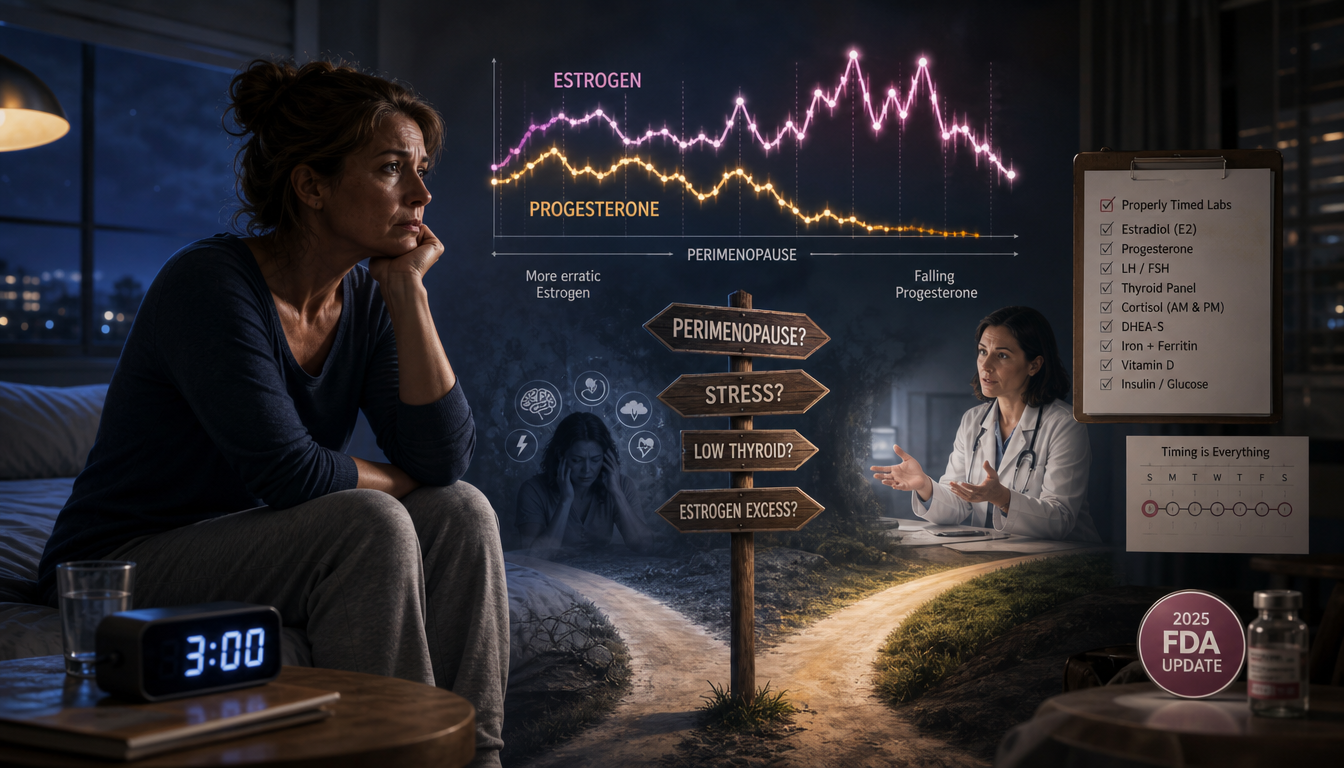
Menopause is not an estrogen deficiency. In the years leading up to it, estrogen is usually higher and more erratic than it was at 30, and the hormone that actually falls first is progesterone. Every lab your doctor ordered was built on the opposite assumption.
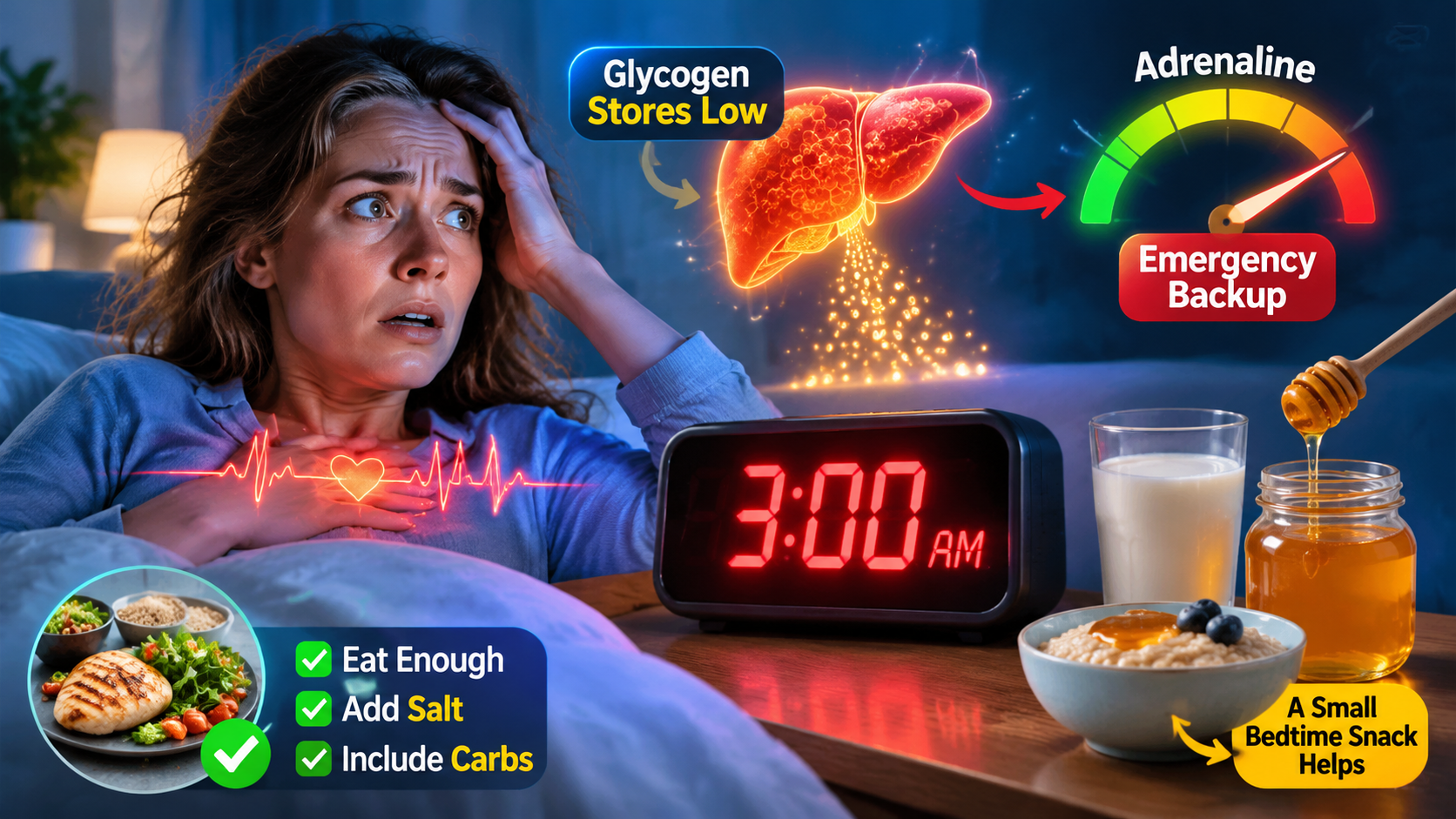
That is why estrogen dominance symptoms, chronic stress symptoms, early hypothyroid symptoms, and perimenopause symptoms all get sorted by which office you walked into. They overlap almost perfectly, and the standard workup for a woman in her forties (a TSH and maybe an FSH) cannot tell them apart. Rage at 4 p.m., awake at 3 a.m., bleeding heavier than at 25: one doctor calls it perimenopause, another calls it stress, a third says the thyroid is normal.
I have watched the same woman collect three diagnoses in a year and no answers. This article covers what estrogen dominance symptoms actually are, which labs separate the four candidates, when in your cycle to draw them, and the November 2025 change to how the FDA labels estrogen, because many of you are being offered hormone therapy right now and deserve the evidence in full rather than a slogan from either side.
Perimenopause or Stress? Why the Same Four Symptoms Keep Getting Four Different Labels
A 44-year-old comes in with night waking, new fat at the waist, a short fuse, and periods that arrive early and heavy. Her family doctor says perimenopause. Her therapist says burnout. Her endocrinologist says the thyroid is fine. Nobody is lying. Each is describing the same physiology from a different door, because perimenopause and stress run on shared machinery. Cortisol and adrenaline are what a body reaches for when it is short on fuel or under load. In the years before menopause, ovulation becomes unreliable, and the hormone it produces, progesterone, goes missing. Progesterone is the body's main brake on the stress response. Remove the brake and the same stress produces a bigger reaction.
That is why a woman who handled a demanding job at 35 feels flattened by it at 45. The stress did not change. The buffer did.
The data agree that stress and hot flashes are one story, not two. In the Penn Ovarian Aging cohort, anxiety predicted hot flashes independent of hormone levels (Freeman 2005), and a disordered daily cortisol rhythm tracked with diary-reported hot flashes in midlife women (Gibson 2016). So yes, perimenopause can produce overwhelm, and so can a cortisol pattern that has nothing to do with your ovaries. The symptom cannot tell you which. The labs can, if the right ones are drawn.
What Estrogen Dominance Symptoms Actually Are (and What Too High Estrogen Feels Like)
"Estrogen dominance" is not a formal diagnosis. There is no code for it and no blood value that defines it. It describes a ratio: estrogen activity in the tissues that is high relative to the progesterone available to oppose it.
This matters because the mainstream story calls the years before menopause a slow estrogen decline. The measured data say otherwise. Jerilynn Prior's 1998 review in Endocrine Reviews, still the canonical description of perimenopausal endocrinology, characterizes the transition as higher and more erratic estradiol with lower progesterone (Prior 1998). Prior's own summary of what those women feel is heavy flow, sore breasts, and migraine: high-estrogen complaints.
The measurements behind that came from a classic study of daily hormone tracking. Nancy Santoro's group followed perimenopausal women and younger controls with daily urine collections for six months. The perimenopausal women excreted nearly twice the estrogen metabolite of the younger women, in both halves of the cycle, while their luteal progesterone metabolite was lower and their follicular phases shorter, about 11 days against 14 (Santoro 1996). Eleven women per group, so a small study, but it measured every day rather than once, and it found the opposite of deficiency.
So what does too high estrogen feel like? Periods that come early, run heavy, and clot. Breasts that swell and ache for a week before the bleed. Migraine at the same point every cycle. Puffiness and water retention. A hot face with cold hands. Itching or hives with no obvious allergen. Mood that swings hard in the second half of the cycle. Sleep that breaks in the early morning. Fat that settles at the waist and hips. Notice how many of those are also on the stress list and the hypothyroid list. That is the whole problem.
The Biospark position, stated once so you know where I stand: most midlife hormone trouble is tissue-level estrogen excess relative to progesterone, not estrogen deficiency. The why, including the gap between serum and tissue hormone levels, is in The Menopause Myth. This article is about testing it in your own labs.
The Symptom Overlap Table: Stress, Perimenopause, Hypothyroidism, or Estrogen Excess
What gets mistaken for perimenopause? Chronic stress, hypothyroidism, iron deficiency, high prolactin, undereating, and sleep apnea, roughly in that order. The reverse is just as common: a genuinely perimenopausal woman gets told she is burned out. The table is a clinical guide, not a diagnostic instrument. Read across each row and notice where the columns separate.
| Symptom | Chronic stress (high cortisol) | Perimenopause | Hypothyroidism | Estrogen excess |
|---|---|---|---|---|
| Fatigue | Wired then crashed, worst afternoon | Variable, tracks the cycle | Constant, heavy, worse in cold | Heavy in the luteal phase, lifts after the bleed |
| Weight gain | Waist and upper back | Waist, within a few years of the transition | Everywhere, with puffiness | Hips, thighs, breasts; water weight |
| Sleep | Cannot switch off; wakes 3 to 4 a.m. | Night sweats, early waking | Sleeps long, wakes unrefreshed | Restless in the second half of the cycle |
| Temperature | Hot flushes with a pounding pulse | Hot flashes and night sweats | Cold hands and feet, low waking temperature | Hot face, cold extremities |
| Cycle | Long, late, or skipped | Short first (early periods), then irregular and heavy | Long, heavy, or absent | Short, heavy, clotted |
| Mood | Anxious, irritable, racing | Irritable, tearful, overwhelmed | Flat, slow, low | Weepy or enraged premenstrually |
| Hair | Shedding after a stressful event | Gradual thinning | Dry, coarse, outer eyebrow loss | Thinning at the crown |
| Waking pulse and temperature | Pulse high, temperature normal | Both variable | Both low | Temperature high in luteal phase, pulse normal |
Two rows do most of the separating. The first is waking temperature and pulse. Low temperature with a slow pulse points to thyroid, and a normal TSH does not rule that out, as I explained in Normal TSH, Low Body Temperature. A high pulse with a normal temperature points to stress hormones. Both cost nothing and move before labs do.
The second is the cycle-length trend. Perimenopause shortens cycles before it lengthens them, because the follicular phase compresses first, exactly what Santoro measured. Periods every 24 days for a year is a perimenopausal pattern even with a normal FSH. Cycles that stretch out or vanish under a heavy training load or a diet are more often a stress pattern.
Hypothyroidism gets its own column because of how common it is in this decade. In the Colorado thyroid prevalence study of more than 25,000 adults, 9.5 percent had an elevated TSH, and the rate climbed with age and was higher in women (Canaris 2000). Fatigue, weight gain, cold intolerance, hair loss, and heavy periods sit on both lists; my hypothyroidism symptoms checklist covers the overlap.
Is There a Blood Test That Can Diagnose Perimenopause?
No. Not a single one, and that is the position of the international staging system, not my opinion.
The STRAW+10 criteria stage the transition by bleeding pattern: a persistent change of seven or more days in cycle length marks early transition, and gaps of sixty days or more mark late transition. FSH is listed as "supportive": variable, needs repeating, not a diagnostic criterion (Harlow 2012). ACOG and the UK's NICE guideline say it plainly: in a symptomatic woman over 45, diagnose on symptoms and cycle history, and do not order FSH to confirm it. FSH is reserved for women under 45, or women on hormonal contraception whose cycle history is unreadable.
The reason is that FSH swings month to month in the transition. It rises when the ovary is quiet and falls when a follicle recruits. A normal FSH in March does not mean you are not perimenopausal; it means March was a month with a follicle. That is also the honest answer to "what is a normal FSH level for a 50-year-old woman": a single value is a snapshot of a moving target.
Estradiol is worse. It can be higher than it was at 30 on one draw and near the floor two weeks later. Drawn alone, without a cycle day and without progesterone from the same sample, it says nothing about the ratio that produces estrogen dominance symptoms. So when a clinic hands you a normal FSH and TSH and says "probably stress," it has established that two variable numbers were in range on one day.
What Labs to Ask For in Perimenopause, and When to Draw Them
Every search result for "what labs to ask for perimenopause" is either a lab company's panel or a guideline telling you not to test. Neither answers the real question: what separates the four columns? Here is what I order, why, and when. This is about measurement; no doses appear anywhere in this article.
Thyroid, in full. TSH, free T4, free T3, reverse T3, and TPO antibodies. TSH alone misses the woman whose tissues are not converting T4 to T3, the most common thyroid pattern under chronic stress.
The stress axis. A morning cortisol, time recorded, read with context; a single normal value does not clear the axis, as I explained in the low-carb cortisol article. DHEA-S. And prolactin, which almost nobody orders. Prolactin rises with stress and with estrogen, which makes it a useful proxy for estrogenic activity when estradiol itself is unreliable. Jay Feldman uses it that way with a stricter functional cutoff than the lab's range; treat the cutoff as a clinician's heuristic, but the direction is sound. I wrote about why prolactin gets skipped.
Sex steroids, cycle-timed. Progesterone must be drawn mid-luteal, about seven days before your next expected period. In a 28-day cycle that is roughly day 19 to 22, which is where the "day 21" habit comes from. The habit fails in perimenopause because cycles run 21 to 40 days: draw day 21 in a 24-day cycle and progesterone has already fallen, so an ovulating woman gets labelled anovulatory. Estradiol goes on the same draw with the cycle day on the requisition, so the two can be read as a ratio. After menopause, estrone is the estrogen worth measuring, because it is what fat tissue makes; Feldman and Mike Fave both point to it as the better readout of estrogenic load in that stage.
Metabolic. Fasting insulin and glucose, A1c, a CBC with ferritin, and liver enzymes. Ferritin because iron deficiency from years of heavy bleeding mimics both hypothyroidism and burnout. Liver enzymes because the liver clears estrogen. Insulin because it moves before glucose does.
One interaction almost nobody mentions. Oral estrogen changes your thyroid numbers. In a 2001 New England Journal of Medicine study, women with treated hypothyroidism who started oral estrogen saw thyroxine-binding globulin rise, free T4 fall, and TSH climb, and a meaningful share needed more thyroid hormone to compensate (Arafah 2001). A normal TSH drawn on the pill or on HRT is not the number you would have off it, and starting oral estrogen can unmask a silent thyroid problem.
Estrogen Dominance Symptoms With a "Normal" Panel: What the Numbers Can Still Hide
Assume you got the full panel, correctly timed, and every value fell in range. Four things can still be wrong.
The ratio. Reference ranges are per hormone. Estrogen dominance is a relationship. Mike Fave has described postmenopausal labs where progesterone and estradiol are each in range, the ratio between them is shifted toward estradiol, and the woman has every symptom on the excess list. Two normal numbers can describe an abnormal relationship.
Serum is not tissue. Serum estradiol reflects what the ovary is putting into the blood today, not the estrogen made and held locally. After menopause the main estrogen source is fat tissue, and concentrations in that tissue exceed what circulates (Simpson 2003). That is why the tissue frame matters even when the blood number looks modest.
Timing artifacts. Progesterone on the wrong day reads low. Estradiol without a cycle day reads meaningless. FSH in a follicle month reads normal.
What you were on when the blood was drawn. Hormonal contraception suppresses your own progesterone and estradiol, so the panel reflects the pill, not you. Oral estrogen shifts thyroid numbers, as above. A panel drawn a few weeks into a hard diet reflects the diet. To know what your body does on its own, draw it when it is running on its own.
Estrogen, HRT, and the 2025 FDA Change: What the Evidence Actually Shows
On November 10, 2025, the FDA announced the removal of the boxed warning that had sat on estrogen products since 2003, covering cardiovascular disease, breast cancer, and probable dementia. It came off systemic and local estrogen alike, and the label now advises initiating therapy within ten years of menopause or before 60 (Sriprasert 2026). The published commentaries since have been uniformly supportive, all written by menopause specialists. The online argument has collapsed into two slogans, and neither is true. Here is the trial evidence.
The Women's Health Initiative. The estrogen-plus-progestin arm stopped in 2002 for excess breast cancer, heart disease, stroke, and clots. The estrogen-alone arm, in women without a uterus, showed more stroke and no heart benefit, but breast cancer was not increased, and in long-term follow-up it tracked with lower breast cancer incidence while estrogen plus progestin tracked with higher. Neither arm changed all-cause mortality at 18 years. The WHI investigators' 2024 review states the current mainstream reading: hormone therapy is reasonable for bothersome hot flashes in women under 60 or within ten years of menopause, and not recommended for preventing chronic disease (Manson 2024).
Timing. ELITE found estradiol started within six years of menopause slowed carotid wall thickening; started more than ten years out, it did not. KEEPS, in recently menopausal women, found no arterial benefit and no harm, and its ten-year follow-up found no long-term cognitive benefit and no harm (Gleason 2024). In the best randomized data, early hormone therapy is cognitively neutral.
Dementia, honestly. The randomized evidence of harm comes from women who started at 65 or older: in WHIMS, estrogen plus progestin roughly doubled the rate of probable dementia (Shumaker 2003), and a 2023 meta-analysis of trials in that age group found a 38 percent relative increase. In younger women the evidence is observational and split. A Danish study of more than 5,000 dementia cases found estrogen plus progestogen associated with a 24 percent higher rate, rising with duration and present even in women who started at 55 or younger, though the authors flagged that women with severe symptoms might carry a predisposition the drug did not cause (Pourhadi 2023). A UK study of more than 118,000 cases found no overall increase, a modest increase with long-term estrogen plus progestogen, and lower risk with long-term estrogen alone in women under 80 (Vinogradova 2021).
Read together, the dementia signal moves with the progestogen, not the estrogen: estrogen plus synthetic progestin runs worse in both cohorts, estrogen alone runs neutral to favorable. No randomized trial shows hormone therapy prevents dementia, and none shows harm when started early. "Estrogen causes dementia" and "estrogen protects your brain" are both ahead of the data.
The honest case for HRT. For a woman under 60 with severe hot flashes, genitourinary symptoms, early menopause, or bone loss, the Menopause Society's 2022 position and the WHI review both consider hormone therapy reasonable, individualized to her risk. A randomized trial also found transdermal estradiol with micronized progesterone prevented depressive symptoms during the transition. That is real evidence.
The honest case for progesterone first. Prior's group ran the trial the bioenergetic community cites most: three months of oral micronized progesterone at bedtime against placebo in 189 perimenopausal women aged 35 to 58. Reported exactly: the primary endpoint, the third-month hot flash score, did not reach statistical significance, and the trial was underpowered for it. Perceived night sweats decreased, sleep quality improved, and there were no serious adverse events (Prior 2023). A supportive result, not a proof.
Where Biospark lands. Georgi Dinkov has called the return of estrogen therapy one of the biggest medical mistakes in the field. I do not go that far, and the trial data do not support going that far. What I do say is this. In the years before menopause, the measured problem is estrogen that is high and erratic against progesterone that is falling, so adding estrogen treats the hormone that is not short. The first questions are metabolic rate, thyroid, the stress axis, and progesterone, in that order, answered with the panel above. For a woman under 60 with severe symptoms who has had that panel read properly, estrogen can be a reasonable second step, decided with her physician with the thyroid interaction and the progestogen question on the table. It is never a default reached from a normal FSH.
The Biospark Approach: Read the Whole Panel Before You Replace Anything
At Biospark Health the sequence is fixed, and it does not start with a prescription.
First, the home readouts: two weeks of waking temperature and pulse, logged before you get out of bed, plus your cycle lengths for the last six months. Free, and they sort thyroid from stress from perimenopause faster than a single draw.
Second, the full panel, timed: thyroid in full, cortisol, DHEA-S, prolactin, progesterone and estradiol mid-luteal on the same day with the cycle day recorded, fasting insulin, ferritin, liver enzymes.
Third, the interpretation, which is most of the work. The ratio, not the absolutes. The pattern, not the snapshot. Which column your body matches, and which two it straddles, because most women in this window straddle.
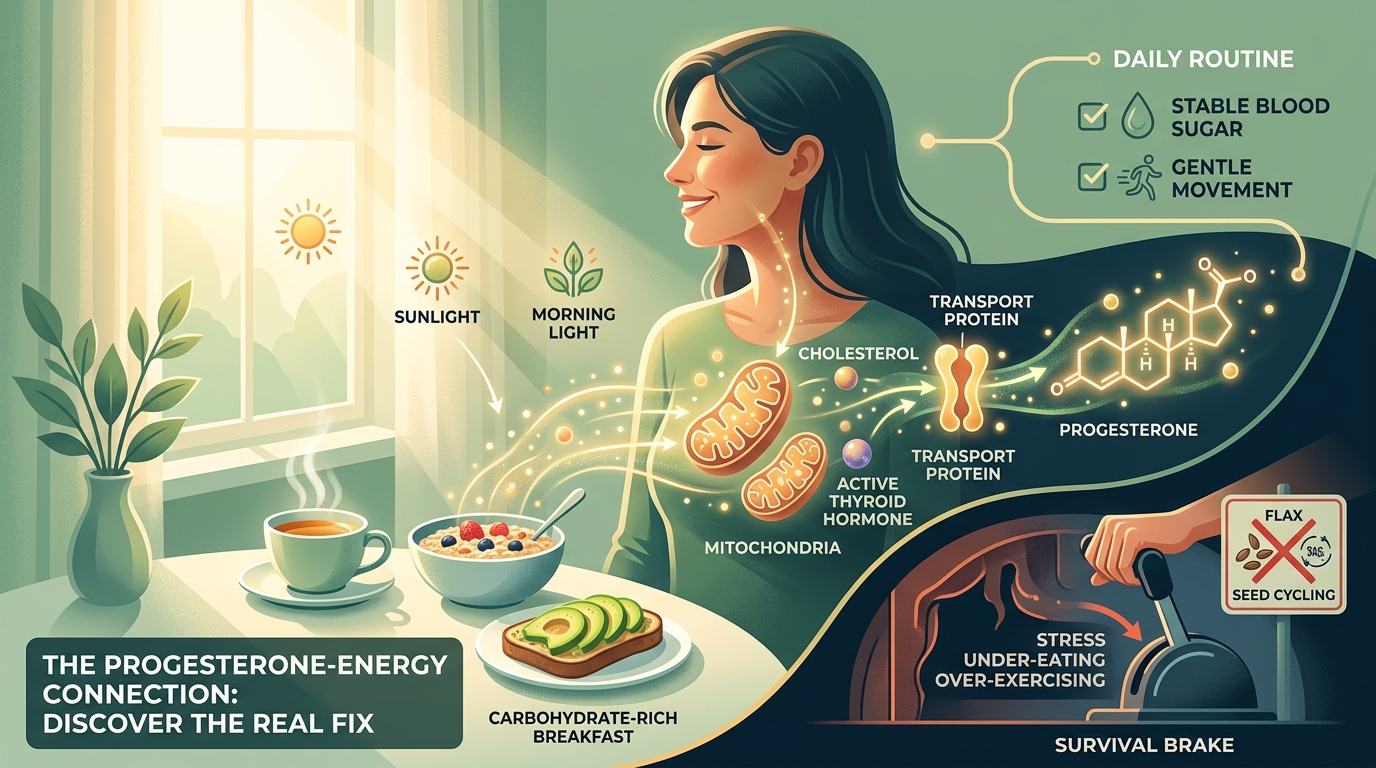
Only then the intervention, ordered by what the panel shows, and it usually starts with metabolic rate. A body running cold, under-fed, and over-cortisoled is not making progesterone, because progesterone is built inside the mitochondria and ovulation is a metabolic event. That is the subject of How to Increase Progesterone Naturally. Bioidentical progesterone is sometimes part of the picture, with a physician, partly because of a caution Feldman raises from clinical experience: it can transiently release stored estrogen from tissue and make symptoms briefly worse before they improve.
If you were told "perimenopause" at 38, read the panel before you accept it. That woman is very often under-fueled and over-stressed, with cycles that lengthened rather than shortened and ovaries that are fine; see The Geriatric Pregnancy Lie. For women in that group who are trying to conceive, our Fertility Program applies the same metabolic framework.
Not sure where to start?
Take our free Cellular Energy Assessment to discover your unique metabolic pattern and get personalized recommendations.
- 10-15 minutes
- Instant results
- No commitment
Perimenopause and Hormone Testing in Reading and Berks County, PA
If you are in the Reading or Wyomissing area and your perimenopause visit ended with an FSH, a TSH, and a shrug, you are in the majority. That is the standard workup across Berks County: two variable numbers on one day, with progesterone, prolactin, and the full thyroid picture never drawn.
At Biospark Health we work with women from Reading, Wyomissing, West Lawn, and Sinking Spring, and across southeastern Pennsylvania, including Lancaster, Downingtown, Allentown, and West Chester. The panel above can be drawn at any local lab once it is ordered correctly and timed to your cycle, and the readouts that matter most are taken in your own bedroom. Virtual and in-person both work.
If you are looking for perimenopause support in Reading, PA, or metabolic health care anywhere in Berks County, the first step is a panel that can actually tell perimenopause from stress. That is the panel we order.
Frequently Asked Questions
How do I fix my estrogen dominance?
Confirm it first: mid-luteal progesterone and estradiol on the same draw, prolactin, and a full thyroid panel. Then address what raises estrogen and lowers progesterone at the source: a metabolic rate high enough to support ovulation (adequate food, adequate carbohydrate, warmth), a stress load your body can buffer, and a liver and gut that clear estrogen. Bioidentical progesterone is a physician's decision after those, not a substitute for them.
What does too high estrogen feel like?
Heavy, early, clotted periods. Breasts that swell and ache before the bleed. Cyclical migraine. Puffiness and a few pounds that come and go with the cycle. A hot face with cold hands. Itching or hives. Mood that turns weepy or enraged in the second half of the cycle, with sleep breaking early in the same window. The pattern is cyclical and worst before the period, which separates it from thyroid symptoms, which are constant.
Can perimenopause cause feelings of overwhelm?
Yes. As progesterone falls, the body loses its main buffer against cortisol and adrenaline, so the same stress produces a bigger reaction, and research in midlife women links anxiety and disordered cortisol rhythms to hot flashes. But overwhelm is also the signature of an over-stressed, under-fueled, or hypothyroid body with normal ovaries. The feeling cannot tell you which. The cycle-length trend, waking temperature and pulse, and the timed panel can.
Conclusion: The Question Is Not Which Hormone, It Is Which System
Perimenopause or stress is the wrong question, because for most women in this window the answer is both. The measured data say the years before menopause are a time of high, erratic estrogen and falling progesterone, not estrogen loss. No single blood test diagnoses it. And an FSH plus a TSH cannot separate a progesterone problem from a thyroid problem from a cortisol problem, which is why women collect three diagnoses and no answers.
The reflex is to confirm a label and replace the hormone the label names. What that does is add estrogen to a body that is usually not short of it, while the thyroid, the stress axis, and the missing progesterone go unmeasured. What we do instead is draw the panel that separates the four candidates, time it to the cycle so the numbers mean something, read the ratio rather than the absolutes, and rebuild the metabolic rate that makes progesterone in the first place. For the right woman under 60, estrogen therapy is a legitimate step after that, decided with her physician. It is not the starting point.
If you want to know which column you are in, start with two weeks of waking temperature and pulse and the Cellular Energy Assessment. The labs can wait until you know what to order.
This article is for education and is not a substitute for medical care. Lab interpretation, hormone therapy, and thyroid treatment decisions belong with your physician.
Tags:
References & Citations
This article is supported by scientific research and peer-reviewed sources. Click citations to verify the evidence.
- [1]Prior JC(1998)Perimenopause: the complex endocrinology of the menopausal transition.Endocrine Reviews.View Source
- [2]Santoro N, Brown JR, Adel T, Skurnick JH(1996)Characterization of reproductive hormonal dynamics in the perimenopause.The Journal of Clinical Endocrinology and Metabolism.View Source
- [3]Harlow SD, Gass M, Hall JE, et al.(2012)Executive summary of the Stages of Reproductive Aging Workshop + 10: addressing the unfinished agenda of staging reproductive aging.The Journal of Clinical Endocrinology and Metabolism.View Source
- [4]Prior JC, Cameron A, Fung MDT, et al.(2023)Oral micronized progesterone for perimenopausal night sweats and hot flushes: a Phase III Canada-wide randomized placebo-controlled 3 month trial.Scientific Reports.View Source
- [5]Manson JE, Crandall CJ, Rossouw JE, et al.(2024)The Women's Health Initiative Randomized Trials and Clinical Practice: A Review.JAMA.View Source
- [6]Arafah BM(2001)Increased need for thyroxine in women with hypothyroidism during estrogen therapy.The New England Journal of Medicine.View Source
All references have been reviewed for scientific accuracy and credibility. Citations follow standard academic format and link to original research where available.
About Dr. Steven Presciutti, MD
Founder & Health Coach at Biospark Health, specializing in bioenergetic health and metabolism optimization.