
Why Do I Keep Waking Up at 3am Every Night? What Your Body Is Asking For
Why do I wake up at 3am? A physician explains why adrenaline should be at its lowest then, what pushes it up, and the bedtime snack that helps you sleep.
Medical Disclaimer
This content is for informational and educational purposes only. It is not a substitute for professional medical advice, diagnosis, or treatment. Always seek the advice of your physician or other qualified health provider with any questions you may have regarding a medical condition.
Almost every article on this topic gives the same answer: your stress hormones spike at 3am, and that is what wakes you. It sounds right. It matches the pounding heart and the racing mind. But when researchers drew blood around the clock from healthy young men, adrenaline did not spike in the small hours. It hit its lowest point of the entire day, at about 3:20 in the morning.
So if you have been asking "why do I wake up at 3am?", the honest answer starts with that correction. A body that is running normally should be at its calmest right then. If yours is wide awake, heart thumping, it is not following the normal script. Something has pushed it off that low.
You may also have come across the "spiritual meaning" of waking at 3am. A wake-up that arrives at the same minute every night does feel like a message. I think it is one. It is just a physical message, usually about fuel.
In this article I will walk through what actually happens in your body overnight, why waking up at 3am every night means your night is not normal, the daytime habits that set it up, and the simple, food-first approach we use at Biospark Health to help people sleep through. The short version: your body is not malfunctioning at 3am. It is asking for something.
Why Do I Wake Up at 3am? What Actually Happens Overnight
Picture what your body is doing while you sleep. You stop eating for eight to ten hours or more, but your brain, heart and liver keep working. Your brain in particular runs largely on glucose, and it does not take the night off.
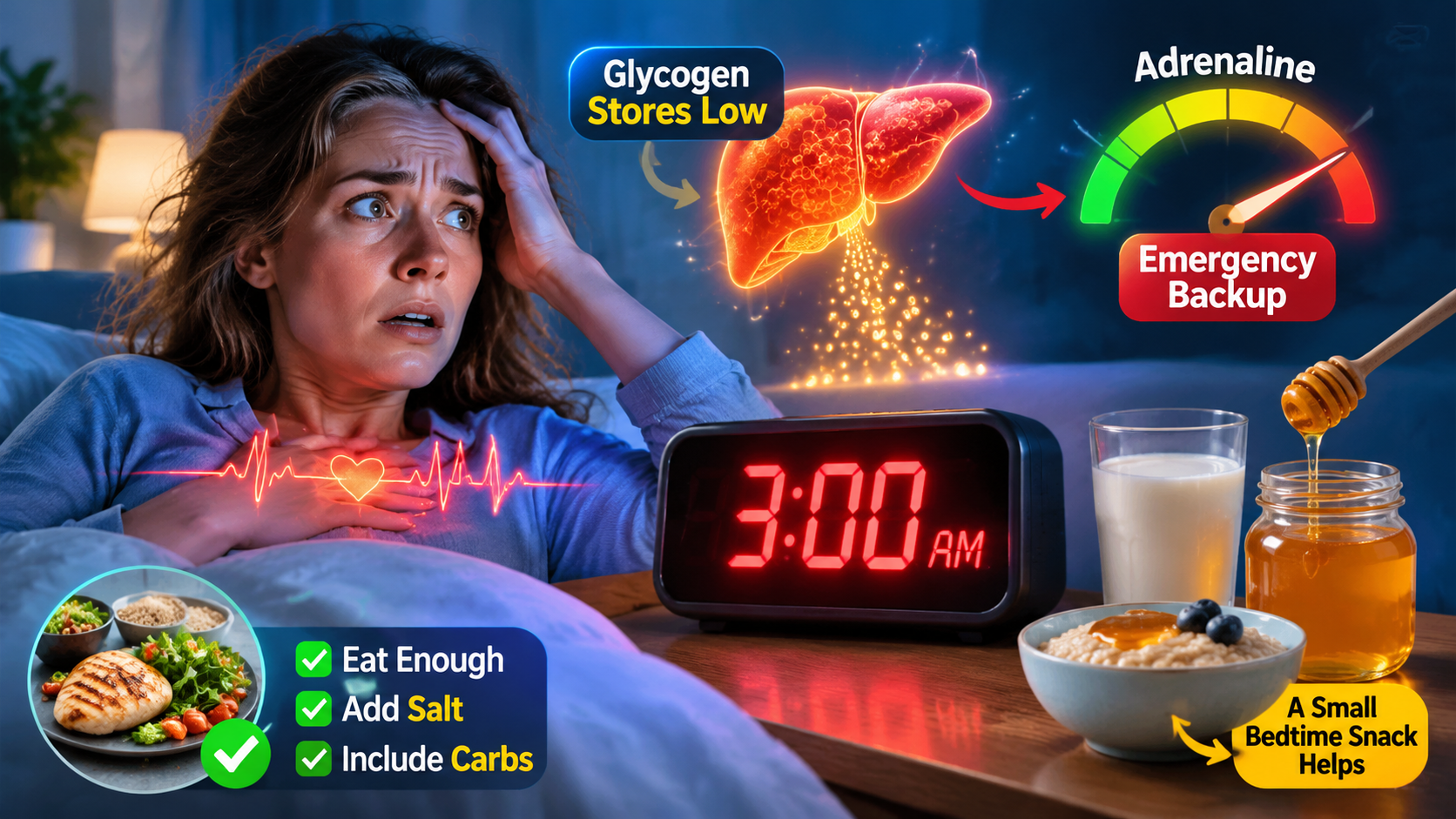
Your liver is the overnight pantry. During the day your liver stores glucose as glycogen, a compact chain of sugar molecules. Overnight, it breaks that glycogen down and releases glucose into the blood to keep your levels steady. A 2020 study that measured liver glycogen directly with magnetic resonance spectroscopy, in 10 healthy men, found that it fell measurably across the overnight fast (Iwayama 2020). At the same time, your liver starts building new glucose from other materials, a process called gluconeogenesis. In a classic 1991 study, gluconeogenesis was already supplying 64% of the body's glucose within the first 22 hours of fasting (Rothman 1991).
To be fair to the evidence: in healthy people, these studies do not show the tank "running dry" at 3am. They show it falling, with the body leaning harder on backup systems as the night goes on. That distinction matters, and I will come back to it.
Cortisol starts its morning climb. Cortisol is not a pure "stress" hormone. It is also part of how your body wakes up. It normally rises in the second half of the night, and research shows that ACTH, the brain signal that tells the adrenal glands to make cortisol, rises ahead of an expected wake time (Born 1999). That rise is a normal part of getting ready for morning, which is why searches for "waking up at 3am cortisol" are only half right.
Adrenaline, though, is supposed to be quiet. Here is the myth worth busting. In a 1985 study that sampled blood across the full 24 hours in healthy young men, plasma epinephrine (adrenaline) reached its lowest point at 3:20am, and norepinephrine reached its low at 2:20am (Linsell 1985). Other work agrees: epinephrine is lower during sleep than during wakefulness (Dodt 1997), and catecholamines, the family that includes adrenaline and noradrenaline, are lowest at night (Prinz 1979).
So what hormone wakes you up at 3am? In a healthy night, none of them should. When people describe the classic 3am wake-up (heart pounding, mind instantly alert, sometimes sweaty or shaky), they are describing an adrenaline-type response. That response is real. It just is not the normal rhythm. It is the body overriding its own low point.
If adrenaline normally bottoms out at 3am, waking with a surge of it is not "just how the body works." Something needed an emergency response.
Ray Peat was half right
The bioenergetic researcher Ray Peat wrote about this pattern decades ago. In his article on hypothyroidism, he described how "some people wake up during the adrenalin peak with a pounding heart," and noted that they "have trouble getting back to sleep unless they eat something."
The timing does not match the data in healthy young men. But the second part, that eating helps, fits the rest of the evidence well. And there is an important clue in the age data, which I will get to next. For the people Peat was describing, people with low thyroid function and stressed metabolisms, the night may genuinely not look like it does in healthy 20-year-olds.
Why Do I Wake Up at 3am Every Night? Your Night Is Not Normal
If you keep waking up at 3am, the question is not "why does my body spike adrenaline at 3am?" The better question is "what is pushing it off its normal low?" The research points to a few candidates.
Low blood sugar can wake you up. In a 2007 study, researchers used an insulin infusion to lower blood sugar in healthy sleepers. When glucose fell to about 40 mg/dL (2.2 mmol/L), 10 of 16 people woke up during early sleep, and all 16 woke up when it happened in late sleep (Jauch-Chara 2007). Late sleep is the second half of the night, exactly where the 3am wake-up lives.
There is an honest nuance here. A 1998 study in teenagers, some with type 1 diabetes and some without, found that at a milder low of about 50 mg/dL (2.8 mmol/L), nobody woke, and sleep actually blunted the adrenaline response to low blood sugar (Jones 1998). Both studies used an insulin drip, not an ordinary night without dinner. So the fair summary is this: a real drop in blood sugar can wake you, especially later in the night, but sleep dampens the alarm, and an ordinary overnight dip is not the same as an induced crash. I do not think low blood sugar at night explains every 3am wake-up. I do think it is the most common one I see in people who under-eat, fast, or cut carbohydrates.
Here is how Mike Fave put the chain of events on Jay Feldman's podcast: "when you drop your blood sugar, you're going to release glucagon, and then eventually you're going to release adrenaline and cortisol." Glucagon tells the liver to release stored sugar. Adrenaline and cortisol are the backup crew. They raise blood sugar, but they also raise your heart rate and switch your brain on. You cannot sleep through an emergency response, and that is the point.
Age changes the night. Remember Peat's "adrenalin peak"? A 1979 study compared young and older men overnight. The older men had 75% higher nighttime norepinephrine and twice as much wakefulness during the night (Prinz 1979). That does not prove one caused the other, but the quiet night of a healthy young man is clearly not guaranteed as we age.
Insomnia comes with an activated stress system. In a study of 11 people with chronic insomnia compared with 13 good sleepers, the insomniacs had higher ACTH and cortisol across 24 hours, with the biggest differences in the evening and the first half of the night (Vgontzas 2001). Sleep-maintenance insomnia (falling asleep is fine, staying asleep is not) is often treated as a mental problem. This data suggests the stress chemistry is running high in the body too.
What does a 3am cortisol spike feel like?
In practice, what people describe is mostly the adrenaline side of the stress response: a sudden, full wake-up rather than a slow drift to the surface, a fast or pounding heartbeat, feeling hot or sweaty, sometimes cold hands and feet, a racing mind that latches onto worries, and sometimes a vivid or unpleasant dream right before waking. Many people also feel hungry. Cortisol is part of that same response, but it is slower. What wakes you is usually the fast-acting adrenaline. If this pattern sounds familiar and also comes with weight around the middle, poor recovery and feeling "wired but tired" during the day, our guide to high cortisol symptoms is worth reading next.
Low Blood Sugar at Night: The Daytime Habits That Set It Up
Waking up in the middle of the night is rarely about the night alone. The 3am wake-up is often the bill for decisions made at breakfast, lunch and dinner. Here are the habits I look for first.
Under-eating and fasting. Fasting is a stressor, and the body answers it with stress hormones. In a study of 8 men on day 5 of a water fast, 24-hour cortisol output was 1.8 times higher than when they were eating (Bergendahl 1996). That is a five-day fast, not a skipped dinner, so I do not want to stretch it. But it shows the direction clearly: less fuel means more stress chemistry.
Cutting carbohydrates. Your thyroid hormone is a big part of how much energy your cells make and how much glycogen your liver can hold. In a 1976 study of adults with obesity, a total fast cut active T3 thyroid hormone by 53%, and an 800-calorie diet with no carbohydrate cut it by 47%. The same calorie level with at least 50 grams of carbohydrate showed no meaningful change (Spaulding 1976). Carbohydrate, not just calories, protected the thyroid signal.
There is also older animal data suggesting a low-thyroid liver is slower to refill its glycogen. In rat liver cells, the enzyme that builds glycogen switched on about 7 times more slowly in hypothyroid cells (Bollen 1988). That is rat tissue in a dish, not people, so treat it as a clue rather than proof. But it fits Peat's long-standing observation that people with low thyroid function seem to have a smaller overnight reserve. If you run cold and wake up at 3am, the two may be related. Our article on what your body temperature reveals about your thyroid explains how to check.
If you have been eating low-carb and your sleep fell apart, you are not imagining the connection. I wrote more about that in does low carb raise cortisol?
Restricting salt. This is the one almost nobody expects. In a large Cochrane review, low-sodium diets raised noradrenaline by about 62 pg/mL across 35 trials, and raised aldosterone and renin as well (Graudal 2020). Adrenaline also rose, though that finding was based on fewer trials and was less certain. These were daytime blood measurements, not sleep studies, so the step from "low salt raises stress hormones" to "low salt wakes you at night" is my inference, not a tested result. But it is a reasonable one.
Jay Feldman makes the same connection on his podcast: "Salt is really good at bringing our aldosterone down, which is one of the main stress hormones and can keep us up." The same episode points out that drinking a lot of plain water in the evening, with little salt, is a common reason for waking up in the middle of the night to urinate. If you are curious why I am not afraid of salt, The Great Salt Lie lays out the case.
The vicious cycle. Poor sleep feeds itself. In one study, a single night of sleep loss raised cortisol levels the following evening by 37 to 45% (Leproult 1997). Higher evening cortisol makes the next night harder, which raises cortisol again. That is why people who keep waking up at 3am often feel the problem getting worse, not better, the longer it goes on.
Put these together: a person who skips breakfast, eats a light salad for lunch, avoids salt, cuts carbs at dinner and has nothing after 7pm has asked their liver to cover a very long stretch on a small reserve, with the thyroid signal and stress hormones already tilted the wrong way. When that reserve runs low in the second half of the night, the body does what it is designed to do: it calls in adrenaline. And you wake up.
The Biospark Approach
The mainstream approach to waking up at 3am every night is behavioral: a strict sleep schedule, no screens, get out of bed if you cannot sleep, and do not eat before bed. Good sleep habits are worth keeping. But "do not eat before bed" is often the exact opposite of what a fuel-short body needs.
When someone asks me "why do I wake up at 3am?", I start from a simple idea: symptoms are requests. A body that wakes up with a surge of adrenaline at 3am is reporting a shortfall. The job is to supply what it is asking for, not to train it to ignore the alarm. Here is what that looks like in practice.
Feed the day. The night is built during the day. Eat breakfast fairly soon after waking, and eat regularly after that, with real carbohydrate at each meal: ripe fruit, juice, honey, milk, potatoes, rice and other well-cooked starches. Keep fat moderate, and cut back on seed oils. No long fasts while you are trying to repair your sleep.
Salt your food to taste. Unless your physician has a specific medical reason to restrict sodium, do not avoid it. Low salt pushes stress hormones up (Graudal 2020).
Have a small bedtime snack. Something with easily digested carbohydrate and a little protein or fat, 30 to 60 minutes before bed. Good options include warm milk with a spoonful of honey and a pinch of salt, a piece of fruit with some cheese, or yogurt with honey. The research on bedtime carbohydrate is limited but encouraging. In 12 healthy men, a high-glycemic rice meal eaten 4 hours before bed cut the time it took to fall asleep nearly in half, from 17.5 minutes to 9 (Afaghi 2007). That study measured falling asleep, not staying asleep, and the 4-hour timing worked better than 1 hour, so it does not prove a bedtime snack stops 3am waking. There is also evidence that sugar softens the stress hormone response: in 19 women, two weeks of sucrose drinks reduced the cortisol response to a stress test compared with aspartame drinks (Tryon 2015). The authors framed this as a reason sugar habits can be hard to break. I see it as the body telling us what calms it.
Keep a 3am rescue on the nightstand. If you do wake up, a spoonful of honey or a small glass of orange juice with a pinch of salt helps many people fall back asleep. I want to be clear that this specific trick has not been tested in a trial. It is my recommendation, reasoned from the evidence above, and it is the same thing Peat observed: people who wake this way often cannot get back to sleep "unless they eat something."
Use melatonin like a hormone, not a sedative. Most store-bought melatonin comes in 3 to 10 mg doses. In adults over 50 with insomnia, 0.3 mg restored sleep efficiency, mainly in the middle third of the night, while 3 mg raised melatonin levels into the next day (Zhdanova 2001). If you use it, use a small dose.
Be cautious with sleep aids. Over-the-counter "PM" products often contain diphenhydramine (Benadryl), which the American Geriatrics Society Beers Criteria lists as a drug to avoid in adults over 65 (Beers 2023). Our article on the dangers of sleep medication covers prescription sleeping pills too.
Know when it is something else. If you have diabetes and take insulin or other glucose-lowering medication, night waking with sweats can be a sign of true hypoglycemia, and that needs a conversation with your doctor, not a snack plan. Loud snoring, gasping or waking unrefreshed despite enough hours also deserve a proper medical evaluation.
Ready to restore your metabolism at the cellular level?
The Bioenergetic Reset Program addresses root causes, not symptoms. Join 300+ members who've discovered what real metabolic health feels like.
- 9+ hours of comprehensive training
- Twice-monthly LIVE coaching calls
- Complete meal plans and protocols
- Direct email support
$133/month | Cancel anytime
3am Wake-Up Support in Reading and Berks County, PA
If you live in the Reading or Wyomissing area and have been waking up at 3am every night, you are far from alone. Many people across Berks County have been told it is stress, age or anxiety, handed a sleep hygiene checklist, and sent home without anyone asking what they ate that day or how their thyroid is working.
Biospark Health is based in Wyomissing, and we work with clients throughout southeastern Pennsylvania, including Lancaster, Downingtown, Allentown, West Chester and the greater Philadelphia suburbs. Our approach to sleep starts with metabolism: how much fuel your body has, how well it stores it, and what your stress hormones are doing because of it.
Our programs run online, so you can join from Berks County, Chester County or anywhere in Pennsylvania. What matters is that someone looks at your whole day, not just your bedroom, when you ask, "why do I wake up at 3am?"
Frequently Asked Questions
How do I stop waking up at 3am?
Start with the day, not the night. Eat regular meals with enough carbohydrate, salt your food to taste, avoid long fasts, and have a small carbohydrate-based snack before bed, such as warm milk with honey. Keep honey or juice by the bed in case you wake. Give it a couple of weeks. If nothing changes, look at thyroid function and other medical causes with your doctor.
Why do I wake up at 4am?
The same logic applies to 4am as to 3am. Cortisol is starting its normal morning rise, and if your fuel reserve is already low, a small extra push can be enough to wake you. It is not because your thyroid hormone shuts off overnight: in 33 healthy adults, free T3 actually peaked at about 4am (Russell 2008).
Is it bad to eat before bed?
For most people with this problem, no. The "no eating after 7pm" rule leaves your liver covering a very long overnight stretch. A small snack with easily digested carbohydrate and a little fat or protein supports that stretch. A large, heavy meal right before bed is a different thing from a small snack.
What is the "forbidden hour" of sleep?
It is not a medical term. Online, the phrase is usually tied to folklore about 3am being a "witching hour." Physiologically, the early morning hours are when adrenaline should be at its lowest, which is why waking up then is worth paying attention to.
What causes low blood sugar at night in people without diabetes?
The most common pattern I see is simply not enough fuel: skipped meals, long fasts, low-carb diets and going to bed hungry. Low thyroid function may make it worse. Anyone with repeated symptoms like shakiness, sweating or confusion should get checked by a physician to rule out other causes.
Does salt help you sleep?
Salt has not been tested directly as a sleep aid. But low-sodium diets raise noradrenaline and aldosterone (Graudal 2020), and those are exactly the hormones you do not want rising at night. Salting food to taste is a reasonable, low-risk step.
Conclusion
So, why do I wake up at 3am? The popular answer, the one behind most "waking up at 3am cortisol" searches, says your stress hormones naturally spike then. The data says the opposite: in a healthy night, adrenaline reaches its lowest point of the day around 3am. Waking up with a pounding heart at that hour means something has pulled your body out of its calmest state, and the most common thing I see doing it is a fuel shortfall, set up by a day of under-eating, cutting carbs and avoiding salt.
That changes what you should do about it. The common reflex is to tighten up: stop eating earlier, cut more carbs, drink more water, try harder at sleep hygiene. Do that, and the alarm usually gets louder, because you have made the overnight stretch longer and the reserve smaller. Feed the night instead, with real carbohydrate during the day, salt to taste, and a small sweet snack before bed, and the alarm often goes quiet.
To be clear about what is cited and what is my recommendation: the low point of adrenaline, the waking effect of low blood sugar and the stress hormone effects of fasting, carb restriction and low salt are research findings. The idea that a bedtime snack and a spoonful of honey at 3am will fix your night is my clinical recommendation, built from those findings rather than tested on its own.
Your body is not broken at 3am. It is asking for fuel. Give it what it is asking for, and let it sleep.
Tags:
References & Citations
This article is supported by scientific research and peer-reviewed sources. Click citations to verify the evidence.
- [1]Linsell CR, Lightman SL, Mullen PE, Brown MJ, Causon RC(1985)Circadian rhythms of epinephrine and norepinephrine in man.The Journal of clinical endocrinology and metabolism.View Source
- [2]Jauch-Chara K, Hallschmid M, Gais S, Oltmanns KM, Peters A, Born J, et al.(2007)Awakening and counterregulatory response to hypoglycemia during early and late sleep.Diabetes.View Source
- [3]Jones TW, Porter P, Sherwin RS, Davis EA, O'Leary P, Frazer F, et al.(1998)Decreased epinephrine responses to hypoglycemia during sleep.The New England journal of medicine.View Source
- [4]Iwayama K, Onishi T, Maruyama K, Takahashi H(2020)Diurnal variation in the glycogen content of the human liver using (13) C MRS.NMR in biomedicine.View Source
- [5]Graudal NA, Hubeck-Graudal T, Jurgens G(2020)Effects of low sodium diet versus high sodium diet on blood pressure, renin, aldosterone, catecholamines, cholesterol, and triglyceride.The Cochrane database of systematic reviews.View Source
All references have been reviewed for scientific accuracy and credibility. Citations follow standard academic format and link to original research where available.
About Dr. Steven Presciutti, MD
Founder & Health Coach at Biospark Health, specializing in bioenergetic health and metabolism optimization.