Aspirin and Metabolic Health: The Reputation Built by Marketing, Not Physiology
Aspirin and metabolic health: what the research says about mitochondrial respiration, glucose oxidation, endotoxin, and why the safety story you inherited came from advertising.
Medical Disclaimer
This content is for informational and educational purposes only. It is not a substitute for professional medical advice, diagnosis, or treatment. Always seek the advice of your physician or other qualified health provider with any questions you may have regarding a medical condition.
Update, October 14, 2026. The ASPREE-XT trial, published in JAMA Oncology in January 2026, found that daily low-dose aspirin did not prevent cancer in adults over 70 and was associated with higher cancer mortality. Several claims below, including the advertising thesis and the endotoxin cytokine argument, are revised in Should I Take Daily Aspirin? The 2026 Trial That Changed Our Answer. This article stays up as originally written so the correction can be read against it.
Almost everything the average American believes about aspirin's safety traces back to a public relations campaign in the early 1980s, not to a finding in physiology. That is an uncomfortable claim, so this article is going to defend it carefully, with the epidemiology laid out honestly rather than cherry-picked. Then we will look at what the research actually says about aspirin and metabolic health: what salicylate does to mitochondrial respiration, glucose oxidation, liver fat, gut-derived endotoxin, and the stress hormones that ride along with all of it.
A warning before any of that, because it matters more than the argument. Nothing here is a recommendation to start taking aspirin, and you will not find a dose anywhere in this article. Aspirin is a real drug with real contraindications, and some of them are serious. What follows is education, plus a list of the specific questions worth bringing to a clinician who knows your history.
Where the Reye's Syndrome Story Actually Leads
In the early 1980s, American parents were told that giving aspirin to a child with a viral illness could trigger Reye's syndrome, a rare condition involving swelling of the brain and acute liver failure. Aspirin sales for children collapsed. Acetaminophen sales climbed to replace them. In the popular memory, that is the whole story: a danger was found, a warning was issued, children were protected.
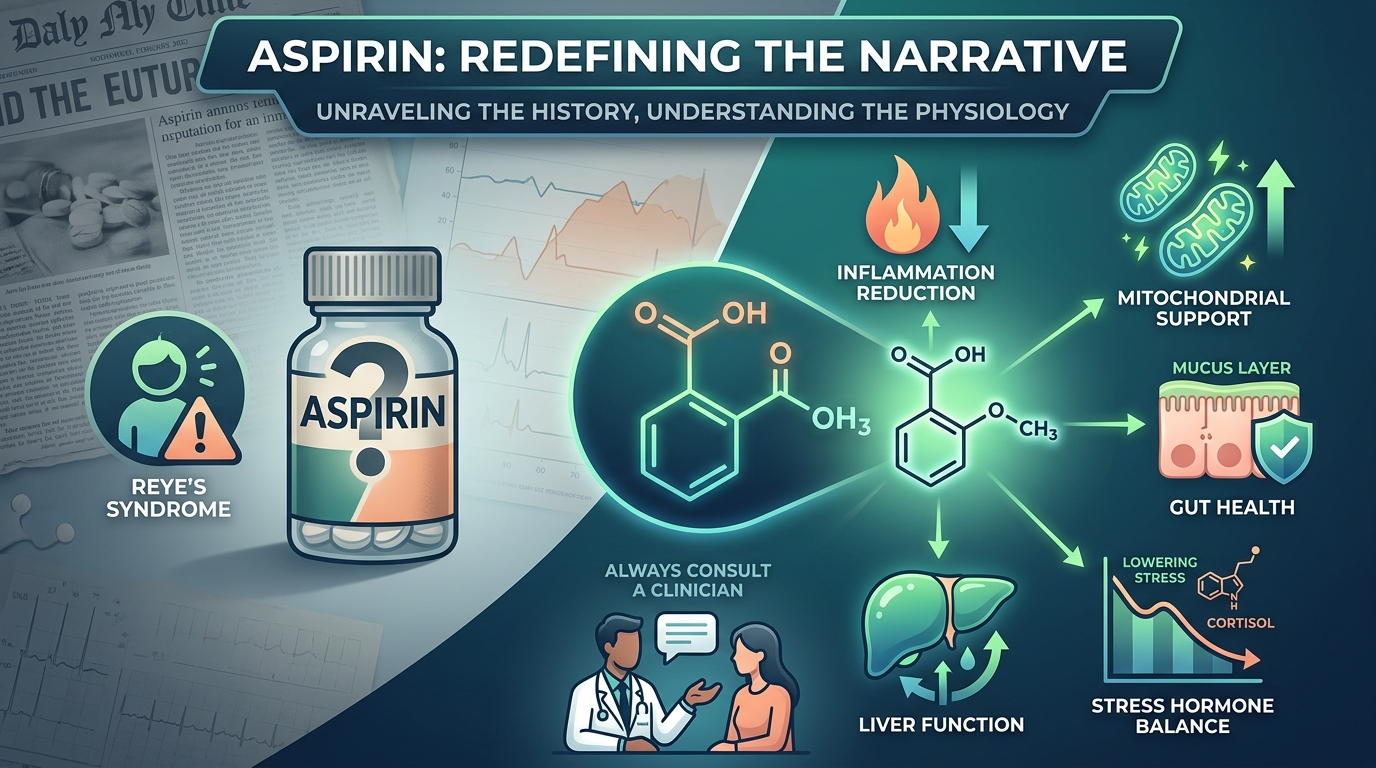
The epidemiology is messier than the memory. Reye's syndrome case counts in the United States were already declining before the aspirin warnings took effect, which is the wrong shape for a curve that is supposed to be caused by the intervention. Rates also fell in countries that never restricted pediatric aspirin the way the United States did, and in some cases fell on roughly the same timeline. A drug restriction that only happens in one country cannot explain a decline that happens in several.
There is a second problem, which is that the case-control studies driving the warnings had methodological weaknesses that were noted at the time and have been revisited since. In a 2007 review in Paediatric Drugs, Schror examined the accumulated evidence and concluded that the case for aspirin as a cause of Reye's syndrome was considerably weaker than the public messaging implied, with the original studies carrying selection and recall bias that would not survive modern scrutiny. And an Australian series found that substantially more Reye's cases had recent acetaminophen exposure than recent aspirin exposure, which is the opposite of what the standard narrative predicts.
None of this proves aspirin is harmless in a febrile child. It does mean the strength of the evidence never matched the strength of the warning. That gap is worth noticing, because it is where the marketing lives.
There is also a competing mechanistic explanation that rarely gets airtime. The liver cells of Reye's patients show a very specific pattern of mitochondrial injury: high-amplitude swelling and a sharp loss of the ability to oxidize glutamate. When researchers exposed isolated mitochondria to peroxidized linoleic acid, the dominant omega-6 fat in seed oils, they reproduced that same structural damage. Which points at a fat-peroxidation problem in an energetically stressed liver, not at a salicylate problem. If you have read our piece on why fish oil and other polyunsaturated fats behave badly under oxidative stress, this mechanism will look familiar.
Who Benefited From the Switch
Aspirin has been off patent since before most of us were born. It costs almost nothing to make and nobody owns it. Acetaminophen, sold as Tylenol by McNeil Consumer Healthcare, a Johnson and Johnson subsidiary, was a branded product with margin attached. When the Reye's story broke, J&J had both the motive and the advertising budget to position acetaminophen as the responsible parent's choice, and it did exactly that. The campaign worked. Tylenol became the default household analgesic in the United States and stayed there for four decades.
Here is the part that should give anyone pause. Acetaminophen is now the leading cause of acute liver failure in the United States and much of the Western world. The mechanism is well described and not controversial. The liver metabolizes acetaminophen into a reactive intermediate called NAPQI, and it neutralizes NAPQI by conjugating it with glutathione, the body's central antioxidant. Take enough, or take a normal amount while your liver is already energetically depleted, and the glutathione pool runs dry. What is left is unopposed oxidative damage to the hepatocyte.
That "already depleted" clause is the metabolic part, and it is where this stops being a story about overdose. A 2024 study in Cell Metabolism found that in fatty liver disease, a rerouting of serine synthesis drives glycine depletion, and that glycine depletion is what makes those livers unusually vulnerable to acetaminophen injury. Glycine is a required substrate for glutathione. So the same metabolic dysfunction that produces a fatty liver also strips out the raw material that liver needs to survive a routine dose of the drug marketed as the safe one. We covered the glycine side of this in our article on glycine deficiency on a high-protein diet.
So the trade was this: a drug whose worst-case pediatric risk was never firmly established, swapped for a drug whose hepatotoxic mechanism is textbook and whose worst case is a liver transplant. That is not a physiology decision. That is a marketing outcome.
Is Aspirin Good for Metabolism? What the Mechanisms Show
Set the history aside and look at what salicylate does inside a cell. This is the part that mainstream coverage almost never gets to, because aspirin gets filed under "COX inhibitor" and "blood thinner" and the filing stops there. COX inhibition is real, but it is a small slice of what the molecule does.
Mitochondrial respiration. Aspirin has been shown to raise ATP levels in intact neurons and in isolated brain mitochondria, an effect tied to increased NADH-dependent respiration, and to enhance the activity of cytochrome c oxidase, the final enzyme in the electron transport chain. It also behaves as a mild uncoupler, which sounds bad and mostly is not: mild uncoupling lets a cell burn through fuel it would otherwise ferment, and it raises carbon dioxide production. CO2 is not a waste gas in this framing. It stabilizes cells, improves oxygen delivery to tissue, and behaves as an antioxidant.
Glucose oxidation. Under stress, cells are pushed toward burning free fatty acids, which suppresses glucose oxidation and pushes glucose down the fermentation path into lactate. Salicylate does the reverse. In a 2001 study in The Journal of Clinical Investigation, Kim and colleagues showed that salicylate prevented fat-induced insulin resistance in vivo, protecting glucose uptake and metabolism from exactly the lipid load that normally shuts it down. That result held up clinically: in a 2012 trial in Endocrine Practice, salsalate, a salicylate derivative, reduced insulin resistance and lowered plasma glucose in people with prediabetes.
Liver fat. This one has a randomized trial behind it. In 2024, Simon and colleagues published results in JAMA from a randomized clinical trial of aspirin in adults with metabolic dysfunction-associated steatotic liver disease without cirrhosis. Aspirin reduced hepatic fat content relative to placebo over six months. A cheap, unpatentable drug moved a hard imaging endpoint in a condition that currently has very few effective interventions.
Endotoxin and the gut. When the intestinal barrier gets leaky, lipopolysaccharide from gut bacteria crosses into portal circulation and hits the liver, where it provokes inflammatory cytokines like TNF-alpha and IL-6. Endotoxin also impairs the respiratory enzymes of the intestinal cells themselves, which degrades the barrier further and makes the problem self-reinforcing. Aspirin interrupts that loop at several points: it blunts the cytokine response, it downregulates inducible nitric oxide synthase, and it helps preserve the cellular energy those barrier cells need to hold the line. Our article on what has been quietly wrecking gut integrity for twenty-five years covers how that barrier gets compromised in the first place.
Serotonin and the stress cascade. Serotonin is not the happiness molecule the marketing made it into. It is a stress mediator that constricts vessels, promotes fibrosis, and inhibits mitochondrial function. Aspirin lowers serotonin and blocks its release from platelets. It is also antilipolytic, meaning it reduces the release of free fatty acids from fat stores, which pulls down the aldosterone and cortisol signaling that follows a fatty acid surge. If you want the longer version of why serotonin belongs in the stress column rather than the mood column, we wrote it up in the serotonin myth, and the cortisol side of the cascade is in how chronic stress destroys your mitochondria.
Read together, that is a fairly coherent picture. Salicylate pushes cells toward oxidizing glucose completely, protects the mitochondria doing the oxidizing, and blocks several of the signals that interfere. It looks less like a painkiller and more like something that props up cellular energy production while the underlying problem gets addressed.
The Two Objections, Handled Properly
Anyone who has read about aspirin for ten minutes has hit two warnings: it tears up your stomach, and it makes you bleed. Both objections point at something real. Neither one means what people assume.
Aspirin and Stomach Irritation
The reflexive explanation is that aspirin is an acid and acid burns the stomach, which is odd on its face, because the stomach is supposed to be an acidic environment. Gastric pH runs down near 1.5 to 3.5 when things are working. A weak acid arriving in that environment is not the novel insult it gets described as.
The likelier story involves two variables that vary a lot between people. The first is the mucus layer. Your stomach lining is protected by a mucus and bicarbonate barrier that has to be continuously rebuilt, and rebuilding it costs energy. In a low-thyroid or chronically stressed state, cellular energy drops and that barrier thins. An irritant that a robust mucus layer would shrug off can do real damage to a compromised one. The vulnerability is upstream of the aspirin.
The second variable is stomach acid status, which is where this becomes counterintuitive. Low stomach acid slows gastric emptying and permits bacterial overgrowth in territory that is supposed to be nearly sterile, and both of those degrade the protective lining. Someone with inadequate acid production is arguably at more risk from a tablet sitting in their stomach, not less. This is one reason we have written skeptically about long-term acid suppression in the hidden cost of PPIs.
Then there is the mechanical issue, which is the least glamorous and possibly the most important. A dry compressed tablet swallowed on an empty stomach can sit against one spot of the stomach wall and dissolve there, creating a concentrated zone of contact that has nothing to do with systemic pharmacology. Taking it with food, or fully dissolved rather than as a dry tablet, removes that point of contact and triggers the bicarbonate and bile flow that protect the mucosa. This is standard clinical advice and it exists for a reason.
It is also worth separating aspirin from the NSAID class it gets lumped into. Aspirin hydrolyzes quickly into acetic acid and salicylic acid, and salicylic acid has a different gastrointestinal profile than compounds like indomethacin. In animal work, salicylic acid has actually blocked the mucosal lesions that other NSAIDs produce. "All NSAIDs damage the gut" is a convenient simplification that flattens a real difference.
Aspirin, Bleeding, and Vitamin K
The bleeding concern is not imaginary. Aspirin irreversibly inhibits platelet COX-1, and that effect lasts the life of the platelet. If you are on an anticoagulant, or you have a bleeding disorder, or you have surgery scheduled, this is a hard stop and not a nuance to reason your way around.
For everyone else, easy bruising or a change in bleeding tendency is a signal worth investigating rather than a foregone conclusion. Vitamin K is required for the liver to carboxylate several clotting factors, and vitamin K status in the general population is not as reliable as it is usually assumed to be. Part of your supply comes from intestinal bacteria, so antibiotics, sluggish digestion, and a disrupted microbiome all reduce it. Subclinical deficiency is easy to carry without noticing, because nothing tests it in a routine panel. The 2025 review by Mathews and Hayward in Annals of Laboratory Medicine lays out how vitamin K deficiency is actually diagnosed and why it gets missed.
The practical version: if adding a mild antiplatelet effect to someone's system reveals a bleeding tendency, the aspirin did not create the fragility. It exposed it. The right response is to find out whether vitamin K status is the reason, which is a lab question and a clinician question, and not something to guess at. We wrote about K2's wider role, including where calcium ends up when it is missing, in vitamin K2 and the calcium paradox.
Where Aspirin Is Genuinely Not Appropriate
This section is short and it is not boilerplate. Aspirin carries real contraindications, and any honest discussion of it has to name them plainly.
Do not use aspirin, and do not treat this article as permission to, if any of the following apply to you:
- You have a bleeding disorder such as hemophilia or von Willebrand disease, or a low platelet count.
- You take an anticoagulant such as warfarin, apixaban, or rivaroxaban, or another antiplatelet drug. Combining agents multiplies bleeding risk.
- You have surgery, a dental extraction, or a procedure coming up. Timing around procedures is a clinical decision.
- You have active or recent gastrointestinal bleeding, a history of peptic ulcer, or unexplained anemia.
- You have aspirin-exacerbated respiratory disease, nasal polyps with asthma, or any history of salicylate reaction.
- You are pregnant, unless a clinician has specifically directed it. Aspirin in pregnancy is sometimes prescribed and sometimes contraindicated depending on trimester and indication, which is exactly why it is not a self-directed decision.
- You have significant kidney disease or advanced liver disease.
- The person in question is a child or teenager with a viral illness. Whatever the strength of the original Reye's evidence, the standard of care is unambiguous, and this article is not an argument for overriding it. Pediatric dosing decisions belong to a pediatrician.
That list does not weaken the case that aspirin's reputation was distorted. Both things are true at once. A drug can be metabolically interesting and still be wrong for a specific person on a specific day, and the only way to know which applies is to look at the actual person.
The Biospark Approach
At Biospark Health, our interest in aspirin is not about handing anyone a bottle. It is about what its mechanism tells us regarding where metabolic problems actually originate.
Notice what the research keeps pointing at. Salicylate helps because it restores glucose oxidation, protects mitochondrial respiration, quiets endotoxin-driven inflammation, and lowers the stress mediators that suppress cellular energy. Those are the same four levers we work on with clients through diet, thyroid function, gut integrity, and stress physiology. Aspirin is interesting mostly because it is a chemical demonstration that those levers matter. If a compound produces real metabolic improvement by pushing on exactly those points, then those points were the problem.
Which is why our first questions with a new client are never about what to add. They are about what is suppressing oxidative metabolism in the first place. Is thyroid function adequate at the tissue level, not just on a TSH readout? Is the gut barrier intact, or is endotoxin driving a low-grade inflammatory load? Is the person eating enough available energy that their body is not running on stress hormones and free fatty acids? Those answers change what any intervention will do, including this one.
If aspirin does end up being part of someone's picture, that decision belongs in a clinical relationship with someone who knows the full history, the medication list, and the upcoming surgical calendar. That is not a legal hedge tacked on at the end. It is the only honest way to handle a drug whose contraindication list is as specific as this one.
Ready to work on the mechanisms instead of the symptoms?
The Bioenergetic Reset Program addresses the root causes of suppressed cellular energy, the same ones the aspirin research keeps pointing back to.
- 9+ hours of comprehensive training
- Twice-monthly LIVE coaching calls
- Complete meal plans and protocols
- Direct email support
$133/month | Cancel anytime
Metabolic Health Support in Reading and Berks County, PA
If you have spent years being handed prescriptions without anyone asking why your metabolism stopped working, you are in good company across Berks County. Most conventional visits are built to name a symptom and match it to a product, which is how a household ends up with a medicine cabinet full of things nobody explained.
Biospark Health works with clients throughout southeastern Pennsylvania, including Reading, Wyomissing, Lancaster, Downingtown, Allentown, and West Chester. Our approach to metabolic health starts with the mechanisms: thyroid function at the tissue level, gut barrier integrity, actual energy availability, and the stress signaling that ties those together. That work happens alongside your medical care rather than in place of it, and we coordinate with your prescribing clinicians rather than around them.
Whether you are in King of Prussia, Montgomery County, or anywhere in the greater Reading area, virtual and in-person options are both available.
Frequently Asked Questions
Is aspirin good for metabolism?
The research is more interesting than most people expect. Salicylate has been shown to prevent fat-induced insulin resistance, lower plasma glucose in prediabetes, and reduce liver fat in a randomized trial in fatty liver disease. Mechanistically it supports mitochondrial respiration and shifts cells toward complete glucose oxidation. That said, "has metabolic effects in studies" is not the same as "you should take it," and the contraindications listed above are real.
What happens to your body if you take aspirin every day?
That depends entirely on the person, which is why daily use is a clinical decision rather than a general recommendation. Daily aspirin has an established cardiovascular evidence base and an established bleeding risk profile, and the balance between them shifts with age, GI history, medication list, and cardiovascular risk. Guidelines on primary prevention have changed more than once in the last decade. This is a conversation to have with a clinician who has your chart, not one to settle from a blog post.
Which organ is aspirin hard on?
The stomach gets named most often. The likelier framing is that aspirin is hard on a stomach whose protective mucus layer is already compromised, which is a function of cellular energy status and stomach acid production rather than a property of the molecule alone. Taking it with food and avoiding a dry tablet on an empty stomach addresses the mechanical part of the problem. Worth contrasting with acetaminophen, where the organ at risk is the liver and the mechanism is glutathione depletion.
Is aspirin or acetaminophen safer?
Neither answer is universal, and the honest response depends on the person and the situation. What is worth knowing is that the widespread assumption that acetaminophen is the categorically safer option came out of a marketing period in the 1980s rather than a head-to-head safety comparison. Acetaminophen is currently the leading cause of acute liver failure in the United States, and the margin between a therapeutic dose and a hepatotoxic one narrows considerably when someone's glutathione or glycine status is already depleted.
Why do I feel better after taking aspirin?
Beyond pain relief, salicylate lowers several stress mediators at once, including serotonin release from platelets and free fatty acid release from fat stores, while supporting mitochondrial respiration. People sometimes describe a warmth or a clarity that does not map neatly onto "the headache went away." That is a real observation and worth mentioning to your clinician, because a noticeable response can also mean something else is going on metabolically.
Conclusion
The case against aspirin was built during a period when a branded competitor had a large advertising budget and a rare pediatric syndrome had an unclear cause. The epidemiology never fully supported the conclusion, the replacement drug turned out to have a well-documented hepatotoxic mechanism, and the actual metabolic research on salicylate has been accumulating quietly ever since. That is the honest version of the story.
The point is not that everyone should be taking aspirin. It is that the reasons most people believe they should avoid it do not hold up well, and the reasons that do hold up are specific, listable, and probably do not apply to most people who repeat them. If you are metabolically unwell and someone has handed you a list of things to avoid without a mechanism attached, that list deserves the same scrutiny this one got. Bring the question to someone who can look at your labs, your history, and your medication list, and who is willing to explain the reasoning rather than just the rule.
Tags:
References & Citations
This article is supported by scientific research and peer-reviewed sources. Click citations to verify the evidence.
- [1]Simon TG, Wilechansky RM, Stoyanova S, et al.(2024)Aspirin for Metabolic Dysfunction-Associated Steatotic Liver Disease Without Cirrhosis: A Randomized Clinical Trial.JAMA.View Source
- [2]Kim JK, Kim YJ, Fillmore JJ, et al.(2001)Prevention of fat-induced insulin resistance by salicylate.The Journal of Clinical Investigation.View Source
- [3]Faghihimani E, Aminorroaya A, Rezvanian H, et al.(2012)Reduction of insulin resistance and plasma glucose level by salsalate treatment in persons with prediabetes.Endocrine Practice.View Source
- [4]Schror K(2007)Aspirin and Reye syndrome: a review of the evidence.Paediatric Drugs.View Source
- [5]Ghrayeb A, Finney AC, Agranovich B, et al.(2024)Serine synthesis via reversed SHMT2 activity drives glycine depletion and acetaminophen hepatotoxicity in MASLD.Cell Metabolism.View Source
- [6]Mathews N, Hayward CPM(2025)Vitamin K Deficiency: Diagnosis and Management.Annals of Laboratory Medicine.View Source
All references have been reviewed for scientific accuracy and credibility. Citations follow standard academic format and link to original research where available.
About Dr. Steven Presciutti, MD
Founder & Health Coach at Biospark Health, specializing in bioenergetic health and metabolism optimization.