Why Am I Always Tired? The Bioenergetic Answer Nobody Gave You
Sleeping enough but still exhausted? Why chronic fatigue with normal labs often comes down to thyroid, cortisol, and mitochondrial energy production.
Medical Disclaimer
This content is for informational and educational purposes only. It is not a substitute for professional medical advice, diagnosis, or treatment. Always seek the advice of your physician or other qualified health provider with any questions you may have regarding a medical condition.
If you are sleeping enough and still dragging through every day, the most likely explanation is not laziness or "just stress." It is usually a metabolic one: your thyroid, your cortisol rhythm, and your mitochondria, the parts of your cells that actually produce energy, are not working together the way they should. Fatigue like this is a signal that your body is not generating enough usable energy, not a character flaw or something more sleep alone will fix.
The Question Behind "Why Am I Always Tired"
Ask most people why they are tired and they will point to sleep: not enough hours, poor quality, a bad mattress. Sleep matters, but plenty of people asking "why am I always tired" are already getting seven or eight hours and still waking up exhausted. That mismatch, adequate sleep time paired with persistent fatigue, is the clue that something else is going on, and it usually points toward how efficiently your body is producing energy in the first place, not how much rest it is getting.

Three Systems, One Shared Job: Making Energy
Fatigue this persistent is rarely caused by one broken part. It is usually the combined effect of three interconnected systems all underperforming at once.
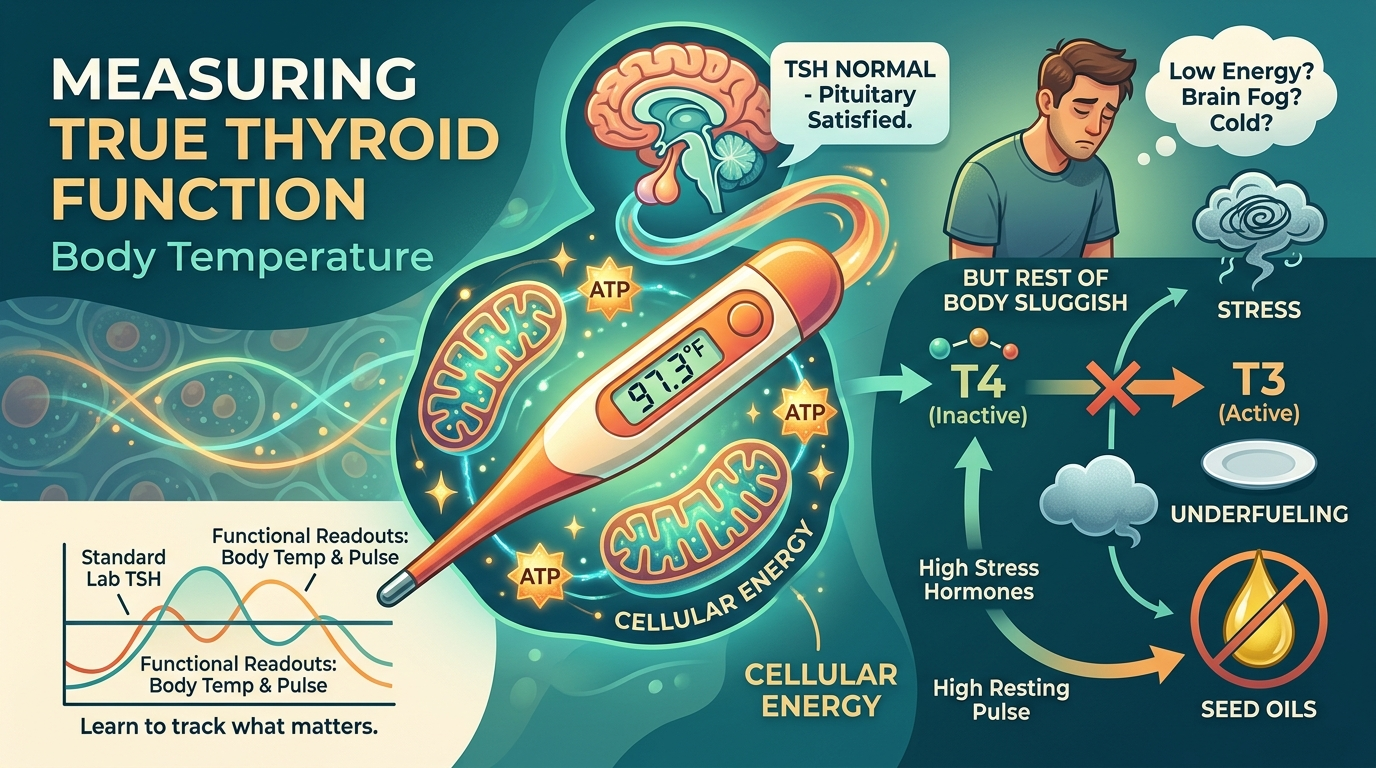
Thyroid. Thyroid hormone sets the pace of metabolism in essentially every cell in your body. When active thyroid hormone delivery to tissue is inadequate, whether from a genuinely underactive thyroid or from a conversion problem further downstream, metabolism slows and fatigue is one of the most universal results. Chaker and colleagues describe fatigue as one of the most consistently reported symptoms across the spectrum of hypothyroidism, from mild to severe (Chaker et al., 2017).
Cortisol. Cortisol is supposed to follow a rhythm: higher in the morning to help you wake and mobilize, lower at night to allow rest. When that rhythm flattens or inverts from chronic stress, you can end up simultaneously wired at night and depleted during the day, a mismatched pattern that leaves you exhausted no matter how the clock reads. Tomas and colleagues' review of the stress-hormone axis in unexplained chronic fatigue found consistent, if variable, disruption of this rhythm, supporting cortisol dysregulation as a real physiological contributor rather than a purely psychological one (Tomas et al., 2013).
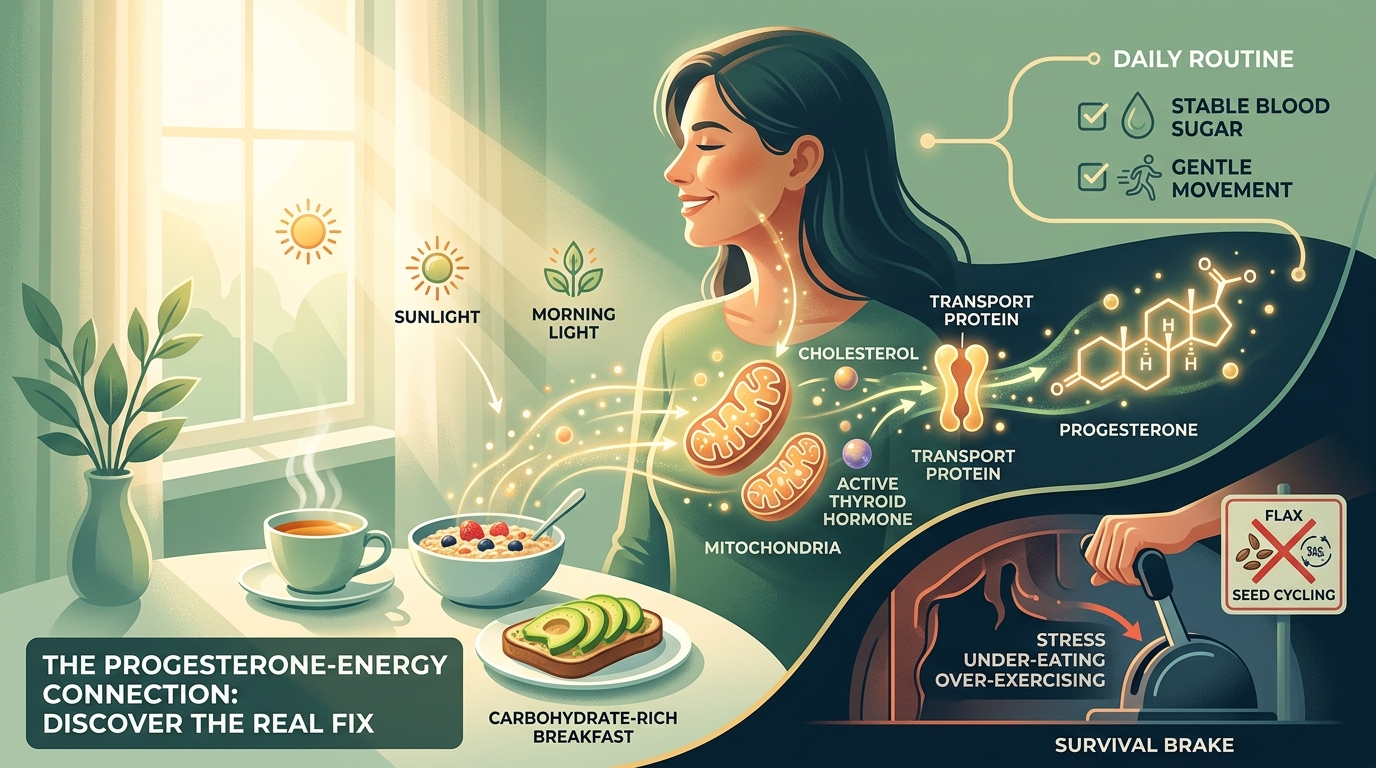
Mitochondria. Even with adequate thyroid signal and a reasonable cortisol rhythm, cells still need functioning mitochondria to actually convert fuel into usable energy. Filler and colleagues' review of the literature on mitochondrial dysfunction and fatigue found consistent associations between impaired mitochondrial function and both general and chronic fatigue, describing mitochondrial energy production as a plausible shared mechanism across many fatigue-related conditions (Filler et al., 2014).
These three systems talk to each other constantly. A struggling thyroid raises the demand on cortisol to keep energy available. Chronically elevated cortisol degrades mitochondrial efficiency. Poor mitochondrial output leaves less energy for baseline hormone regulation. Fatigue is what it feels like when this loop is running downhill instead of holding steady.
Why Fatigue Gets Treated as a Mental Health Issue Alone
Persistent fatigue with normal-looking labs is frequently handed off as a mental health concern: depression, anxiety, "just stress." Mood and energy are genuinely intertwined, and mental health absolutely deserves real attention. But treating fatigue as exclusively psychological skips the measurable metabolic component underneath it. Tryon and colleagues found that fatigue conditions are associated with measurable disruption to the daily rhythm of activity and rest, a physiological pattern, not simply a subjective mood report (Tryon et al., 2004). Fatigue with a metabolic driver can look identical to fatigue with a purely psychological one from the outside, which is exactly why it gets miscategorized so often, and why "just try to relax more" so rarely fixes it.
Signals Worth Tracking Before a Formal Workup
Before or alongside seeing a clinician, a few low-cost signals can help you build a clearer picture of what is driving your fatigue:
- Morning and afternoon body temperature. A sluggish metabolism often runs cooler than expected, especially first thing in the morning.
- Resting pulse. Both unusually slow and unusually fast resting pulse can be informative when paired with temperature; we walk through how to interpret this pairing in our article on normal TSH with hypothyroid symptoms.
- Sleep quality, not just quantity. Waking at a consistent time in the middle of the night, even if you fall back asleep, can point toward a cortisol rhythm problem rather than a sleep hygiene one.
- Energy pattern across the day. A hard afternoon crash, especially after meals, points toward blood sugar and cortisol involvement rather than simple sleep debt.
Tracking these for a week or two gives you, and any clinician you bring them to, far more useful information than a single snapshot of how you feel on one bad day.
"Tired" Versus "Energy-Depleted"
There is a meaningful difference between being tired and being energy-depleted. Tired is what a hard week, a late night, or a demanding stretch produces, and it resolves with rest. Energy-depleted is what happens when the systems that produce your energy in the first place are underperforming day after day, so that rest alone cannot replenish what is missing. You cannot sleep your way out of a metabolism that is not generating enough usable energy, any more than you can charge a phone with a broken charging port by leaving it plugged in longer.
You're not broken. You're energy-depleted. That distinction matters because it changes the fix. Tiredness asks for more rest. Energy depletion asks for root-cause repair: restoring thyroid conversion, calming a dysregulated cortisol rhythm, and supporting the mitochondria that ultimately do the work of making energy.
What a Root-Cause Path Actually Involves
A bioenergetic approach to resolving fatigue does not start by treating each symptom separately, more caffeine for the mornings, something else for the crashes, something else again for sleep. It starts by asking why the underlying energy-producing systems are underperforming together, and addresses fuel, stress load, and the specific bottlenecks, thyroid conversion, cortisol rhythm, mitochondrial support, that are keeping your metabolism from running the way it should. Our article on cortisol's role in stress-driven weight gain covers one piece of this same interconnected picture in more depth.
This article is educational and does not diagnose or treat any medical condition. Persistent fatigue deserves a full evaluation from a qualified clinician, particularly to rule out other causes.
If chronic fatigue has become your normal, a Free Discovery Call is a good first step to talk through what might actually be driving it.
Tags:
References & Citations
This article is supported by scientific research and peer-reviewed sources. Click citations to verify the evidence.
- [1]Filler K, Lyon D, Bennett J, et al.(2014)Association of Mitochondrial Dysfunction and Fatigue: A Review of the Literature.BBA Clinical.View Source
- [2]Chaker L, Bianco AC, Jonklaas J, Peeters RP(2017)Hypothyroidism.Lancet.View Source
- [3]Tomas C, Newton J, Watson S(2013)A Review of Hypothalamic-Pituitary-Adrenal Axis Function in Chronic Fatigue Syndrome.ISRN Neuroscience.View Source
- [4]Tryon WW, Jason L, Frankenberry E, Torres-Harding S(2004)Chronic fatigue syndrome impairs circadian rhythm of activity level.Physiology & Behavior.View Source
All references have been reviewed for scientific accuracy and credibility. Citations follow standard academic format and link to original research where available.
About Dr. Steven Presciutti, MD
Founder & Health Coach at Biospark Health, specializing in bioenergetic health and metabolism optimization.