The Brain's Nightly Wash Cycle: How Your Glymphatic System Flushes Dementia While You Sleep
Discover how the glymphatic system and sleep work together to clear dementia-causing proteins from your brain, and why deep sleep is your strongest defense against cognitive decline.
Medical Disclaimer
This content is for informational and educational purposes only. It is not a substitute for professional medical advice, diagnosis, or treatment. Always seek the advice of your physician or other qualified health provider with any questions you may have regarding a medical condition.
Every night, your brain does something extraordinary. The moment you drop into deep sleep, a hidden plumbing network switches on and begins literally flushing toxic waste out of your head. Scientists call this the glymphatic system, and the glymphatic system and sleep are inseparable partners in keeping your mind sharp. Skip the deep stages of sleep, and the cleanup crew never shows up for the shift. Instead, amyloid-beta, the sticky protein implicated in Alzheimer's disease, slowly accumulates between your neurons.
For decades, conventional medicine treated sleep as passive downtime, a quiet spell where the brain simply idled. The bioenergetic model always disagreed. Sleep is not the absence of energy. It is the most metabolically demanding repair shift your brain runs, and the cost of skipping it shows up decades later as memory loss, brain fog, and dementia.
In this article, you will learn how brain waste removal during sleep actually works, why mainstream medicine keeps missing the root cause, and what you can do tonight to switch your glymphatic system back on.
How the Glymphatic System and Sleep Clear Your Brain
The glymphatic system was only formally discovered in 2012, and it rewrote neuroscience overnight. Named for the glial cells that power it, this network uses cerebrospinal fluid to rinse metabolic debris out of the brain tissue. Think of it as a municipal sewer system that only operates at night, and only when you reach deep, slow-wave sleep.
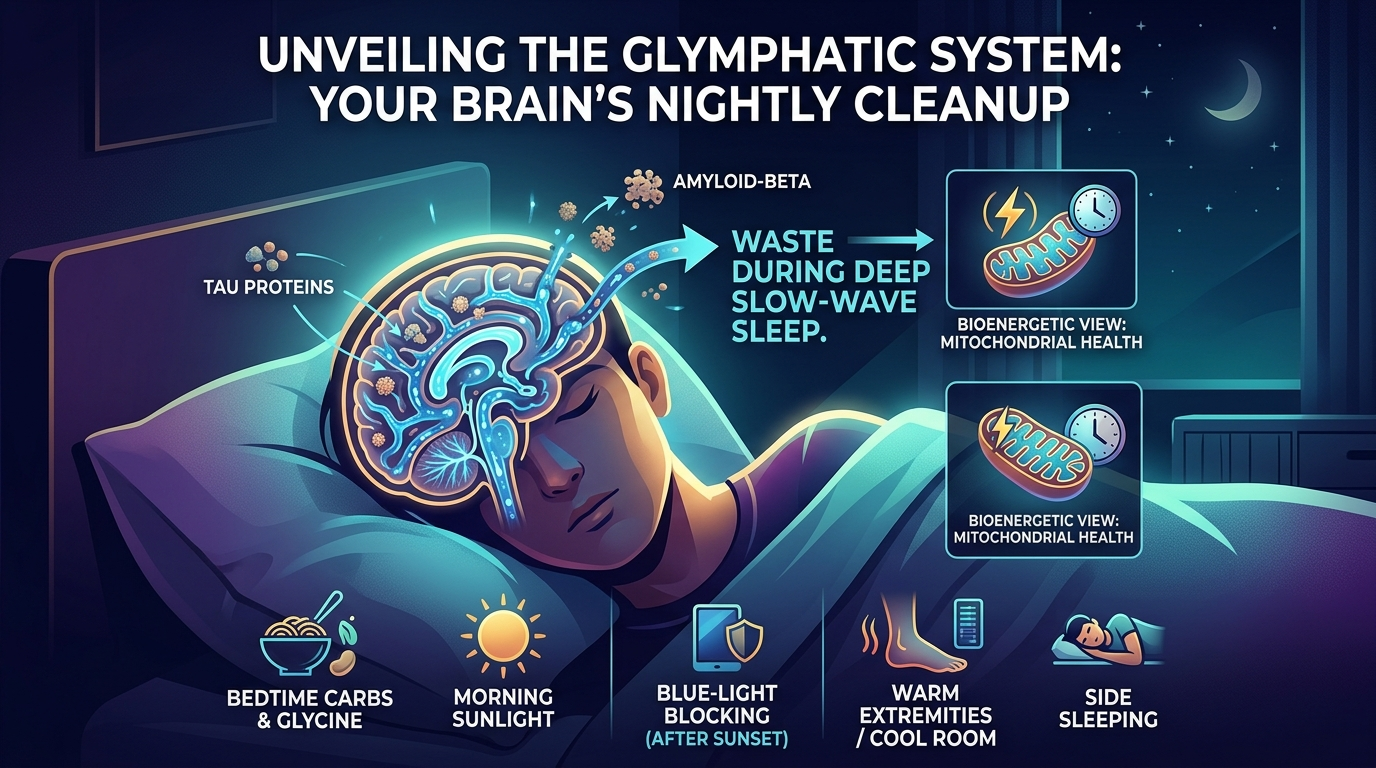
During the day, your neurons burn enormous amounts of energy. As they fire, they produce metabolic waste, including amyloid-beta and tau proteins. In a healthy brain, this is not a problem. The glymphatic system handles it. Cerebrospinal fluid flows through the spaces around your blood vessels, sweeps up the debris, and carries it out to the liver and lymph nodes for disposal.
Here is the critical part: the glymphatic system runs almost exclusively during deep slow-wave sleep. Researchers at the University of Rochester found that the space between brain cells expands by roughly 60 percent during deep sleep, allowing far more fluid to flow through and clear waste. Wakefulness shrinks that space back down, and the cleaning slows to a trickle.
This is why sleep deprivation is so devastating. One single night of poor sleep produces a measurable spike in amyloid-beta accumulation. Chronic sleep disruption effectively turns your brain into a dirty kitchen that never gets cleaned.
The glymphatic system and sleep are so tightly linked that researchers now describe glymphatic failure as a final common pathway to dementia. The waste clearance breaks down first, the proteins pile up, and cognitive decline follows. The mainstream view blames the proteins themselves, treating amyloid as the villain to be attacked with drugs. The bioenergetic view asks a better question: why did the cleanup crew stop showing up?
From the bioenergetic perspective, the answer is cellular energy. The resting state of a neuron is actually a highly energized state. Restorative sleep requires vigorous metabolism and a normal, warm body temperature. When mitochondrial energy production falters, from aging, chronic stress, hypothyroidism, or a poor diet, sleep architecture degrades. Deep slow-wave sleep collapses into a shallow, fragmented, torpor-like state, and the glymphatic system loses the conditions it needs to run.
The proteins are not the root cause. They are the smoke. The fire is the failing metabolism underneath.
This reframes everything. If glymphatic failure is metabolic, then it is also reversible in ways a drug targeting amyloid can never match.
What Causes Most Dementia (And Why Your Sleep Position Matters)
Ask conventional medicine what causes 70 percent of dementia, and you will get a list centered on age, genetics, and amyloid plaques. The implied message is that dementia is largely a genetic lottery you cannot control. This is one of the most disempowering myths in modern medicine.
The bioenergetic model tells a very different story. Alzheimer's disease is fundamentally a metabolic energy failure. Postmortem examinations of Alzheimer's brains reveal significantly reduced activity of cytochrome oxidase, the key enzyme in the mitochondrial electron transport chain. Without functional cytochrome oxidase, neurons cannot produce ATP, the energy currency of the cell. When a neuron runs out of energy, it loses the ability to maintain its own structure and becomes vulnerable to excitotoxicity, a process where normal stimulation becomes lethal to an exhausted cell.
This is why dementia is not random. It follows patterns of metabolic breakdown: chronic stress, thyroid dysfunction, blood sugar dysregulation, nutrient deficiencies, and decades of poor sleep. Amyloid and tau are downstream consequences of this energy collapse, not the starting gun.
Once you understand this, prevention stops looking like a guessing game. It becomes a question of supporting mitochondrial energy and protecting the deep sleep that lets your glymphatic system run.
This brings up a fascinating and frequently asked question: what is the best sleeping position to avoid dementia?
Research suggests side sleeping may give your glymphatic system a measurable advantage. Lateral sleep positions appear to align the jugular veins and brain drainage pathways in a way that maximizes cerebrospinal fluid clearance compared to sleeping on your back or stomach. One study using MRI on sleeping volunteers found that the lateral position cleared amyloid-beta more efficiently than prone or supine positions.
Side sleeping is not a magic bullet, and no sleep position can rescue a metabolism running on empty. But combined with the other interventions in this article, it is a low-cost, zero-risk optimization worth making tonight.
There is a deeper point here about Finland, which consistently ranks among the highest rates of Alzheimer's disease in the world. Why does Finland have such a high rate of Alzheimer's? Researchers have pointed to genetics, cold climate, and vitamin D deficiency from long dark winters. The bioenergetic lens adds another layer: chronic cold stress, low sunlight, and seasonal metabolic slowdown all conspire to depress thyroid function and mitochondrial output. When the metabolic engine runs cold for months out of the year, deep sleep suffers, glymphatic clearance drops, and the long arc leads to cognitive decline.
The lesson is not that Finland is doomed. It is that light, temperature, and metabolic rate are not footnotes to brain health. They are central.
How to Improve Glymphatic System Function Starting Tonight
Knowing your brain cleans itself at night is useless unless you know how to improve glymphatic system function. The good news is that nearly every lever you can pull also happens to support your metabolism, because the two systems share the same root requirement: cellular energy.
Here is where the bioenergetic model diverges sharply from generic sleep advice. Mainstream tips like "sleep eight hours" and "avoid screens" are fine, but they miss the metabolic engine that powers deep sleep in the first place.
Support your blood sugar overnight. One of the most common and overlooked causes of fragmented sleep is nocturnal hypoglycemia. When your liver runs low on glycogen in the middle of the night, your body pumps out adrenaline and cortisol to break down muscle tissue for emergency fuel. This is the classic 3 AM wake-up, and it directly destroys the deep sleep your glymphatic system needs. The bioenergetic fix is a small bedtime snack containing easily digestible carbohydrates, protein, and salt. Milk and honey, cheese and fruit, or a glass of orange juice by the bed can keep blood sugar stable and stress hormones quiet through the night.
Balance your amino acids with glycine. Muscle meats like chicken breast, lean beef, and whey are loaded with tryptophan and methionine, two amino acids that, in excess, drive stress chemistry and deplete cellular energy. Glycine, found abundantly in gelatin, collagen, and bone broth, is the antidote. Glycine acts as an inhibitory neurotransmitter that calms the nervous system, gently lowers core body temperature to ease the transition into sleep, and actively protects the brain against excitotoxicity. This is one reason gelatin-rich foods and glycine supplements show real promise among glymphatic system supplements for supporting deep, restorative sleep.
Get morning light and block blue light at night. Your circadian clock is anchored almost entirely by light hitting your eyes. Ten to fifteen minutes of unfiltered sunlight within thirty minutes of waking sets a healthy daytime cortisol rhythm and suppresses melatonin when you need to be alert. After sunset, the opposite matters just as much. Artificial blue light tricks your brain into thinking the sun is still up, suppressing melatonin and keeping cortisol elevated into the night. High-quality orange or red blue-blocking glasses after sunset, dim warm lighting in the evening, and a fully dark bedroom give your glymphatic system the hormonal environment it needs.
Use temperature strategically. Deep sleep requires a warm brain and a cool room. Many people with sluggish metabolisms run too cold at the core, which prevents the brain from reaching slow-wave sleep. Warm your extremities with a hot bath or warm socks before bed while keeping the bedroom cool, around 65 to 68 degrees Fahrenheit. Warming the extremities dilates blood vessels and raises core temperature in a way that mimics healthy thyroid function, allowing the brain to sink into the deep repair states where glymphatic clearance happens.
Sleep on your left or right side. As discussed, the lateral position optimizes the brain's drainage anatomy. If you naturally sleep on your back, experiment with a body pillow to train yourself toward side sleeping.
Protect your thyroid. Restorative sleep requires a vigorous metabolism, and a vigorous metabolism requires adequate thyroid hormone, particularly the active T3 form. Subclinical hypothyroidism is rampant and routinely dismissed by conventional labs. If your hands and feet are cold, your body temperature runs below 98 degrees Fahrenheit in the morning, and your sleep is shallow, your thyroid deserves a thorough evaluation from someone who understands the bioenergetic model.
Notice what is conspicuously absent from this list. You will not find melatonin gummies, prescription sleeping pills, or antihistamine-based sleep aids. The bioenergetic model is deeply skeptical of all three.
Chronic melatonin supplementation, while useful in rare short-term cases, can suppress your body's own production and act as a metabolic signal of darkness and torpor. Prescription sleep drugs like benzodiazepines and the so-called Z-drugs sedate the brain without producing the natural deep sleep architecture that drives glymphatic clearance. Worse, many sleep aids and common anticholinergic medications are now linked to increased dementia risk themselves. You cannot drug your way into the kind of sleep that cleans your brain. You have to metabolically earn it.
The Biospark Approach
At Biospark Health, we do not treat dementia as a mysterious disease that strikes from nowhere. We treat it as the predictable endpoint of decades of metabolic decline, and we believe that decline can be interrupted.
The glymphatic system and sleep sit at the exact center of this approach. When a patient comes to us with brain fog, memory lapses, poor sleep, or a family history of Alzheimer's, we do not jump to fear or to pharmaceuticals. We ask what their cells are actually producing. We look at thyroid function, blood sugar stability, nutrient status, and inflammatory load. We measure what mainstream medicine often ignores.
Dr. Steven Presciutti's approach is built on the bioenergetic principle that the body heals when it has enough energy. The brain is the most energy-hungry organ in the body, consuming roughly 20 percent of your total energy output despite being only 2 percent of your body weight. When energy fails there, the consequences show up first as poor sleep, then as cognitive symptoms, and eventually as diagnosable disease. Our job is to catch the failure early and reverse it at the root.
This is the opposite of the conventional approach, which waits until amyloid shows up on a scan and then prescribes a drug to attack the protein while ignoring why it accumulated. Attacking amyloid without restoring mitochondrial energy is like bailing water from a boat without plugging the hole.
Ready to restore your metabolism at the cellular level?
The Bioenergetic Reset Program addresses root causes, not symptoms. Join 300+ members who have discovered what real metabolic health feels like.
- 9+ hours of comprehensive training
- Twice-monthly LIVE coaching calls
- Complete meal plans and protocols
- Direct email support
$97/month | Cancel anytime
Glymphatic System and Sleep Support in Reading and Berks County, PA
If you are searching for answers about memory loss, poor sleep, or dementia prevention in the Reading or Wyomissing area, you are not alone. Many residents throughout Berks County struggle with brain fog and sleep disruption, often hearing that their labs are "normal" while their symptoms worsen.
At Biospark Health, we serve clients across southeastern Pennsylvania, including Lancaster, Downingtown, Allentown, West Chester, and the greater Philadelphia suburbs. Our metabolic approach to brain health helps local residents address glymphatic dysfunction, thyroid issues, and sleep architecture at their source rather than masking symptoms.
Whether you are dealing with early cognitive changes, chronic insomnia, or a family history of Alzheimer's and want to take preventive action, our virtual and in-person options make it easy to get the metabolic support your brain needs. The same bioenergetic principles that govern the glymphatic system and sleep apply whether you are in Wyomissing, King of Prussia, or anywhere across Pennsylvania.
Frequently Asked Questions
How can I improve my glymphatic drainage?
Improve glymphatic drainage by protecting deep slow-wave sleep through metabolic support. Eat a small carbohydrate, protein, and salt snack before bed to prevent nocturnal blood sugar crashes. Take glycine or eat gelatin-rich foods to calm the nervous system. Get morning sunlight, block blue light after sunset, sleep in a cool room with warm extremities, and sleep on your side. Above all, support your thyroid and mitochondrial energy, because deep sleep requires a vigorous metabolism.
What is the best sleeping position to avoid dementia?
The lateral, or side, position appears to optimize the brain's drainage pathways and clear amyloid-beta more efficiently than sleeping on your back or stomach. Side sleeping is a useful, zero-cost optimization, but it cannot compensate for a metabolism that produces poor sleep in the first place. Pair it with the metabolic interventions above for the strongest effect.
What causes 70 percent of dementia?
The bioenergetic answer is decades of metabolic energy failure, not bad luck or genetics alone. Chronic stress, thyroid dysfunction, blood sugar problems, nutrient deficiencies, and poor sleep slowly collapse mitochondrial output in the brain. Amyloid plaques and tau tangles are downstream consequences of that energy failure, not the root cause. This is why dementia prevention is largely a metabolic project.
Why does Finland have such a high rate of Alzheimer's?
Finland's high Alzheimer's rate likely reflects a combination of genetic factors, cold-climate metabolic stress, low winter sunlight, and seasonal thyroid suppression. Long dark winters reduce vitamin D and depress metabolic rate, which fragments deep sleep and impairs glymphatic clearance over decades. The takeaway is that light, temperature, and metabolic health are central to brain aging, not afterthoughts.
Are sleep aids and melatonin safe for long-term use?
The bioenergetic model urges caution. Chronic melatonin supplementation can downregulate your natural production and signal metabolic torpor. Prescription sleep drugs sedate without producing the deep sleep architecture that drives glymphatic clearance, and many common sleep aids and anticholinergic medications are linked to higher dementia risk. The safer long-term path is to metabolically earn restorative sleep rather than drugging yourself into unconsciousness.
Conclusion
Your brain is not helpless against dementia. Every single night, you have a built-in waste clearance system designed to flush out the very proteins blamed for cognitive decline. The glymphatic system and sleep are your strongest natural defense, and they run on one fundamental requirement: enough cellular energy to reach deep, restorative sleep.
The mainstream approach waits for disease and then attacks the proteins. The bioenergetic approach supports the metabolism so the proteins never accumulate in the first place. One chases symptoms. The other addresses root causes.
You do not need a perfect routine to start. Tonight, try one thing. Have a small bedtime snack, block the blue light after sunset, warm your feet, and sleep on your side. Then build from there. Your brain has been waiting for you to give it the conditions it needs to clean itself.
If you are ready to go deeper, the Bioenergetic Reset Program walks you through the full protocol for restoring mitochondrial energy, repairing sleep architecture, and protecting your brain for the decades ahead. Your cleanest, sharpest mind is still ahead of you.
Tags:
References & Citations
This article is supported by scientific research and peer-reviewed sources. Click citations to verify the evidence.
- [1]Dagum P, Elbert DL, Giovangrandi L, et al.(2026)The glymphatic system clears amyloid beta and tau from brain to plasma in humans.Nature Communications.View Source
- [2]Chong PLH, Garic D, Shen MD, et al.(2022)Sleep, cerebrospinal fluid, and the glymphatic system: A systematic review.Sleep Medicine Reviews.View Source
- [3]Rasmussen MK, Mestre H, Nedergaard M(2018)The glymphatic pathway in neurological disorders.The Lancet Neurology.View Source
- [4]Mukherjee U, Sehar U, Brownell M, et al.(2024)Mechanisms, consequences and role of interventions for sleep deprivation: Focus on MCI and Alzheimer's disease in elderly.Ageing Research Reviews.View Source
- [5]Ju YE, Lucey BP, Holtzman DM(2014)Sleep and Alzheimer disease pathology: a bidirectional relationship.Nature Reviews Neurology.View Source
- [6]Astara K, Pournara C, de Natale ER, et al.(2023)A novel conceptual framework for the functionality of the glymphatic system.Journal of Neurophysiology.View Source
- [7]Parhizkar S, Gent G, Chen Y, et al.(2023)Sleep deprivation exacerbates microglial reactivity and amyloid-beta deposition in a TREM2-dependent manner in mice.Science Translational Medicine.View Source
- [8]Ringstad G, Vatnehol SAS, Eide PK(2017)Glymphatic MRI in idiopathic normal pressure hydrocephalus.Brain.View Source
All references have been reviewed for scientific accuracy and credibility. Citations follow standard academic format and link to original research where available.
About Dr. Steven Presciutti, MD
Founder & Health Coach at Biospark Health, specializing in bioenergetic health and metabolism optimization.