High Ferritin: The Iron Overload Nobody Tests For (Especially on Carnivore)
Iron overload symptoms, high ferritin causes, and the one lab that separates real overload from inflammation. A Reading, PA physician on what to test first.
Medical Disclaimer
This content is for informational and educational purposes only. It is not a substitute for professional medical advice, diagnosis, or treatment. Always seek the advice of your physician or other qualified health provider with any questions you may have regarding a medical condition.
A ferritin of 450 means two opposite things, and the lab report does not tell you which one you have.
In one person that number is iron, really piling up, in the liver and the joints and the pancreas, with the classic iron overload symptoms to match. In the person next to them it is a liver under strain, hiding ordinary amounts of iron away from the blood because the body reads stress as a reason to hide it. Same test. Same flag. Opposite problems, and one gets worse if you treat it like the other.
The lab that separates them costs about as much as a sandwich and is almost never on the panel. I see this most in people a year or two into carnivore or keto: tired, achy knuckles, no libido, and finally a ferritin someone thought to run.
This post is the explanation: the three high ferritin causes a physician has to separate, the thyroid connection that makes ferritin lie in the other direction too, and when phlebotomy is indicated versus when the two largest trials say it does nothing.
Iron Overload Symptoms: What High Ferritin Actually Feels Like
The honest answer to "does high ferritin make you tired?" is yes, sometimes, and so does almost everything else.
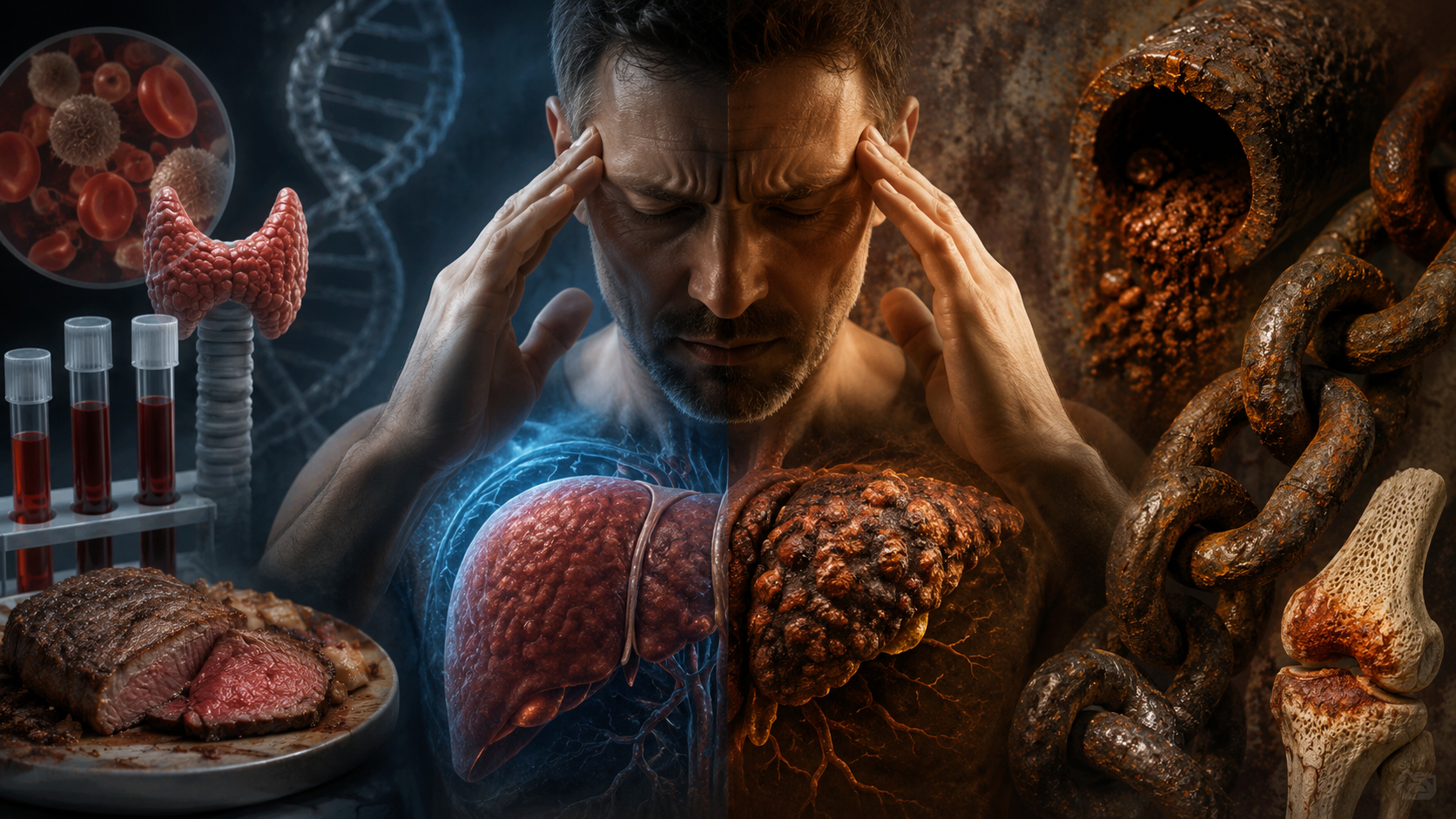
Fatigue is the most reported symptom of true iron overload. In the largest screening study ever run for the condition, diagnosed carriers of two copies of the main hemochromatosis gene reported chronic fatigue at close to three times the rate of controls (McLaren 2008). But fatigue is also the lead symptom of low thyroid function and iron deficiency. On its own it points nowhere.
The symptoms that point somewhere are physical:
- Joint pain in the second and third knuckles. Swelling where the index and middle fingers meet the hand was about four times more common in carriers than controls. This location is close to a fingerprint.
- Low libido and low testosterone. Iron deposits in the pituitary and testes (Carlomagno 2026).
- Skin darkening. Bronze or grey pigmentation was nearly five times more common in diagnosed carriers.
- Raised liver enzymes on a panel ordered for something else.
One caveat: people found by the screening test rather than by symptoms mostly resembled controls on liver disease, heart disease, and diabetes. A gene plus a high ferritin does not mean the organs are damaged. It means it is time to find out. And notice how much of that list overlaps hypothyroidism, which is why iron and thyroid have to be read together.
High Ferritin Causes: Overload, Inflammation, or a Fatty Liver
Ferritin is the protein your cells use to store iron, and most of the time the blood level tracks iron stores. The catch is that ferritin is also an acute-phase reactant: when the body is inflamed, infected, or under metabolic strain, the liver makes more of it regardless of how much iron is on hand.
The British Society for Haematology guideline lists the causes of a raised ferritin plainly: iron overload, inflammation, liver disease, kidney disease, malignancy, alcohol, and metabolic syndrome (Cullis 2018). That is the answer to "what can falsely elevate ferritin?" Almost anything that stresses the liver.
So a raised ferritin has three common stories behind it:
- True iron loading. Usually genetic, sometimes years of iron pills or transfusions.
- Inflammation or liver stress. The liver is making more ferritin. Iron stores may be normal.
- A fatty liver with a little of both. Roughly one in three people with fatty liver or metabolic syndrome has a raised ferritin (Rametta 2020), and the American College of Gastroenterology says fatty liver and alcohol are more common reasons for one than hemochromatosis.
The lab that tells them apart is transferrin saturation. Transferrin carries iron in the blood, and saturation is the percentage of its seats that are full. The 2022 European liver guideline sets the flags: saturation above 45 percent in women or 50 percent in men, with ferritin over 200 in women or 300 in men, points at real loading and toward genetic testing (EASL 2022).
A high ferritin with a normal saturation is a different patient: the iron is mostly where it belongs, and the ferritin is reporting on the liver. Mike Fave's clinic rule fits: with a drastically elevated ferritin, "I would also take a look at CRP and ESR."
Ferritin Runs Both Ways: The Thyroid Connection Most Panels Miss
Everything above is ferritin reading falsely high. It also reads falsely low, and the mechanism is thyroid hormone.
A September 2026 piece from the Substack Master Metabolism put it well: thyroid hormone stimulates ferritin synthesis independent of iron stores, so low thyroid function can produce a low ferritin in someone whose iron is fine. In 1985, Japanese endocrinologists gave one week of T3 to eleven volunteers with normal thyroid function and watched ferritin rise in every one, by anywhere from 23 to 243 percent (Takamatsu 1985). Every Hashimoto's patient they treated saw ferritin climb as thyroid hormone was replaced, and every Graves' patient saw it fall on the way back to normal.
One nuance the Substack skipped. Takamatsu found no difference in average ferritin between hypothyroid, hyperthyroid, and normal groups compared side by side. The effect is inside one person as thyroid status changes. It does not mean low-thyroid patients as a group have low ferritin. It does mean that in you, a ferritin drawn while T3 is low is not the number you would get with your thyroid working, and a randomized trial found iron plus thyroid hormone beat iron alone (Cinemre 2009).
The arrow points back the other way too. Thyroid peroxidase, the enzyme that builds thyroid hormone, needs iron, and in rats iron deficiency cut its activity by a third to a half (Hess 2002). Iron is one of the three nutrients Jay Feldman names as "sufficiency, not excess" for the thyroid: too little starves the enzyme, too much drives the oxidative stress that suppresses it.
That is why a ferritin cannot be read without a thyroid panel beside it.
Hemochromatosis Screening: Who Needs the HFE Test
Hereditary hemochromatosis is not rare. In the New England Journal of Medicine screening study of nearly 100,000 primary care patients, about one in 227 people of Northern European ancestry carried two copies of the C282Y mutation (Adams 2005). In a county settled by Pennsylvania Germans, that is a local question.
One finding from that study shapes how I order tests. Among men who carried the gene and did not know it, 88 percent already had a ferritin above 300; among women, 57 percent were above 200. Saturation is the screen. The gene test confirms.
The sequence, per the European and American guidelines:
- Ferritin and transferrin saturation, fasting, on the same draw.
- If saturation is above threshold, repeat it. Saturation bounces.
- If it stays high, HFE genotyping for C282Y and H63D.
- If positive, ferritin sets the next step: above 1,000, or with a raised ALT, the liver gets imaged and a hepatologist gets involved.
Iron, Insulin Resistance, and Fatty Liver: The Bioenergetic View
Iron and blood sugar travel together in the population data. In a 2024 analysis of more than 200,000 people, those eating the most heme iron, the kind in red meat, had a 26 percent higher risk of type 2 diabetes than those eating the least (Wang 2024). That is an association; red meat travels with other habits. Here is how the bioenergetic model reads it, with the cited part and the inference marked.
The cited part: a heavy fat load makes mitochondria leak oxidants, and that leak is what makes a cell stop importing glucose. Blocking the oxidant preserved insulin sensitivity in animals fed a high-fat diet, with no change in how the mitochondria were breathing (Anderson 2009). Insulin resistance, in that frame, is the cell protecting itself from fuel it cannot currently burn cleanly. I cover this in the insulin resistance root cause post.
The inference: iron amplifies that leak. Free iron catalyzes the reaction that turns a mild oxidant into a fierce one, and polyunsaturated fat is the tissue most easily set alight by it. Feldman puts it in one line: iron "is kind of like PUFA, in that it's an amplifier of inflammation and of lipid peroxidation." The chemistry is textbook; the human outcome data are thinner, so I keep this as the mechanism's picture, not a proof.
Ray Peat called iron "a potentially toxic heavy metal," and that argument has pushed part of the bioenergetic world toward unloading iron at every opportunity. Fave pushed back: "I don't think that's a necessarily ideal view." The house position is sufficiency, with the fat load and the PUFA brought down so the iron you carry has less to ignite.
High Ferritin on a Carnivore or Red-Meat-Heavy Diet
To be precise: there is no published human study of ferritin on a carnivore diet. What exists is a clinic pattern and a mechanism.
The pattern, in Fave's words: "people coming off carnivore or keto who had a very meat heavy diet having extremely high iron levels and their ferritin being over the reference range," and, he added, "women included, not just men." It is the most common reason a ferritin lands on my desk.
The mechanism is not mysterious. Heme iron from meat is absorbed efficiently, and the gut does not throttle it the way it throttles plant iron. In the Framingham cohort, red meat was an independent predictor of high iron stores in older adults, and regular iron supplements raised the odds more than fourfold (Fleming 2002). Phytate from grains and legumes pulled stores down.
A meat-only diet removes every brake at once: no phytate, no calcium with meals, often no coffee or tea, and three heme-rich meals a day. Then it adds a second problem. Months without carbohydrate lower active T3 and raise cortisol, which I laid out in the post on reintroducing carbs after keto or carnivore. So the ferritin climbs while the thyroid signal you would read it by is falling.
The fix here is not dramatic. Fave describes it for women as "as simple as just decreasing iron intake" to an appropriate level. Restore the carbohydrate, bring back the foods that moderate absorption, and re-test in about three months. Most of the time the number moves before anyone needs to think about a needle.
How to Lower Ferritin Naturally, and When It Will Not Work
"How to flush out excess iron" is one of the most searched phrases on this topic, and the premise is wrong. The body has no active way to excrete iron. So lowering ferritin means putting less in, fixing the reason the liver is making extra ferritin, or, when medically indicated, removing blood.
What moves a raised ferritin that is not genetic overload:
- Treating the cause of the inflammation. When CRP falls, ferritin follows.
- Weight loss and diet change in the fatty-liver pattern. In the 274-patient French trial, people who lost weight improved blood sugar, insulin resistance, ferritin, lipids, and liver enzymes whether or not they had blood removed (Laine 2017). Diet and lifestyle, the authors concluded, remain the first intervention.
- Rebalancing intake. No supplemental iron, less fortified flour, fewer heme-heavy meals a day, and the traditional absorption brakes with iron-rich meals: dairy, coffee, tea.
What does not work: detox protocols, "iron flush" supplements, and chelating agents taken without a diagnosis.
Blood donation is what everyone's friend recommends. One Finnish cohort found donors had far fewer heart attacks than non-donors (Salonen 1998); a larger American cohort found no association at all (Ascherio 2001). Donating blood is a good thing to do for its own sake. It is not a treatment for a diagnosis you have not had, and nobody should do it to manage a number without a hemoglobin and hematocrit checked first.
When Phlebotomy Is Medically Indicated
There is one situation where removing blood is unambiguously right: confirmed hereditary hemochromatosis with elevated iron indices. It is the standard of care. The European guideline targets a ferritin below 50 during induction and below 100 for maintenance (EASL 2022), and it prevents the organ damage that used to define the disease. Nobody should be talked out of it.
The contested situation is the far more common one: a raised ferritin riding on a fatty liver and insulin resistance, without genetic overload. The evidence cuts both ways, so the pro-phlebotomy side goes first.
The positive evidence is real. In a 2007 Italian study of 64 matched pairs, iron depletion lowered insulin and insulin resistance meaningfully (Valenti 2007), and a meta-analysis of four small trials pooled a modest drop in insulin resistance.
Then the two largest randomized trials were run, and both were negative. An Australian trial of 74 patients with fatty liver found that reducing ferritin by phlebotomy "does not improve liver enzymes, hepatic fat, or insulin resistance" (Adams 2015). The French trial of 274 patients found bloodletting improved no metabolic or liver measure, was associated with weight gain, and produced fatigue in a quarter of the treated group versus 2 percent of controls (Laine 2017). Insulin resistance was, if anything, worse in the treated arm.
So: phlebotomy reliably lowers ferritin. It does not reliably fix the metabolic problem the ferritin was reporting on. In the fatty-liver pattern it is a physician's judgment call, not a protocol, and hemoglobin and hematocrit are checked before and between draws, "so you don't make yourself anemic in the process," as Fave puts it.
The Labs to Order Before You Do Anything
A raised ferritin is a reason to order the panel that explains it, not a reason to act. One draw:
| Lab | What it answers |
|---|---|
| Ferritin | The flag. Repeat it fasting. |
| Serum iron, TIBC, transferrin saturation | Is iron actually loading? The discriminator (Cullis 2018). |
| High-sensitivity CRP and ESR | Is inflammation inflating the ferritin? |
| CBC with hemoglobin, hematocrit, MCV | Baseline before phlebotomy is even discussed. |
| ALT, AST, GGT | Is the liver the source? |
| Fasting insulin and glucose, triglycerides, HDL | The metabolic pattern behind a fatty-liver ferritin. |
| HFE genotype (C282Y, H63D) | Only if saturation stays above threshold (EASL 2022). |
| TSH, free T4, free T3, reverse T3, TPO antibodies | The other half of the ferritin story. |
| Waking temperature and pulse log | The at-home readout that moves before labs do. |
One optional add: reticulocyte hemoglobin, which Master Metabolism suggests as a tie-breaker when low ferritin and low thyroid coexist. Reasonable, and not a guideline recommendation.
The Biospark Approach
The reflex on a high ferritin is to ignore it, to treat the number with a needle, or, in the worst version of bioenergetic thinking, to treat iron as a poison and unload it at every opportunity. All three treat a readout instead of a system.
What we do instead at Biospark Health starts from a different premise. Iron status is an energy-system readout. The same low thyroid that makes you cold and tired also lowers the ferritin your liver makes, so an iron deficiency can hide behind a passable number and a real excess can hide behind a stressed liver's inflation. Get the thyroid right and the ferritin starts telling the truth. Get the fat load down and the iron you carry has less to ignite. Then measure properly and treat what is actually there.
Practically, for the person who came off carnivore or keto with a ferritin over range:
- Order the whole panel above, once, before deciding anything. A ferritin alone is not a diagnosis.
- Restore the carbohydrate. Ripe fruit, juice, honey, well-cooked roots, dairy if you tolerate it. It moves T3 in the direction that makes every other number readable.
- Rebalance iron intake to sufficiency. Fewer heme-heavy meals, absorption brakes back at the table, no supplemental iron unless a physician has a reason for it.
- Bring fat to moderate and PUFA to low. Not zero fat. Moderate.
- Re-test in about three months, then decide.
- If saturation is high and the gene test is positive, that is a medical diagnosis and it is treated as one.
I want to be clear about what carries which weight. The cited findings are that ferritin rises with inflammation, that saturation separates real loading from the rest, that thyroid hormone raises ferritin within a person, that red meat predicts high stores, and that phlebotomy failed to improve metabolic outcomes in the two largest trials. The recommendation to restore carbohydrate and lower the fat load first is our clinical position, reasoned from the mechanism. No trial has tested it against a ferritin.
Not sure where to start?
Take our free Cellular Energy Assessment to discover your unique metabolic pattern and get personalized recommendations. If your ferritin is high and nobody has checked your transferrin saturation or your free T3, this is the first step.
- 10-15 minutes
- Instant results
- No commitment
Iron Overload Testing in Reading and Berks County, PA
If you have been handed a high ferritin in the Reading or Wyomissing area and told to "keep an eye on it," you are in a large group. Berks County is heavily Northern European in ancestry, the population where hereditary hemochromatosis is most common, and it is home to a lot of people who spent the last few years on meat-heavy diets.
At Biospark Health, a raised ferritin gets the full panel in one draw: transferrin saturation, inflammatory markers, liver enzymes, the metabolic picture, and a complete thyroid panel with free T3 and reverse T3. Iron and thyroid are read together in the same visit, because reading them apart is how both get missed.
We serve clients throughout southeastern Pennsylvania, including Lancaster, Downingtown, Allentown, West Chester, and the greater Philadelphia suburbs, virtually and in person. If you are looking for iron overload testing in Reading, PA, or metabolic health support anywhere in Berks County, the first step is a panel that can actually tell you what your ferritin means.
Frequently Asked Questions
What can falsely elevate ferritin?
Anything that stresses the liver or inflames the body: infection, inflammation, liver disease, alcohol, kidney disease, malignancy, and metabolic syndrome, per the British haematology guideline. A normal transferrin saturation beside a high ferritin is the clue that this, not real iron loading, is what you are looking at.
Does high ferritin make you tired?
It can. Fatigue is the most reported symptom in genuine iron overload, but also of low thyroid function and iron deficiency, so a tired person with a high ferritin still needs a transferrin saturation, a CRP, and a full thyroid panel before anyone blames the iron.
Can beef liver increase ferritin levels?
Yes. Liver is the most concentrated heme iron source most people eat, and heme iron is absorbed efficiently regardless of how much the body already holds. Liver once or twice a week on a mixed diet is a different exposure than liver on top of three meat meals a day with every absorption brake removed.
How do you lower ferritin naturally?
By addressing what raised it. Iron does not flush out. If the cause is inflammation or a fatty liver, ferritin falls as those improve. If the cause is intake, fewer heme-heavy meals, no supplemental iron, and dairy, coffee, or tea with iron-rich meals move the number. If the cause is genetic overload, none of that is enough, and it is a medical diagnosis.
Conclusion
Iron overload exists, it damages organs, and it is treatable. Nobody arguing for careful testing denies that. But the number on your report is more often a stressed liver than a genetic disease, and it lies in both directions. Low thyroid function can hide an iron deficiency behind a passable ferritin. Inflammation can dress ordinary iron stores up as overload. And a diet that removed carbohydrate and kept only meat does both at once: loads iron while lowering the thyroid signal you would need to read the iron by.
So here is the contrast, plainly. Go carnivore, and iron climbs while T3 falls, and the panel that would catch either is never drawn. Bring the carbohydrate back, keep iron at sufficiency, bring the fat load down, and measure the whole system on one draw. That is what we do instead. The cited findings support the first sentence. The second is the house position, reasoned from how the energy system works, and I will not dress it up as a trial result.
Iron is not a poison and it is not a supplement. It is a readout of whether your body is making energy well, and the job is to fix the capacity, measure properly, and treat what is actually there.
Tags:
References & Citations
This article is supported by scientific research and peer-reviewed sources. Click citations to verify the evidence.
- [1]Cullis JO, Fitzsimons EJ, Griffiths WJ, Tsochatzis E, Thomas DW(2018)Investigation and management of a raised serum ferritin.British Journal of Haematology.View Source
- [2]European Association for the Study of the Liver(2022)EASL Clinical Practice Guidelines on haemochromatosis.Journal of Hepatology.View Source
- [3]Takamatsu J, Majima M, Miki K, Kuma K, Mozai T(1985)Serum ferritin as a marker of thyroid hormone action on peripheral tissues.The Journal of Clinical Endocrinology and Metabolism.View Source
- [4]Adams PC, Reboussin DM, Barton JC, McLaren CE, Eckfeldt JH, McLaren GD, et al.(2005)Hemochromatosis and iron-overload screening in a racially diverse population.The New England Journal of Medicine.View Source
- [5]Adams LA, Crawford DH, Stuart K, House MJ, St Pierre TG, Webb M, et al.(2015)The impact of phlebotomy in nonalcoholic fatty liver disease: A prospective, randomized, controlled trial.Hepatology.View Source
- [6]Laine F, Ruivard M, Loustaud-Ratti V, Bardou-Jacquet E, Vergniol J, Renaud M, et al.(2017)Metabolic and hepatic effects of bloodletting in dysmetabolic iron overload syndrome: A randomized controlled study in 274 patients.Hepatology.View Source
All references have been reviewed for scientific accuracy and credibility. Citations follow standard academic format and link to original research where available.
About Dr. Steven Presciutti, MD
Founder & Health Coach at Biospark Health, specializing in bioenergetic health and metabolism optimization.