Is the Cell Danger Response Real? What It Explains About Chronic Illness
Is the cell danger response real? A physician explains Naviaux's healing cycle, why the body gets stuck after illness or injury, and what helps it finish healing.
Medical Disclaimer
This content is for informational and educational purposes only. It is not a substitute for professional medical advice, diagnosis, or treatment. Always seek the advice of your physician or other qualified health provider with any questions you may have regarding a medical condition.
You smell smoke, the alarm goes off, and someone puts the fire out. Ten minutes later the alarm is still screaming. An hour later, still screaming. The fire is long gone, but nobody has told the alarm, so the whole house keeps acting as if it is burning: the doors stay shut, the lights stay off, everyone stands outside in the cold waiting for an all-clear that never comes.
That is the picture behind the cell danger response, and it is why so many people recognize themselves in it the first time they read about it. The virus cleared in March. The surgery healed. The stressful year ended. And you still feel like you are standing outside the house.
The idea comes from Dr. Robert Naviaux, a physician and mitochondrial researcher at UC San Diego, and it has spread fast through the chronic fatigue, long COVID and functional medicine worlds. Which raises a fair question: is the cell danger response real, or is it a tidy story that sounds good on a podcast?
In this article I will walk through what Naviaux actually published, what the evidence does and does not show, how you might recognize a body stuck in danger mode, and why I think the most important part of the model is the part that gets the least attention: a cell cannot finish healing without the fuel to do it.
Is the Cell Danger Response Real?
Short answer: yes, it is a real, peer-reviewed scientific model. It is not a diagnosis, and there is no blood test that says "positive for cell danger response."
Naviaux first described the cell danger response in 2014, and in 2018 he published the fuller version I used as the basis for this post: a 20,000-word paper in the journal Mitochondrion titled "Metabolic features and regulation of the healing cycle" (Naviaux 2019). His starting point is a simple observation. Most of modern medicine was built for acute problems: find the poison, the bullet, the bacteria, remove it. That works brilliantly in an emergency room. It works much less well for chronic illness, which now affects more than 60% of American adults and 30% of children and teens, according to the figures he cites.
His central claim is this: most chronic illness is caused by the biological reaction to an injury, not by the injury itself. The original trigger, whether an infection, a toxin, a head injury or a period of severe stress, is often long gone. What persists is the body's response to it, which never finished.
That is a bold claim, so here is what supports it and where the limits are.
What supports it. Naviaux's lab used metabolomics, which measures hundreds of small molecules in the blood at once, to look for a chemical signature of illness. In a 2016 study of 84 people (45 with ME/CFS and 39 matched controls), they measured 612 metabolites across 63 pathways. People with chronic fatigue syndrome showed abnormalities in 20 pathways, and 80% of the metabolites that distinguished them were decreased, consistent with a body that had turned its metabolism down (Naviaux 2016). The pattern was consistent across patients even though their illnesses had started in different ways, and it resembled a survival state seen in worms called "dauer," a kind of hibernation the animal enters when conditions are harsh.
His lab also tested a drug called suramin, which blocks the danger signal at the center of the model, in a pilot trial of 10 boys with autism. Five received a single low-dose infusion and five received saline. The suramin group improved on a standard autism rating scale and the placebo group did not.
Where the limits are. That trial had five treated children and one dose. It is a signal worth following, not proof. Suramin is not approved for this use and is not something you can or should obtain. And Naviaux himself describes the details of the healing cycle as "provisional," a current model built from many experimental studies that will need correcting as more data arrives. Critics point out, fairly, that a framework broad enough to explain over 100 diseases is hard to disprove.
So the honest answer is: the cell danger response is a serious, evidence-informed model from a credible researcher, built on biology that is well established (cells really do release ATP as an alarm signal when injured, and mitochondria really do change roles during inflammation). The grand unifying claims are still a hypothesis. I find it useful because it explains patterns I see every week that the acute-care model cannot.
The Three Stages of the Healing Cycle
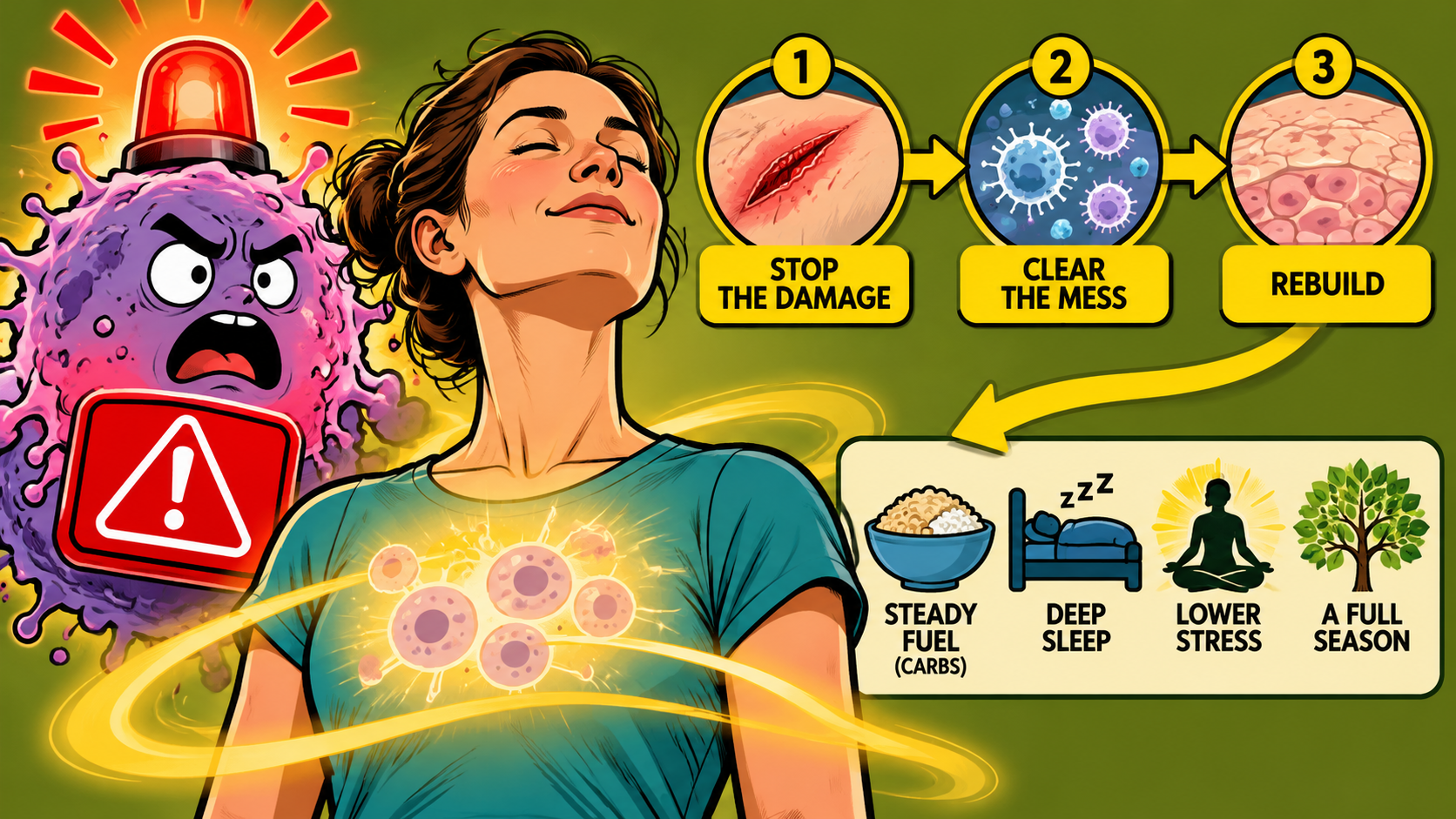
The core of Naviaux's 2018 paper is a map. Healing, he argues, moves through three stages of the cell danger response, abbreviated CDR1, CDR2 and CDR3, and each stage runs a different kind of metabolism.
The alarm. When a cell is injured or threatened, it leaks ATP, the molecule it normally uses as energy currency, into the space around it. Outside the cell, ATP stops being fuel and becomes a siren. Neighboring cells detect it through purinergic receptors and change what they are doing. Ray Peat described the same event in plain language: a stressed cell "becomes incontinent, and releases ATP into its surroundings," and that ATP and its breakdown products signal blood vessels to dilate and cells to divide.
CDR1: damage control. The first stage is inflammation, defense and clean-up. Mitochondria shift into what Naviaux calls an M1 or pro-inflammatory configuration. Instead of making as much energy as possible, they help generate reactive oxygen species to fight intruders, and the cell leans on glycolysis, the fast and inefficient way of burning sugar.
CDR2: rebuilding. Once the threat is contained, cells that need to be replaced start dividing. This stage runs on aerobic glycolysis, the same pattern cancer cells use, because dividing cells need building materials more than they need maximum energy.
CDR3: reconnecting. New cells stop dividing, mature into their specialized jobs and, critically, reconnect with their neighbors and with the brain. Mitochondria return to full oxidative phosphorylation, the efficient way of making energy. Hormone sensitivity comes back. Only then does the body return to the normal "health cycle" of active days and restorative sleep.
Between each stage is a checkpoint. A cell does not move forward until its mitochondria are ready for the next job. Naviaux describes these checkpoints as probability gates, decided cell by cell based on the chemical signals around it.
Chronic disease, in this model, is what happens when cells get stuck at one of those gates. He organizes over 100 conditions this way. Persistent pain and inflammatory syndromes sit near CDR1. Cancer and some cardiovascular disease sit in CDR2. Autism, Parkinson disease, Alzheimer disease and autoimmune disease sit in CDR3. He even notes that some genes and drugs that protect against a disease in one stage raise the risk of a disease in another: statins used for cardiovascular disease are linked to higher diabetes risk, and some cancer treatments to later dementia.
Cell Danger Response Symptoms: How Do You Know If You Are Stuck?
Because the cell danger response is a model, not a diagnosis, there is no symptom checklist that confirms it. But there are patterns that fit the model well, and in my experience they are the patterns that conventional workups most often miss.
It started with an event and never resolved. A bad virus, a surgery, a concussion, a pregnancy, a mold exposure, a divorce. You "recovered," but you never got back to baseline. Naviaux makes a striking point about this: a second head injury before the first has fully healed produces a worse outcome than the first, even when the second impact is weaker. Incomplete healing sets up the next injury.
Your labs are "normal" but your body is not. This is one of the most useful parts of the paper. Naviaux describes hormone resistance as a built-in feature of the cell danger response. When tissue is injured, it stops taking orders from distant glands and switches to local, cell-to-cell decision making. Thyroid, adrenal and other hormone signals get turned down at the tissue level. He notes that these states "do not fit classical medical definitions of deficiency or failure" because the glands can still produce hormone when pushed. That is why someone can have a TSH in range and still be cold, tired and slow.
Your nervous system is stuck on high alert. Light and sound sensitivity, poor sleep, waking at 3 a.m., a racing heart when you stand. Naviaux points out that about 80% of the fibers in the vagus nerve carry information from the organs to the brain, including sensors that detect extracellular ATP. The brain is listening for the danger signal. If it keeps hearing it, it keeps the body defensive.
Exercise or effort sets you back. In the healthy body, effort followed by rest triggers repair. In a body stuck in danger mode, effort becomes another injury. This is the defining feature of post-exertional malaise in ME/CFS.
You get better, then drift back. Naviaux calls this "metabolic addiction": a tendency to slide back into the old disease state unless you keep supporting recovery. He compares it to addiction recovery, and cites data showing that after one episode of major depression, the risk of another is three to six times higher than in the general population.
None of these alone means you are "in" a cell danger response. Together, they describe a body that is still acting on old information.
Why the Body Gets Stuck: The Fuel Problem Underneath
Here is where I want to add something the cell danger response discussion online usually skips.
Every stage of healing costs energy. Cleaning up debris, dividing new cells, building tissue and re-establishing communication are among the most expensive things a body does. So the obvious question is: what happens when the energy is not there?
The danger response is protective, not broken. Naviaux made this argument as early as 2012, in a review with an unusually blunt opening: "the mainstream field of oxidative damage biology has been running fast in the wrong direction for more than 50 years." His point was that reactive oxygen species are not random damage. Functional and metabolic defects appear in the cell before the oxidative changes, and the oxidation is a deliberate shield. In his words, "ROS are the response to disease, not the cause" (Naviaux 2012).
The same logic shows up in a 2009 study in PNAS titled, plainly, "Insulin resistance is a cellular antioxidant defense mechanism." Researchers found that mitochondrial oxidant production was a common feature across many models of insulin resistance, and that cells reduced their response to insulin in reaction to it (Hoehn 2009). The cell is not failing to listen. It is declining fuel it cannot safely process.
That is a very different starting point from "your immune system is overreacting, suppress it." If the shutdown is protective, the job is to remove the reason for it.
Stress mobilizes fat, and fat turns down the thyroid signal. When the body is under strain, stress hormones release stored fat into the bloodstream as free fatty acids. That is basic physiology. What is less well known is what those fatty acids do to thyroid hormone, the master regulator of how much energy a cell makes.
In 1985, Inder Chopra's group found that the blood of patients with non-thyroid illness contained something that blocked the conversion of T4 (the storage form of thyroid hormone) into T3 (the active form). When they looked for the culprit, several fatty acids turned out to be potent inhibitors, with the polyunsaturated ones, arachidonic, linolenic and linoleic acid, the strongest, and oleic acid weaker. In those patients, the level of free fatty acids in the blood tracked closely with the blocking activity (Chopra 1985). A few years later, two other groups showed that unsaturated fatty acids also interfere with T3 binding to its receptor inside the cell nucleus (Wiersinga 1988; Inoue 1989).
These are test-tube and animal-tissue findings, and the receptor-binding effect is not limited to polyunsaturated fats. But put them next to Naviaux's description of hormone resistance and the pieces line up: a sick, stressed body raises its circulating fatty acids, and those fatty acids help turn down the very hormone signal that drives cellular energy production. Less energy means more danger signaling, which means more stress, which means more fatty acids.
Seed oils tilt healing toward scarring. Ray Peat's 2012 article "Regeneration and degeneration" describes how fetal tissue heals without scars and adult tissue heals with them, and connects the difference partly to the polyunsaturated fats adults accumulate from their diet. Prostaglandins made from those fats drive inflammation in adults, and animals made deficient in them heal with more vigorous tissue remodeling. Older data points the same direction: a 1951 rat study found that animals fed a diet without polyunsaturated fat had 38% higher activity of cytochrome oxidase, the final enzyme of energy production, and that adding linoleic acid brought it back down (Kunkel and Williams 1951). That is rodent data from 70 years ago, so treat it as supporting, not decisive.
Carbohydrate protects the thyroid signal. The other side of this is fuel. In a 1976 study of adults with obesity, people on an 800-calorie diet with no carbohydrate lost 47% of their circulating T3 within two weeks. The same people on the same calories with at least 50 grams of carbohydrate showed no significant drop (Spaulding 1976). The authors concluded that "dietary carbohydrate is an important regulatory factor in T3 production in man."
To be clear about what is cited and what is reasoning: each of these findings is published. The chain connecting them, from a stuck cell danger response to a fuel shortage that keeps it stuck, is my reading of how they fit together. No trial has tested it as a whole. But it explains why so many people stall in recovery while eating in a way that keeps their stress hormones and fatty acids high.
How to Get Out of the Cell Danger Response
Naviaux is careful not to promise a single fix, and I think that is right. Here is what his paper recommends, where I agree, and where I think the emphasis needs to change.
Remove the ongoing trigger. If there is still an active infection, a toxic exposure, a moldy house or a relationship that keeps you in fight-or-flight, the alarm has a reason to keep ringing. Healing cannot complete while the injury is being repeated.
Restore the health cycle: active days, deep sleep. Naviaux calls sleep medicine and exercise medicine, and he means both literally. Slow-wave sleep is when much of the body's repair happens. Gentle, regular activity "reminds" the body how to heal. In adults over 60, even about 15 minutes a day of moderate to vigorous activity was associated with a 22% lower risk of death (Hupin 2015). The key word for someone stuck in danger mode is gentle. Effort should leave you better the next day, not worse.
Be wary of anything that blocks a single stage for a long time. One of the most practical sections of the paper warns against chronic treatments that force one stage of healing on or off. Long-term anti-inflammatory use is a good example. Inflammation is CDR1, and stopping it does not complete it. A 2026 review of 38 studies found that NSAID use was linked to a higher risk of fractures failing to heal (odds ratio 1.56), particularly at higher doses and in adults, while short courses of 14 days or less were not (Komargodski 2026). Short-term symptom relief is reasonable. Chronic suppression is not the same as resolution.
Respect the timeline. Naviaux says new patterns of gene expression begin to consolidate in 3 to 4 days, the body takes about 3 weeks to reset to a "new normal," and full commitment takes a season, about 3 months. If you change your diet and sleep and feel nothing in a week, that is not failure. That is biology.
Where I differ: do not add stress to a body that is already signaling danger. Naviaux's paper also endorses occasional short fasts and the mild "good stress" of compounds like sulforaphane from broccoli, which works by briefly depleting the cell's antioxidant glutathione to provoke a stronger defense. In a resilient body with energy to spare, that kind of challenge can build capacity, and I will not pretend the research says otherwise.
But a person stuck in a cell danger response, by definition, does not have energy to spare. Total fasting cut T3 by 53% in the same 1976 study, in adults with obesity fasting for one to two and a half weeks (Spaulding 1976). Cold plunges, prolonged fasting and hard training are stressors no matter how they are marketed. For a body that already believes it is under attack, the evidence above suggests the better message is the opposite one: you are safe, you are fed, you can afford to finish.
The Biospark Approach
Here is where we land.
The reflex, when someone has been sick for a long time, is to look for the one remaining trigger and attack it: one more antimicrobial, one more detox, one more elimination diet, one more stressor marketed as resilience. Sometimes there really is an active trigger, and it needs to be found. More often, in the people I see, the trigger is gone and the body is still standing outside the house.
What we do instead is treat the stuck healing cycle as an energy problem first. That means:
- Assessing how much energy the body is actually making. Waking temperature and pulse, a full thyroid panel including free T3, and a look at what the tissue is doing, not just what the gland is producing. Naviaux's point about hormone resistance is exactly why a "normal" TSH does not settle the question.
- Feeding the cell. Regular meals with easily used carbohydrate (ripe fruit, juice, honey, milk, well-cooked starches), adequate protein, and fat kept moderate. No prolonged fasting while you are trying to heal.
- Lowering the fatty acid load. Cutting seed oils, and keeping blood sugar steady enough that the body does not have to keep pulling fat out of storage under stress hormones.
- Protecting sleep and adding gentle activity that leaves you better the next day.
- Adequate salt. In a Cochrane review, low-sodium diets raised renin, aldosterone and noradrenaline (Graudal 2020). Restricting salt in a body already on high alert pushes the stress hormones higher.
- Giving it a season. We plan in 3-month blocks because that is how long Naviaux's own timeline says it takes for the body to commit to a new normal.
I want to be plain about which claims carry which weight. The cited findings are that the cell danger response is a published, metabolomics-based model; that people with ME/CFS show a turned-down metabolic signature; that fatty acids block thyroid hormone conversion and receptor binding in the lab; and that carbohydrate preserves T3 during calorie restriction. Treating a stuck healing cycle by restoring fuel and lowering stress, rather than adding more challenges, is our clinical position, reasoned from that evidence. No trial has tested it head to head. That distinction is yours to know.
Ready for a plan built around your own body?
1:1 Coaching with Dr. Presciutti is for people who have tried the general advice and are still stuck. We look at your history, your labs and your daily patterns together and build a protocol for your biology, then adjust it as you respond.
- 1 to 2 private coaching sessions every month
- Custom protocol design
- Quarterly lab review
- Priority email access
$250/month ($375 initiation) | Education and coaching, not medical treatment
Chronic Illness Support in Reading and Berks County, PA
If you are in the Reading or Wyomissing area and have been told your labs are normal while you still feel like you never recovered from an illness or injury, you are not alone. Many people across Berks County live with exactly that gap between what the tests say and how they feel.
Biospark Health is based in Wyomissing and works with clients throughout southeastern Pennsylvania, including Lancaster, Downingtown, Allentown, West Chester and the Philadelphia suburbs. Our coaching is built around metabolic health: understanding why your body is conserving energy and what it needs to start spending it on repair again.
Because coaching sessions happen online, it does not matter whether you are in Berks County, Chester County or elsewhere in Pennsylvania. What matters is that someone looks at the whole picture, including thyroid function, diet, sleep and stress load, rather than one lab value at a time.
Frequently Asked Questions
Is the cell danger response the same as fight or flight?
They are related but not the same. Fight or flight is a nervous system state driven by adrenaline. The cell danger response happens inside individual cells and changes how their mitochondria work. The two talk to each other constantly: the vagus nerve carries danger signals from the organs to the brain, and the brain's stress response feeds back to the cells. That is why calming the nervous system helps, and why it is rarely enough on its own.
How can I repair my mitochondria?
Mitochondria are not usually "broken" in the cell danger response. They have been reassigned from making energy to defending the cell. The most reliable way to bring them back is to remove the reason for defense: steady fuel, enough carbohydrate to support active thyroid hormone, fewer seed oils, deep sleep and gentle movement. Supplements can help specific deficiencies but do not replace those basics.
What depletes mitochondria?
Chronic stress, under-eating, prolonged fasting, poor sleep, low thyroid function, and a heavy load of polyunsaturated fats all reduce how much energy mitochondria produce. So do some medications. Naviaux notes that many common drugs have mitochondrial effects that help some people and harm others, depending on which stage of healing they are in.
Can supplements turn off the cell danger response?
No supplement has been shown to switch it off. The drug studied for this purpose, suramin, was tested in a very small trial and is not available for this use. Supplements are best used to correct specific gaps, such as thiamine or magnesium, that keep cells from using fuel efficiently, alongside the bigger changes above.
Does the cell danger response show up on blood work?
Not as a single test. Research labs can detect its metabolic signature with metabolomics, but that is not available as a routine clinical test. In practice, it shows up indirectly: low-normal free T3, low body temperature, a resting pulse that does not match how you feel, and a history of an illness or injury you never fully recovered from.
Conclusion
The cell danger response is real in the way most good models are real: it is grounded in solid biology, supported by early evidence, and still being worked out. Its most useful insight is simple. Chronic illness is often not the injury. It is the healing that never finished.
What I would add is that finishing costs energy. A body that is underfed, overstressed, running on mobilized fat and holding down its own thyroid signal is not being stubborn by staying in danger mode. It is being careful, because it cannot afford to move on.
So the common move, adding one more stressor or cutting one more food in the hope of forcing the body out, usually tells it the danger is still there. The better move is to make the body safe enough to leave: feed it, let it sleep, lower the stress chemistry, and give it a full season to rebuild. If you have been standing outside the house for months or years, that is the all-clear signal worth sending.
Tags:
References & Citations
This article is supported by scientific research and peer-reviewed sources. Click citations to verify the evidence.
- [1]Naviaux RK(2019)Metabolic features and regulation of the healing cycle: A new model for chronic disease pathogenesis and treatment.Mitochondrion.View Source
- [2]Naviaux RK, Naviaux JC, Li K, Bright AT, Alaynick WA, Wang L, Baxter A, Nathan N, Anderson W, Gordon E(2016)Metabolic features of chronic fatigue syndrome.Proceedings of the National Academy of Sciences of the United States of America.View Source
- [3]Naviaux RK(2012)Oxidative shielding or oxidative stress?.Journal of Pharmacology and Experimental Therapeutics.View Source
- [4]Chopra IJ, Huang TS, Beredo A, Solomon DH, Chua Teco GN, Mead JF(1985)Evidence for an inhibitor of extrathyroidal conversion of thyroxine to 3,5,3'-triiodothyronine in sera of patients with nonthyroidal illnesses.Journal of Clinical Endocrinology and Metabolism.View Source
- [5]Hoehn KL, Salmon AB, Hohnen-Behrens C, Turner N, Hoy AJ, Maghzal GJ, Stocker R, Van Remmen H, Kraegen EW, Cooney GJ, Richardson AR, James DE(2009)Insulin resistance is a cellular antioxidant defense mechanism.Proceedings of the National Academy of Sciences of the United States of America.View Source
- [6]Spaulding SW, Chopra IJ, Sherwin RS, Lyall SS(1976)Effect of caloric restriction and dietary composition of serum T3 and reverse T3 in man.Journal of Clinical Endocrinology and Metabolism.View Source
- [7]Wiersinga WM, Chopra IJ, Teco GN(1988)Inhibition of nuclear T3 binding by fatty acids.Metabolism: clinical and experimental.View Source
- [8]Inoue A, Yamamoto N, Morisawa Y, Uchimoto T, Yukioka M, Morisawa S(1989)Unesterified long-chain fatty acids inhibit thyroid hormone binding to the nuclear receptor. Solubilized receptor and the receptor in cultured cells.European journal of biochemistry.View Source
- [9]KUNKEL HO, WILLIAMS JN Jr(1951)The effects of fat deficiency upon enzyme activity in the rat.The Journal of biological chemistry.View Source
- [10]Hupin D, Roche F, Gremeaux V, Chatard JC, Oriol M, Gaspoz JM, et al.(2015)Even a low-dose of moderate-to-vigorous physical activity reduces mortality by 22% in adults aged ≥60 years: a systematic review and meta-analysis.British journal of sports medicine.View Source
- [11]Komargodski R, Kittany S, Abu-Kishk I, Beeri Berkovitch R, Epstein D, Matok I(2026)NSAID Use and Bone Healing: An Umbrella Review with a Reconstructed Meta-Analysis.The Journal of the American Academy of Orthopaedic Surgeons.View Source
- [12]Graudal NA, Hubeck-Graudal T, Jurgens G(2020)Effects of low sodium diet versus high sodium diet on blood pressure, renin, aldosterone, catecholamines, cholesterol, and triglyceride.The Cochrane database of systematic reviews.View Source
All references have been reviewed for scientific accuracy and credibility. Citations follow standard academic format and link to original research where available.
About Dr. Steven Presciutti, MD
Founder & Health Coach at Biospark Health, specializing in bioenergetic health and metabolism optimization.